Software
Houzz Logo Print
austin_tom

Insulation problems

18 years ago

Our house in Austin, TX is a one story ranch style house built in the late 60s. We bought it at the beginning of the year. Winter seemed cold but we wanted to go through a full year before doing anything. Summer is almost over and it was pretty warm in the house.

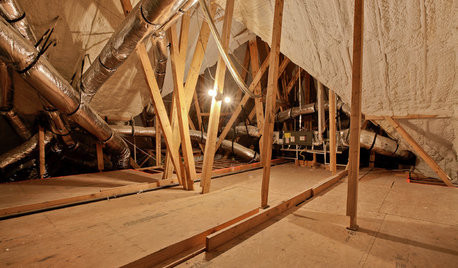
The attic is pretty accessible and covers about 2500 square feet. There is less than 6 inches of insulation between the ceiling joists with what looks like R-8 fiberglass roll. R 38 is recommended for our region. There is also some lose cellulose and some newer fiberglass batting but most is in pretty bad shape, besides the signs of 4 legged friends making themselves comfortable. Ceilings throughout the house vary meaning that the attic isnÂt level. Our water and gas pipes run through the attic. There are 4 vents in the roof (2 whirlybirds and 2 traditional vents) but it gets really hot up there during the summer.

So, it is time to do something about this. Here are my questions:

 Do I replace any or all of the current insulation?

 Do I fill the voids in the old insulation with lose batting or do I have to use rolls?

 Do I just add another layer (>R-25) perpendicular to the current layer?

 Can I just cover water and gas pipes? Should I mark them with sprinkler flags or something else so I can find them?

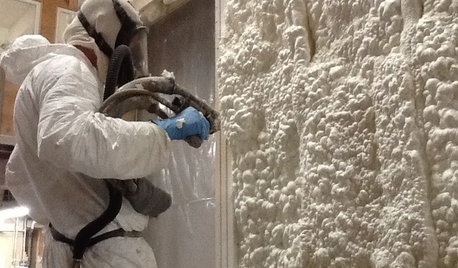
WeÂve thought about having the inside of the roof sprayed with foam, but the one quote I got so far is for about $4k for R 19. Than is much more than 45 roles of 60 sqft each of R 30 or about $1350. Am I off?

Comments (5)

  • 18 years ago
    last modified: 11 years ago

    My feeling is that the spray-on insulation is fine for walls but on the underside of the roof it will hide water leaks that could go many years without detection until structural damage occurs. I'd go with blown-in insulation. The water and gas pipes could be easily 'dug up' later if access is needed. The solar-powered attic vents are great! You can usually construct brackets to adapt them to existing roof penetration. A radiant barrier is a good idea. I'll include my 'energy rant' since you are in a hot area like Florida...

    Currently the U.S. is sending an exorbitant portion of it's energy money overseas. Anyone who does not take some initiative to cut their power bill (and therefore energy usage) needs to realize that they are providing 'aide and comfort' to those who would love to see us dead and are taking great delight in our current difficulty. Drilling for more domestic oil is not the panacea for this mess as prices are not being controlled by the mechanism of supply and demand, rather by a combination of speculators and OPEC who control such a large portion of the world's oil supply that they can easily negate any of our drilling efforts by simply closing the tap at their end just a little. Any oil we produce won't save us any money. We currently produce a large amount of oil in Alaska but do you see us getting a break on it because it's domestic? No, we pay the going world rate, set by the aforementioned OPEC and speculators...and provide another windfall for the oil companies. They sit before Congress smiling saying their huge profits are necessary to allow them to explore....excuse me....we are talking about NET PROFITS here...what's left AFTER exploration expenses. We the people have no control over this sort of manipulation of our government, whether we have Republicans or Democrats in charge. . .there's too much money involved. Our only hope is to cut energy usage, not drill and give them more avenues for profit. We all need to realize the best thing we can all do to help the energy situation and economy is to take individual action. Rather than waiting around for the government to do something we can each cut our electric usage dramatically....up to one half of your bill if you are willing to spend a little time and money. Every time you see your power bill shrinking, that's money for you rather than some oil producer. Money you can spend here to help the economy or save as you prefer. Here are several sites worth visiting that aren't selling anything but tell it like it is. Plenty of simple and painless techniques to cut your power bill.

    http://michaelbluejay.com/electricity/

    Mr. 'Bluejay' does a great job explaing away a lot of scams...see his section on surge suppressors for example.

    http://www.builditsolar.com/index.htm

    Be sure to look at the 'Half' program.

    The current situation has people grasping at all sorts of non-cost effective solutions that sound great on paper but don't hold up to scrutiny in the real world. Solar electricity is one of those as would be wind power in cent. Florida. Solar PV (photo voltaic) just costs too much at the present. Hopefully ongoing research will change that in the future but it's not ready for prime time yet. The rental program below will probably be practical if it gets underway.

    Check out this site for info on a possible contender for solar PV at home.

    http://renu.citizenre.com/index.php?c=1218495642

    The 'Build it Solar' site also has some good info about costs.

    http://www.builditsolar.com/Projects/PV/pv.htm

    Plenty of outright scams getting too much press also. The 'run your car on water' crowd is one I can think of (apparently many people didn't pay attention in high school physics). A good site explaining the physics that negates that scheme is here along with other interesting info about some of those behind the current revival.

    http://www.alternative-energy-resources.net/browns-gas-the-reality....

    Another scam that's been revived is the 'phase controller' that supposedly saves electricity by making motors run more efficiently. Home show demonstrations with an electric motor show it's electricity usage dropping dramatically when the motor is plugged into the device rather than straight into the incoming power. These devices actually do work in the applications they are designed for...this has the unfortunate effect of helping the scammers (or to give them the benefit of the doubt, uneducated-in-electricity folk) sell these things. An industrial application that produces savings would be a big table saw in a woodworking shop that runs constantly. When it's not cutting wood, the motor is under no load and at that moment, a phase controller will save energy. The goal of electrical engineers is to make sure anything with a motor runs that motor at rated capacity at all times...that's the point a motor is most efficient. Their striving for this is what has made ACs and refrigerators much more efficient lately. The point here is motors in your home all run at rated load all the time. There is no 'off load' time like with the big table saw. A 'phase controller' saves nothing in this situation.

    In hot climates a proven strategy that works well is a heat recovery unit attached to your AC unit. It provides free hot water and also increases the efficiency of the AC a couple of SEER points by reducing head pressure (and electricity draw) on the compressor. You're paying for your A/C to move a great deal of heat out of your house, you might as well use that heat to provide you with hot water. Adding one of these to an older AC unit that still runs well is a good way to cut $30-$50 off your monthly power bill during AC season (which here in cent Fl can be about 9 months). The neatest thing about this solution is that it's cost-negative. In addition to being free hot water as opposed to other 'high efficiency' heaters that still consume energy, it actually lowers your cost of air conditioning. Here is a manufacturer's site for two of these and a power company document about it as well. The second mfg site has a neat calculator for your savings...but my experience shows it to be somewhat under-optimistic. I don't think it's taking into account how a hru will improve your AC's efficiency. There are claims that they don't work with higher efficiency unit, but I have two HRU connected to 13 SEER heat pumps that provide plenty of hot water.

    http://www.trevormartin.com/about.asp

    http://www.turbotecproducts.com/EPhome.html

    http://www.p2pays.org/ref/11/10104.pdf

    Another real saver in hot areas is a radiant barrier in the attic or metal roof. Both create similar savings. If you are re-roofing, consider changing to a metal roof. When installed over a normal wood-decked roof, noise is not a problem. Most people thinking of a noisy metal roof have heard one that's been installed over wood 'stringers' as was the case many years ago...very noisy in a rainstorm. If you have a hip roof house or a lot of dormers metal may be too costly due to the waste from all the cutting to fit...metal is most cost effective on a two-slope 'shed type' roof. Radiant barriers can either be installed during construction..an easy way is using foil-backed plywood roof decking ...or added later. See this site for info and material.

    http://www.atticfoil.com/

    Tankless water heating is also a problem area for accurate claims of savings. A gas tankless heater can be much more efficient since it eliminates the flue that passes through the center of a conventional tank heater and becomes a chimney to carry away your water's heat once the flame shuts off. Electrics are another story... Big savings are claimed that are not supported by data. No studies are shown that give specifics telling you what make/model/year tank unit is being compared with the advertised tankless. Maybe they use an ancient cast iron tank heater insulated with sawdust? Verifiable details please. Somehow electric tankless heaters dodge the requirement for the yellow government 'EnerGuide' label that every other appliance must have. If they had to carry it, their claims would show to be false. Claims of better durability because of 'no tank' are a red herring also...the 'tank' still exists, only it's now smaller. Buildup from hard water deposits may be more of an issue with tankless, possible surcharges from the power company later due to high instantaneous current draw, heavy wiring needed, new construction with planned tankless can make retrofit of tank type later very difficult due to lack of dedicated hot water piping, incompatibility with future solar or other alternative power sources due to aforementioned high current draw. These are all serious disadvantages of the tankless electric. All electric hot water heaters are 100% efficient at heating water. That's a function of an electric element immersed in water. The only added efficiency of a tankless is the reduction of standby losses which are very minimal in new technology insulated tank heaters. Put your hand on one and you'll see they pretty much run at room temperature...very little standby loss.

    Another myth is that shading a A/C condenser saves '10-20% or more. The reality is not much. Similar situation to a garden hose left out in the sun...you turn on the water and what comes out is scalding hot....but in a few moments the water is cool...sun impinging on something will make it very hot but that is a function of 'accumulated heat'. What heat is striking something and being carried away by a fan is very small. See the following link about this subject...

    http://www.fsec.ucf.edu/en/publications/html/FSEC-PF-302-96/index.htm

    A free, online calculator that can help you plan upgrades is here:

    http://hes.lbl.gov/

    Two technologies have the potential to really turn things around..see these two links for something both companies say will arrive sometime next year...Still better to get moving with your own plan that to wait with your fingers crossed..

    http://www.eestorbatteries.com/

    http://www.nanosolar.com/

    Please use due diligence when deciding on ways to save energy. There are LOTS of scams out there. The internet is a great source of info and you can easily see both points of view on any energy saving strategy. Just simple conservation by time-tested means is still the best way to approach our dilemma. If we all cut our power bill in half, we'd all have much more money in our pocket and our nation would be much more secure. This action, along with Mr. Picken's ideas on wind power, WILL free us from imported oil and rather quickly.

  • 18 years ago
    last modified: 11 years ago

    Austin Tom,

    I had a smaller portion of my old home about 1600 sq. ft. which was in a similar condition to yours. I started by removing all batt insulation, then vacuuming up the blown-in. I used one layer of batts (same depth as joists), then another layer run perpendicular to the first. If you want to blow-in the insulation, you can rent a blower, some Home Depots rent equipment. You need to first install vents between the soffit and attic. These vents prevent insulation from blocking air flow to the attic from the soffit vents.

    Take Care,

    Dan Martyn

  • 18 years ago
    last modified: 11 years ago

    Do I replace any or all of the current insulation? NO JUST BLOW IN 12-15 INCHES MORE ON TOP.

    Do I fill the voids in the old insulation with lose batting or do I have to use rolls? JUST BLOW IN MORE.

    Do I just add another layer (>R-25) perpendicular to the current layer? DONT LIKE BATTS AT ALL. CELLULOSE IS CHEAPEST BUT IS A LITTLE DUSTY.

    Can I just cover water and gas pipes? Should I mark them with sprinkler flags or something else so I can find them? COVER THEM. GOOD IDEA TO MARK THEM.

    Weve thought about having the inside of the roof sprayed with foam, but the one quote I got so far is for about $4k for R 19. Than is much more than 45 roles of 60 sqft each of R 30 or about $1350. Am I off? NOT A GOOD IDEA.

  • 18 years ago
    last modified: 11 years ago

    If you end up doing batts for whatever reason, I'd follow Dan's suggestion on removing the old insulation. I'd also be sure to foam all of the places air can get from your house into the attic (plumbing/wiring/etc penetrations, framing gaps, and the like).

    Cellulose is supposed to take care of this by itself. When we did insulation, I didn't want to deal with cellulose falling out of the ceiling during the remodel that came later.

  • 18 years ago
    last modified: 11 years ago

    Thanks for the great tips. What kind of savings could I expect for materials on doing cellulose vs. batting?