Software
Houzz Logo Print
catgalvin

So we got our asbestos tests back, What would you do?

20 years ago

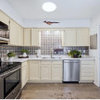
So we got our asbestos tests back. The good news was that the textured ceiling was not Asbestos. Good news since some of it fell down a few months ago! Bad news is that the vinyl, linoleum, linoleum floor sandwich that we have going in former kitchen has a middle filling of 15% Chrysotile asbestos. This floor is really strange. The top layer is vinyl tiles that are breaking up, the middle BAD layer is sheet linoleum and the bottom layer is the awesome, ancient original linoleum that appears to be made of cardboard. Parts of all are visible since the room used to be a kitchen and the previous owners never installed the stuff the same way twice. So here is the problem: the floor is very uneven. Part of the floor is the original wood, and parts are peeling up uneven linoleum. Obviously the responsible thing to do is to cover this flooring with a fourth layer--but what do you put on there if you want to keep some integrity and don't have a ton of money? Also, with the vinly tiles popping up, can we put a new floor on top? I am so tempted to cut the floor into large squares with a utility knife and just lift the sections of "Bad Sandwich" out. Please talk me out of it! Would anyone else be tempted? Just for the backstory: we have a circa 1915 Foursquare that used to be a multi-unit--hence the "moved Kitchen."

Comments (16)

  • 20 years ago

    I would strip it down to the sub floor and lay a new layer of plywood. Then install your new flooring. If your state does not require a sub contrator for asbestos abatement I would remove it myself. The asbestos in floor tile is encapsulated. As long you are not grinding it to fine fibers it will be safe in my opinion.

  • 20 years ago

    I agree w/ Joed. Asbestos can be extremely hazardous, but if it's not completely chipped (friable), you can remove it safely (imo). Buy yourself a mask and a HEPA vac (investments of $400 or so that you'll use elsewhere), isolate the kitchen as you work and take it out down to the subfloor.

  • 20 years ago

    When you say HEPA vac, you don't mean the dirt devil that says HEPA that I already use, right? Where do I get one? I think the floor is actually a real floor, ie, what we have in most of the rest of the house. The asbestos is not touching it, the bottom layer is the very old, non-asbestos linoleum.

  • 20 years ago

    If you can use water to spray on it also that will help keep the particles from going into the air.

  • 20 years ago

    Send the family out for the weekend, and get to work. Keep it moist, isolate the room from any others, get some good masks, cover the counters, get a hepa vacuum.

  • 20 years ago

    Correct, the HEPA filter you have in your regular vacuum doesn't make it a HEPA vacuum. The vacuum is also airtight. If you use your regular vac, you'll be spewing dust particles all over the house.

    Kudzu is right, you should weigh the risks very carefully.

    Warning: Personal Philosophy Statement Ahead

    As a culture we revel in taking great risks (extreme sports, are a good example, there are others) because in our everyday lives we are overly risk averse.

    That is not to say that DIY asbestos removal is not risky, but that given the right amount of education and caution, there is no reason why you couldn't do this work, imo.

    How many of us are much more capable of doing more than we do because we've been lead to believe that we're NOT capable?

    PullmanHolt makes a small HEPA vac that's about $450 or so. It's what our housing rehab program recommends for lead and should work for asbestos as well (double check this, though).

    If you do a search for asbestos respirator, you'll come up w/ a ton of links. Here's one: http://www.websoft-solutions.net/asbestos_respirator_asbestos_respirator_p/3m-2091.htm

    Commercial/Industrial supply houses should carry both of these or get them.

    Good luck, with whatever you do. That's the great thing about this forum, you should get enough opinions to completely confuse you and then you can go off and make the best decision for yourself.

    Here is a link that might be useful: PullmanHolt

  • 20 years ago

    > Correct, the HEPA filter you have in your regular vacuum doesn't make it a HEPA vacuum. The vacuum is also airtight. If you use your regular vac, you'll be spewing dust particles all over the house.

    Could you explain this? First, I have trouble imagining an airtight vacuum, where lots of air goes in and none comes out.
    I have a regular household (Kenmore) vacuum, that says HEPA, and I have a shop vac from HD with a HEPA filter. Why are these vacuums not suitable? Isn't HEPA some sort of standart that garantees to hold back particles down to a certain size?

  • 20 years ago

    HEPA = High Effiency Particulate Air
    The filter might be HEPA but if the seals around it aren't then it's not really HEPA.

  • 20 years ago

    JOED said it. Sorry, I can see where I added to the confusion. Ever look behind you after you've used your shop vac? If it's a dusty job, you can see all the particles in the air.

    Here are a couple of online sources that say it better than me:

    "HEPA VACUUMS
    Whether conducting lead abatement activities or lead
    safe work practices, contractors should only use a
    "TRUE HEPA" vacuum cleaner. A true HEPA
    vacuum has a few features that most vacuum cleaners
    do not have, including:
    (1) A HEPA filter that is individually tested and rated
    as 99.97 % effective and capable of collecting lead
    dust down to 0.3 microns in size;
    (2) "O" rings or seals to prevent leakage around
    connecting points; and
    (3) Manufacturer specifications stating that the HEPA
    vacuum is designed to collect lead dust."""

    From http://www.epi.state.nc.us/epi/lead/pdf/LeadUpdate2002.pdf

    And a much longer explanation at the link below, but one that's very worth following and reading.

    Here is a link that might be useful: definition of HEPA

  • 20 years ago

    Asbestos fibres are incredibly small and essentialy invisible to the naked eye. The reason they can be dangerous is that they are like microscopic needles that lodge in you lungs and don't get expelled like larger particles. One of the best ways to contaminate your house after an asbestos removal is to vacuum with a non-HEPA vacuum: you think you're cleaning up, but you're really using the vacuum to very efficiently spew asbestos fibres into the air.

  • 20 years ago

    I've been making myself sick thinking about this and I think that we are going to start by covering everything with a plywood floor. Does anyone have any ideas about leveling the section that is just wood (bringing it up to where the tiles are) ? Also, will it be safe to drive screws through the plywood into the linoleum? If not, how do we lay the foor?
    The funny thing is that SO many people have told me that they have peeled old floors and that they didn't know and still don't think that there was asbestos in them. My sister-in-law, who restored houses around Penn in Philadelphia, told me that she peeled 30-50 layers of the stuff. Without a mask. Without even thinking that there could be a problem. I am a huge hypochondriac though and would drive myself crazy worrying about the potential fibers lodged in my lungs and the lungs of my husband and kids.

  • 20 years ago

    Then best to do as you're planning. Sorry can't comment about your next question. It might be worth a separate post, as you'll likely get folks who are interested in flooring, rather than asbestos. Best of Luck!!! I'm sure it will be beautiful either way when all is said and done.

  • 20 years ago

    Gosh - I guess I live near your sister-in-law and I must admit that when my folks were in town last spring we removed about four levels of floor materials that are akin to what you're tackling. And about 2 weeks ago we tackled another room! I couldn't believe the patters of the linseed linoleum. Trying to find vintage NIB stock of it is impossible!

    You may not be the best person to do it if you're a bit nervous but you could find some people who wouldn't mind doing a bit of "homestyle remediation" as we call it in my neighborhood. We have about 3 different face masks at this point in time and between using really good eye covering and body suits, we feel pretty comfortable tearing out fiberglass insulation and removing most-probably-lead-paint. I'd look on craigslist.

    Oh yeah - and let me tell you about marmoleum tiles! I just ordered a huge array of samples from the manufacturer! I don't know if you figured out what you're going to replace it with but you may want to do a little research on the Forbo web site.

  • 9 years ago

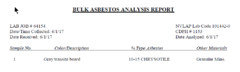
    Hi all I have a question, could someone point me to a resource or if you know even better. I had my home siding tile tested and the Lab report came back saying out tile is "10-15 CHRYSOTILE" and as note they put "Granular mins" Now I have done some googling and while I know that my tile contains some Asbestos, I'm not sure how much. My overarching question is what is the highest percentage of Asbestos that siding can have before you have to have a special company come in and remove it? I'm in Sacramento CA and I know that if siding has Asbestos in it that you have to get a Certified company in to remove it per it is Hazardous. But is there a way a homeowner can remove it with all the proper protections if it has low level of Asbestos? ***also just uploaded a pic of my lab report if that might help.***


    ***

  • 5 years ago

    yes hepa filters help


Sponsored
Kuhns Contracting, Inc.
Average rating: 5 out of 5 stars26 Reviews
Central Ohio's Trusted Home Remodeler Specializing in Kitchens & Baths