Software
Houzz Logo Print
strife_rat

1920's house siding

19 years ago

I'm currently doing some electrical work that has led me to knock some holes in the walls. I can see an underlayment of the siding that appears to be a thick black paper material. Does anyone know if this type of underlayment was used in the 1920's. I'm trying to figure out if the original siding is still underneath my aluminum siding without having to pry the aluminum up.

Thanks

Joe

Comments (13)

  • 19 years ago

    That's tar paper. It was used from well before the 1920s (not sure exactly when it was invented) and is still used today. Most new construction uses Tyvek Homewrap or a similar product instead, but tar paper is still used sometimes.

  • 19 years ago

    Yep, tarpaper. Your siding is probably under there. It was rarely taken off, just covered up like they do today when they put up vinyl. I pulled all the asbestos shingle siding off my 1928 home a couple of years ago. Asbestos and then aluminum were the predecessors of vinyl.

    The issues that I had and that you should think about were:
    1. the (lead) paint was in REALLY bad condition and had to be stripped down to bare wood to start again. An expensive paint job.
    2. LOTS of nail holes... probably will be less on your home, because I think aluminum was installed more like vinyl in long strips and not shingles like my asbestos was, though I have seen aluminum shingles, too.
    3. The original window trim had been absolutely butchered in the process of putting up the asbestos. All the "ears" on the sills had been hacked off, and many nail holes. Significant carpentry to repair.
    4. Some clapboards were beyond repair and had to be replaced (this wasn't unexpected).

    Also, if you do decide to pull the aluminum, get some insulation blown in while you're doing all the siding repair, etc! A really cheap way to keep the place warmer. Besides, you can probably pay for it with the $$$ you can make on selling the aluminum to a recycling place! All in all I'm glad I pulled mine off but it did cost more than I initially had planned because of the condition of the original siding. We left the tarpaper in place and used more where it was needed.

  • 19 years ago

    I pulled the aluminum siding off of my 1920s bungalow, one side per year. I was lucky because my window trim hadn't been hacked up like edselpdx mentions (my neighbors across the street weren't so lucky). My siding was intact, and in good condition. The paint was bad, but the wood was all good.

    It was a lot of work, but I did it all myself...pulled off the siding, stripped the old paint with a heat gun (be sure to read up on lead paint and take a lot of care to collect the paint chips), caulked, primed and painted. The end result was worth the effort!

  • 19 years ago

    edselpdx and arlosmom, is there any way you could give me a any advice on pulling off aluminum siding and restoring the siding beneath, like you did? I, too, live in a 1920's house, covered in aluminum siding, and every time there is wind, something falls off our house. We are tired of living in fear :) Plus, the siding is truly hideous. But we have no idea how much it would cost to take it down and fix what's beneath. We don't even know where to start. So any thoughts you might have would be very appreciated--especially ballpark figures. We have no idea is this is a $1500 proposition or a $15,000 one.

  • 19 years ago

    My house was a bungalow (I've since moved to an older house in worse shape!), so it was fairly small and only 1 1/2 stories high. I did one side per year, and the clapboard underneath was in good condition -- the paint was chipping and alligatoring, but the wood was sound.

    We bought two levels of scaffolding (I think that came to about $1,000) but you could use a ladder instead. Scaffolding is a chore to disassemble and reassemble each time you need to move it, but once assembled gives you ~35-40 square feet that you can easily reach.

    For removing my siding, it was easiest to start from the top and work down. Each row fit into a groove in the piece below. I used a pry bar (another name is cat paw) to pull out the nails -- there was a nail about every 3 or 4 feet. I used a heat gun and a putty knife to remove the old paint. Wear leather gloves or you'll burn yourself. After the paint is off, sand or scrape (you have to be a fanatic about the lead paint chips, especially if there are kids around), caulk and fill the nail holes with wood putty, sand the areas you patched, prime (oil-based) and two coats of paint (latex).

    Based on the recommendation of a painter friend, I did NOT caulk all the horizontal joints in the siding (you want the wood to be able to expand and contract with temp and humidity variations), but I did caulk around all the windows.

    Since I did it myself, the only costs were scaffolding, paint (~$350?), brushes, caulk, etc. It was a LOT of work, but I know I saved myself at least $10,000. Plus there is a certain warped satisfaction in knowing that you did it yourself.

    I took my discarded aluminum to the recycling center and got about $300 for it...and that was four or five years ago, so I'm sure it would be more today.

    Good luck! Keep us posted if you decide to tackle the job yourself.

  • 19 years ago

    arlosmom, thank you so much for the detailed information. We're having such a hard time trying to decide what to do with our siding problem--it's just a starter house, and we really don't want to put much money into it, but on the other hand, the aluminum is killing our curb appeal and it's coming down in windstorms. I hadn't thought about taking the aluminum down ourselves, but it is a tiny house (900 square feet) and one story, so it might be a possibility. Saving money would be great! So we really appreciate your advice.

    I do have one more question if you happen to check back: did you know your wood siding was in good shape before you started the project? Or did you just go into it blind?

    Thanks again!

  • 19 years ago

    If it was installed in the 20's east of the rockies it is probably asphalt saturated cottom rag felt. It is a far better material than what is produced today. West of the rockies it would more likely be an asphalt coated kraft paper.

    Coal tar, to my knowledge, was never used for building underlayments since it is too brittle when cold and too soft when hot.

  • 19 years ago

    Embarassing to admit, but I went into it blind after a couple of glasses of wine. I was complaining to a friend how the aluminum siding was the one thing I really hated about the house and the next thing I know he was on a small ladder with a prybar. I was very lucky. : )

    If your house is a small one story, you can definitely pull the aluminum off yourself. Even if you pay someone else to paint, you should save yourself a decent amount of money.

    I don't have a "before" picture, but I'll try to post an "after" picture so you can see.

  • 19 years ago

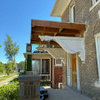
    Here's a couple of pictures of my old house after I took off the siding. In the one picture, the aluminum is still on the side.

    Here is a link that might be useful: my bungalow

  • 19 years ago

    Arlosmon, that is a gorgeous house and I really appreciate you sharing it with me. We'll see what ours looks like underneath--we have no idea whatsoever!

  • 10 years ago
    last modified: 10 years ago

    Thank you all so much for sharing all this great information! My husband and I are newlyweds living in our first home, it was built in 1928, is one story and had horrible aluminum siding and fake plastic shutters! We recently pulled most all the siding off ourselves, it wasn't too bad! We need to replace some of the wood siding, but for the most part its in great condition, we sanded the front already and I think with some paint it'll look great!

    I have a question for you all who have done this already, would you reccomend finishing one side at a time or doing the entire house in steps. (By in steps I mean, remove all siding, replace siding on all sides, sand all sides, prime and paint all sides) or would you say this is more of what my personal preference is?

    As for the scaffolding would you say the purchase was well worth it or do you think renting scaffolding would be a good option? Obviously I would have to rent it multiple tines, but I Iive very near an equipment rental shop. What made you decide to buy or decide on renting the scaffolding??

  • 10 years ago

    Buy the scaffold. By the time you've rented it for several weekends you will have paid for it anyway. When finished you can sell it on CL.

    Don't use ladders, they are unsafe. As a contractor I fire any employee working from a ladder. Buy and use the scaffold handrails and tie it into the house to avoid tipping over. Scaffolding is very safe and secure if used properly. The work will get done much faster if you feel secure.

    This thread is almost 10 years old so don't expect much feedback but I too live in a 1928/29 home and would like to restore the exterior one day. So far I've removed the plaster walls on the 2nd floor, replaced the electric, reinsulated, removed and replaced the wood flooring, etc. I've now begun on the ground floor. Eventually I will remove the vinyl siding to see whats underneath.

    GL, I look forward to seeing pics.