Software
Houzz Logo Print
pierreone

Rescue Pyrenees not adjusting to indoors or crate

18 years ago

Five weeks ago we adopted a 16-month-old Great Pyrenees rescue. He was a stray, fostered outside for 2 months and they think he was a farm dog before he became a stray. He is having a very hard time adjusting to inside suburban life and especially dislikes his crate.

He destroyed his first crate, escapes from his second, and will still bark for 6 straight hours if left in overnight - which our neighbors told us they can hear. We've tried baby-gating him in a room but he either knocks the gates down or climbs them. We also tried keeping him in a bathroom, but he partially dug through the wall and door. We work with him to try to get him used to the crate and also leave him all sorts of toys and a treat-filled Kong. He doesn't care about any of them.

Is it possible he will never adjust to being an inside dog or being in a crate? I know a full adjustment can take a while, but I thought he would adjust at least a little in this time. BTW, this isn't our first dog - he's our fourth Great Pyrenees and second rescue. I feel so bad for him and like I'm a totally inept owner. Any advice?

Comments (20)

  • 18 years ago

    My first suggestion would be to increase the amount of exercise and mental stimulation he gets. A tired dog is a good dog.

    I adopted a partially stray/almost feral dog, a long time ago. I was alot younger then. I wouldn't do it now, I'm too old.

    It took me about a year before I felt that he was comfortable being contained. We walked and walked and walked and walked. Walking was about the only thing that he was agreeable to for a long time...but once he accepted his role as a pet, he was a wonderful dog for many years. Though he was always an escape artist.

  • 18 years ago

    pierreone I need more info. Where is the crate when you crate him at night? If its away from you, that may be part of the problem.

  • 18 years ago

    cindyandmocha, for the first two weeks we had his crate in our bedroom, but after two weeks of almost no sleep we decided to move it downstairs. We also have a one-year-old female Pyr. We've put their crates next to each other and have her sleep in her crate at night next to him. That doesn't seem work either. A couple of times we've tried to have him sleep out in our room with us (on a pet bed), but the problem is he's destructive - he chewed on the bed linens, the carpet, the chair, the pet bed, etc. and ignored his toys.

    joepyeweed, I know what you mean about escape artist. Over the weekend I put him in his crate to run a few errands. I came back and the crate was perfectly intact, even both latches still fully shut, but no dog! He must have popped the top, there's no other way I can figure he got out, but like I said, the crate was perfectly intact.

  • 18 years ago

    Pierre, it sounds like you've done all the right things. Now you truly have me stumped. You were absolutely right to try the crate next to you and then next to your other dog. Both of those examples have worked for me in the past with various dogs.

  • 18 years ago

    Some dogs hate crates, can I ask why you are intent on having a crate? Can you tell me how much time you spent with the dog before crating it? It sounds like this pup has seperation anxiety issues, which means leaving him alone little bits at a time. Crate training will probably be needed as well, start slowly, leaving the crate door open or even the top off. Put his dinner in there, or a treat. Since he has had negative crate time, it will take more patience and a bit longer to get him use to it. Some dogs just dont like crates and since he has had a past before coming to you - it might be he had a negative experience in a crate. Leash walk your dog everyday for at least a week, this will help with you being seen as the alpha and things might run a bit smoother. Your dog might never like the crate tho - mine never did, I made him a place under a table with some old comforters - which is where he likes to hang out.

  • 18 years ago

    He needs a crate because he is destructive. Left unsupervised he could chew on something like a cord and get electrocuted or swallow something causing an obstruction.

    So how much exercise are you able to give him?

  • 18 years ago

    My first Golden Ret. was a rescue. she had lived her 1 1/2 year life outside. when we got her she had no idea what do do inside. she would jump at noises and had a hard time settling down. she would often pace back an forth and wine or sit by the door. We knew that she was tied up most of her life. So I tied her up out side(I hated to do this) and brought her in several times a day for about 10 min each time and the whole time she was in I sat on the floor by the back door to pet/talk to her. And the second day I would bring her in a little farther and for longer times. By the third day she was much better and was more willing to walk around(she spent nights outside). On the forth day I got her to go into her cage by putting a scoop of canned food in there and left the door open, I continued to do this 4 or 5 times that day eventually shutting the door for a few seconds then a few min. I put an old comforter in her cage and put her in there that night. She did wine for awhile that night but I got up extra early in the morning to let her out. After that she slowly got more comfortable in the house but from the forth night on she was in the house day and night. I'm not sure if this will work for you or you GP. but I wanted to share what worked for me.

  • 18 years ago

    Yes, he needs a crate because he's destructive. Mazer, we've tried both dinner and treats in his cage, but he won't eat anything out of it. Our long-term goal is for him to be out free in the house full-time, but until we're confident that he won't destroy things or hurt himself, he'll have to somehow be confined.

    As far as exercise goes, right now with the weather being so bad, he gets two walks a day - and surprisingly he is pretty good on a leash. He also gets a total of about an hour of outside time in our back yard, most of it spent in hard play with our female Pyr. Do you think that's not enough exercise?

    rosegarden, thanks for the story of your rescue. That gives me hope that our guy will be able to eventually adjust to indoor life.

  • 18 years ago

    How long are the walks?
    You may need to add a backpack?

  • 18 years ago

    You say the Pyr was fostered outside. Did the foster have stock...goats, sheep, fowl, etc? If he was previously utilized as a flock guardian, it is going to be harder for him to adjust to indoor life, especially indoor life in a subruban environment. LGD's are often escape artists and 12-20 months is the prime time for them to come into rescue because they are coming into their temperament ( I foster and own Anatolians)
    The good news is that he is still very young and is not set in his ways. Tire him physically with walks and hard play. Tire him mentally with obedience skills. I know you said he refused treats and dinner in his crate .... how long did you attempt feeding him in his crate? You may have given up too soon, so may want to try leaving his food in the crate all day ( you might need two or three days - just remove the bowl at night when you lock him up) Make it very low -key...just place the bowl at the back of his crate and walk away. Leave the door open and let him dart in and out to grab a mouthful or so - he may have been tricked into a crate in the past or is nervous about being trapped, so let him discover that the crate can be a good thing. You'll still have to confine him at night, but learning that he can move in and out of the crate during the day should help to relax him.
    Did you obtain him from Pyr rescue? Have you contacted rescue or has the foster offered any helpful advice?

  • 18 years ago

    Normally our walks are about 45 minutes each, but these past few days with the weather being so bad we've just gone around the block - only a 15 minute walk.

    shroppie, no the foster family didn't have stock, just lived in the country. We did get him from a Pyr rescue and have been in contact with the director this whole time. She's a little surprised at how hard his adjustment has been and is very willing to take him back, but we're not going to do that. I don't want to ping-pong the poor guy around.

    Some great news (and I hope this isn't undoing our crate training), but he slept out in our rooom last night and didn't destroy anything. He got restless a couple times, but for most of the night he was on the floor at the foot of the bed. It's the most sleep all of us have had in a while.

  • 18 years ago

    Wow. I just wanted to say bless you for taking him in and dealing with all this and refusing to give up on him!

    We had two 4 month old foster puppies that had been born and lived outside. They were the oddest little girls we had dealt with yet. They had no clue what to do inside. They would hug the wall near the door and wanted out every chance they got.

    Fortunately for us, they were still young enough converting them to inside life didn't take long at all. One of my own dogs taught them what they were supposed to do. They must've never had a toy because they didn't know how to play. My dog taught them well!

    I think your other GP will also be able to help this guy out - but it is going to take a while I'm sure. Rosegarden's story is an inspiration to anyone going thru this.

    Good luck to you and please keep us posted on your progress.
    Sher

  • 18 years ago

    Sorry to say this, but, you have a tough road ahead of you if you plan to crate a Great Pyr.

    They are extremely independent, breed for herding flocks, they have minds of their own and are not easily obedience trained. Because of the nature of the breed it goes against their nature to be crated or kept confined to any degree.

    Here is a link that might be useful: What the AKC says about Great Pyr's

  • 18 years ago

    pierrone, that's good news. My own dogs sleep in the bedroom at night on dog beds. They are crated when ever I am out of the house, though, for their own safety. Fosters are crated at night and when unsupervised. I don't know what your home life is like and I know you already have one Pyr so you may know already, but LGD's (as well as most other breeds, especially those who have been re-homed) really benefit from a schedule. They are a guardian breed and a routine helps them learn what is normal and should be ignored and what isn't normal and should be acted on. The crate will, in time, just become part of the routine. Regardless of their indpendent nature, they CAN be trained and should be (but you know this)
    Pointers (just adopted a 1 yr old last week), on the other hand .........................Good Lord, give me a stubborn 2 yr old LGD anyday!

  • 18 years ago

    Okay, leash walking is important, makes you the leader, and allows for them to sniff other dogs scents. Play time is good, but I suggest leash walking. BIG TRICK - leash walk your dog just before you feed him. Make him tired, a good long leash walk to start off with, and then place just a tidbit of his food in the crate - lid off. just the bottom half will do. Just leave him and his crate and his tidbit of food, and let him sort it all out. You might have to wait a bit. Try and be patient. You might want to put the waterbowl in there as well. When he eats or drinks from the lower half of the crate praise him until the cows come home, like he just brought you a bag full of hundred dollar bills. Keepup this type of training. It will desensitize him to the crate. SOon you should be able to put the top on, and have him go in for his water and food....etc Good luck

  • 18 years ago

    You've gotten some really good pointers here. One thing you MIGHT try, as silly as this sounds, but can you put an article of your clothing in the crate? Something that you've worn and not washed will have your scent on it so he will feel your closeness, I have no ideas how your breed behaves but when I babysit with my Granddaughter's Goldie I always ask her to bring along a worn sweatshirt or whatever. This dog is very attached to her but she snuggles into the clothes at bedtime with no problem at all. Hope this helps a little Good luck to you both. BT

  • 18 years ago

    Thanks, everyone, for all the advice.

    One thing I discovered this weekend that calmed him down just a little is that he doesn't like his crate covered. I'd always read that you should cover the top and three sides to make the crate seem more den-like. He shreds everything we put over the crate, so this weekend I just stopped covering it and he did a little better.

    brownthumbia, you know, the first week we had him I left one of my old sweatshirts in the crate, but he shredded it to ribbons.

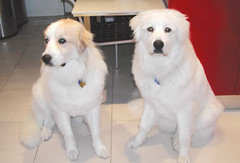
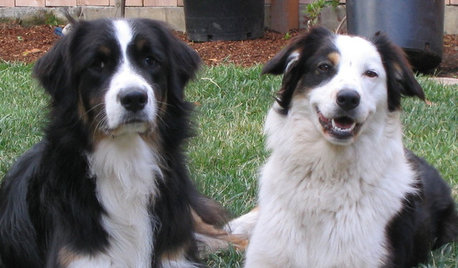
    Here's a pic from this weekend. The rescue, Murray, is the one on the left with the tan mask, and the other is Maizey, our female.

  • 18 years ago

    I have not advice. Wow what pretty dogs. I hope things get better.

  • 5 years ago
    last modified: 5 years ago

    I wonder if a once free-range large former farm dog now forced to spend a lot of hours in a crate and not enough exercise thinks of himself as "rescued." Rescued from what?

    OP is long gone, and probably the dog as well... this is just an idle musing of a laid off person with not much to do No one above suggested the obvious solution, rehoming the dog to more appropriate place. It's one thing to raise a dog, or cat for that matter, from a young age to live most of its life inside a house, but another thing all together if it's an adult that has learned to love running around free.

    Yeah, sure, some will adjust (I had a former street cat who would have NOTHING to do with the outdoors, ever - she had had enough of it.) But it shouldn't be a surprise when some just plain can't.