Software
Houzz Logo Print
thomaspultz

My Noritz Tankless Installation - Any Problems?

18 years ago

Happy Memorial Day everyone!

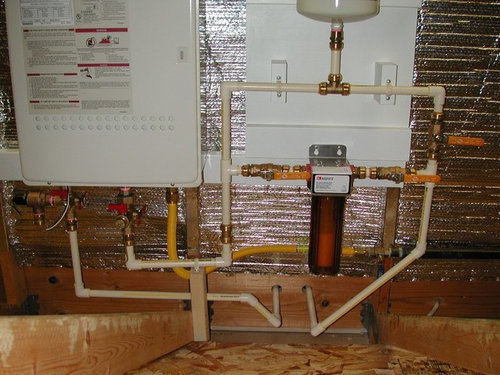
Here's a couple of pictures of my Noritz tankless water heater installation located in the garage attic. I have a few things left to complete, such as plumbing for the over-pressure discharge and connecting the hot and cold water lines to the appropriate lines on the other side of the joist shown... but I'd appreciate it if the experts here would take a look and let me know if this looks OK so far.

Gas piping is 1-1/4" from the new high flow meter outside the garage up to corner of the attic, from there it's 1" to the gas flex line shown.

Once the water lines are connected and tested I'll install pipe insulation.

Thanks allot for any comments.

Comments (9)

  • 18 years ago

    I am assuming the gas line rises vertically then turns horizontal to this location. If that is correct, in my jurisdiction you would be required to have a Tee on the end of the black iron pipe. You would connect your fixture shutoff valve on the end of the tee as you have it now, then you would install a 4" nipple off the side outlet of the tee and run it vertically down with a cap on the end to make a "Drip Stub".

  • 18 years ago

    Thanks lazypup. You are correct about the gas line. It comes into the side of the garage, runs vertically down about two feet, then horizontal to the back corner, and up and over to the tankless. It was professionally installed and passed inspection.

    The rough-in insepctor seemed very thorough (we also had gas lines run for an outside grill, redid the fireplace line, and ran a line for a rangetop in the kitchen) so I assume our jurisdiction must be different than yours. About all the 'final' inspection entailed was making sure the Earthquake shutoff valve was properly installed. It was literally a 1 minute inspection.

    FWIW, the old water heater in the garage does not have the 'drip stub' you mention, but the furnace does.

    Tom

  • 18 years ago

    The requirements for drip stubs can vary greatly from one jurisdiction to another.

    Both the International Residential Code and the Uniform Plumbing Code require drip legs at low points and meter outlets if there is the potential for having water vapor in the gas. Note, the operative word is the "potential" for water vapor in the gas supply.

    Most of the natural gas consumed in this country is initially produced from the Texas/Oklahoma oil basin or the California oil basin and because of other elements present in the gas it requires refining process before it can be used for fuel, thus during the refining process they not only extract the undesirable elements, the gas is also dehumidified.

    Such is not always the case in my region. While it is true that we are primarily using Oklahoma gas delivered via Tennessee by pipeline, nonetheless, we also happen to be on the Pennsylvania/N.E. Ohio gas field. Gas in this region is referred to as "Sweet gas" and it can be used directly from the wellhead once it has been stenched. (stenching is the process of adding the odor that we recognize as natural gas). While they do conduct a filtering process to eliminate water vapor at the stenching plant there still remains the potential that some of the natural ground water may be carried forward in the gas so our local codes are very strict about drip stubs.

    Both my sister and my uncle have farms in this region and they have gas wells on their farms. In addition to receiving a small royalty check for the gas they produce, they we also given the opportunity to run a gas line from the well head to their homes and they get an unlimited supply of gas for their personal use. In fact, at my sisters farm she not only has her house but my mother has a second house on the property and both receive an unlimited supply of free natural gas. (Sure helps out on the heating bills during those long winter nights).

  • 18 years ago

    Besides the gas drip leg and running the relief valve drain, I would have left room to install an angled fabricated drain pan under all that should a valve leak at it's packing, the filter, exp tank, fittings or heater itself sprung a leak

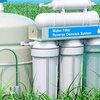
    BTW, whats in the filter housing? a filter or that chemical compound sold in the beverage industry to reduce liming?

  • 18 years ago

    The 'filter housing' is a Noritz Scaleshield. It's some type of chemical compound to reduce scaling in the copper HX and pipes. It's probably some kind of phosphate conditioner. The cartridges are supposed to last about 6 mo. At the time I bought it I thought it would be good to have if it helped protect the expensive HX, but since then I've been thinking about intalling a water softener to help reduce scaling... but first I need to get the water tested to see what are water quality actually is.

    A drip pan of some sort would be a good idea if I can fit something in. I may also look into one of those auto-shutoff valves that closes when the sensor detects water. I'm not expecting problems, but hey, you never know!

    Think I'll run the 'drip leg' question by my gas piping installer and see what he says.

  • 18 years ago

    I figured it may be a scale inhibitor but with a filter too. Nioe way to protect the flow valve. Since it is from Noritz it must have the flow capabilities. Most combo units I have come across are restricted to 2-4 GPM, which I believe was designed for the ice maker/beverage industry. I know that Cuno makes the AP430? scale inhibitor that works well but, no filter.

    With regards to the drain pan thing and perhaps won't work for you but incase others are reading, I made my own. I used a double wide heavy plastic wallpaper pasting/soaking pan, drilled and mounted a pvc drain fitting and screwed it to the wall with screws and fender washers. Worked slick is sleek to the wall and fits well under my wall hung unit and valves.

  • 18 years ago

    I fired this unit up for the first time on Tuesday evening, June 3rd. It sprang to life on the first "start attempt" and seemed to be running fine with just the kitchen hot water on. However, when I left that faucet running and then opened an upstairs lavatory faucet I heard some loud "shuddering" sounds coming from the garage attic. Yikes, what's that!

    With one faucet running I was able to recreate the shuddering sounds by adjusting the setpoint temp from 120 up to 135, letting it sit there for about a minute, then quickly setting the temp back down to 120. As the burners and burner exhaust quickly tapered off the front cover on the unit started shuddering rapidly back and forth in an oil-can motion.

    Thus, it appears that some type of pressure wave is being set up when sudden changes in heat demand, either from more flow, or much lower temperature setpoint cause a step change in burner and exhaust flow.

    My guess is the vent holes in the front cover are not sufficient to allow the pressure to stabilize across the face without causing internal pressure fluctuations.

    Tonight I will try running the unit with the cover removed. I have submitted an inquiry to Noritz about the problem. Could be this is a known situation which was corrected in later releases of the N-084M, which was purchased nearly three years ago and is just now being installed as part of our overall home remodeling and upgrading.

    Tom

  • 18 years ago

    Hi Tom -- I'm not a plumber, but we had a Noritz tankless unit (exterior model) installed in January. We also had a shuddering the first couple of times we used the faucets that are farthest away from the unit, but that stopped after we had run each faucet 1-2 times. Might just be because the water was off for a while during the install?

  • 15 years ago

    Hi, I need to replace the water filter but some how I can't find the wrench which fit this filtering system. where can I find the wrench? I have noritz tankness heater and water filter system installed below the heater. thanks