Software
Houzz Logo Print
carolek_gw

Stippling question

18 years ago
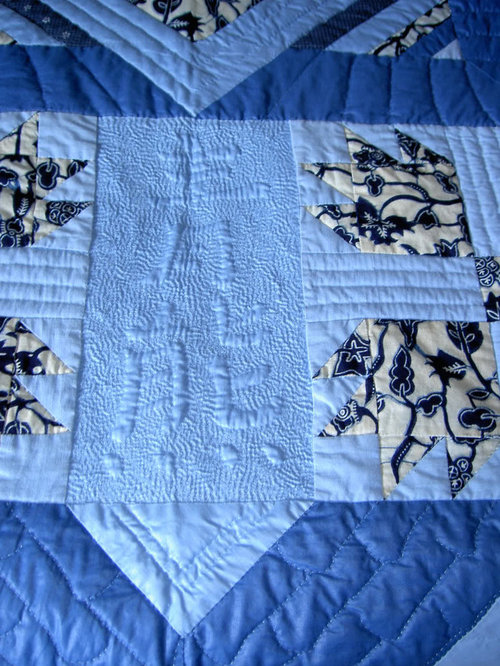
I was looking at an ad for machine quilting--the kind that uses chucks (that'a my term) that automatically produce a design as opposed to free motion. Anyway, it was labelled stippling. That threw me. I learned to stipple by hand years ago and it looked nothing like the ad. To me stippling was very close quilting that completely filled in an area. It could be just a design feature or used to make a design really stand out. I've used it both ways, although as it is very time consuming, I don't use it often. My question is do any of you do stippling? And Annie, do you do it when you are doing free motion?

I'm including an example from my Blue Bear quilt. The Chinese characters say Blue Bear.


Comments (12)

  • 18 years ago

    I use stippling as a filler but in a larger form than what you've shown. I don't use it overall like a "panograph" would make a machine do. I think that ruins a nice quilt. But, it has it's uses. Just my take on it.
    Linda

  • 18 years ago

    I have a wallhanging done in the technique like your quilt which I did by hand but the stippling that I do with the machine is further apart and also called meandering. I use it to fill in the blank spaces as I do not do MQ well but stipple without too many problem. My understanding of stippling is free form quilting. Jayne

  • 18 years ago

    Meandering, what a great term. I think meandering would be a better term for the looser quilting. As hand quilting came before machine quilting, I'm inclined to use stippling for the really close stitching. I haven't found examples in old books to suggest a variety of meanings.

  • 18 years ago

    OK, before commenting on the photos, I really need to know what your definition of "chucks" is. I've never heard that term before(not surprising since you say it's your own term).

    What I see in that close-up photo is free-hand stippling.

    Long-arm machine quilters use many different backgroung filler patterns. Most do them free-hand - meaning they guide the machine themselves. There are as many stippling patterns out there as there are quilters.

    There are computer-controlled systems, but they are usually used for pantograph (edge-to-edge patterns), or for single block patterns.
    It is possible the quilter in question outlined the characters, and then stippled around them.

    I still really want to know what you mean by "chucks"? I've been quilting for years, and I've never heard that term before.

  • 18 years ago

    For my quilts, I do not care for very close stippling. It may have it's place in certain uses, but I think it makes the area quite hard and stiff. Wall hangings or table runners might be where I would use stippling, but not baby/lap/bed quilts that I would want to have a draping quality.

    In filling in large areas of quilting, I often use meandering with the movement like stippling but bigger with more space between the stitching. I aim to make the quilting evenly spaced and flowing above all....sometimes I succeed.

  • 18 years ago

    Time for some FM quilting terminology: Meandering refers to almost any relatively large-scale design that flows randomly over the surface of the quilt. You can meander vines, feathers, loose curves, almost anything. It's usually done free-hand. Stippling refers to the tiny form of curved meandering and is used in the same way that traditional hand quilted stippling was, to compress the background around a motif that you want to stand out.

    The link I'm including will take you to a picture of a feathered wreath with two sizes of stippling: the outside stipples are about 1/4" in diameter if the curves were closed, the center of the wreath features tiny "micro" stippling--about 1/8" diameter.

    If you look at the next two pictures you'll see an example of curving meanders with hearts added once in a while for interest. The fourth picture shows meandering feathers and the fifth, vines.

    Incidentally, the tiny, curvy stippling has been used on quilts for centuries. I know of examples of quilted petticoats from the 1700s with this type of stippling.

    In FM quilting, stippling is almost like a fingerprint--everyone does it a bit differently and I can often ID local long arm quilters simply by looking at the stippling/meandering on a quilt.

    Annie

    Here is a link that might be useful: Annie's Webshots albums

  • 18 years ago

    Carol, Are you referring to something you drop into( or insert) to a machine that makes it do different stitches? Years ago my mom had a Viking that had these.

    Oh I love your hand stippling. I want to learn to do this. On the quilt I'm working on now, there are a few blocks where the block doesn't lie flat. These blocks are made of homespun, and have a quilted feather. I think if I used stippling around the feather it might look better. What do you think?

    Janice

  • 18 years ago

    Sorry all. To start with, forget "chuck" A chuck is what you put different drill bits into, so even my far out analogy is off. I was sort of thinking of the disks that some machines used. What do you call the design guides the quilting machines use?

    Annie, thanks for the pics. I feel that even the smaller meandering is quite a bit larger than the hand stipling I learned, but it does serve to enhance the design. Actually, in Blue Bear, that was my first attempt and it covered more space than I have done since. I think the way I do it should be an accent feature only.

    Yes, stippling probably started out in clothing--even earlier say back to Midieval times when quilted clothing was quite common. Stippling would have been used in fine clothing. I think it has been used in gowns in the late 1800's as well. My daughter, who has a background in costuming, thought it was also used in early Chinese clothing, but I haven't seen any examples.

    Janice, it depends on how big the block is. I don't think I would stipple the whole block. Maybe two or three lines of echo quilting would be sufficient to make the design line flat.

  • 18 years ago

    Carol--You are thinking of cams. I don't know of any cams to do machine quilting, they were used for embroidery stitches before the advent of computerized embroidery, but that's not to say they aren't out there. The long arm machines that I'm familiar with are either hand guided or computerized. As Mary pointed out pantographs are popular as well, these are paper patterns that the quilter follows with either a pointer or laser to make a uniform pattern over a quilt or in a border.

    Machine stippling will look quite different than hand-stippling due to the limitations of the machine. Currently, stippling is "out" and McTavishing is "in". I don't have any pictures of my own McTavishing (so called because Karen McTavish was the first quilter to gain recognition for using this sort of filler pattern.) Here's a link to some good shots I found on the 'net. Scroll down to the bottom of the page.

    Annie

    Here is a link that might be useful: McTavishing

  • 18 years ago

    I've seen McTavishing demonstrated on (some random TV quilting show I can't remember at the moment). However, there are any number of free-hand designs that could be used. Here's a Sharon Schamber video that shows a few of the background designs she teaches:

    Sharon Schamber demonstrating background quilting

    I imagine you could free-hand machine quilt just about any design that you can teach yourself to doodle - you know, start on one side of a sheet of paper and doodle a repeating design without lifting your pencil until you've covered the entire sheet. If you can do it with a pencil, you can do it with a longarm and you can do it with your home machine, too.

    I've found, with doodling, the trick is to figure out how to get "in" and "out" of nooks and crannies so your entire area is filled with an even amount of doodling/quilting.

    CMC

    Here is a link that might be useful: Sharon Schambers You Tube page - all her online videos

  • 18 years ago

    Wow, Lovely quilt design, but I think it would be best suited to white on white--it is so spectacular, it takes over the quilt. I have used quilting as part of the pictorial design in my Zuni Sunrise, but it is not an all over repetition. Like stippling, I think it needs to be an accent. It almost looks like stuffed work, but that could be a high loft batt. Have you done any stuffed work?

    thanks for the pictures. Carole

  • 18 years ago

    I doubt that it's a high-loft batt. The cotton battings look like that when tightly compressed with such tight quilting.

    CMC: Doodling is a very good description of what free-motion background filler patterns are. I tell my students to get comfortable with possible patterns by doodling them on paper just as you describe. This gives you muscle memory and makes it a lot easier to accomplish the patterns when you get to the quilt. Thanks for the links to Sharon's video--I got some ideas for my own work from it.

    Annie

Sponsored
Wannemacher Interiors
Average rating: 5 out of 5 stars26 Reviews
Customized Award-Winning Interior Design Solutions in Franklin Cnty OH