Software
Houzz Logo Print
aloha2009

Modern Kitchens Over the Decades

14 years ago

We all know to well that kitchen styles have changed throughout time.

As I try to narrow my decisions down, I thought about what kitchens in the 50's, 60's, 70's, 80's, 90's, and even during the early 2000's, looked like. How different are the cabinets, countertops, appliances etc? Does modern ever go out of style completely since the lines are the same? One can't help but notice using black in the modern kitchen. Is black the stamp of the 2000's?

Any modern kitchen pictures you have of yesteryear (and what year) would be greatly appreciated. For those kitchen designers, what elements are indicative of modern kitchens in the various decades?

Comments (24)

  • 14 years ago
    last modified: 10 years ago

    I'm pretty sure one of the decorating online mags has an archive of kitchen by decade. I don't have it bookmarked on my iPad, but try googling it.

  • 14 years ago
    last modified: 10 years ago

    It was linked here, and was cool to look at. Pretty much lowered the hammer on any notion of a "timeless" or "classic" kitchen.

    No, modern does not always stay the same. It is never the same.

  • 14 years ago
    last modified: 10 years ago

    I think that most of the time, "modern" is applied to kitchens that are using the newest innovations/materials/technology. So, in the 70's, a kitchen with orange laminate and yellow swag lamps and dark wood cabinets with ornate pulls might be called "modern" in a decorating magazine. I think "modern" and "contemporary" get interchanged. I'm not sure whether this is appropriate.

    I think there are various styles that fall into the "modern" category, but I'm not sure what makes a style "modern" vs "contemporary". Is there a strict definintion of the modern style?

  • 14 years ago
    last modified: 10 years ago

    Mtnrdredux, I can't seem to find any. If you have some that you can refer me to, I'm anxiously awaiting.

    Marcopolo. I think I remember seeing the thread you were talking about. I'm talking about general lines that "seem" to define modern (which I included below). IMHO even an older modern kitchen doesn't lose it's appeal to me. I remember too the film from the 40's or 50's that was shown around here...I had envied parts of that kitchen. Even though very old, there was something about certain elements that make me want to incorporate those into my 2011 remodel.

    I would like to incorporate things from decades ago into a current modern kitchen.

    I think modern is hard to define exactly. For myself, I am looking for more of a modern look and not an ultra modern look (only defined in my head).

    I found the following article at
    http://interiordesign.lovetoknow.com/What_is_the_Definition_of_Modern_Design

    "What Is the Definition of Modern Design - Design Themes
    Modernism was a rejection of the ornate flourishes of other design styles, such as Gothic, Renaissance and Victorian styles of design. Some themes associated with modern design include:

    �Clean, straight lines
    �Stainless steel, chrome and other metals
    �Minimalism
    �Lack of clutter (accessories, etc)
    �Primary colors (bold colors used for accents with white, black or neutral colors used for furniture and other large pieces)
    These are the basic themes of modern design, although the actual application can vary greatly. Modern design encompasses both the bright and bold designs of a store like Ikea and ultra minimalist furniture at the same time. On one end of the spectrum, the spirit behind modern design is to reject the notion of designing for mass appeal in favor of starker and more minimalist designs, while on the other end of the spectrum you will find designs inspired by the bold colors used in abstract art."

  • 14 years ago
    last modified: 10 years ago

    I think people usually think post war/mid century when they think "modern" and "contemporary" is the contemporary interpretation of modern.

    What and actual architectural historian would call it is probably different.

    Google "retro kitchen" or something similar for examples--there are lots!

  • 14 years ago
    last modified: 10 years ago

    Yeah, but Marcolo, that article had some pretty out there designs. I don't think one off over-designed items should define an era. YSL's Russian peasant look was highly influential, but no one actually dressed like that in the '70's, and that's not what comes up as the exemplar of the '70's look except in a discussion of top designers. Same for interiors. That '60's carousel themed red and white horror might have been the ne plus ultra of design ideas, but it's not what '60's kitchens really looked like, even in most of the homes done by top interior designers.

    I do agree that "Modern" changes with technology. When we visited Epcot center in the early '90's we had many good guffaws about how it presented the '50's white man's view of the future. You have to update your ideas as life outpaces Star Trek.

    OTOH, around here we all think that wall mounted range from the '60's with the pop out stove top and side by side, chest level ovens, is really really cool. The design is modern--still modern--even though the technology, inc. coil burners, is outdated. You could do something similar with induction and a speed oven and you'd be right on target.

    "Modern" design wasn't big in the U.S. in the '90's going into the 2000's. The watchword was "furniture". There were a lot of backward looking carved elements, unfittedness, feet on cabinets, etc. Aloha's definition is right on for what "Modern" means as a design scheme. What you can add to the Modern aesthetic from that period is really what's behind the doors. It's the Blum glides, the look of long, deep drawers and no lower cabinet doors, full extension, soft close, and all those funky German organizers and dividers. Horizontal uppers or open shelves, usually in a lighter color, often with glass doors.

    From the '80's into '90's, Modern is the European (frameless) cabinets, and especially lacquered doors in deep, bright colors.

    The mid-late '70's style was more "natural look". Lots of rough wood, recycled glass, etc. Modern, in that context, and moving toward the '80's, was nigh onto Disco. Lots of black and sleek, mirrors, and bling. Early '70's were about bright, fresh, warm colors, mostly citrus. Modern was pretty much passe for a time there. Old enough to be old fashioned, not old enough to be cool or retro.

    The '60's version was Jetsons/Star Trek influenced. Not as straight lined as MCM and more colorful, with an emphasis on whizbang gadgetry, like the Nu-Tone built-in into the counter food processor.

    Modern from the invention of the style (Mid-Century) through the mid-'60's is long and low, angular and sleek. Medium colored woods for cabinetry, but a sparseness of cabinetry, all hung on the wall or with long, thin legs. Clutter free. Hidden spaces for the actual detritus of life so that the living space could be void.

  • 14 years ago
    last modified: 10 years ago

    Sure, that thread was focused on eye candy of the times. But certainly, no one in 1968 was doing white inset kitchens with soapstone and marble and white subways. If they did, their neighbors would've thought they were crazy.

    I think the word "modern" has a much more restricted definition than "contemporary." Modernism in some way always maintains its roots back to the International style, and even further back than that, through all its transmogrifications over the decades. That is why I think modernism often falls out of fashion but it dates less, because it is at least a somewhat cohesive style.

    "Contemporary" is quite different. It's not cohesive. It has no distinctive ornament, or lack thereof, or color palette, or motif, or anything that would make it an enduring "style." It's whatever Pottery Barn, or its predecessors or future successors, deems to be fashionable at the moment. So it changes, and dates, all the time.

  • 14 years ago
    last modified: 10 years ago

    ...well, my mother did a white kitchen with a narrow partial overlay inset door with a white brick floor, and a stainless cooktop and rangehood ...in 1968. Formica was king so it has Formica countertops, (still) and stainless refrigerators were not available, although it was bottom mount and counter depth. It also had white shutters and a chandelier, and white wallpaper.

    People did think it was unusual,(she told people she would've hated harvest gold and dancing pots-n-pans wallpaper)

    But if you removed the 1985 update wallpaper and balloon shades, its an awful lot like what people are doing now. I posted a picture once and I got guesses from 1950 to 1992 when I asked about era. The adjacent library does have full inset paneled cabinetry just like people are doing now. Not being able to guess is a good sign.

    And the 1968 bathrooms are white tile and fixtures, white mosaic with grey grout floors, and marble(-look, laminate) countertops.

  • 14 years ago
    last modified: 10 years ago

    Anyone ever seen Mon Oncle with Jacques Tati? :D

  • 14 years ago
    last modified: 10 years ago

    Palimpsest, it sounds like your mother's kitchen was modern but not contemporary.

    Real estate agents are some of the biggest offenders in the misuse of the word modern. So many times, I've seen a listing taut a "modern" kitchen, but when I click over to the kitchen photo, I see something with Baltic brown granite, ornate gel-stained cabinets, a pig standing on the countertop (still don't understand that one), and a busy tumbled-stone backsplash. I think in realtor-speak, "modern" means, "It isn't that old."

  • 14 years ago
    last modified: 10 years ago

    Plllog, thank you so much for defining more of what modern was during each time period.

    Pllog and Marcolo, how modern fell more out of vogue in the 90's and 2000's is probably more of why I am concerned with going modern. Is it that it's getting more common (contemporary) that I'm gravitating towards it, or is it that I truly like modern?

    When I tell others I'm looking into modern, they sort of almost grimace and that's OK with me. I think the lack of clutter snags many from ever being able to have a modern kitchen (even if they wanted). I saw a modern kitchen with "clutter" around the kitchen. I had to really look hard to see that the basic kitchen was trully modern.

    Even when more prevalent styles were more in fashion, my kitchen exhibited a minimalisic look. My countertops have always been pretty sparse and I don't like clutter around. As I get older, I'm getting even more so (my kids call me the reverse hoarder).

    I know what you mean contemporary has no cohesive theme, that can be described through the decades. It can be awesome when it's used but how quickly does it fall out of favor?.

    Our new kitchen layout will be open to the remainder of the living areas. I need the kitchen to blend more so because of this. Even though furniture quality cabinets are nice, it's just not the look we are going after. I do have hesitations also that the modern fits into the rest of the house. Our house is more contemporary with large walls of windows,high ceilings, and open floor plan. It does have definite traditional aspects including 6-panel doors. To really "age" the house there are 3 old fashioned curved doorways. I was hoping that the modern wouldn't stick out, as long as I don't make it ultra modern.

  • 14 years ago
    last modified: 10 years ago

    Well thats how contextual some of the use of these words is. Technically, I would call the kitchen "traditional" in terms of its elements, but it was years ahead of its time.

    I think people interchange modern and contemporary, even though "modern" is more of a style or movement, and "contemporary" is whatever is happening now that is not a complete reference to something in the past. However it's not always easy to separate the two.

    So, when I am talking about Modern meaning a particular style like MCM...I call it ModernIST so people have a better idea of what I am talking about, I hope.

  • 14 years ago
    last modified: 10 years ago

    Aloha, my house is a mid-century modern, and something that was important to me when I designed the kitchen was that it stay true to the style of my house. So, my kitchen has modern "bones". If I clutter it up, then it will still match the rest of my cluttered house. In your case, I think the kitchen can reflect some of the elements of the rest of the house. For example, you could go with a more traditional door style to play off the traditional doors that are in your house. But, you can make other elements more modern and keep the counters clear. I guess what I'm saying is that you can have a contemporary kitchen with modern touches, just like I have a modern kitchen with clutter. I've seen old homes in design magazines where the resident prefers a modern lifestyle, so though the house was built 200 years ago, and some of the furniture is quite old, everything is put together with a modern eye, and the effect is modern.

  • 14 years ago
    last modified: 10 years ago

    So, pal's mom's kitchen didn't really date, because it wasn't even on trend at the time it was installed. And it wasn't part of a "kit," like gold counters and turned wooden room dividers, or soapstone and white inset and subways. Good lesson there, I think.

    Did you see that contextual beauty thread palimpsest started? You sound like the exact target audience--someone unsure whether they what they want to do will fit the house, today and in the future.

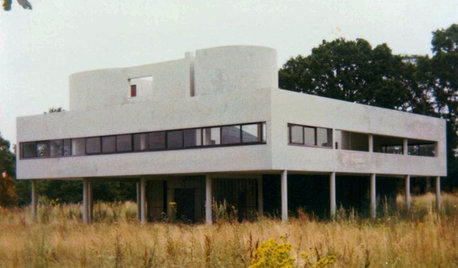
    I would say, first, don't overdo the Modern(ism) per se. You're not living in a Le Corbusier. Modern influences are fine.

    Second, tie the kitchen into the house in some way, as mcmjilly suggested.

    It's do-able.

  • 14 years ago
    last modified: 10 years ago

    It's okay to juxtapose two styles as long as you pay attention to what you're doing. Those Star Trekian Italian and German Modern kitchens are often found in hundreds of years old buildings with hand carved plaster moldings and Beaux Arts details. What looks weird with Beaux Arts would be something with an equal amount of detailing, but in a different style. Think of the '60's Americana style that Palimpsest's mother rejected. It's cute in a ranch house or rambler, where there isn't a lot of architectural detail, but that pots-n-pans wall paper with egg and dart moldings. French casement windows (in-swing with horizontally divided lights), and 1'x2' pavers on the floor? Not so much.

    So...you have some architectural details from another era. They're not imposing. The main thing is if the kitchen is open to the living room, and you want a sleek Modern look, you need to consider the design of the kitchen and living room as a whole. That's one aspect of Modern that's inescapable. It can settle fine in older architecture, but it doesn't play well with ordinary, and if you go for it in a big way in the kitchen, it will look best if you carry it through in the living room furniture, since it's one space. The furniture wouldn't have to be Modern, necessarily, but clean lined and spare. Too fussy and it'll want to turn into an eyesore. Slightly fussy and it'll be a jumble. Clean, uncluttered, and simple, and you'll be fine.

  • 14 years ago
    last modified: 10 years ago

    it doesn't play well with ordinary

    This is a really great way of describing it. It's why ultra modern sleek kitchens in magazines look great in gigantic white rooms with Rococo plaster ceilings, and a little less great in Toll Brothers tract homes.

  • 14 years ago
    last modified: 10 years ago

    Mcmjilly. I too think the confusion between modern and contemporary has stemmed from some realtors misuse of the terms. I've poured through pictures and sometimes I come out thinking "how is this modern". I think I was initially confused because of others misuse of the term.

    There are only a few doors in the entire house. Though there are doorways that are traditional (and old fashioned), I have only a few of them. The house has a more modern feel then a traditional. The 6 paneled doors and definately the curved openings seem almost out of place. I don't really care for a traditional kitchen cabinet door and that's where part of the dilemna is.

    In previous homes that the kitchens were contempoary and traditional, a modern feel never was felt by any stretch, no matter how uncluttered I was. I believe if one has a modern area and there is "clutter" around, it almost negates the modern feeling, such as I gave an example of (sorry no pics), even when cabinets, counters, etc are truly modern. It's almost as if the "clutter" accessorizes the modern, which of course would negate the streamlined, minimalist look.

    Is it perhaps that one can not stray too far away from streamline or the moderism is lost?

  • 14 years ago
    last modified: 10 years ago

    My mother-in-law's architect-designed 1963 kitchen was not severely modern--it would walk the line between "modern" and "traditional" in GW parlance. If it weren't for the obviously 60s Formica and vinyl flooring pattern and the old appliances, you'd probably think it was a newer kitchen. Walnut dark-stained cabs with some raised panel or incised rectangular trimmings, stainless steel sink, small custom windows under the uppers flanking the sink, undercounter lighting, interesting pull-up hinged extension of the countertop for projects and buffet serving, a small oven over the range, but crappy overhead lighting (undersized bulbs?) without adjacent windowing so the room was dark until someone turned on all the undercab lights and the dining room light and opened living room curtains. It was a great one-cook kitchen and she served 5 men from it.

  • 14 years ago
    last modified: 10 years ago

    Plllog, I think I know what you mean by out of place. When we moved here about 18 months ago our traditional furniture seemed out-of-place. The few antiques I have REALLy look out of place. It took me sooooo long to find those pieces that I've had a hard time letting go. The pieces fit spacially in the areas but look out of place. I also have a Queen Anne bedroom set that looks hopelessly old fashioned at this house.

    We purchased a new livingroom set that has squared thinner arms with low backs (Dick Van Dyke style) but looks great in here. We also purchased a brushed chrome and glass dinette. Basically the more streamlined pieces look better then the traditional pieces.

  • 14 years ago
    last modified: 10 years ago

    Is it perhaps that one can not stray too far away from streamline or the moderism is lost?

    I'd say more that you can bury Modern with clutter. Modern is about entire, large geometry. Break it up too much and you just have whatever. Since we're talking terminology however, let's get rid of "streamlined" and be careful with "Modernism". "Streamline" doesn't actually mean unadorned in design speak. There's a huge difference between "Streamline Moderne", which comes from the late Art Deco era, and "Modern" which nowadays harks back to the post-WWII Modern Design movement.

    Streamline is the ripples you get with speed. You can see it on a lot of old signage, cars, etc. The long lines, often joined with curves, and concave between, that look like your cheeks on a roller coaster. They're meant to show movement and speed. "Streamlined" can mean unadorned to pass easily through air, usually with curves similar to airfoils, but it's usually presented with streamlines in some form, rather than being a uniform surface.

    Modernism describes an art movement from the early 20th century, and while there are sociological origins in common, is really different from the Modern Design movement in design.

    Aloha, if you don't like your six panel doors, replace them. The arched doorways are fine, though I suppose you could change those too if you had a mind to. I wouldn't worry about them. I also wouldn't worry about tying the kitchen design to those rather sparse cues that don't really inform the rest of the architecture of the house. If you really want to tie in the arches, you can do a curved cabinet. Not all Modern is angular. It's all simple geometry, but that can include simple curves. But, again, I wouldn't worry about it. The rest of the design of the house sounds like it'll support Modern without any problem.

  • 14 years ago
    last modified: 10 years ago

    Ouch on the antiques. It sounds like the new furniture will be fine with the Modern kitchen. If the antiques are great pieces, and not fussy, don't give them another thought. When you're done and have the whole design pulled together, and have been living with it for at least a year, look again. Have some people whose style you trust come look as well. Real people live generationally, not styled for magazines. A few outliers, like your favorite antiques, can enhance the design by providing tension. They point out the sleekness of the Modern by giving it a foil.

    The best thing to do with the Queen Ann bedroom, if it makes you sad (sometimes "hopelessly old fashioned" does, other times it's just c'est la vie), is do something unexpected with it. I'm assuming it's dark wood. If so, paint a wall or two purple, and festoon the bed with white in multiple textures (ruffles, crochet, furry, lace, broadcloth, velvet). Or paint the walls a beachy aqua and use all the colors of a conch in the bedding. In other words, juxtapose the staid furniture with something fun and now. Nothing is going to make it Modern, so don't even try. ;)

  • 14 years ago
    last modified: 10 years ago

    It's hard to find online images of "typical" from the 50s-80s just like it is hard to find pictures of typical kitchens in many magazines now, except kitchen periodicals that showcase different kitchens at various price points. Appliance and cabinet company ads tend to highlight their product, so the layout is more about showing maximum product than a real working room.

    And magazines tend to feature the unusual either in size, expense or design.

    Now, we see a lot more typical interiors because of digital cameras, the internet, blogs, and people's general willingness to publish their whole lives, for better or worse.

    So the internet is full of images of sixties kitchens with a merry-go-round theme, a dishwasher that pops up out of the middle of the huge dining table, and 70s Spanish Gothic kitchens with flocked velvet walls and the opposite: the kitchen that prominently displays the all-harvest-gold appliances or the arabesque patterned sheet vinyl to the expense of everything else. There is very little professional photography of real, built kitchens.

    We still see the current version of these outliers but it is tempered by pictures that people take of their own houses.

  • 14 years ago
    last modified: 10 years ago

    aloha2009,
    I suggest that you hit the library and look at lots and lots of modern architectural and interior design books from the past 50 year or more. You will find things that are consistently true to who you are. Internet is not a good way to truly educate yourself. These books are generally written and edited by people who actually know, teach, make and understand good design. Internet is a bunch of yahoos who may or maynot have any credibility ;) (like myself)

    Kitchen is an integral part of your house's architectural element. This is why you need to look at architectural books not just kitchen books.

    I would replace your doors with simple slab doors. Doors are actually quite cheap. Hollow core paint grade slab doors cost less than $50. If you get exotic veneer with cool hinges from Europe, each door will cost you a few hundred $. You will be surprised how far that can carry you in bringing the elements of your design. Doors and windows are HUGE in architectural ornamentation.

    Modern is not necessarily minimalistic. Even in modern design, you have to find elements that you like. I like things that are minimalistic, simple, and unadorned. You can do modern with shiny lacquered fire engine cabinets versus "flat" painted white slab cabinets. They will have completely different feel to the "modern" design even though they are both "modern".

    Modern will never go "out of style" because it is stylistic and fulfills its own genre. (imagine victorian design style.. whether you like it or not, it will be around because it fits certain houses and there are characteristics that are intrinsic only in this particular design element.) Any design style may become "less popular" over time.

    Modern comes in and out of popularity. The modern design that you do today many not look new, contemporary or fresh in a few years. That is to be expected.

    HOWEVER, if you are true to your house, your location, the light and space in your house, the flow of your rooms, other materials used in the house and your inner guidance, then the design will endure longer than following the whim of the current design trend. Some people have a great knack for this and their designs endure. If you look at some of the modern designs from 1930s, 40s and 50s, you can see what I mean. I love looking at old architectural books for this reason. Some look as attractive, interesting, innovative and cohesive today as when it was first put in. Others, you can see that the design did not endure. One of the things you do is to educate yourself with intent. if you see that the design did not endure, ask youself why and analyze so you don't make the same mistake.

    For example, I know that dark cabinets would have been dramatic and would have had the wow factor in my kitchen in the current design climate. I chose to go with VG fir because my entire house has VG fir trim and molding that is a mix of slightly traditional with a modern lines. I needed to honor that in my house and be honest about what my house is. We chose VG fir slab doors. I would say that this is one of the least popular wood used out there for cabinets.... Time will tell if my kitchen will endure beyond the current trend of modern popularity.

    I have always gravitated toward modern design. When i did a huge remodel in 2001, i could NOT find modern stuff to save my life. The only thing easily available were the copies of Pottery Barn style in 2001. It was really hard to find stuff I liked that were NOT expensive. (ergo Dornbracht versus nothing that even came close!) Right now, you can do modern without paying a fortune. This time around (2010/2011), everybody wants to do modern because it has become popular so there are more cost effective availability for the design elements.

    Unfortunately, much of modern stuff out there are not necessarily good design to my eyes. They are just of modern genre which will not endure, IMHO.

    One should not be designing with "popular design" as the guiding theme. You should do what is cohesive with the house, the place, and your inner guidance.

    I wish you the best.

  • 14 years ago
    last modified: 10 years ago

    I want to thank everyone for the expertise that you have all graciously shared. I have read and reread this thread as it's quite a lot to take in as a layperson.

    I now know I have some more homework to do but I have much, much more direction on what and how to look at design. I was feeling anxious about putting everything together, but now I'm much more aware of what I need to look for. Instead of being anxious about the kitchen process, I'm now excited to learn more!