Software
Houzz Logo Print
cefreeman_gw

So I've got this pine...

12 years ago

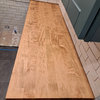
or what I've determined must be pine by all the pics and its grains. I have more than enough 3/4" and very wide boards to put down as a kitchen floor. Love the idea.

I've been looking at online pics and see pine in many different hues, from almost white/yellowish to dark brown, to reddish colors.

My questions are this:
1) to what color does pine actually age if you leave it alone?

I see tung oil recommended frequently.
2) doesn't that yellow over time? Oil being oil.
3) What would you recommend if you wanted the grain to stand out as brown(er), and a finish that penetrated like oil?

As always, thanks!

Comments (6)

  • 12 years ago

    Most SPF (Spruce/Pine/Fir) lumber ages to an orange/brown color over a couple decades. The 200+ year old Eastern White pine floors in our church are a wonderful very dark orange-tinted brown. I'm not so sure where southern yellow pine ends up-- do you know which pine you have?

    Tung oil does impart an amber tone.

    If I wanted to add color and pop the grain a little I'd use a thinned down dark shellac under a polyurethane finish. I do think the best looking pine floors are the ones that get there naturally-- that's a long term project though.

  • 12 years ago

    Are these boards tongue and groove?

    Tung oil as you see advertised is not tung oil, it is a finish formulated using a tiny bit of actual tung oil.

    the following is from the Wiki:

    "Tung oil or China wood oil is a drying oil obtained by pressing the seed from the nut of the tung tree (Vernicia fordii). As a drying oil, tung oil hardens (dries) upon exposure to air. The resulting coating is transparent and plastic-like, a property exploited in most of its applications which include wood finishing and the composition of oil paints and printing inks. Related drying oils include linseed, safflower, poppy, and soybean.[1] The oil and its use are believed to have originated in ancient China and appear in the writings of Confucius from about 400 B.C. Raw Tung oil tends to dry to a fine wrinkled finish; the US name for this is gas checking: this property is used to make crystal finishes. To stop this, the oil is heated to gas-proof it, and most oils used for coating are gas-proofed. This property was used to make wrinkle finishes, usually by adding excess cobalt drier.

    The name is often used by paint and varnish manufacturers as a generic name for any wood finishing product that contains the real tung oil and/or provides a finish that resembles that obtained with it."

    There are much better finishes for wood flooring. I used MinWax Poly for Floors on our hard maple flooring and got a color close to what you might like.

    See the linked info.

    Here is a link that might be useful: wood floor nfinishes

  • 12 years ago

    Handymac, I guess you didn't follow cefreeman's other post about what these boards might actually be. They are various widths up to 16" and she never mentioned T&G. I am from the west coast. Wide boards like that suggest pine. When I got back to North Carolina, I was shocked to find that people could use pine and fir for flooring. I had never heard of hard pine or fir. On the west coast, it is very soft. CE, I would certainly check to make sure it doesn't badly dent when gently hit with a hammer. Also, as handymac is intimating, your boards were not designed for flooring anyway.

  • 12 years ago

    Old growth eastern white pine or SYP can be as hard and wear-resistant as any hardwood. Modern stuff from the lumberyard with 1/4-in plus growth rings would be completely inappropriate unless you are going for a very rustic (eg dented) look. Pine flooring now is generally cut from reclaimed timbers or recovered sunken logs and can run $10-20/bf and up-- so not a low end product, but essential for reproduction and repair work. Widths up to 20" can still be found--our church floor probably averages 16" wide boards, with a couple that are over 2 ft.

    My bad-- I just assume "100% pure tung oil" because I try to drive the existence of all that other stuff from my consciousness. I love it, but wouldn't use it as a floor finish except as a first coat under polyurethane, then only after a very long drying phase.

  • 12 years ago

    RE: Tung Oil
    100% tung oil is a poor finish for a floor as it's in the wood, non-film forming

    Most "Tung Oil FInishes" are simply thinned varnish or oil-varnish blends. Not that either of those are bad, it's just that you are being lied to. Most don't have a drop of tung oil in them. Some do actually have a drop (or so they say).

    My choice would be Waterlox. It's a dark amber varnish made _from_ tung oil and phenolic resin. Despite the aura about tung oil, it's like saying that loaf of bread is white flour. It's not, it's a new product -- varnish (or bread). The waterlox web site has lots of information about application.

  • 12 years ago

    1) hi.
    2) they're not tongue and groove, but there's no reason I can't make it such.
    3) I won't be using anything I know will yellow. That's the whole point.
    4) I know wood changes on its own and pine can and probably will become amber or yellow, but I don't want to help it along.

    I'm looking at Gliza stuff and a BM product whose name escapes me. No decisions yet, but this is probably going to be flooring. It's too cool not to.