Software
Houzz Logo Print
sniffdog

Grounding power generator & ATS

18 years ago

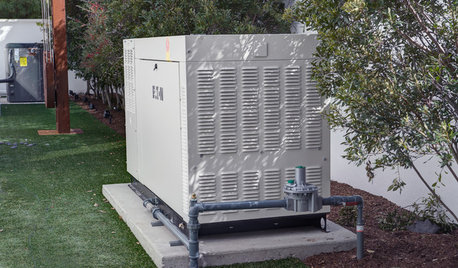
I just ordered a power generator and will be doing some of the grunt work to get things ready for the electrician. I have a few questions so I know what to ask for:

1) Is a seperate ground required (or recommended) for both the genset and the automatic transfer switch OR are these devices tied into the main house ground when the ATS is hooked into the house? If I do need a seperate ground, do I need 1 or 2 ground rods? For my application, I have a seperate sub-panel already in place with all of the circuits to be backed up, and I will have an ATS without the load center.

2) Should I have 2 conduits run (one to carry the 110V power and ATS DC control lines and the other to carry the genset power feed to the ATS) or can I put all the cables into one larger conduit?

Thanks

Comments (10)

  • 18 years ago

    1. all grounds must tie to the house main. your specific setup will determine how this is done. a ground rod at the genset is fine, as long as it too goes back to MGB.

    2. i have always prefered to have 3 conduits, 1 for power into teh genset chassis, 1 for control lines, and 1 for power back out from teh genny. makes it easier to trouble shoot later if everything is seperate and neat.

  • 18 years ago

    david

    thanks for the input. The 3 conduits make a lot of sense, and I will have those put in.

    The reason I am asking about the grounding is that the 3 main panels for the house (and the grounds for them) are on 1 side of the house and the sub-panel with the backup circuits and the location of the genset is all the way on the other side and opposite corner of the house - over 100 feet away. This was done for asthetics, noise, and the way the wind typically blows.

    I was hoping that when the power supply feed from the genset was connected to the ATS, the ground with that feed would be tied into the house ground when the ATS was connected to the subpanel. Do you know if it works this way? Is that a sufficient ground for the generator? I have a Kohler 12kW genset with a NEMA 3R ATS.

    Thanks

  • 18 years ago

    it just has to tie back to the main ground with the proper sized ground wire. it can be run inthe same conduit as the other wiring. i am no sparky, but i have had several installed.

    your electrician should be handling this part. make sure he knows what he is doing installing this genset. the county has the 30kw kohlers, and they had to get a factory rep to come in and do initial setup cause the "pros" screwed it up. if this on runs on LP, you need 2 regulators, 1 at the tank and one at the genny.

  • 18 years ago

    "if this on runs on LP, you need 2 regulators, 1 at the tank and one at the genny."

    Not always.
    It depends on what the supply line from the tank to the generator is, and exactly how it is installed.

  • 18 years ago

    On an aside, I guess LPG is the ideal fuel for backup generators, I've seen Natural Gas ones and thought it sounded nice, clean and simple (as opposed to having diesel and having to have the fuel tested periodically, and what do you do with the fuel when it's been standing too long, cost of tank etc) but if things are bad enough to require the use of a genset, then there's no certainty you'll have a gas supply.

    If it's propane, or LPG what's the procedure for ageing of the gas/replacement etc?

  • 18 years ago

    David,

    I hear you about the "electricians should know" but I have had some interesting experiences with electricians in my area - and I want to know what needs to be done so I can make sure they do it right. The Kohler manual is lacking in the section on grounding - very skimpy details.

    I did find an install procedure on line for a Kohler 17kW unit and they installed a ground rod near the generator, connected that to the unit, then ran a grounding wire through the conduit (all of this covered in the procedure), and then presumably tied the ground into the house (that was not shown in the procedure) - which is my question.

    Can the ground wire from the generator be connected to my sub-panel (which is tied into the house ground) - or should this new ground wire run all the way over to the main panels (where the house ground enters the house) which are 100 feet away?

    The Kohler generator I bought can be operated on Natural Gas or LP. It comes configured for NG and has the parts for an LP conversion which is very simple. As far as regulators go - when I had Amerigas install the gas when the house was built, I told them about my generator plans and they installed a valve at the propane tank that has the capacity to support both the house and a generator. There will be 2 lines running from my tank - one goes to the house and the second line goes to the generator. I think that the generator comes with a regulator in it (looks like a round disk) - very similer to the device at the gas service entrance into the house.

    Thanks for the info - it is very helpful.

  • 18 years ago

    "...if things are bad enough to require the use of a genset, then there's no certainty you'll have a gas supply."

    I cannot even remember the last time NG was interrupted outside of earthquake areas and large flooding.

    At least some utilities can burn their own NG to pressurize the system.

    Non-required back up generators have an entire code section covering their installation.
    Article 702 Optional Standby Systems applies. Article 700 and 701 ONLY cover legally identified or required standby systems.
    Article 445. Generators applies to both required and optional backup systems.

    Unless you find an electrician experienced with these special articles they are actually likely to make mistakes.

    The rules even change depending on if the neutral is disconnected in the transfer switch (and that is only one decision that is needed).

    Correct and safe rounding and bonding are often NOT readily apparent, and even the genset makers often provide instructions that contain errors due to the possible number of allowable methods of hooking up a permanent standby system.

    If you get a system large enough ($$) the genset manufacturer may be willing to have a field service person come and help you at least decide on a legal and correct method to hook it up.

  • 18 years ago

    It may depend on your area and what regulations are in place. I was told by the inspector last fall when I installed mine that only one single point ground is allowed. I have several ground rods (about 8Â apart) but they are all connected by one #2 (bigger then needed) bare copper wire from each of the ground rods to the transfer panel and to the incoming water and gas lines, this is one continuous wire, it was much cheaper this way then buying a cad welder.

    The transfer panel becomes the main panel and the ground bonding and grounds all go there. From there you run four wires for 220 to the panels in your home (2 phases, neutral and equipment ground). The main panel becomes a branch panel when the genset is connected through a transfer switch. You need to also remove the bonding screws from all the branch panels as well.

    If you are not comfortable get a good electrician that knows what he is doing. When lightning and power surges mistakes are expensive.

  • 18 years ago

    gil

    Thanks for the input. I have done a little more research about this based on brikeyee's input "The rules even change depending on if the neutral is disconnected" and below is a summary of what I found. Hopefully I can get some comments to confirm this is correct.

    If your generator is a separately derived system (neutral is switched) then the generator's ground is bonded to it's neutral, as well as the ATS. This mimics the way main power is fed to the house, and the way things are bonded and grounded at the main panel.

    If your generator does not switch the neutral, then the generator's ground is attached to the ATS and from there (in my case) the ground goes to the sub-panel that houses my backup circuits which of course is already tied to the main house ground. In this setup, the generator ground is an integral part of the house ground.

    I will have a two pole ATS with an unswitched neutral. So I would have to wire a separate ground wire from the generator's frame to the ATS enclosure, and from the ATS enclosure to the sub-panel ground bus (thus making the connection to the house ground). The neutrals from generator and sub-panel will connect to the neutral buss in the ATS which will NOT be bonded to the enclosure.

    If this is correct - now I know exactly what to expect the electrician to do. I don't understand why the generator companies can't put this into their manuals, but I have checked several vendor manuals and they are all very sketchy on the grounding approach. All they have is a few sentences stating that the grounding must conform to code.

  • 18 years ago

    I don't understand why the generator companies can't put this into their manuals,

    because what is code in on location may not be code literally right across the street. therefore they CYA with the generic check local codes statement.

    different locations adopt different versions of teh NEC and some modify it while others don't. you could literally be working on 2 houses side by side and one fall under an older NEC while the other is NEC 2008. this would mean 2 identical houses could require totally different electrical setups, and not just for generators but for for how the different circuits are protected/interrupted.