Software
Houzz Logo Print
raee_gw

Flooring discovery, what do you think?

Well, we started the tear-out of my old kitchen last week! Even though I am still waffling on exactly which counter top (and what to do with the walls is a far-off decision); I did choose a color for the painted maple, nearly shaker style cabinets: Behr Campfire Ash; and have an idea of the color scheme, inspired by some kitchens here and on Houzz in soft warm blue-green-gray tones.

I had purchased some engineered red oak flooring in a color called Antler, which played well with but didn't seek to match the original red oak floor in the dining/living room adjacent to the kitchen. It was to go down after they pulled up the old vinyl --at least 2 layers.

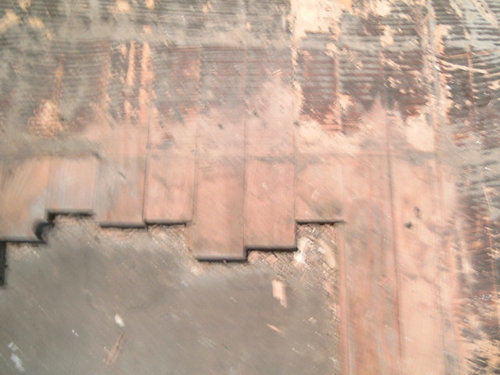
Well, guess what! the men started pulling up the layers of vinyl in the kitchen today, and instead of the 1941 linoleum that I expected (well it was there, but under that) there is solid oak 1 1/2 inch width planks. I've never seen an oak floor with such narrow boards. The men think that it can be salvaged, despite the many nail holes from the first layer of plywood/vinyl. And, it is perfectly level with the dining room floor although the joint between the two rooms is a mess and will need some work.

So, a decision must be made, and quickly. Do I have them repair and refinish this old, narrow planked floor, at some additional couple hundred of dollars, or do I stick to the original plan? I can't return the engineered wood, BTW, I bought it on clearance, final sale, but it was only $140. I would also have to decide whether to go with a natural finish, to save $$, or get it stained similarly to the 'Antler'.

Here is a pic showing the unfinished edge of the floor where the original cabinets used to be. They didn't continue the hardwood under the cabinets, but it is everywhere else in the room.

Comments (23)

  • 13 years ago

    Wow, that is a find! My DMIL's home that my daughter just refinished has floors that looked just like that. Very narrow strips. She also had significant termite damage but they were able to save the lr and dr floor. They sanded, cleaned, stained, and top coated the floors and they look smashing! You could probably sell the other flooring on CL.

  • 13 years ago

    I would try to save it.

  • 13 years ago

    Here is a pic of the doorway into the dining room: you can see that the floors don't match, but I think that is probably a nice way to define the separate rooms. The engineered wasn't going to match either, it would have been wider and a darker stain.

    I think that I am inclined to stick with the darker stain idea. Definitely leaning toward saving it (I just have to come up with the extra $$)

  • 13 years ago

    I would try to save it. I think if in good shape it is a better quality than what you can buy now.

  • 13 years ago

    I'd do what it takes to save it. Not sure about the color, I'd be inclined to match the existing floor if possible.

  • 13 years ago

    Is the sub floor underneath it in good shape? No water damage?

  • 13 years ago

    Definitely try and save it. It's probably all wood and therefore will be thicker than your engineered choice that has a thin layer on top of the composite wood. Could be really really pretty stained in a dark color!!

  • 13 years ago

    I'd try to save it too. If it is in good shape and has held up this long, it will outlast any engineered you put down. And being flush with the other floor is a bonus too. What kind of subfloor is under it? Looks like slab in your photo but that's hard to believe in a 1941 house so it may just be the photo.

  • 13 years ago

    What you see isn't a slab, but some kind of paper (now very brittle!) that is laid over the subfloor (which is diagonal wood). There are water stains on that, but I really don't see any on the oak. The damage is from nail holes (and a few gouges made while getting the layers of plywood off).

    Firsthouse, it is definitely all wood, nearly an inch thick!

    I suspect that it was never finished or saw the light of day after installation, I think that the linoleum was part of the original build. There are patches where the glue has come up with the plywood that look like brand new wood!

  • 13 years ago

    I wish that was in my kitchen! The skinnier strips were HIGH CLASS and more expensive.

    If a builder has a small amount of something left over from a job, he'd use it somewhere else. So you can find a maid's bathroom with the same marble tile as the master bath, or a posh bit of cabinetry in the scullery.

    To make the junction seam go away, look at Schluter's T-moldings. They just tap into the gap, with caulk, and cover the seam. Various metals and finishes. Use the one that blends best.

    You can also get wooden t-moldings and stain them to match

  • 13 years ago

    Lazygardens, it is an interesting thing about my home -- it is part of a neighborhood of modular or pre-fab houses built 1941-1945. So you would think that all materials would be the same from one house to the next, but you can see variations in windows and variations in the basic floor plans too, I've been told that it had to do with construction material shortages as the nation got ready then entered WW2

  • 13 years ago

    And.....after having several flooring contractors out for estimates (which ranged from ~$3.50 sf to "don't bother") and they all told me that it was oak....some said white oak, some said red oak....

    Here it is after sanding. It's pine.

  • 13 years ago

    What Holly-Kay said keep the old and sell the new.

  • 13 years ago

    Gorgeous - do keep the old!

  • 13 years ago

    Yes, I am keeping it!
    My dilemma now is what color to stain it -- I hadn't planned for pine in my color scheme! Something darker than the DR floor I am pretty sure.

  • 13 years ago

    Going both ways could even be an option and might help an imperfect transition.

    [Traditional Kitchen[(https://www.houzz.com/photos/traditional-kitchen-ideas-phbr1-bp~t_709~s_2107) by Atlanta General Contractors Intown Revival Construction

  • 13 years ago

    What a find! Love it.

  • 13 years ago

    PIne seals and stains nicely ... you could match the other floor fairly easily with almost any stain brand.

    The trick is to IGNORE the names and look at the colors ... stain some scraps of pine various colors that looked like a close match in the brochure and drop them on the floor you are trying to blend with.

    Back off and look at the boards - the one you can't easily see is the color you want.

  • 13 years ago

    That's gorgeous!! What a find!

  • 13 years ago

    I love having the original floor. Much more interest than a new one. it's going to make much more of a statement, because it's so unique. Please show it to us when you're finished :)

  • 13 years ago

    Save it. It will outlast you and original HWF are generally a good selling point. You could stain to match and then use a transition to help with the visual 'break'

    http://en.allexperts.com/q/Flooring-Carpeting-1621/2011/6/leveling-hardwood-floor.htm

  • 13 years ago

    Rosie that is a fabulous floor! Thanks! At the very least, I think that I might do that contrasting color on the transition strip between the two rooms We will see how it goes!

    Lazygardens, good advice, thank you!

    And everyone else, I appreciate the encouragement. I was at first disappointed that it was pine, not oak, but it will still look good I think.

  • 13 years ago

    I had both pine and oak in my former home. Both were beautiful. Congrats on a great discovery!