Software
Houzz Logo Print
ysrgrathe

Building large containers

11 years ago
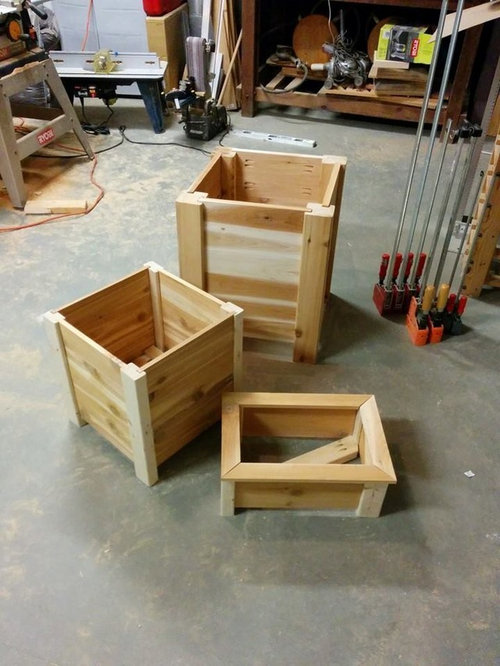
I have recently started experimenting with building large containers from cedar. The walls are 7/8" actual thickness. I had a couple of questions for the experts here:

1. If I scale these up to 2' cubes, is there enough soil mass to avoid winter kills in my zone? (6b)
2. Is it worth lining the inside with rigid foam insulation (XPS)? I'm guessing this would help with fluctuations but probably not keep it any warmer than the average air temperature.

My potting medium would be a variant of Al's gritty mix (turface/pine fines/perlite). I would be planting trees in them. I'd like to try a z5 Kanzan cherry. My backup plan would be z2 Amur Maple.

For reference, I normally overwinter plants in much smaller containers, but I always move them in the lee of my house and mulch them.

Thanks for any input!

Comments (25)

  • 11 years ago

    Great planters! I'm not sure about overwintering them, my experience is once they're off the ground, they lose some of the heat coming off the earth. So chances are they won't provide any additional protection. And it'll be hard to replace that soil when the time comes.

    I use Root Pouches inside a design similar to yours. Being able to pull the bags out makes repotting easier. I don't overwinter anything in my zone, but I have seen people use the fabric pots buried in mulch for winters.

  • 11 years ago

    Thanks! I like the two-tone stain on yours.

    There seems to be little data available on root hardiness. The rule of thumb seems to be containers are 2 zones less hardy, but there is lots of disagreement about that in the forums. I found a paper saying that trees planted in 4' square (!!) cubes in Indiana had relatively poor long-term success, so it is unclear how big containers have to be before they start approximating the ground.

  • 11 years ago

    Interesting. My sense is there's no size that replicates the ground since the earth acts like a giant wick and can pull water and nutrients deep underground. Even big 500 gallon tree containers still work by the principles of containers, unless they don't have bottoms (so are raised beds) or have some kind of wick to connect it to the earth.

    But that's just in regards to water. I believe the fabric pots have been shown to be superior in cold hardiness over regular containers for a number of reasons, the main one is that plastic and wood can freeze, directly freezing the roots, where fabric does not.

    Maybe check out the fruit subforum here, lots of people are growing trees in your zone and will probably have specific answers.

  • 11 years ago

    If you don't want to move them, I would connect them to the ground, making them raised beds. I was worried about hardiness in raised beds and it works well. Amazing so. If you keep as is, you will need to move them in the garage or something. The ground is so much warmer, it will protect your plants if connected. You know even if on concrete, it would be better than not on the ground at all. Although the concrete underneath will probably be ruined.

    I do too like the fabric bags a lot. I will never buy another conventional pot, although I do forage them in the trash (yes I'm cheap kinda guy!)

    Using insulation may help, but not to keep them warm, but to keep them cool. The freeze-thaw cycles from the sun heating the pot, cells expanding taking on water, and then night temps freeze the pot, and expanded cells killing them. If kept frozen this is not an issue.

    Other things to do would be to use anti-desiccant sprays to keep plant from dehydrating as once roots freeze it doesn't always kill them, but they cannot move water to the branches once frozen. The sprays lock in water

  • 11 years ago

    There was a discussion similar to your question on this recent thread:
    click here - maybe you read it?
    I have been thinking about similar wood containers lined with styrofoam insulation, I would imagine it will help some.
    Do you want these container to be 'good looking' thru the winter too? Otherwise, maybe some pieces of foam insulation could be cut to size & used to fill space between the soil & bottom of container? or pack it with straw or chopped up leaves (maybe better drainage than styrofoam?) - just thinking here, I don't know if that would be sufficient. And to 'improve' the looks, maybe whole could be wrapped with burlap....tie with a thick rope in 2 places to make it look better...

    Rina

  • 11 years ago

    Thanks for all the input! I did have a read through the linked thread, there is some good info there.

    I also found this resource, which provides soil temperatures that are fatal for a number of species. I'm guessing that if the container is large enough, the soil temperature will end up being roughly the average daily air temperature, so that can be used as a rough guide for what might survive.
    http://extension.umass.edu/landscape/fact-sheets/overwintering-container-grown-ornamentals

    Here is a link that might be useful: Overwintering Container-Grown Ornamentals

    This post was edited by ysrgrathe on Sun, Jan 11, 15 at 12:29

  • 11 years ago

    Nice looking containers.

    But since you are building them, my question is

    Why not go 1 step further and put in a Wick watering system in the bottoms of the pots??

  • 11 years ago

    Nice looking containers.

    But since you are building them, my question is

    Why not go 1 step further and put in a Wick watering system in the bottoms of the pots??

    {{gwi:2117568}}

  • 11 years ago

    Very impressive! I tend to use tapla's mixes though and I'm not sure they would respond well to bottom watering given the large particle size.

  • 11 years ago

    Which mix are you referring to. He says 5:1:1 But then he changes that to 5:1:2 or 6:1:1.

    What he doesn't ever say is what his starting PH is and the ending PH is after adding the Dolomite. If you want to grow Blueberries or Azaleas you can't do that in a sweet soil, but tomato's like it.

    PH is important to know for growing different types of plants.

    Besides with using wicks, you are able to bring the water moisture up into the soil column thus bypassing any PWT.

  • 11 years ago

    Insulating a container is not going to help, be cause over months of cold, freezing temperature eventually the center of the container will be the same as outside. Even in the garden bed the ground freezes and in some zones frost line can be couple feet deep. So if a given plant is hardy in that zone, in the garden, it should be hardy in a large container or in a raised bed. The problem with container is that it may go throu temperature fluctuation and that can be harmful to some plants.
    Even in northern climates garlic is hardy but they are mulched heavily, not because to protect from cold but prevent temperature fluctuations.

    Seysonn

  • 11 years ago

    Seyson

    I was thinking that insulation would lessen the cold winds, not so much keeping it warmer thruout. If plants are kept in pots and the soil is well draining, they would be OK with regular freezing of soil. Wind blowing around the container is worst - but maybe I am wrong.
    Container made of wood would be better regarding temps fluctuation than black container (plastic or otherwise).
    What do you think?

    Rina

  • 11 years ago

    Seyson, it sounds like you would agree with Drew51: insulation may have value, but it is not for keeping the soil warm but rather to moderate temperature fluctuations.

    This makes sense to me. For example, the average daily low temperature for my city is ~21F in January/February, which is above the 14F rootzone killing temperature for Z6 Acer Palmatum. However, there are frequently excursions down to single-digit and below-zero temperatures, and warm days in the 40s and even 50s. Keeping container plants alive probably means moderating these swings as much as possible.

  • 11 years ago

    Rule of thumb: For outdoor containers resting directly on the ground with some protection from wind, you can over-winter plants listed as hardy to one zone colder than where you live. For outdoor plants not on the ground, you can over-winter unprotected if listed hardy to 2 zones colder than your zone. Mulched plants buried against the north side of a heated building can usually be counted on to over-winter ok if they are hardy to one zone warmer than yours.

    You need to guard against (root) killing low temps. Ideally, roots should remain above 25*, but even daily freeze/thaw cycles are not a problem for plants unless one of the thaw cycles are warm enough and long enough in duration that it stimulates the plant to growth, which significantly reduces cold-hardiness. If that occurs, it's subsequent freezing temps that cause the issues.

    Insulating a pot won't help keep it from reaching killing lows unless there is an extraneous source of heat that can be trapped and held by its insulative value. Think of 2 Dixie cups full of water, placed in a freezer, one w/o protection and the other insulated inside of a cooler. The unprotected cup will freeze inside of an hour, while it might take 8 hours or more for the cup in the cooler to freeze, but eventually, the ice in both cups will be exactly the same temperature. So, pot insulation serves only to slow temperature change, not impact actual temps; i.e., unless there is that extraneous heat source like a building wall, the ground, a garage floor .....

    For temperate plants, soil water and water between plant cells can freeze w/o damaging cold-hardy plants, but when water INSIDE the cell freezes, it kills the cell ..... which is why it's the killing lows that largely determine viability as it relates to chill.

    Al

  • 11 years ago

    Al, with all due respect to your much greater practical knowledge in these matters, I'd like to suggest that a better physical model might be a freezer that turns the compressor on at 30 and off at 20. The average temperature will be ~25, but the minimum temperature will be 20. A large thermal mass (or a well-insulated one) will always be ~25. A uninsulated small mass will vary nearly 10 degrees. I think this is a closer analogy to the daily temperature fluctuations that occur due to weather and the sun.

    This is interesting to me because the lowest daily temperature in a typical year in my area is at least 2 zones colder than the average daily low....which might be where the "2 zones colder" rule of thumb comes from. An infinitely large sink (e.g. the ground) should track the average daily temp, whereas a small container will track more closely to the instantaneous temperature. Protected containers (in ground, mulched, etc.) should be somewhere in the middle.

    It would be very interesting to actually get a multichannel temperature logger and measure this with actual containers. Maybe next winter. ;)

  • 11 years ago

    I forgot to mention, I brought up these thoughts as a possible area of inquiry. I don't think they are of much practical value until measured empirically. In particular, without strong data on the thermal flux, it is possible the idea could be completely correct and still not tell you how many days (or hours) of sub-zone temperatures are survivable. Plants could survive for years in an insulated container and then perish during an extended cold snap.

  • 11 years ago

    For winter hardiness, if you don't want to move them, your best bet is to enclose the pot with plastic and place a light inside plugged into a thermostat that comes on at 35 degrees and off at 45.

  • 11 years ago

    If you do decide to insulate your containers, consider buying aluminum reflective insulation sheets (sold by the foot) at garden centers or hardware stores. I discovered them after having cut up enough styrofoam to fill 18 containers of an average of 16 cubic feet. It is much easier (and less messy-trust me) to install than the styrofoam, and saves alot of space for the roots. The sheet is about 1/4 inch thick and has (apparently) better isolating properties than the styrofoam.

  • 11 years ago

    I'm guessing you are referring to XPS foam. It is definitely much nicer to work with than Styrofoam (EPS) and absorbs about 10x less water, making it a much better choice for this application.

    Here is a link that might be useful: xps vs eps foam

  • 11 years ago

    No actually that's not it. I've posted a picture. It is even thinner than the XPS foam and easier to work with!

  • 11 years ago

    julie

    Do you have the name of the product you bought? (Prodex, RadiantGuard come to mind).

    Is that with bubble in between the sheets of foil or multi-foil?

    Rina

  • 11 years ago

    dp - removed

    This post was edited by rina_ on Mon, Feb 2, 15 at 20:45

  • 11 years ago

    removed...dp

    This post was edited by rina_ on Mon, Feb 2, 15 at 20:46

  • 11 years ago

    Hi Rina it looks just like Prodex. What you have to check is if it's the same product in garden centers vs hardware stores. They LOOK the same to me. But check anyways. My garden center sold it from a roll by the foot and it did not have a brand name on it (they sell it as 'aluminum bubble insulator'). I am in Montreal so even if I found the name I'm not sure you'd have the same in Ontario. I have it in a few containers and it is my garden's first winter so I can't tell you yet how it will do. My garden center was pretty convinced about it being great for containers here where there are terrible temperature fluctuations.... we'll see in the spring who survived!

  • 11 years ago

    Julie

    Thank you.
    I am sure there are some other manufacturers, I just couldn't think of the names (Resisto I think).
    I have checked them before in Lowe's, Rona. They sell them in different sizes & thickness - depends on use. It may be same, or not - in case GC sells product specifically designed for greenhouses (I think that may have some UV protection)? But for use inside of container it wouldn't matter I think.

    Rina