Software
Houzz Logo Print
joe_fristoe

Gritty mix is not for me

11 years ago

It's back to Farfard for me. Gritty just drains way too fast and my plants started to suffer quickly. May work for some, but I don't have the time to piddle with the job and projects I have. It was a neat experience, now to repot somewhere over 100 of those suckers.

Comments (41)

  • 11 years ago

    Indeed what I have said for a long time, what is good for some, may not be good for all.

    Christopher.

  • 11 years ago

    Where are you located? I bet there is several people on here who would be happy to take it off your hands! I have to make a new batch in the spring myself.

  • 11 years ago

    didn't you just repot them? maybe its less the mix and more the time of year u repotted.......idk maybe give it some time before you repot 100+ plants and stress them further? I had to repot some plants in late October BC of a rot scare and even then they looked a little bummed for a few weeks, but are now doing great. time heals all wounds/broken roots!

    if you do go ahead and repot, seconding deva! when I think of how much driving I'll have to do come spring....*shudders*

  • 11 years ago

    Joe, but succs don't need to be watered every day - even in gritty?
    How often did you have to water? Is it very hot where they are?
    Just wondering...obviously, do what suits you best.

    Rina

  • 11 years ago

    They are inside under t5 lighting, keep my thermostat on 62. I watered after noticing stress and definite need of watering, 5 days so should've been even sooner? If I need to water this many plants this often, I'm going back.

  • 11 years ago

    I thought the same thing when I first tried gritty mix. I experimented a bit and came up and a mix that worked best for me and my situation. Now, my plants are thriving. Also, when I try something new, I usually only do it with 2 or 3 plants that way if it doesn't work out, it's not that much work to repot into another mix. I hope it all works out. :)

  • 11 years ago

    meowmeow-if the mix is so great why were you having rot problems? i thought the sacred soil eliminated things like that.

    This post was edited by davids10 on Sun, Feb 1, 15 at 2:12

  • 11 years ago

    Sacred soil separated from this soiree, the proportion of ingredients that many adhere to may not be for all, and certainly isn't for me, but the idea's sound - it's just labour-intensive, and that also isn't certainly for me, a far too lazy person. Parts of the creed are true, verily, but it ain't all necessarily so.

  • 11 years ago
    <?xml version="1.0" encoding="UTF-8"?><md>davids10\-\- the plants with the issue were in heavy, peaty soil. try again! ☺

    and anyway, my point was less "gritty mix can do no wrong" and more that there are a number of other reasons a plant might not be responding well to a repot at this time of year, and that the op might as well give it a little bit more time before undoing the process with dozens of plants.....but please, continue to stay pressed if you wish
  • 11 years ago

    I really like the idea of the mix even if its a little OCD. I use granite and perlite to keep my potting soil arid. But since 95% of my plants will likely be PIG one day they need to be ready for garden soil and moisture.

  • 11 years ago

    Some things I thought about after getting some sleep.

    1. I watered without saucers the first watering
    2. When preparing for repot to gritty, the plants lost their fibrous root system
    3. I did not add Gypsum and used a diluted Foliage Pro mix last night
    (Two capful per 2 gallon, filled 1/2 with water and diluted mix for first). Watering

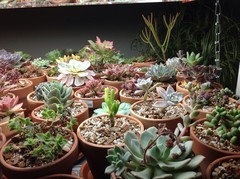
    It was a very strange experience watering. I could hear what sounded like some strange whistling and popping (almost like some 60's and 70's stoner background music) after things started to soak in from the saucers, so it may not be over just yet. I did pick up 6 bags of Fafard, as my local guy only gets it at the trade shows. The Leopard Plant and others are already showing signs of improvement, so maybe I will give it a few months and adjust watering.

    Although this is winter, how many hours of light should I be providing? Right now, it's about 13 hours. Should this be gradually reduced to 8 or less? Should I raise my lightship to reduce intensity? Not quite sure on these, so maybe that is adding to the PERCEIVED a issues.

    That gritty mix just looks so dang cool!

    This post was edited by Bama_Joe on Sun, Feb 1, 15 at 9:15

  • 11 years ago

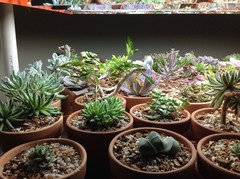
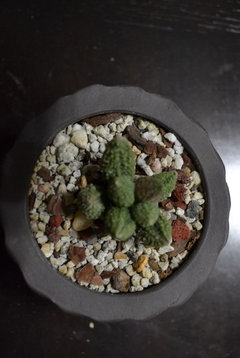
    Pic 2

  • 11 years ago

    I hear you, Joe. I use my plants to defrag my brain and I ditch those that turn out to be more chore than meandering distraction.

    However, it is exactly this mix that has allowed me to treat plants this way. Except for my mesembs and my Aeonium gladulosum, all my other succulents have been in the 1:1:1 mix for a couple of years now and I water whenever (every 2 to 3 weeks if they are lucky). It certainly has been conducive to my combined minimalist "care", characterized by laziness, forgetfulness and random bursts of OCD in the winter when they get audited. Oh and two rambunctious catzillas.

    Pagan

  • 11 years ago

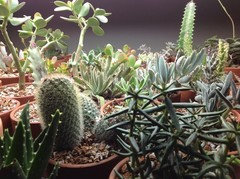
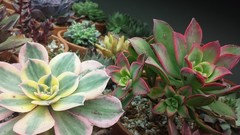
    Pic 3

  • 11 years ago

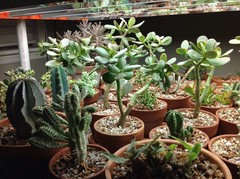
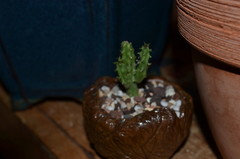
    Pic 4

  • 11 years ago

    Just read the comment about root rot. If you have root rot with a mix like this, I can't see how it is the fault of the mix.

  • 11 years ago

    Joe,
    Hard to see any 'problems' with your plants in the photos, they all look very good.
    As far as light, I would not reduce it unless they get lots of natural light. I don't know if there is a 'rule', but min. of 12hrs has been recommended very often. I have lots of plants in basement (not only succs), and they get about 16hrs. There is hardly any natural light there, and never over 60F - that's just the way it is.

    I water approx. 1x/10 days or longer (not set in stone!). In winter, many succs are dormant anyway. I have to restrain myself from watering too much/too often - so for me, gritty is great (and most of my gritty is without bark). Definitely very little fertilizer - I often forget.

    After repotting, there is often sign of stress if roots are damaged. And really, it is not prime time for repotting. But I do it at any time if I think it's necessary. I recently potted so many cuttings (mostly jades), they are really starting to look good in the mix after about 10 days or so, putting on new leaves and even coloring up (especially tricolor jade) - they were left to callus for very long time.

    I found that less I fuss, better they look.

    Rina

  • 11 years ago

    "2. When preparing for repot to gritty, the plants lost their fibrous root system"

    There's your problem right there. It pays to be very careful when barerooting, but they should recover.

  • 11 years ago

    "I really like the idea of the mix even if its a little OCD. I use granite and perlite to keep my potting soil arid. But since 95% of my plants will likely be PIG one day they need to be ready for garden soil and moisture."

    You should check out the work going on at University of Missouri with gravel beds. They use gravel and calcined clay to hold bareroot trees for planting. This allows them to take a bareroot tree in spring and then hold it for planting at any time of year. The aggregate mix (which is similar to gritty) creates a very strong fibrous root ball that is in excellent shape for planting out and dealing with the streses of late season planting. The root balls are definitely better than the one you get from typical container culture.

    Here is a link that might be useful: Missouri gravel beds

  • 11 years ago

    The first thing that jumps out at me when someone says the gritty mix doesn't hold enough water is - they didn't get the most important part - the concept that's behind the medium. Basically, it's a medium that holds almost all of its water inside of soil particles, on the surface of soil particles, and at the interface where soil particles touch each other, but not in the air spaces between soil particles. I know the concept isn't fully understood, because if you really DO need extra water retention (but you probably don't for succulents/ cacti) all you need to do is increase the volume of Turface or calcined DE and decrease the volume of grit in proportion. Or, you can just add more screened Turface and call it a day.

    The reason the soil is an effort to make is, you have to screen the ingredients or otherwise ensure the ingredients are size appropriate in order to get everything the soil CAN offer. If you don't screen, or add some peat/ coir/ other fine material for 'extra water retention, you might as well just buy someone's cactus mix off the shelf, add a little perlite to reduce water retention, and call it a day. The problem with that is, you don't get the drainage or aeration you get in a medium that's designed to optimize aeration and drainage, and you still have a soggy layer of soil at the bottom of the pot that can't optimize root function or root health, which are prerequisites to a healthy plant.

    The gritty mix isn't for everyone. Some of us have real life priorities that come well before our plants, and some growers simply think it's too much effort. That's fine - who should presume to judge someone else's prioritization? Still, that doesn't change the fact that there are significant differences in the amount of limitation on vitality soil choice can impose. Ideally, growers would at least have their plants in a soil that allows them to water at will to beyond saturation w/o having to be concerned their soil will remain soggy so long it impairs root function or root health.

    Soggy soils kill the finest roots very quickly - within hours. The plant then has to expend energy it would have put toward growth, reproductive structures, defense, or keeping its systems orderly, to regenerate the lost rootage when the soil regains enough air (oxygen) to fuel that process. If the cyclic death and regeneration of roots doesn't manifest itself in the plant's appearance, it certainly does in lost potential, and lost potential in plants is something that can never be regained.

    Al

  • 11 years ago

    I think last night I was tired and just not thinking clearly. The fibrous roots that were not able to be saved were mostly due to a mix some of the specimenss were in and it's nigh impossible to save fibrous toots wrapped around d a long slender piece of wood, etc. Same principle for establishing a newly planted tree, shrub, etc...carefully watch at first and you will know when the plant is established.

    As far as water retention, I realize the mix retains water, especially one of the ingredients (turface). If I do not have an established root system then I cannot expect the gritty mix to do its job. I'm going to keep this up for a few months and see how things go and expect they will go well.

    r
    Regarding the gypsum, I have some at home for my lawn (I live in Alabama...need I say more?) And purposely didn't include it in anticipation of receiving the fertilizer.

    Al - I have a bone to pick with you specifically. Why didn't this miracle "gritty mix" instantly generate the fibrous roots, or get rid of that root rot, cure cancer, bring world peace? I'm deeply disappointed in you and your claims of it ESPN CALLS the claim of it giving my car better gas mileage.

    /endsarcasm

    Thanks for the mix Al and looking forward to seeing how she performs once my plants recover from transplant!

    Joe

  • 11 years ago

    Joe - you laid me bare with your scathing wit, cut me to the quick and left me agape, with no answer's for the soil's failures.

    ..... but if you unload it from your trunk, you might notice improved fuel economy. There's something?

    Thanks for your good nature. I'm hoping you fare well.

    Al

  • 11 years ago

    Joe,
    Maybe I'm mistaken, but didn't you recently repot into the gritty mix? Especially in winter, it's going to take time for the plants to adjust.

  • 11 years ago

    Yes sir, which is why I retracted my assessment in my own sort of way.

    It doesn't perform miracles and will have to give it time. I jumped the gun WAY too earmy and hope folks read this thread and realize, it takes time.

  • 11 years ago

    Joe,
    after a re-pot, it is important to keep the upper layer of the mix more uniformly moist *so that* the fine roots don't dry out during the transition. Once the roots colonize the mix, the roots and the mix retain more moisture and one can go longer between waterings.

    Also, is that bark screened to 1/4 inch? Some of it looks just a little bit large, and that will surely cause drainage that is inconveniently fast.

    Josh

  • 11 years ago

    Nil13, thanks for the info seems interesting. I am constantly improving my soil for what works best for me based on whats available. At this point I would say I use about 50% gritty in pots and 75% PIG.

  • 11 years ago

    Compliments to your persistant efforts in the area of suxs, as you said it takes time On the brighter side (and while your waiting with a smaller pun) it helps to add a bit of water, at least every now and then.

    I cant say that your the first person who had mentioned daily watering via use of grits for suxs growing in a pot thus this is the second time I chuckle with this thought.
    Either you're doing something right, or your doing something wrong...
    .

  • 11 years ago

    Don't believe I mentioned daily, did i? Definitely not watering daily. That is a recipe for disaster with any mix.

  • 11 years ago

    No you didn't mention daily watering but you did mention grits are to fast in the drying area for you.

    My error is reading what isn't said, even though daily watering in potted suxs with grits as a media grits has been mentioned .

    You also didn't mention adding more of one thing or the resizing of anouther. I guess it's safe to assume you'll not follow the repot them all agian and even after that again suggestion(s) ?

    Regardless of how it's said right for you is ( more often than not) also be right for the plant as well


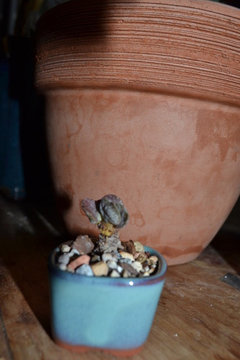
    Check this one out, growing with no turface and no bark watering isn't every day but it could be be watered that often at times avg is watering every three to five weeks and can even survive longer with out a drink. Ironicly it's already been micro'd

  • 11 years ago

    Hah! What the heck is that? Do wish I could find shallow, square clay pots that size.

  • 11 years ago

    Do a search for "bonsai pots".

    Al

  • 11 years ago

    For what's worth, I replanted 60% of my succulents into the 1:1:1 gritty mix last spring and am only now seeing positive results with them. Granted, I am in hot/humid central florida, so quite a few if not most of them have been dormant until our winter time when max temps and humidity levels come down to more moderate levels. I'm currently watering approx once per week in my gritty mix under LED/natural light growing conditions and about twice per week for my jades in full sun winter sun exposure. All my gritty mix plants are in clay pots as well.

  • 11 years ago

    I don't use it either.I have neither the time nor the patience to fool around mixing soils.I just buy off the shelf,add some perlite,no measuring etc,and plant away.I grow a lot of things other than sux and cacti,and i grow outside all year round,and as you've all seen from my pictures on here i have no problems.

    I like mother natures way of doing things!!! just sayin"

    By the way i posted a few pictures a few minutes ago.
    Kathi

  • 11 years ago

    Being able to grow outdoors mitigates many of the issues associated with heavy potting mixes.

    Josh

  • 11 years ago

    ..... unless you're in an area where it rains a lot. Then it's roughly the botanical equivalent of water-boarding.

    Al

  • 11 years ago

    Having been waterboarded (in SERE school), that's a very rough equivalency.

  • 11 years ago

    Weighing them is one way and a good way to time check them to dryness. I often soak a pot full of just a mix or a soil and set it to the side under summmer sunlight after soaking checking on it ( depends on the pot size) every other day or so untill it's very dry.
    RE: your indoor lighting question

    Lighiting times vary for one type of plant to anouther anouther in general 12 hours is a good refferance point even though the the sun doesn't keep every spot on the world bright for 12 hours every day. A second general guide is a dormant plants needs less time in the brightness as the active growing plant would bennifit with more brightness.

    An example is in the pic I left Explaning in some goo roo nic pic details: for the past few weeks : it's been under four T-5 bulbs incresing time to 13.25 hours this week. I will increase the brightness time in incormints for the next next few weeks while it's INSIDE.

    After transitioning to OUTSIDE the most it would get is 18 hrs of brightness with an avg of 6 hours of much warmer and brighter sun in the AM and again a little coooler four hours in the evening sun, the least it would need is 10 at this point and outsie under all day sun or brightss I bring it in when there is 9.5 hours of daylight including sunset to total darkness Lowest I dare to kept it at outside is 40F but would need to be warmer later that next day
    Intro stage left of this not very picky easy growing sux top view only is nothing more than one of my a bullet proff Adromichus that only needs a little less heat during my hellish summers hottest days.


  • 11 years ago

    Quite the improvement started two days ago.

  • 11 years ago

    Lighting example #2: While keepiing in mind that not all plants need the same lighting every day.

    I promise to keep it a little less boring in the nic pic goo roo discription It's is ( inside) natural lighting from the south by Seast winow featuring not every day but on colder days of snowy and frosted windows sitting apx 2 feet away from the sills and is only enhanced by 120 volt 13 watt = 60 watt energy effecent CFL bulbs ( X8 daylight color untill 8:30 PM It'll get more brightness later when windows no longer frost it'll also speed time outside over summer but isn't as bullet proff as the adro seen.
    No doubt( Even though I proberly wont get them) I could use some better indoor cultivating tips from someone who isn't on this thread. Slight chance but maybe they will comment later or maybe they let me continue marching to my own drum beat too. If not then I'll wait untill I get face to face tips from a that other local friend..

    Entering stage left with some pots in the back ground view in all it's winter glory at my house. Huneria procumbus

  • 11 years ago

    to water or not to water and the second turface concept ( The first concept that comes to my mind.)
    Cooler soils hold moisture longer and allows the remaining available amount of moisture to move more slowly.
    Why add more water on occasions is because over time any and all absorbed moisture has to leave.

    Cooler soils hold moisture longer and allows the available amount of moisture to move more slowly.
    Why add more water on occasions ? Over time any and all free and absorbed moisture has to leave as it will Water will as it has to what ever water doesn't need to be water behind in or and or on a pot or any surface

    The question I ask is, A) do you spend more time adding more turface to a warmer pot thats already filled that often allows more moiture to work ( or damage) faster or. B) Spend less time moving the pot to a cooler spot while saving time of soil modifications keep in mind as some amount of moisture that's may already be in a pot can work slower and spend more time doing it's work which often results in less damage ?

    True turface will absorb and hold it's allowabler amount of moistureer but turface doesn't absorb nor does it refelects heat in warmer spots.

    Sad but true regardless of how much or how litte turface you use any amount of water must obey the laws of nature.
    Anyhoo thanks for baring with Captain Obvious ( MUAH)

Sponsored
CHC & Family Developments
Average rating: 5 out of 5 stars6 Reviews
Industry Leading General Contractors in Franklin County, Ohio