Software
Houzz Logo Print
munnybunni

need help quick on buying a range

11 years ago

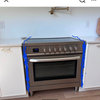
i have a small kitchen...looking for a range, and I saw the Samsung flex oven range electric...like the looks of the slide in...

cost of free standing is less, but I think I could squeeze some blood out of the turnip to get the slide in if I could.

has anyone bought a freestanding and had second thoughts about not buying the slide in....or vicea-versa

Comments (4)

  • 11 years ago

    I've always wondered what the difference between a free standing vs. slide in really is. I know that aesthetically a slide in looks better, with more view of the backsplash, etc., but is there really a functional difference?

  • 11 years ago
    last modified: 11 years ago

    The functional differences are non-issues for most people, so the decision is usually made based on look and budget. It's not really a decision we can help you with on the forum, you'll have to decide for yourself whether you like the slide in look better enough to spend the extra dough.

    Functional differences:

    The ovens on slide ins tend to be a little smaller than freestanding.

    Slide ins have all controls up front which is safer than the rear controls most freestanding ranges have.

    Slide in ranges have lips on both sides that go over the countertops, whereas freestanding ranges have small cracks that crumbs can slip through.

    Aesthetic differences:

    Most slide ins have unfinished sides, though that is changing.

    Most slide ins are less than the full cabinet depth (that is also changing). This means you can put a strip of countertop behind them for a more built in look.

  • 11 years ago
    last modified: 11 years ago

    Most slide-ins are just as deep as freestanding ranges, so full counter depth like freestanding ranges. That is certainly the case with the Samsung slide-in ranges you looked at. ("Drop-in" ranges can be a whole different story, though, and folks sometimes get that style mixed up with slide-ins. Doesn't sound like that's a problem for you, though.)

    There are a few Euro-styled ranges which are are shallower than usual. Also, some folks install extra deep cabinets and counters. One has to be careful about that when positioning a stove. You want the face of the range -- the part that the oven door closes against --- to be a little proud of the cabinets. Otherwise, There is enough heat that can escape to the sides from the space between the oven door and the frame that there is a risk of scorch marks on cabinet fronts when a stove is set too far back. (Some years ago, we had a thread on this started, IIRC, by someone who had installed a Blue Star range into a cutout in extra-deep cabinets.)

    Some brands and models of slide-ins need the countertop back-trim that hvtech mentioned and some do not. It depends on whether the back of the range has a bump-out for the oven(s). For example, the GE slide-in induction ranges -- currently, the PHB920 and, formerly, the PHB925 -- have flat backs to allow them to be pushed directly against a back wall, just like a freestanding range. (Ovens are the same size as in the freestanding versions, btw.) Those do not require the back-trim piece. Other ranges, such as Electrolux slide-ins, have bump-outs at the back to accomodate oven depth. When those stoves are pushed against a rear wall, the cooking surface will be three or four inches out from the wall and a trim piece will be required to fill that gap. To know for sure on other models, you pretty much have to look at the stoves and/or download pdfs of the installation instructions

    When installing a slide-in range into a kitchen island, you just have the countertop cut-out adjusted accordingly. However, pretty much all slide-in models in an island will need an optional additional trim piece to provide the lip to cover the gap between the back of the range the island countertop.

    As Hvtech says, another difference between slide-ins and freestanding ranges is that the cooktop of a slide-in projects a lip out on either side to overhang the gap between the stove and countertop. Think of the projection as being like the brim of an upside-down hat. The body of the stove will be a standard nominal 30" width (which is actually 29 7/8" on almost every model) and will fit into any standard 30" countertop cut-out (which should be 30 1/8" wide). The overhanging side brim/lips of the cooktop will be about 31 and 1/4" wide or thereabouts, so the overhang will be about 3/4" to either side. Some standard height counters may be a bit too low for the overhang and leave a gap. (Or, more precisely, a gap with a roof.)

    Numbers of folks have discovered that the stove height cannot be adjusted down far enough for the overhang to look like it was sitting on the countertops in their kitchen. (You don't want the lip actually sitting on the countertop and bearing the weight of the stove, you just want it to look like it could be doing that.) Sometimes, it may be necessary to fabricate some trim/filler strips to correct this problem. I recall a discussion of this issue, with illustrating photos of solutions, in the long thread on the first GE induction slide-in, the PHB925. Here is a link:

    http://ths.gardenweb.com/discussions/2321834/ge-profile-slide-in-induction-range-phs925stss

    (Now that I've given that link, I don't know if Houzz brought over the photos when it took over this forum.)

    GE's Cafe series of ranges are kind of in-between freestanding and slide-ins. GE calls them freestanding ranges because their cooktops do not overhang the sides. Some people still regard them as slide-in because the Cafe ranges have a slide-in style oven-vent at the rear (so no backsplash/vent/riser like most freestanding ranges.)

    For the Cafe models and some slide-ins, you can get a thin vent-riser for the back -- akin to what is seen on pro-style ranges -- to diminish the risk of stuff rolling off the cooktop into the oven vents. (We've had a couple of threads about that problem over the years.)

    Some slide-ins come with side panels, including those from GE and Samsung. Most sides are painted black, as also seems to be the case with many freestanding ranges these days. (Some, such as the current GE induction ranges, come with metallic gray sides, rather like what you see on some stainless-clad refrigerators.) For the brands of slide-in ranges that come with unfinished sides, all manufacturers offer optional additional side-panels so you can put the range out in the open or at the end of a cabinet run with an exposed side. Prices for optional panels range from modest to expensive depending on the brand and model of the range.

    Some differences between the Samsung slide-in models and other brands: the Samsungs have a slightly larger cooktop space because there is no oven vent across the back. The cooktop also extends over top of the front control panel. Many other slide-in brands have an angled control panel in front and and an oven vent trim across the back of the range. Those result in a little less room on the cooktop than on freestanding models.

    However, do be aware that the Samsung slide-ins' oven vents at the front of the stove at the lower left side of the oven control panel. Another thing to check on the radiant electric version is whether the burner dials are continuously adjustable or if, instead, there are only ten heat settings. The induction version, being all digital, has only ten discrete steps with no setting in between. Some of us think are too few adjustments for our cooking. The Samsung radiant models use the same knobs as the induction versions (with ten marked positions) but probably --- note the qualifying "probably" -- are continuously adjustable as on most radiant electric stoves. One might think it is crazy to have only ten burner heat settings but I'm old enough to remember electric stoves and cooktops back in the previous century that had ten push-buttons for the heat settings for their burners.

  • 11 years ago
    last modified: 11 years ago

    I should clarify - I was giving the "traditional" industry definition of a slide in. In the past couple of years more manufacturers have been introducing full depth slide ins.

    The new Whirlpool full depth slide ins (including KitchenAid/JennAir) also have finished black sides. That seems to be another trend in slide ins.

    JWVideo are the Samsung slide ins full depth?