Software
Houzz Logo Print
kathrynecheng

Should we replace engineered hardwood floor in our kitchen, and if so,

11 years ago
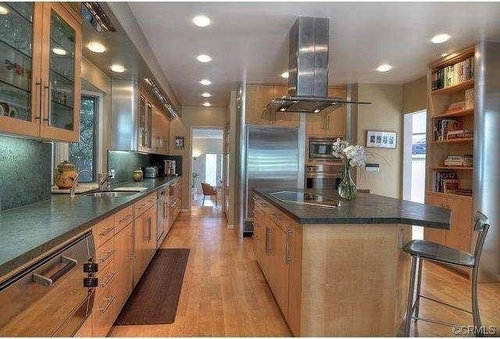
We are confronting the second of two very expensive repairs to our "engineered" hardwood floor in the kitchen, due to water damage. The first episode was due to a leak while we were on vacation. The second--a minor water spill--again resulted in warping and lifting of the floor. I have HAD it with engineered hardwood, and am considering replacing the whole dang thing. The counters are green Fench limestone the cabinets some kind of wood(ish) material. There are a lot of slate floors on the lower and third level would slate work here, do you think? Or, if I replace the engineered material with actual hardwood, are there issues to consider, other than the hideous cost? Thanks for any insight you can offer, fellow Houzzer's!

Comments (39)

  • 11 years ago

    There's no controlling water. I'd consider tile that looks like wood. So many colors and patterns. I love mine!

  • 11 years ago

    Tile that looks like wood? suggest brands? where do I find these?


  • 11 years ago
    Thanks for sharing that idea, Barbara. I never heard of wood-looking tile. I just Googled it--not sure how I'd like it for this situation, but I will definitely check it out!

    Our handyman said replacing the current floor with real hardwood might raise the floor height, causing problems. Aargh.
  • 11 years ago

    yes, or laminate that looks like wood...

  • 11 years ago
    Is laminate different than engineered hardwood, Nicole, do you know? Is it more durable than engineered hardwood in terms of resisting water damage?
  • 11 years ago

    Oh, yes it is. I was told to use an engineered hardwood in wet areas instead of hardwood. I have already done most of my wet areas with ceramic & porcelain tile. But a have a huge stack of engineered wood to be installed yet in my living room, hallway & bedrooms. Have it installed already in one bedroom. Would only use a tile in a kitchen or bathroom. They do have a new wood look alike tile. It has a texture & has a very small grout line when installed.

  • 11 years ago

    Look it up on Build Direct, porcelain tile It is one foot by 2 foot.

  • 11 years ago
    Thanks so much for your comment, HomeReborn. That's what I'm afraid of--that we may have to replace all of the flooring on the second level, if we replace the kitchen floor with something entirely new. I guess my real worry is that I wonder what it will look like to have one look (engineered hardwood) throughout the second floor, plus two levels of stairs, and use a different material in the kitchen.
  • PRO
    11 years ago

    A house always has better visual flow (which also enhances the sense of spaciousness) if there is a single type of flooring throughout each floor, thereby avoiding flooring transitions between rooms. That's why so many people now put wood floors in kitchens (especially in open-concept kitchens).

    But practicality often overrides aesthetic considerations with many of my clients, who insist on tile in their kitchens - and I can't disagree. If you've "had it" with engineered wood in your kitchen, bite the bullet and install tile instead.

  • PRO
    11 years ago
    last modified: 11 years ago

    Hello Kathryn.

    Pray that Home Reborn is incorrect about the floors going underneath your cabinetry. To check for this situation you can pull out your fridge. There is usually no molding concealing the situation. Look to see if the flooring is cut where the cabinets sit to the subfloor (black paper, plywood or concrete) or if the cabinets are on top of the flooring.

    We do not recommend laminate for kitchens with the real risk of water intrusion. Wood floors too are susceptible to the finish getting damaged.

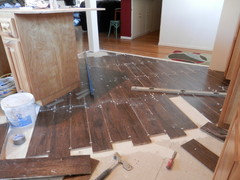
    Yes you can use slate. Yes it will slightly raise the floor. Yes it can be sealed and it will not be a problem. You can purchase honed material that is machined on bottom to have thinner material. It can also be honed on top to be flat as ceramic would be.

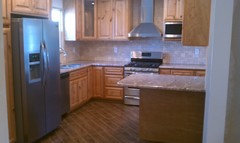
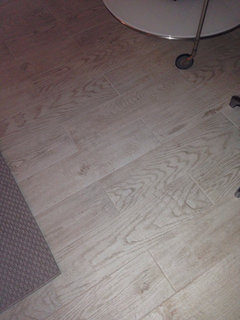
    Tiles that look like wood...

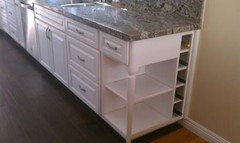
    When you add a tile you will have to accommodate a difference in heights from materials. Transition strips can be made of wood, slate, or any material. This picture has an oak transition strip stained dark to match the ceramic so you cannot distinguish it.

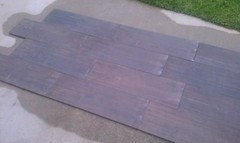
    Here is a picture of the tile prior to installation so you can see it better. These tiles often will not be flat 100%. Something with the manufacturing. You will see that the tiles are only overlapped about 25%. This is because the slight, and I mean slight, hump in the center of the tile would meet the lowest dip at the grout line and be most prominent.

    Best wishes to you.

    ps: Your kitchen is very nice

  • 11 years ago
    Wow, thank you, Construction Guaranteed! Very good information. Sigh. I have meetings set up to discuss the options with a local contractor and an interior designer. Hopefully they'll help me find a path to the "least bad" option!
  • 11 years ago
    Btw, a pox upon whomever invented "engineered hardwood," lol!
  • 11 years ago
    I have porcelain tile that looks like wood throughout my Florida condo. No worries about wet bathing suits left on floor, plus easy to clean.
  • 11 years ago
    That must be a great solution in Florida, jmvman, especially if you have swimmers or dogs who love the water!
  • 11 years ago
    I've always been curious why a wood or engineered wood or laminate floor cannot be sealed to avoid water damage. Boats are made of wood after all.
  • 11 years ago
    Excellent question, Mamadubbs. I suspect "the Market" hasn't gotten as irritated with its durability issues as I have, lol.
  • PRO
    11 years ago
    last modified: 11 years ago

    Any click floor is a poor choice in kitchen. If you are using hardwood in the kitchen it should be sanded and finished on site.

    Watch out for crappy fridges. My Kitchen Aid fridge was so bad it leaked and flooded our floors over and over. Finally yearrs later I got he right parts and had the fridge fix right.

    Anyone with hardwood in their kitchen should be asking them selves. "Do I have a Duck Bill Fitting in my fridge for the defrost cycle?"

    If you do not know - call the maker. If they say yes. Ask them if it is a recalled part. You might be as surprised as me to find your leaking fridge is the result of a faulty $3.00 part. The fix is a new design and a $22.00 part.

    My Kitchen Aid fridge leaked so much I almost installed a linear drain in front of it! I kid you not.

    My second set of advice with fridges is avoid at all cost self peircing water line connectors.

  • 11 years ago

    Laminate floors that i have since 2006, warp and curl as soon as anything is spilled on them..they don't shine or clean up well, look like paper...I'd rather have plywood floors! As soon as I can afford to, I will install engineered wood floor with a 3-4 mm wood layer...and as the person said earlier...a load of water on any type of wood will prob ruin it...if this a recurring issue u should use a tile...

  • 11 years ago
    Annetterose, right now I'm so leery of water hitting the floor that I hover over the dog whenever he's on it, ready to pounce on any doggie drool!
  • 11 years ago

    Wow; something to consider. You never know when there's going to be an unexpected leak. Tile is probably best for a kitchen after all.

  • PRO
    11 years ago

    @John Whipple - you are completely right about the "duck bill fitting" although we did not know the name we are familiar with the part. It gets gummy and clogged which causes the leak. Fortunately we found out because the freezer floor kept having ice on the bottom, not because of an external leak.

    Your Terry Love thread regarding the Duck Bill Fitting is spot on.

    Agree that wood floors can be problematic if a fridge/water fitting fails.

  • 11 years ago
    I have engineered wood floors in every room in my house except the bathrooms and kitchen. They are beautiful and were a lot less expensive than the real hardwood I had in another house. These look good and I follow manufacturer's cleaning guidelines. Don't be afraid to install this type of wood.
  • 11 years ago
    You wouldn't be any happier if you had solid wood flooring that got water damage, so the reality is that neither is the best choice for the kitchen when it comes to leaks and major spills. Having said that, the engineered wood floor that we have had in our kitchen for 5 years has been issue free and still looks like new. Fortunately we've had no leaks or major spills to contend with.
  • PRO
    11 years ago

    I'll keep this short but sweet. The answer is YES, replace that engineered wood flooring and go with the tile; you won't be dissipated.

  • 11 years ago

    I've been looking around, and decided I like limestone. Of course, it also can't handle water! Que sera!

  • PRO
    11 years ago

    Typo sorry, disappointed not dissipated

  • 11 years ago
    I'm not sure what your concern is for limestone. My inlaws have had a limestone floor for years in their kitchen, and I can assure you they have spilled many things on it...including water without any issues at all.
  • 11 years ago
    Thanks Kivi! I was just reading about maintenance and upkeep of various types of flooring materials, and read that limestone has moisture issues, among other things. But I'm no expert!
  • PRO
    11 years ago
    last modified: 11 years ago

    @Kathryn Cheng...

    1st of all... it always pains me to hear of people having trouble with hardwood flooring.

    Having been in the business for too long to mention without depressing BOTH of us...

    Let me just say that most often, the problems aren't with the choice TO have engineered hardwood... but the choices IN engineered hardwood flooring!

    Regardless of what the marketing strategies suggest... they are NOT all created equally!

    In response to some of the other comments... there is no "porcelain" or tile product that can replicate the appearance & feel of wood. They are all "pictures" of wood that have been superimposed on tile. They don't offer the level of resilience as wood flooring, so the result is a surface which is less forgiving on ones legs, back, and anything breakable, which would have had a 50/50 chance of surviving over wood... lol

    Regarding laminates... as with tiles, another product with a "picture" of wood on plastic, which has been affixed to a medium or high density fiberboard. This is the weak link in laminates when it comes to daily use & maintenance because the fiberboard substrate is like a dry sponge if water is introduced through spilling or mopping. The plastic surface may be waterproof... but the joint between the individual components is the Achilles heel.

    Ultimately, the end results are tough to predict in the event of a major incident such as flooding, although we've produced engineered flooring which has been in place for, in some cases, 20 years without incident, which is about how long we've been working with it.

    As a matter of fact, on a couple of occasions over the years, I've actually witnessed flooring we had produced which was literally covered in water due to a plumbing leaks, which even I thought would be totally lost... but in both cases, the water was vacuumed up within a reasonable amount of time, and the floor remained intact... (even I was shocked).

    Of course, our floors had been produced in a fashion which allows an additional coat of finish to be applied AFTER installation... which is a benefit not shared by most of the mass production choices on the market which focus on offering LOW pricing as opposed to HIGH quality.

    At any rate... as they say: "don't throw the baby out with the bathwater".

    Or as my kids would say: "hate the player, not the game"... haha

    Good luck!

  • 11 years ago
    @Select, good to know there are more durable versions out there. I don't even know what kind we have--it was installed by the previous owner. Our wood veneer cabinets in one of the upstairs bathrooms are also falling apart due to water issues. I'm sure cost was a factor in whatever they selected. Now we're paying someone to glue the cabinets back together. But that's another issue, another room! I do remember in our previous home having to hold my ground in a discussion about what type of wood to use for some built-in cabinetry we installed in the den. I insisted on using solid maple, and wow, it was expensive! I'm glad for the people who bought the house that we did that though, lol.

    In the kitchen, I think I'm an unusually hazardous and somewhat oblivious cook. I didn't ever cook until we moved into this house, and I'm always spilling water and sloshing around. Doesn't help the floor situation. ;)
  • PRO
    11 years ago

    @Kathryn Cheng...

    I feel your pain... I'm a self proclaimed "cook" myself, and have been known to be less than "neat" while I'm at it! (haha)

    Sounds like you're dealing with the results & paying the price of what happens when someone lets low prices dictate their purchasing decisions. I'm no different in some respects, although I've learned the lesson that good "value" isn't always walking hand in hand with the lowest price.

    Rest assured, there are products out there that will take a lickin' & keep performing well.

    The species, finish STYLE, & finish TYPE are the keys to making a successful choice in hardwood flooring. I won't bore you with the details of what we offer... that wouldn't be fair (because I'm biased... haha).

    Good luck.

  • 11 years ago

    Select Hardwood Floor Co. Would you mind sharing the brands and woods you think would be most durable for a kitchen? I am depressed after reading so many of these comments, as I am choosing to go with engineered hardwood for our kitchen remodel. We will have heavy traffic in our kitchen, will spill things and drop things, and I want to make sure I am making the right choice. I ruled out tile although I love it and it would be my first choice because breakables break very easily on it, it is hard on the feet and back, and it's cold in winter! I don't want marmoleum: just not the look or patterns I want, and I almost would use vinyl tiles that can be grouted since they can look like tile, but I don't like the off gas factor and sometimes vinyl can have that "sticky" feel which I don't like.

    Anyway, I was relieved to read your post and am in the process of choosing maybe oak or maple but what I don't know is which brand is best, what's the best thickness of veneer, and which has the best finish and least toxic!


    Hope you read this and can help. Thank you so much.

  • PRO
    11 years ago

    Hi @emmalemma,

    To answer your question about which brand is best... well that's a tough one, because I think ours is... (of course).

    Having read your comment, I think I'd lean in the direction of a nice White Oak, because it offers so many options in terms of color choices, and is also extremely durable when finished properly.

    I can't suggest any of the other products on the market, because I deal with what we produce... but I'll suggest that you consider an engineered floor with a heavy top/face layer.

    Ours, for example, is 5mm thick.

    Look for a sliced face top layer as opposed to a rotary sliced veneer.

    Finish style is important, and I'd suggest either a very lightly hand-scraped (subtle) or wire-brushed finish... both can be very forgiving as well as easy to maintain in high traffic areas.

    As far as TOXICITY... I can't speak for anyone else's products, but OUR engineered flooring is constructed using Formaldehyde free adhesive produced here in the USA, as is our flooring. This has finally become the much needed topic of conversation thanks to our illustrious friends with the big yellow signs, and their blatant disregard (IMHO) of consumer safety in exchange for market share. Unfortunately, although they (L.L.) get the spotlight... the import market as a whole, should be considered questionable until proven otherwise.

    If you have any other questions, please feel free to drop me a line at: david@selecthardwoodfloor.com

    I'll do my best to answer them honestly, as long as you promise to use OUR flooring... (lol- just kidding).

  • 11 years ago

    Thank you SO much. This really helps "Select Hardwood Floor"; am I addressing you correctly? First, what *is* your flooring? I am in Portland, OR so I don't know what your brand is or if it's here. I would love to know :)

    I am in agreement with your opinions and I really appreciate your feedback. I am beyond frustrated with picking all of this stuff out, and this will help me narrow down the choices, esp. knowing about the finishes and health aspects! Thanks for your email, I will keep it handy! I am off again today to check things out.

    Best

  • PRO
    11 years ago
    last modified: 11 years ago

    Hi Emmalemma...

    We produce our flooring on a "per order" basis... so it's not readily available through the general "retail store" channels.

    However, we have Clients we produce flooring for all over the country, to their specifications. Specie, color, style, etc..

    And Portland is just a stone's throw away due north of us.

    Just a small portion of what we do can be viewed on our Houzz profile page by "clicking" on our button in the top left corner.

    If that's something of interest, please feel free to drop me a line at: david@selecthardwoodfloor.com

    Just give me some specifics about what you're looking for, and perhaps we can be of service. Hope that helps.

  • 11 years ago

    Do you have your product at CFM?

  • PRO
    11 years ago

    I'd have to assume the answer is probably: No... since I'm not sure what CFM is.

  • 4 years ago

    @selecthardwoosfloorco I got some quotes to refinish my engineered flooring, but when it came down to it, the veneer layer was too thin to sand down. So, I’m understanding that I can’t ever do anything with my floors except replace them. How difficult is it to pull out and replace engineered wood floors?