Software
Houzz Logo Print
leekle2mane

Training Up

11 years ago
last modified: 11 years ago
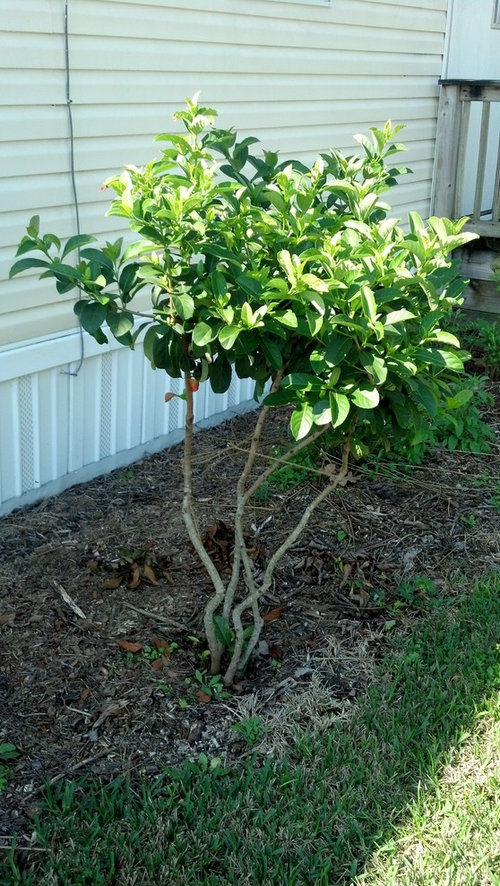
After some poking and prodding on my regular forum, I'm bring my question to you tree (and shrub?) experts.

I have these two Sweet Viburnums (Viburnum odoratissimum) that I have been limbing up to eventually provide shade for this side of my house. It is the north side and a tricky spot for planting as except for the first 12-18" from the wall, it will be in full-sun all summer long here in Florida, but in winter it is full shade. These Viburnums are some of the few plants that I was able to find that can handle both shady and sunny situations, but I saw some at a local demonstration garden that some were being used to provide shade for tropicals. I figured I could do the same thing and change this sunny patch into at least a Part-Shade if not Full-Shade area once the Viburnums are large enough (They can get to 20 ft easy). Mine are currently about 5 ft tall and after sleeping and creeping they are apparently now in the process of leaping as 2 ft of that was put on over the past 3-5 months.

My question pertains to the training process. I initially pruned away the larger, lower branches that I didn't want and I also pruned out any that looked like they would end up crossing or growing toward the house. Once they get above the roof-line I might let them spread out more to shade the roof a bit. After a reading a recent article, I believe I may have limbed them up a bit too much for the first go. Oops. Now I check on them every few weeks and use my thumb to rub off any new lower growth as well as pick off any coming from the base. I'm curious if there will ever be a time when I don't have to do this or, at least, not do it as much?

Thanks.

Edit: PS, I intend to eventually have them limbed up to about the 5 ft height they are now so I don't have to stoop too much to get under them. I'm a bit over 6 ft myself and have a bum back.

Comments (11)

  • 11 years ago

    Hi Michael! Welcome to "Trees"! One thing is going to happen-someone, probably named Ken, is going to tell you those are too close to the house, lol. But they are smallish, ornamental trees and my guess is that they will somewhat sweep out and away from house in their phototropic search for the sun. At any rate, you did right so far, if perhaps a bit too much like you said. The general idea is-and I apologize if I'm just telling you stuff you already know-that young trees need as much foliage as possible, in order to supply the food for growth and respiration. So yes, a gradual approach is called for. Beyond that, we sometimes advocate for working to maintain a central leader, but even I-one of this forum's most ardent supporters of doing that-don't see nearly as much need in species which will never be 90 ft. tall and which are more ornamental trees (even though shade is one of your goals here).

    I'd suggest doing little more than removing any obvious bad structure, and in a case like this plant, it's going to have to be really bad to matter. So rubbing branches are about it, so far as I'm thinking right now. the rubbing off of new adventitious buds as they form along the stems is fine and of little consequence. Did I miss anything?

    +oM

  • 11 years ago
    last modified: 11 years ago

    Well, with this being a shrub, will it ever get to the point where it puts less energy into creating lower growth and putting more energy into top growth?

    I know these are a 'little' close, but there is a reason. Time to ramble.

    The very first plants I got when we moved here were three Pygmy Date Palms. It was June and the area was already in Full Sun, so I, being new to Florida, thought that the palms were perfect choices and this was the perfect place for them. Come October, I realized that the shade was getting closer and closer to hitting the Pygmies. I also had read up on them by now and realized that as popular as they were in the big box stores, they weren't very cold hardy. With only 4 months under my gardening belt, I already knew that going into shade and on the north side of my house, they would be dead in one winter. So I had to transplant them. I spent pretty much the next year researching which plants would handle the shift from cold and shady to hot and sunny and the list was very small. I finally had settled on Walter's Viburnum and went to a local nursery to get two. It didn't take long before I realized that these were not Walter's Viburnums (like the nurseryman insisted they were) but were Sweet Viburnums. I did some reading on these and found out that they respond well to pruning and tend to behave. So I would be able to prune them and keep them away from the walls. I have since then seen many tightly pruned Sweet Viburnums as well as some not-so-tightly pruned ones.

    During the year in which these 'slept', I kept reading and digging up various information on all things gardening, landscaping and some horticulture. During this time is when I went down to my county's Extension Office and got to see their demonstration gardens. As demonstration gardens go, it is far better than the ones in my neighboring counties. At the demonstration gardens, not only did I see the ones pruned up to provide border shade for the Tropical Area, but I saw a pair of multi-trunked Pineapple Guavas also limbed up to create a living arch. I would love to copy that look, but I am on a rental lot and it just isn't big enough to support such a display. I also got to see actual Walter's Viburnums... is it wrong that I'm kind of glad that nursery is no longer open?

    When I got home, I looked at my two 'sleeping' shrubs and envisioned them limbed up with a similar manner to the guavas. While they wouldn't have the same effect, they could create a wide, narrow arch against that side of the house with enough pruning. At least I told myself that. They also wouldn't spread enough to completely cover the space between them, but it should be enough to give me a part-shade area.

    Limbs growing toward the house have been a concern of mine, but I keep an eye on them and if one starts in that direction, I snip it, encouraging a more east/west spread of the limbs. If the Viburnums ever top the roof-line while I'm here, I will start allowing them to arch over. But for now I allow them to grow in any direction but toward the house.

    Sweet Viburnums are very popular here in Florida (and probably other southern states). Partly because they can quickly create a privacy hedge, partly because of how they handle pruning and partly because they're just about bulletproof. After the few Tropical Storms and 'weak' Hurricanes I have endured down here, I have never seen a broken Sweet Viburnum limb, not unless something else fell on it. So I am not really worried about northern winds pushing them into the house.

    So there you go. I know they're a little close, but I've taken it into consideration and am trying to take steps to make sure they don't become an issue. Maybe not the smartest idea, but don't we all take a little risk here and there? Oh and my property line stops about 2 ft in front of the shrubs, so there wasn't much more room for me to move them.

    A sweet Viburnum up the street from showing how tightly they can be pruned. Not how I would have pruned it, but the previous maintenance guy loved to turn every shrub and tree into a chicken drumstick for some reason. (Oh, and Wiscontitom, that bright, healthy oak behind it has both Ball Moss and Spanish Moss in it. :)

    And older picture of the Pineapple Guava arch.

  • 11 years ago

    Well, with this being a shrub, will it ever get to the point where it
    puts less energy into creating lower growth and putting more energy into
    top growth?

    ==>>> no.. you can not change its genetics.. thru pruning ...

    what tom said.. i would say .. lol ...

    ken


  • 11 years ago

    and .... it is.. and always be.. a shrub ... no matter what form you train it into ...

    but its no use to repost in the shrub forum ... because all the same peeps..populate both forums ...

    good luck.. live your pruning/training dreams ...

    ken


  • 11 years ago
    last modified: 11 years ago

    Seeing as I have no intention in getting into the genetics side of horticulture, I guess a fair bit of pruning/rubbing is in my future! Thanks.

  • 11 years ago

    It might actually start to shade itself out at the base-at least to some degree, thereby tending to lessen the amount of growth down lower, so yeah, I'd just keep doing what you're doing. Nice plant. What's the big fella behind there, a live oak? Also, clump of some kind of fern behind the rocks up front there?

    +oM

  • 11 years ago

    Yeah. It's a Live Oak. The ferns are from his (the old maintenance guy) 'compost heap' where he dumped all his rakings, windfall limbs and plants that people would leave behind when they moved. He found the ferns growing there, dug some up and put them around the base of the above live oak as well in pots and near his driveway. Yep, that was his house before he left. I think they're simple Boston ferns that you can find in the Big Box stores, but I really don't know for sure, ferns aren't my thing. Whatever they are, it only took one season for a handful of plantings to explode out from his half-hearted border around the oak and even start climbing up it's 'buttress' roots a bit. Probably not really buttress roots, but I'm guessing you know what I mean?

  • 11 years ago

    Indeed. And a little OT, but one of the delights of visiting sub-tropical Florida for this plant geek is seeing all the resurrection ferns-and really, ferns and orchids of a wide variety-growing in the cracks and crevices of full-size trees. I really do dig that. Your state tree-the Sabal palm-is especially good at attracting other life forms up and down its trunk, what with those "boots". Always wondered how they got that appellation-"boots".

    Is there some dead wood/twigs in your shrub/tree there Michael? One thing that's always in season is the careful removal of dead parts. Even if just for aesthetics, it can rapidly make a large difference-for the better.

    +oM

  • 11 years ago

    Michael, limbing shrubs up to create tree-form specimens is very popular and a great way to bring interest and variety to our yards and gardens. You probably see examples of this everyday in your location.

    A partial list of the shrubs that make good canditates for training include ligustrum, wax myrtle, holly, camellia, osmanthus, viburnum, pittosporum, Indica azalea, and photinia.

    Prune them to an 'open vase' form, removing crossing and inward growing branches to establish a wide canopy. Branches should be cut back to outward growing buds or branches.....no stubs. Single or multi-trunk forms can be stunning.

    I can assure you that most specimens will stop or slow down the production of lower branches. Maintenance of the tree-form shrubs can be very enjoyable, once one learns the art and science behind it.


  • 11 years ago

    Tom, the bigger one is not in my yard, but up the street from me. It sure looks like it has some dead spots, but I put that on the previous maintenance guy. Like I said, he turned anything under 15' into a chicken leg, which included a 10' photinia in my front yard until I told him to stop and that I would take care of it. He also trimmed the live oak outside my lanai and the cuts he did made me cringe and would probably make a certified arborist hunt down his chainsaw and smash it to pieces.


  • 11 years ago

    Hah, OK Michael. Chicken legs, hamburger buns, fake poodles.....aren't these the very essence of horticulture?

    Carry on bud, and have fun. Maybe some day one of my dreams will come to fruition and I'll be digging in that sandy ground down your way.

    +oM