Software
Houzz Logo Print
stephen_houser

Visible Cells on Butternut Squash

11 years ago
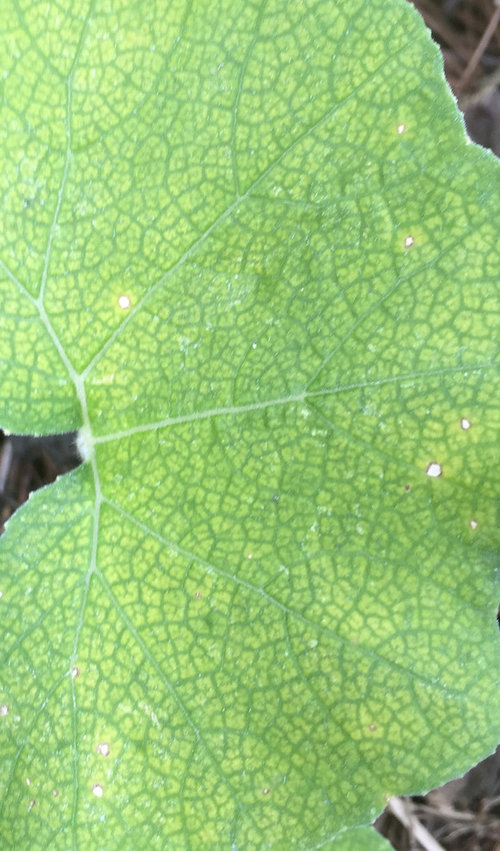
Ok, I did just post about powdery mildew on my cucumbers, but here is a different problem. I've noticed that some of the leaves on my butternut squash have been attacked by insects, which I have now treated with spinosad.

However, I am noticing that many of the leaves are turning out like the photo below. Any idea what this is and how to stop it?

Thanks,
Stephen


Comments (6)

  • 11 years ago
    last modified: 11 years ago

    What are you using for fertilizer? How much and how often?
    What are the plants growing in?
    Garden soil? Potting mix? or?

  • 11 years ago

    Hi Jean001,

    For fertilizer I have primarily used Mighty Grow, which is pelletized chicken manure and feather meal, but have also just put some general mix (bone meal, blood meal, and green sand).

    Plants are growing in a 1/3 compost, 1/3 cocunut coir, and 1/3 vermiculite. Located in full size whiskey barrels in a sunny location.

    The climate here in New Orleans has been extraordinarily wet and humid lately.

    Thanks,
    Stephen Houser


  • 11 years ago

    Let me correct the soil mix composition by saying that the compost is actually mostly worm castings.


  • 11 years ago

    The leaves of the cucurbit family (squashes, melons, pumpkins as well as cucumbers) all get whitish spots on the leaves as they grow and that may not mean much of anything. Your local office of your Louisiana State Universities Cooperative Extension Service may of more help.

    http://www.lsuagcenter.com/en/administration/about_us/extension/

    kimmq is kimmsr

  • 11 years ago

    hmmm...


    perhaps I'm just bonkers, but dark green veins and chlorotic...I mean, yellowish interveinal areas have a rather specific prognosis and treatment.


    Lots of rain in the area lately.


    Technical answer: get a soil test. You are looking for pH and recs on nitrogen, and separately iron and other polyvalent minerals.


    Practical answer: A dose of fertilizer with green these up. If you can find something that has fe, mn, mg, so much the better. I'll bet you a box of donuts that a local garden center will be able to help.


    The spots are from water. Be it water or spray mix, results are the same.

  • 11 years ago

    I agree with Wayne, a soil test is the way to go. Your soil description shows that there is little, to no actual 'earth' in the mix. While it's not necessarily 'bad', use of such 'soil less' mixes often can quickly result in ph imbalances.and nutrient deficiencies, especially those of 'minor' and trace elements like magnesium (which can at first glance can show as a pale leaf color similar to a nitrogen deficiency.)

    Use of soil is not necessary, and not always desirable, but depending on where you live and the elemental make up of your starting mix and factors such as the level of organic matter, soil can offer a 'buffering' capacity and be a good source of trace nutrients.. However, soils can also harbor undesired components and conditions.

    Your additions of the 'general mix' fertilizers may help, but only the soil test will show what is available and if anything is getting 'locked up' by ph factors.

    Looks like kimmq offered good advice of where to turn for information on getting the tests. Keep in mind though, that each addition to the medium is not always immediately 'testable'. It takes time for added ingredients to incorporate into the soil and give a 'true' reading. The best time to test is before you amend and prior to planting.


    When it comes to 'fixing' problems, particularly without knowing the elemental details of the soil make up, I find that its usually better to err on the side of caution and make additions carefully, a little at a time. You can always add more if you see improvement, but washing something out is not always practical or even possible.


Sponsored
Whisler Home Improvement
Average rating: 5 out of 5 stars9 Reviews
Franklin County's Committed Home Improvement Professionals