Software
Houzz Logo Print
hzdeleted_19165820

Best trees for steep hill

11 years ago

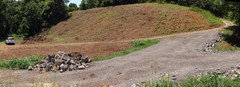
Middle TN. I'm looking for the best trees to put on a steep hill that I have. It is a large wide and tall hill (about 50 FT tall, 100 FT long, too steep to mow). It is east-facing and comes down to a creek bed. It was covered with numerous woody shrubs, thorns and thickets; was cleared with machinery last summer and now has the same re growing. I would love to create a little forest that stifles out all the underbrush.

Any ideas?

Comments (40)

  • 11 years ago

    If your aim is to stabilize the steep bank, locust trees - robinia or gledistia - are hard to beat. They fix atmospheric nitrogen, have a dense fibrous root system and attractive pink or white flowers loved by bees. A couple of important cautions: Once planted, they will spread by root suckers and be next to impossible to remove. There are thornless varieties, but most have them.

    As for stifling existing undergrowth, no tree, locusts included, will do this easily, if at all. Undergrowth with mature root systems will persist, sending up new growth every year unless the roots are removed or herbicide (certainly not advised in your case with close proximity to a creek) is employed. This tends to be a multi-year project. You also might consider repeat annual cutting even if that is not an ideal solution. What is presently growing may be essential to stabilizing the bank.


    User thanked akamainegrower
  • 11 years ago

    Alnus rubra is another.

    Dax


    User thanked gardener365
  • 11 years ago

    anything can be planted on a hill ... its all about the planting.. and how to water properly on a hill

    ken


  • 11 years ago

    Ok. Well a follow up question... Let's say I found the perfect tree(s) for my hill. Considering the thick undergrowth there now, what would be the best plan for getting those trees to thrive without getting choked out by the competition?

  • 11 years ago

    why dont you show us a pic ...

    trees need full sun to thrive ... and water for about two years ... before they go free range ... so planting in or under thick undergrowth could be a problem ...

    unless you are talking about planting like they plant to reforest lumber production areas ... with very small plants ..... and even those areas are clear cut ...

    and i dont understand how big a trees you are thinking of planting ...

    i just can not conceptualize what you are getting at .. the scope of this hill.. nor the scope of the project ... .. other than hoping you can find an easy way to do it ... good luck with that.. i have been looking for that basket of gold for about 30 years.. in my garden .. lol ...

    i think the bottom line is ... you need to clear the hill of the brush ... and that isnt going to fun .. or in the alternative.. cheap...

    the trees.. are that absolute last consideration ....

    ken


    User thanked ken_adrian Adrian MI cold Z5
  • 11 years ago

    The fundamental idea has problems. Around here, it seems to take about 40 years before new growth forest is dense enough to clear out the forest floor. Something this narrow is also going to have issues with light coming in from the sides since it is more forest edge than deep forest. So it comes down to the usual option of mowing or weeding. Either is going to be a royal pain.

    How do you feel about goats?


    User thanked mad_gallica (z5 Eastern NY)
  • 11 years ago

    Shouldn't ok control the regrowth right away? Say, with 4 or 5 inches of wood chips? What's the erosion situation? I agree the carts before the horse

    User thanked Marie Tulin Boston burbs z 6a
  • 11 years ago
    last modified: 11 years ago

    Ok maybe a picture will keep the momentum going

    This was 1 yr ago. Hill is shaped the exact same now with the new undergrowth about waist high.

  • 11 years ago

    Weeping willows and cottonwood for fast growth. Maybe Liriondren (improper spelling, tulip tree) or sycamore. Hopefully the water is sufficient. Plant a couple oaks or something you like at the edges. My scarlet oak is averaging 2+ feet a year but it doesn't keep up with my neighbor's weeping willow which might be 35' x 50' now its 10 years old.

    Round up is going to be your friend for scrub growth control for the next decade. I bet once a year keeps it reasonable.

    User thanked Toronado3800 Zone 6 St Louis
  • 11 years ago

    I think one a year means now, before you have to put in as much work as you did the first time.


    User thanked Marie Tulin Boston burbs z 6a
  • 11 years ago

    Is money an option? For centuries, literally, Black Locusts were used for that very purpose. They grow nearly as a fast as weeds and spread like mad. They easily compete with brambles and shrubs. You could plant just a few and have it all covered in no time. The costs would be next to nothing. Matter of fact, in Tenn. it should be easy to get saplings of Black Locusts, they are all over the place here in the Eastern half of the State.

    Their foliage allows dappled light through to the underbrush and hardwoods will usually eventually take over. This is the way nature takes over an area, and it does so very well.

    User thanked rgreen48
  • 11 years ago

    Chestnut

    User thanked Sean Bankos
  • 11 years ago

    @bankos talk to me about chesnut - why? any variety?

  • 11 years ago

    Historically American Chestnut grew on slopes in your area.....until they died out from blight (fungal disease)....however there are hybrids out there that are pretty much disease free. They can tolerate the conditions you described. Dustan Chestnut is a well known variety but looks more like its chinese parent; it still produces a lot of chestnut though.Then you got Timburr Chestnuts and Kens Select grown by Oikos Food Crops. You can also try your luck with pure American Chestnut but there if a very good chance it will get attacked in the future by the blight. Chestnuts are great for wildlife (deer and turkey love them).

    User thanked viper114
  • 11 years ago

    As Mr. Adrian pointed out, any tree is capable of growing on a slope. I thought, however, the intent here was to somehow choke out or shade out the existing undergrowth. If that is the case, you do have to face the fact that no matter what species of tree you plant it's just not going to be able to accomplish this goal in any reasonable time frame, if ever. In one year, the undergrowth has regrown to waist height. The exact same rapid regrowth will continue to happen no matter how many or what kind of tree you plant. You can try planting a limited number of trees in select areas small enough to keep undergrowth-free by hand, but you have 5000 square feet of brush of various kinds, all with extensive mature root systems. Trees will not stifle it. Spraying many, many gallons of Roundup on a slope leading to a creek is another very bad idea. Perhaps learning to live with what's there is the best option, although there is a certain appeal to goats.

    User thanked akamainegrower
  • 11 years ago

    Everyone is going to have an opinion. I'd suggest a hillside of magnolia, because of how glorious they will look. Or a planting of nut trees, because of long term value of timber, intermediate value as a wildlife feed, and short term value of...well, once you get done, it's a reason to drink. Or a hillside of maples. Pretty in the fall, and you can always tell yourself you are going to try to make your own maple syrup.


    Or you can just plant whatever makes you happy and fits in your budget. As long as the tree will survive your winters, pretty much anything will make it.


    What I would do, given that you have intense competition from existing vegetation, is use mulch and probably landscape fabric, but only the heavy stuff. You don't have to keep the entire area clear, just a few feet around each desired plant.

    User thanked waynedanielson
  • 11 years ago

    some good feedback. thanks.

  • 11 years ago

    Pine?


    LOL

    tj

    User thanked tsugajunkie z5 SE WI ♱
  • 11 years ago

    Have you considered a ground cover like drift roses. You could plant a couple of trees and fill in with the roses, or other ground cover.


    User thanked krnuttle
  • 11 years ago

    I'm open to a ground cover - as long as it's not invasive. I think a ground cover could look great and be low maintenance but I can't have it running up the hill to invade my front yard. I've even considered a cover crop such as buckwheat (I would just leave it for nature to enjoy). Pros / cons anybody?

  • 11 years ago

    Another option is to create a wildflower meadow......this you would have to seed in..........although you would have to mow it once a year to keep the brush from growing there. http://www.americanmeadows.com/wildflower-seeds

    User thanked viper114
  • 11 years ago

    This is a fascinating thread. We have lots of suggestions as to what to plant, but pretty much nothing about what to do about the existing underbrush. Installing 5000 square feet of heavy duty landscape fabric or roughly 2500 cubic feet of mulch are pretty high on the utterly impractical scale. Magnolias, chestnuts, wildflower meadows, roses and the rest remain in the realm of charming fantasy until the underbrush question is dealt with.

    User thanked akamainegrower
  • 11 years ago

    What about a controlled burn to get rid of the underbrush? Seems easy and cheap (assuming all goes to plan). And would perhaps add to the soil. Eco-friendlier than herbicide.

  • 11 years ago

    Please tell me what is wrong with just getting rid of it as he did the first time, however it was done. ? Chip the underbrush. (What did you do with the first lot of growth?) then spread a whole lot more wood chips and get planting.

    No matter how you cut it, its at least a five year project to keep control of the weeds so the newly planted stuff grows. And it will cost money if not for woodchips then for labor to spread it. Expense may not be a deterrent for OP. If that's the case, he can do what he needs to do.

    Cut again before the new growth sets seed. And keep cutting. Is there water nearby? Could OP use a pre emergent herbicide like snapshot?


    Nan Ondra of Hayefields (blog) took control of a couple of old fields. Not steep hills. But her process, or rather the process of reclamation, might be instructive, if only for the patient vigilance required.


    User thanked Marie Tulin Boston burbs z 6a
  • 11 years ago

    The difficulty with any brush clearing strategy that targets the above ground growth is that it leaves the roots behind. Annual burning is a time honored technique, but doesn't, of course, lend itself to replanting. Herbicide, because of the proximity to the creek, would be pretty muvh out of the question I imagine. Since you are dealing with a lot of woody growth, the only possibility that comes to mind is a a tractor or dozer with a toothed ripper blade capable of uprooting briars, scrub and vines. It's not going to get every single piece of root, but will do better than anything else. There are two big drawbacks. One is finding someone to do it for a reasonable price. The second, very important one, is the potential for destabilizing this steep bank. I certainly wouldn't do it without asking about required permits, waterway protection laws and would have the project evaluated by someone from county extension, soil and water conservation, etc. before proceeding.

    User thanked akamainegrower
  • 11 years ago

    Bamboo

    User thanked girdledinvasive
  • 11 years ago

    Herbicides would be a necessity I believe, in a project such as this. Not foliar-applied though. I'm taking cut-stump or, as I call it cut/treat, whereby the offending woody plant is cut near to ground level and an appropriate herbicide is daubed on the cut surface immediately afterward. I see no other reasonable way to get this stuff out of the way. And proximity to water is not especially an issue with this type of application.

    The two main chemicals to be used in this application would be glyphosate, at 41% dilution of active ingredient, or one of the formulations of triclopyr, AKA Garlon. I believe Garlon 3A, the water-soluble version, would be your choice this time of year, or generic equivalent. Check it out: These are real techniques with a proven track record. Where I live and work, we do these things all the time.

    +oM

    User thanked wisconsitom
  • 11 years ago

    Cutting and applying herbicide will get rid of the current crop, but do nothing to stop the future brush. This is not a one time thing, but ongoing maintenance for the foreseeable future. Mulch doesn't do much to stop woody plants at least partially because there are little gardeners out there digging through the mulch and planting seeds.


    User thanked mad_gallica (z5 Eastern NY)
  • 11 years ago

    We have a deep gully behind our house and it's similar to your sizing. I've looked into naturalizing it for control of soil erosion. There are currently quite a few pine, a cedar, some choke cherry and maples at the top. There are also some dog wood shrubs. The maples I want to yank because the previous owner put them in very close to the septic and house. I'm talking 10 feet from the septic holding tank. Why anyone would do that is beyond me. Anyway so I looking into other trees that are great for soil erosion and found a link that might also help you. Usually it's more shrubs that are used to prevent erosion so I couldn't find something specific to my area, but the link was still useful.

    http://www.ecy.wa.gov/programs/sea/pubs/93-30/table3.html


    User thanked redtartan
  • 11 years ago

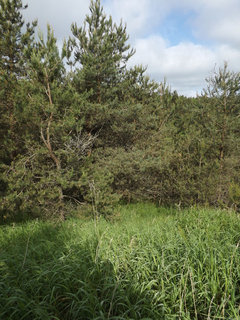
    Despite the long grass, trees do pop up thanks to the birds, so vegetation isn't likely to choke it all out, at least not in my experience. None of this was planted, everything naturalized on it's own.

    A bit of a mis-leading photo but that is a steep hill and the pine flourish. Under the pine grows some wild strawberries & short grass.
    The ground cover is mostly native grass, but we do also have golden rods that spring up, some daisies and a few other flowers here and there. Our hill is becoming dominated by the pine. According to the previous owner it's only been there in the last 15 years. He was burning something, it got wild and just tore across the field. After that point the pine from the next door neighbor spread like crazy. We will be thinning it out for sure. There is so much of it. I think you just have to take care not to remove too much at a time.

    User thanked redtartan
  • 11 years ago

    shep,
    Spent some years in Giles Co.; now located just across the KY line, north of you... so I know, more or less where you are, and what's likely to grow &/or work there.
    Left untended, you'll likely end up with a mish-mash of redcedar, hackberry, black cherry, sassafras, elm ... and, unfortunately, these days... probably a bunch of callery pear seedlings, popping up among the various weeds, blackberries, sumac, buckbrush and other 'pioneer' species.
    If you're looking to plant trees, you're probably still going to be committed to doing some annual(at least) mowing/clearing around and between them, to keep undesirable(if only in your perspective) 'undergrowth' suppressed until the desirable trees can get ahead of the competition.
    If you're envisioning an 'open' woodland feature with little to no undergrowth ... that's probably decades away... if so, you may need to go for a 'high stem-density' planting, with plans to regularly thin a percentage of the trees as they begin to size up.
    As a nut tree enthusiast, I'd certainly be on board with previous recommendations for some nut trees...chestnuts, black walnut, hickories, oaks. But, bear in mind... a 50x100 plot won't support - at maturity - more than a couple; or at most, 4 to 6 - mature, productive nut trees.

    Landscape fabric...meh; horrid stuff. Weeds root right down through it; if you've ever removed it...it's like a biological desert under there; bare ground almost resembling concrete.


    User thanked lucky_p
  • 11 years ago

    Allelopathy is often overplayed, particularly with regard to black walnut/juglone. Sure, it's inhibitory to SOME plant species(rhododendrons, tomatoes, etc.), but there's plenty of stuff - especially weeds/grasses that are totally unhindered by whatever juglone a BW can throw at them.


    User thanked lucky_p
  • 11 years ago

    Hybrid poplar would also grow there.....very fast too....in only about 2 years you could have a decent looking forest going on

    User thanked sbankk114
  • 11 years ago

    Black walnuts aren't invincible -- sugar maples scoff at juglone and the one below is strangling its B walnut neighbor. The B walnut below is noticeably weakened w/sparse foliage:


    User thanked bengz6westmd
  • 11 years ago

    Boy, I love a good scrap!


  • 11 years ago

    May the best tree win!

    +oM

  • 11 years ago
    last modified: 11 years ago

    You know, seeing that maple take down that walnut makes me smile in a sadistic way. It's like revenge for the apple trees I've tried planting on my property.

    We've been using hybrid willows around our property for problem areas. They seem to be able to thrive anywhere and they grow really fast. We also like them because they make good wildlife cover and browse, and they're easily propagated- meaning you can start with a couple and in a couple years have lots of growth to take for new trees.

  • 8 years ago

    Do Norway spruce do well there? That's what i've decided to stick with on my very steep hillside in zone 5b. They pretty much take care of themselves and grow fast and big. Some that we planted 5 years ago are already 15 feet or so. And they definitely create the dead zone underneath that you are looking for. We've tried just about every evergreen that can grow around here and that is the easiest. Deer resistant too! But I have heard they aren't fond of southern summers. Pines have done ok for us but they need to be FAR away from the walnuts. For hardwoods, red oak seems to be doing well(also fast) but requires some extra watering during dry periods. Which is a pain on a hill. We got a lot of hickory, cherry, walnut and hackberry growing naturally on the hill. Would like to get rid of the ugly hackberries but they seem to do such a great job of holding the steep hill together.