Software
Houzz Logo Print
marfloors

Dry Tomato Leaves

11 years ago
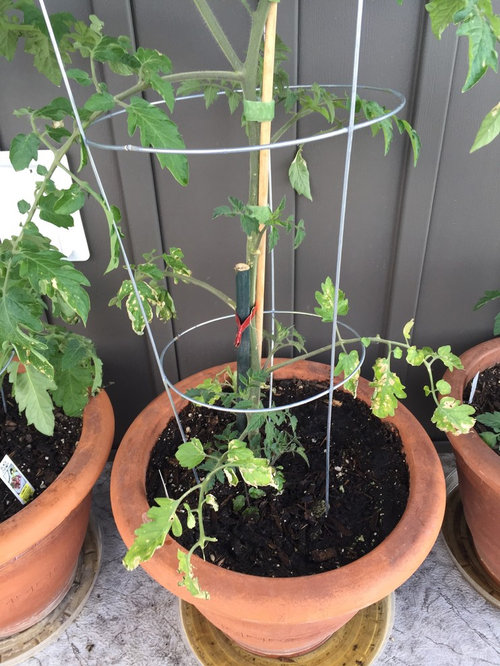

Hi there,

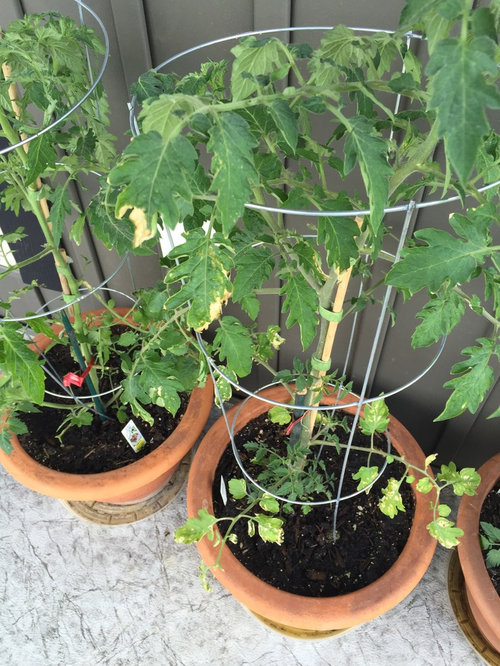
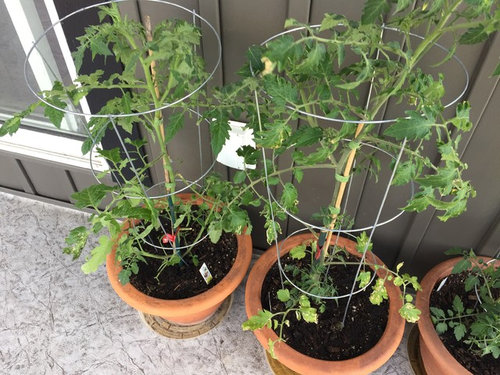
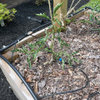
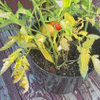
I'm growing heirloom tomatoes (yellow pear and black cherry) on my balcony and some leaves have started to dry up. I'm not sure why as I generously water the plants everyday...to the point that the pot saucers fill up with water. This last week I had to reduce the amount of water I've been watering as the saucers overflowed a few times and my downstairs neighbour wasn't too happy. Could that be the reason why the leaves are drying up? I've attached photos.


Should the dried up leaves be cut off or should or should I leave them?

Comments (20)

  • 11 years ago

    I think that is environmental and probably because of too much water.
    I would prune all those yellow leaves. No matter what , they are not going to revive.

    Sey


  • 11 years ago

    Very leggy plants in what appear to be very small containers. And clay pots which dry out very quickly.

    I'd be concerned that they aren't getting nearly enough sun and likely too frequently watered due to the small size of the containers. I assume you are feeding them regularly to compensate for all the lost nutrients? I can't tell from the pics how deep the saucers are but using much bigger/deeper saucers that hold more water might help stabilize the soil moisture levels.

    And yes there is nothing to be gained by leaving all the damaged leaves on the plant.

    dave


  • 11 years ago
    last modified: 11 years ago

    Hi Marion and welcome to the tomato place!

    Sorry about the problems you are having in the clay pots. I also would like to know what you are fertilizing with and how often. Actually if you have a tiny pinch (but NO more than that!) of boric acid --the stuff for eye wash-- I would add it with the next watering.

    As for the plants, I think they are sick and suffering from multiple problems. It's hard to say which, but my guess is the plant is salt stressed and not properly absorbing key nutrients like potassium. When that happens, the roots are unable to provide the lift and the water puddles below, evaporates and leaves the fertilizer salt deposits if you are using any. The next stage is the roots begin to rot from water-logging. It is a page from the old Mariner Poem caught out at Sea:

    Water, water every-where,

    And all the boards did shrink.

    Water, water, every-where,

    Nor any drop to drink.

    The very deep did rot - Oh Christ!

    That ever this should be.

    Yea, slimy things did crawl with legs,

    Upon the slimy sea.

    That's how your plant feels at the moment and it is dehydrating and rotting below. My best guess, anyway. If you concurred, flush the pot generously everywhere somehow with fresh water that won't shower downstairs with a couple of gallons of water and be sure it all drains as much as possible. That's like hitting the 'reset' button. Then fertilize lightly with a soluble fertilizer. The plant may still recover but that depends upon whether the roots rotted much or are still ok.

    Cut only a couple of the pale green, damaged leaves on the very bottom. You can be slow about that. The plant has enough to worry about at the moment than getting dismembered a lot.
    PC

  • 11 years ago
    last modified: 11 years ago

    Thanks. I use Miracle Gro Tomato Plant Food once a week. I'll try flushing the plants out with fresh water. If I can't (kinda tough to do on a balcony), would you say that I'm watering the plants too much or too little? Just so I can adjust my watering habits.
    Thanks again!

  • 11 years ago
    Once more question, going forward, how often should you say I should be watering my tomatoes? The average temp has been about 26°C (80°F) lately. Is the daily watering too much?
  • 11 years ago

    That is a good question but difficult to answer.
    There are few factors;

    1- We know that clay pot loose moisture by sweating and evaporation.
    2- Smaller pots tend to get dry faster, due smaller moisture storage capacity.
    3- At direct sun and higher temps water evaporate both from the soil top and the foliage at faster rate.
    4- Potting soil/mixture structure. What are you using? Most peat moss based mixes are highly moisture retentive.

    But in zone 3 you should be fine with watering once or twice a week.
    To find out you can check manually or get a moisture meter. After a few times of experimenting/ checking you should be able to figure it out how frequently you should water.


    Sey

  • 11 years ago
    last modified: 11 years ago

    Remember it's just an educated guess. You didn't mention if you are using the Miracle Gro at the dilution recommended by the manufacturer of 1 tablespoon per gallon when you apply it weekly. If so, then everything does fall into place. MG is too powerful fertilizer to be using in small pots like yours at the high end of the manufacturer's recommendation for outdoor plants ... and will easily give you this problem.

    I need to emphasize you probably have a crisis-situation in the soil so you don't have the luxury of keeping the plant in that situation without acting drastically. It has been over-fertilized and now the soil/medium is salted. If you really can't flush it very generously, the only other option is to just eliminating fertilizing completely and using water skipping perhaps 2 weeks. That will help cut back on the buildup, but may lead to some deficiencies on the minerals that your plant has stopped absorbing - watering's a delicate balance!

    If you do decide it is the only option you can exercise due to the difficulty of flushing on the balconey, then use distilled water for watering (I buy it in Walmart for $0.88/gallon here), rather than tap water for a period of time you are remedying the salinity. Tap water also contains dissolved minerals and won't get you anywhere quickly enough and can have been partly to blame as well getting you to where you are now; distilled is mineral-free. So is reverse osmosis in case you or a friend have a purification system, or clean rain water if you can collect it mostly free of microbes. You then go back to tap water after you resume fertilization, since the tap has calcium your plants need.

    But I highly recommend you find a way to leach some of the salts out right away to get your plant healthy again while you still may have a chance. As recommended above by digdirt, you can get a larger saucer anyway. That could help you to accomplish this and then be useful later, or anything that holds excess coming out of the pot including a tough plastic garbage bag. With the saucer, generously water all around the top and swap saucers like you were bailing water as it fills ... having two saucer to use alternately, you can manually do this if you've got the muscle to lift the pot a lot - so nothing much leaks on the balcony as it drains - and have a bucket handy to keep dumping what you collect, not reusing it once used. Run the two gallons through it or even more if you can. I just suggested that as a minimum, but that was just a guesstimate. A little more is safer!

    Going forward, you'd need to cut the Miracle Gro back. Since we don't know the rate you apply all I can say is cut back to 1/3 the amount. Note a teaspoon per gallon is 1/3 a tablespoon per gallon, and you could start that immediately after a good flush, every 10 days to two weeks. The rates are per gallon, so you may not use them all each application, just the correct amount of water and then put it aside (in a dark place) for the next fertilization, but try to just mix the amount you need.

    The daily watering is a good idea but if you have soil/media that has a high affinity for absorbing water (spongy), you may need to rethink the whole saucer-as-a-reservoir idea and just water enough to wet the soil and keep in mind what to do every month or two so salt doesn't accumulate again. The watering frequency is not key and less more frequently is best. What is key is the amount of water in your soil. It should never be muddy for long. Tomatoes get sick when their roots are suffocated. It's hard for you to know what's happening in the bottom of the pot. It should be damp to touch, like a nice handful of mulch from the forest floor with that foresty smell, after a light rain. Growing in a small pot is very challenging for tomatoes because they are very thirsty plants. But you can do it if you are tenacious and sensitive to the conditions of your plant.

    Hope that helps :-)
    PC

  • 11 years ago

    Skip on using any saucers at all... you are letting the roots stand in water and you will probably end up with root rot, like Pythium. And, if you are fertilizing too much, guess where all those excess salts are being flushed to? Yep, right into that saucer full of water.

  • 11 years ago

    <Skip on using any saucers at all... you are letting the roots stand in water and you will probably end up with root rot, like Pythium.>

    Using a saucer under a container like that is no different than using any of the many self-watering containers. The roots are not standing in water, the bottom of the pot and restricted access to the soil is. So limited soil wicking is all that happens, no root rot just as you don't get root rot in a self-watering container.

    Plus in this situation run-off of drainage has to be controlled and saucers are the only way to do that. Larger saucers might also allow for the plants to be moved out from the wall where they can get more sun and it will help a little in preventing BER.

    I agree with PC that MG used at full strength and weekly is far too much nutrients AND salts. Standard recommendation is diluted to 1/4 to 1/2 strength every 7-10 days.

    Dave

  • 11 years ago
    last modified: 11 years ago

    Thanks everyone for your help! I will flush out the soil today.
    As for the MG, I use 1 tablespoon per 1 gallon however, I spilt that gallon water among 4 plants. I don't know if that make a difference or not.
    Thanks again for the advice!

  • 11 years ago

    Yes it does. Weaker mix is better. Mix no more than 1/2 T in 1 gallon of water.

  • 11 years ago
    last modified: 11 years ago

    Marion,

    I'm glad you are taking action ;)

    I'm going to build on ncrealestateguy's and digdirt's comments, including's Sey's earlier comments, because I agree with most of them LOL. All get great results growing in their conditions. I mentioned rethinking the saucer-as-a-reservoir if (and only if) you have very spongy soil. Then you are told to forget the saucers, and then you are told to get bigger saucers (*smile*)

    So in the end, you need to have an action plan that everyone can tolerate and you'll probably be best. This is because a pot like that forces trade-offs and you'll need to pick and choose yours. One way is to consider the shape of your saucer. A tall saucer will put your roots in water and subject them to rotting. A squat one is a good compromise. So the wider the better. Rather that getting technical take a look at why a 14 inch (35 cm) saucer only has to be half the height of a 10 inch (25 cm) one to contain the same amount of water, and let's use pizzas with tomato sauce and fresh home grown tomatoes as toppings to see that:

    How much topping is on my Pizza?

    The take away is that a larger diameter disc (or square or other area shape) keeps the water further from the roots. Instead of flushing after you get through this round (which must be done this time), just dump a full saucer every few weeks as routine maintenance just before certain fertilizations (water twice on perhaps every third to fifth fertilization (around once a month, or six weeks), first from above with tap water, to get that drainage your saucer lacks, dumping the excess effluent, and second immediately afterwards, doing the fertilization as normal to leave the plant as usual). That's an artful compromise and doable I would guess ;-)

    Cheers

    PC

  • 11 years ago
    last modified: 11 years ago

    Just a note on the saucers. If, as you mention, you are concerned about runoff dripping down to the balcony below, yet don't want your plants sitting in water, use saucers, but put a few 'risers' in the dish to raise the plants out of the water.

    I do this with house plants to allow old salts to leech, and still catch the overflow. Depending on the desired height, in my houseplant dishes I use beer, or water bottle caps. However, if you need, I'm sure you could find something a bit higher for your situation. Using a few risers also reduces the displacement of the pot and your saucers will be more effective as overflow catchers.

  • 11 years ago
    last modified: 11 years ago

    Hi rgreen,
    I think that's a good idea to raise a pot for small plants and it certainly could be utilized on the balcony. But for tomatoes I would not be too keen on it. As was brought up by digdirt, the saucer is performing two functions, specifically that to catch overflow, as well as to provide a reservoir similar to an SWC ("self-watering") does. If you go to the extreme of ncrealestateguy, in this case, having a saucer without being a saucer, that would be a great solution for some plants; I don't use saucers for my containers myself ... but it Sun showers on them every day too in my coastal, humid climate.

    Here are my two concerns. House plants have very low nutritional requirements. The tomato is on the other end of the spectrum and consumes a great deal of water and nutrients. The pot being used by Marion simply does not have the holding capacity for its demands of up to a half gallon per day in summertime, and by the time it is into fruit production it's more critical. Marion needs the reservoir for this water buffering, and your solution will break the wicking ability and just be a drain catch. That will cause the soil to dehydrate without very frequent irrigation which can easily slip her mind and result in a stressed wilted plant.

    Secondly, and it is not clear, you may be suggesting she dispose of the overflow. This is not necessary, either way, it could be done if you want. But keep in mind the fertilizer rates we suggest somewhat have built in the building up of fertilizer and if the pot sits too high on risers the fertilizer will need to be increased and there likely will be more fertilizer waste. For an African Violet you won't notice, but for a tomato it would hit the wallet. Perhaps experimenting with the additional variables and a working system could be designed. That system would require more attention than simply choosing a wider saucer. It would completely or partially remove the water from soil contact which has the above drawbacks (and potential benefit of avoiding a rot situation) but demand more care and attention. digdirt's suggestion to get more Sun when possible up there in Canada will probably result in healthier, more productive and tastier tomatoes. The more Sun on this pot, water not only drains, but the more evaporating out of the sides, so soil/growing medium dehydrates even more quickly.
    PC

  • 11 years ago
    last modified: 11 years ago

    Hello Pupilla,

    I pretty much agree. When I grew tomatoes in containers, I purposefully used deep 5 and 6 gal. buckets, yet here in the Mid-Atlantic South, I had to water most every day. My point being that a deeper container helps to leech salts to the bottom of the soil, away from the roots. The salt build up in those smaller, clay (moisture wicking) containers which would be sitting in water, isn't the most effective set up.

    If the idea is to mimic a self-waterer, I would, at the very least, flush it out every month.

    I used to do a lot of indoor gardening and after 4 months sans flushing, the medium was useless without major processing.

  • 11 years ago
    last modified: 11 years ago

    Marion,

    Sorry it took me a couple days to get back here after asking you questions. You have received a lot of good advice in the meantime. Sometimes conflicting :)

    I think by the time you read this you will have already flushed the plants; hopefully you found a way to do it without upsetting the neighbor. But I was thinking, depending on how big they are, putting them in the bathtub to do it might be an option.

    I would summarize the advice you've received this way:

    -As you now know, using full strength Miracle Gro each week is too much. Weird, but true. If you cut it down to half or 1/3 strength, you should be fine.

    -Also, watering is tricky - overwatering can cause dry leaves, ironically. You may have been giving too much in the beginning, by watering every day without regard to actual soil moisture. It's better to actually check how dry the soil is, and only water when needed. At this point, between your hot weather and the clay pots, they may actually need the daily watering -- and perhaps the extra in the saucer, as PC talked about.

    Just in general, I like to check the moisture in the bottom of a pot by pushing a bamboo cooking skewer down into the soil, then feeling it to judge the moisture level in the pot. (PC also talked about how it's nice to know what's going on down there.) You can also just use your finger, but it doesn't let you feel the bottom. In general, only water when the soil is fairly dry (although this depends on the type of plant and its specific conditions).

    - Make sure they are in the sunniest spot on your balcony. They look like they are back by the wall - could you rearrange to have them out by the railing to get more sun?

    - Lastly, next year you might consider using bigger pots/plastic pots/self watering planters to retain more moisture if you do find you have trouble keeping them watered as the season goes on. But, don't overwater them at the beginning!

    Good luck and let us know how it goes. I think your plants will be looking better soon!

    Jenn

  • 11 years ago

    I have been planting in pot starting last year.
    I use my own 5-1-1 mix, initially with some SRF. But then I feed with MG water soluble at about 1/3 to 1/2 strength every other week or so. Part of the nutrients is lost through drainage every time you water. So you'll need more frequent fertilizing but diluted.
    The concept behind 5-1-1 (bark based mix) is to avoid and reduce PWT as much as possible. With a tray under the pot and a c peat moss based mix there will be a soggy portion at the bottom, compromising aeration. You wouldn't want your garden to be that, would you ?. UNLESS you are growing something that like wet feet, like water cress, eg.
    The purpose of saucer under plant is for house plants because you don't want to make a mess, not to water the plants. JMO

    PC, .. yeah MG blue stuff is potent ( 24-8-16) but when you use it @ ~ 1/3 strength it is like using 9-3-6.

    Sey


  • 11 years ago

    Exactly Sey... I don't know any experienced gardeners that like self watering containers.

  • 11 years ago
    last modified: 11 years ago

    Actually, I know of a bunch of experienced gardeners that do amazing things with self-watering systems. Some really rock the Earthboxes. And you must not have seen Raybo's Earthtainers yet. Or the rain gutter grow systems.

    But, it's a totally different philosophy. And I think it works better in some parts of the country than others. Here in the PNW, I go with 5:1:1.

    Also, a true self-watering container is a lot different than having water in a pot's saucer.

  • 11 years ago

    "Also, a true self-watering container is a lot different than having water in a pot's saucer."

    I agree.