

Need help tomatoes & cukes asap, please someone!!!
I am in Milwaukee, Wisconsin. Our Spring has been a lot cooler than normal. I planted my cukes and tomatoes about 1 week ago . The cukes were all dead the next day. I have 5 more cuke plants to plant. It is getting warmer and will consistently be in the 70s (day time highs) this week. I planned on planting them today. Good idea or not? My thoughts are that normally it takes up to 65 days to get a harvest. In years past, the cukes started drying up by late August, early September(if my brain is remembering correctly). If I wait much longer, I'm not going to even give them a chance to get a decent harvest. What say ye?
The other concern with both my tomatoes (that are doing well--planted a week ago) and my cukes. An owner from the garden store we bought the plants at said people are under a misconception that they need to water a lot. He said water LESS to get MORE harvest. The people who water more get less of a harvest. Do you agree? It seems if we don't get rain frequently, our soil looks parched & cracked. I cannot see that as a good sign for a healthy harvest. Help everyone. Thanks.
Comments (18)
 11 years ago
Night temps are almost more important than day temps right now. Soil temp also, which may have been your cuke issue. Need more info.
Related Professionals
Middletown Landscape Architects & Landscape Designers · DeRidder Landscape Architects & Landscape Designers · Jacksonville Landscape Contractors · Cedar Rapids Landscape Contractors · Kearney Landscape Contractors · Jamestown Landscape Contractors · Williamsport Landscape Contractors · Platteville Landscape Contractors · Kalispell Landscape Contractors · Wenatchee Landscape Contractors · Richmond Accessory Dwelling Units · Boston Accessory Dwelling Units · Janesville Accessory Dwelling Units · Logan Accessory Dwelling Units · Bronx Accessory Dwelling Units 11 years ago
<Cukes were all dead the next day.>
Several possible causes ranging from damage from transplanting and their lack of tolerance for transplanting - the primary reason direct seeding is preferred - to some sort of pest like cutworms, etc. Why not just direct seed some? They almost always catch up and surpass any transplants.
Can't really address the store owner's comments as they are far too vague and out of context. So he could have meant just about anything. Sure OVER-watering can dilute flavor, cause root rot and nutrient deficiencies and cause all sorts of other problems that might result in a reduced harvest. But that in no way means you should UNDER-water them intentionally as that only creates a totally different set of problems, one of which can be reduced harvest. For best results tomato plants require consistent soil moisture levels that aren't overly wet or overly dry and don't waffle from one extreme to the other. So the key is finding just the right amount of watering.
<if we don't get rain frequently, our soil looks parched & cracked.>
Many gardeners all over the country do so successfully with out much rain at all, much less frequently. And frequent rains only wet the soil surface for the most part rather than down at root level. So the secret is fixing the soil tilth by working in a great deal more organic matter on a regular basis to stabilize moisture content and then heavily mulching the plants, not watering more.
Dave
nickjoseph Milwaukee, WI
Original Author11 years agoMostly 70s & some 80s, with one temp high 60s highs for next 10 days, lows are high 50s & 60s
- 11 years ago
Leaving cukes on the vine too long will reduce harvest. Pick em young Pick em often. Trellis the cukes up so they can be seen & harvested - they will blend in and hide. It also helps them grow straight. That one BIG one (hiding) will tell the plant it has reproduced its seed. When you find the BIG one you won't believe you missed it and by them the plant will be slowing down - too late.
Inconsistent watering will cause blossom end rot and splitting in tomatoes and likely stress cukes also.
I water my tomatoes and cukes daily - sometimes twice a day during the heat of summer.
Why was this sooo urgent? - 11 years ago
OP indicates that tomatoes and cukes were both planted 1 week ago -
tomatoes survived yet the cukes "died" the next day. To me that
eliminates wx and soil temp. While I think it normally takes longer than
1 day for a plant that is not been hardened off to die I suppose one
day is enuff in bright sunshine to make it look dead.I think I would be asking where the plants were purchased so it doesn't happen to the next plants. IME ask when purchasing but always be sure to harden plants yourself as many places just don't do it.
While stressing a plant will cause it to reproduce I don't think withholding water is the way to do it as the heat of summer will provided enuff stress for tomato and other plants.
Also worth noting the normal lifecycle of plants is to reproduce so if you have to stress them to reproduce something else is wrong. I think that technique is used for other reasons.
IME a rain storm will certainly show IF the plant has been getting enuff water as it will result in splitting of the fruit if it suddenly gets more rain water than you've been supplying.
As mentioned earlier insufficient watering will cause blossom end rot in many plants.
fwiw - stressed plants are more susceptible to disease and other problems. Said another way - Not a good idea to stress mama when she is caring for babies.
 11 years ago
"not a good idea to stress mama when she is caring for babies"... anywhere else in nature I think this would be true, but I've seen farmers lop off branches of their tomato plants in an effort to both concentrate energy on producing fruit, and stressing the plant into mass-production. Am I wrong in this? I've literally seen it be successful myself... I'd like some input on where the line is between hurting your plant, and hurting production... because in the end, the tomato plant will die anyways, so it's really all about whatever you can do to push out optimal fruit before first frost... I'm curious on the final word on this having several plants myself! :)
- 11 years ago
Plants produce the most when they are happy - good soil, water, & full sun (normally) are needed to raise the production.
<"but I've seen farmers lop off branches of their tomato plants in an
effort to both concentrate energy on producing fruit,">This is a different situation entirely than withholding water (nutrients) - water moves the nutrients needed to produce thru the plants.
"Topping" is done to indeterminate tomato plants (much like pinching blossoms is done on others) so that energy will be directed to (ripening) any existing fruit when the end of the season (Frost) is near.
IMHO - "not a good idea to stress mama when she is caring for babies" applies everywhere.
- 11 years agolast modified: 11 years ago
I think the term "good" here is too broad... yes, the plants need adequate nutrients, light and water to survive... but I still think that "stressing" the plant... and I don't mean torturing it, just stressing it, is a common tactic to increase tomato yields.
I don't mean "topping"... I mean chopping off branches at the base, leaving plants that look like mere shadows of what they once were. But I guess this is kind of subjective... what I might call "lopping off", you might call "topping". Look here for an example of lopping off...
http://www.thecabingarden.com/tomato-whacking-actually-works/For me, this is "topping"
https://www.youtube.com/watch?v=BsR3B_PPiggOn watering, I read some published articles and found that we're actually both right. It turns out that when restricting watering during the ripening stage of the plant, yields can be reduced about 20%, but this is a loss of the mass of each fruit, not the loss of fruit count. But I guess in the end, loss is loss. Also, it's noteworthy to mention that when giving ripening tomato plants some drought stress, the flavor and quality of the fruit increased. So I guess it's just what you want out of your fruit.
Here's a link to the article for drought stress via McGill University, scroll down to the bottom of pg. 20 and the top of pg. 21 for immediate info about the results of drought stress on tomatoes:
http://webpages.mcgill.ca/staff/deptshare/FAES/066-Bioresource/Theses/theses/265MollaNuruddinMd2001/265MollaNuruddinMd2001.pdfHope this helps!
- 11 years ago
Sorry Miss Moose but IMO both those first 2 links to topping and lopping are to very good ways to reduce yields, not increase them. Not only do they remove producing branches and so lose all that potential fruit they also increase the % of sun scaled fruit that has to be tossed. Been there, done that, compared results and quit doing it years ago.
Dave
- 11 years agolast modified: 11 years ago
This is really interesting to me! Thanks Dave for the 2 cents... I feel like I've entered into a whole new "branch" of tomato growing theories, excuse the pun. Obviously there are people out there who feel counter to your opinion(s), but I now feel like I'm going to prepare a few plants next spring solely to play with some of these tactics and see just what happens! Very excited indeed :))...
By the way Dave, seeing as how you are such a trusted resource here, do you have any insight into the OP's question about drought stress, or lowering the watering or even giving more water, etc. at certain stages? I'd be very curious to know your input on this. I've always known that you water young plants like crazy, but don't over water older plants so the fruit doesn't crack and it turns out sweet and healthy and doesn't confuse the old plant into producing yet more flowers and young tomatoes...
nickjoseph Milwaukee, WI
Original Author11 years agoOh and gumby I think it was "urgent" because you know you have to sit
around until next spring to garden again, so tossing out a whole year is
a bummer. I think he's trying to save the season... I don't blame him. I
think if it came down to it and I REALLY wanted a tomato garden or
cukes but just couldn't keep them alive, at the end of the day I'd just
go buy some semi-mature plants from a nursery and get a harvest in
before first frost in September. It means that much to me to not have to
scrap a whole year without veggie plants.
Exactly Miss Moose, I don't want to waste a year of something I love, so you said it exactly! I belong to another Gardening site (of mostly amateurs) & most of the people's cukes died at the first planting. They were told, cukes do not hold up as well as other plants with the cooler Spring we have had in Wisconsin. The soil needs to heat up & the temps need to be consistent in the 70s.- 11 years ago
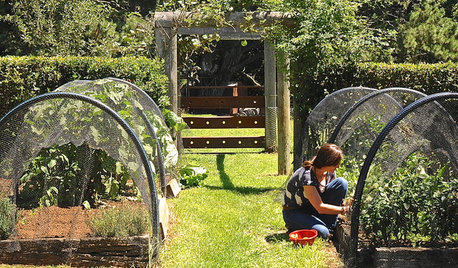
Here where I have cool nights and a shorter season (05/15 through 10/15), for things that like it warmer, I try to give it to them. For my bed with cukes (likewise the bed with melons) I cover them with row cover fabric until they start showing flowers. The row cover fabric keeps some more heat in the bed. I also have used a perforated plastic from from Territorial Seeds that has worked well and done the same thing. A nice thing with the perforated plastic is I can leave that on the whole time as bees can still get in to pollinate (as can other bugs but they are not a big problem for me). Once flowers appear, the fabric needs to come off for pollination.
Almost all of my tomatoes get their start in Wall-O-Waters. Eggplants stay in Wall-O-Waters the whole time. It is rare that I see a night time low of 60. For my cukes and melons that are outside of a bed, they will often have their start in a milk jug cloche until they outgrow it (same with basil, otherwise my harvest would be miniscule). I think it is also important to note that many people succession plant cucumbers because they produce for a while and then taper off and that is why you might be seeing them dry up by August. A second planting from seeds could be a worthy experiment for you. Good luck.
- 11 years ago
I think the point is that just because something dies on transplanting or doesn't seem to be doing as well as we'd like it isn't the end of the season by far. It happens all the time in gardening. New gardeners need to learn to accept that fact. And it in no way means a lost year of gardening.
The title of this thread conveys a sense of panic, a plea for urgent , immediate help needed right this minute. Life and death is on the line! Such a situation very rarely exists in gardening and most of us know that. So for purposes of effective communication it's best to save such wording for those times in life when it is truly necessary. Say something along the line of "Help!! My 4 year old just pulled up my tomato plants! Please help me save them!" :-)
<do you have any insight into the OP's question about drought stress, or lowering the watering or even giving more water, etc. at certain stages? I'd be very curious to know your input on this. I've always known that you water young plants like crazy, but don't over water older plants so the fruit doesn't crack and it turns out sweet and healthy and doesn't confuse the old plant into producing yet more flowers and young tomatoes...>
Well I addressed it in part above but as I said since it is a second hand comment taken out of context I wouldn't put much stock in it either way. And since this is a topic often discussed over on the Growing Tomatoes forum - as is the debate on pruning and topping plants and their effects - I'm not going to rehash all the various opinions given.
But my personal position is that do not believe in ever intentionally stressing plants for many reasons. Be that with water or unnecessary pruning/topping. In general both defeat the purpose of growing the plants in the first place and both are done almost exclusively due to a grower's lack of information or for the convenience of the grower, not the plant.
Obviously there are exceptions to the pruning issue as it all depends on the (1) the type of plant as determinates are never pruned, (2) plant in ground or in container, (3) spacing used for planting and (4) the methods used to support the plant. But when proper plant spacing and support are used, when adequate soil prep is done on in ground beds, and when proper sized containers are used the only pruning needed IMO is of any branches low on the stem that would come into ground contact and/or any branches showing signs of disease. Anything more is stressful to the plant and should be avoided. And, those devoted to aggressive pruning/topping of all plants regardless of the listed considerations are always amazed to learn that the vast majority of growers do NOT prune.
Clearly there are those who disagree with me and that's fine. All I ask is that they don't just jump onto any bandwagon without first trying at least a few of the alternative approaches.
As to the water issue, IMO ideal growth and production of tomato plants requires consistent levels of moderate soil moisture at the root level. That doesn't mean wet, it means moist. It doesn't mean daily watering as some are determined to read it. It means checking the moisture level at the root level daily and adding water only if needed. It doesn't mean wet soil surface since you shouldn't be able to see your soil surface anyway if the plants are well mulched as they should be.
I don't "water young plants like crazy" as that only stunts root development. They get what they need and no more. And I don't worry about cracking fruit since I always harvest at first or second blush/breaker stage. Cracking, pests, heavy rains, etc. isn't an issue that way so there is no need to withhold water from them at any time.
Just some thoughts to consider.
Dave
- 11 years ago
Ok now I actually remember having this conversation about pruning tomato plants last summer and remembered the "yes, prune"/ "no, do not prune" feud... I remembered saying that it seemed like a waste of potential tomatoes to which half the room said "yes!" , that was until the end of last summer when my super sweet 100's grew two stories tall and I started sweating that none would ripen before frost rolled around. Eventually just chopping it back saved my crop... the tomatoes on the base of the plant must have stayed green for oh say... a month? I would literally come out every morning expecting a blush to develop, only to find the plant had just pushed out another cluster of small, green tomatoes rather than just ripen the ones on the vine. Of course this may be a different circumstance, the cherry tomato I think is considered a different animal. I'm not sure about the in-determinant heirlooms for example, but where I live you have to sort of make a decision come September. You end up saying to yourself, "it's gonna hit 30*F at night in three weeks, and my tomatoes are still green. Do I cut the plant back, or just take the chance and let them sit on the vine in the chilly fall weather hoping they ripen and maybe be forced to ripen them inside which really lowers the quality of the tomato IMO"
I know this is sort of going off-topic, and I'm not challenging Dave at all. All I'm saying is... there's a thousand different tomatoes and a hundred different ways to grow them and all have been successful for someone at some point, somewhere in the world for some reason. Maybe tomatoes aren't the most "fruitful" thing to argue about, it seems the countless combinations of weather, location, variety and soil basically turn the topic into something that you'd literally have to be talking to a person in Your area about the same kind of tomatoes to really be able to say "this will work, this will not, this might".
I think that's how I'll approach tomato questions from now on... "get advice from people in your zone, regarding your tomato family" :)
Of course I'm the odd ball here, being in zone 2, that I realize. Dave's in 6/7 which means he's pretty much probably around everyone's growing zone and the guy to talk to! Meh... my head hurts!! LOL - 11 years agolast modified: 11 years ago
Not to butt in, but there are so many ways to garden. learning from others helps us to fine tune our methods to achieve the goals we want out of gardening. What is the 'proper' way for one person, may not be proper for others.
For example... my space is somewhat limited, so I push the limits of crowding. Some may say that it's not 'proper' spacing. However, my goal may not be to get the biggest fruit, or weight per plant, but to get maximum yield per sq. ft. I recognize that my style may open me up to potential problems, I appreciate information warning me of such hazards and information that teaches me about the plant's preferences, but unless I tell someone - I, and only I know my goals and reasons for my methods.
What is 'proper', or appropriate for some, may not be 'proper' or appropriate for me, my goals, my specific plants, or my situation.
Anyway, I'm new here, and this is a little off the topic of the thread, and frankly maybe none of my business (except as a reader and user of the site like anyone else.) I, however do try to appreciate all comments, even if we don't agree. Learning can happen under many circumstances, not all of them favorable.
- 11 years ago
Couple of points. First, it is early June so based on all the comments so far what we have been talking about is pruning/watering during the season. Not sure how we got to end-of-season but end of season pruning/topping is a whole other ballgame and none of my comments above were related to that. Regardless of zone we all share at least a 75 day growing season for tomatoes. That's the season I was addressing.
Second, since we have gotten so far off the original question I hope the OP doesn't mind if I add (or reiterate) that I know many folks grow things in very different ways and yes, I know that what works for one does not work for all. I know we all have different zones, different size gardens, different goals, different situations, etc. But that does not mean there aren't common standards for growing tomatoes or corn or beets or whatever. It also doesn't mean that a tomato plant doesn't have specific needs no matter where it is grown. That's why I stressed IMO. I prefer to make the needs of the plant the focus, not my needs.
However, if one has first tried some of the 100's of ways before deciding that Method Z (whatever it may be) is the only way that will work for them, that's great. At least they tried. But if they have locked themselves into a belief or a method only because they "read something about it on the web or in a book so it must be true" or because "this is the way Grandpa did it" or because they "don't want to make the effort to try any other ways" or because "if it ain't broke why should I try to fix it" then they may well be doing themselves and their plants a disservice.
They then compound that disservice by making authoritative comments like "people are under a misconception that they need to water a lot. He said water LESS to get MORE harvest. The people who water more get less of a harvest."
I wonder if he has ever read any of the many studies done on the production levels from dry-farmed fields compared to the production levels from irrigated fields and how he would explain the greatly increased production from the latter?
Dave









Miss_Moose (Winnipeg, Canda. Zone 2)