

Drought Lawn Ideas
I am in California - so not much water...
We are between Scotts Valley and Santa Cruz which is somewhat mild - Just over a mile from the ocean - but up in the hills in a protected space that is warmer than the coast. We are just above the fog line and wind protected.
We are re-doing our backyard and have removed a lawn that was requiring too much water. Plus it was sloped too much to use as a good play space. After last years drought it pretty much died after not watering it for over a year. It was a dwarf fescue blend.
We have created a small flat area that we would like to put some real grass in. This will be around 25' x 25' in size and gets sun almost all day long and just a little late shading from a west fence. The original lawn that was about 55' x 30' in size.
Our idea is to try out the UC Verde buffalo grass. However, if we do that we were also thinking of doing the subsurface irrigation (Rainbird XFS) to save as much water as possible. We would also be open to using the low water MP Rotator heads.
What are the potential water savings we could see using both the buffalo grass and subsurface irrigation.
We are doing great with our water use as a household and are averaging about 33 gallons per person, per day. We would like some green lawn, even in a drought!
Comments (35)
 11 years ago
Here is a picture of what hybrid buffalo (like UC Verde) looks like on the west side of a 2x2 foot brick mail box stand.

Note that half a day is not enough sun for buffalo. The rest of the yard looks like this...
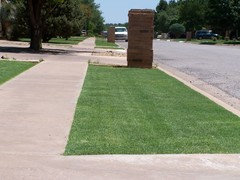
So it's not the care it gets, it's the light. So on the east side of your western fence you're not going to have buffalo grass. You might plan now for a mulch bed, flowers, or some other ground cover up by the fence. This grass, by the way, is called Turffalo or TechTurf. It is a fast growing buffalo that becomes pretty dense in 3 months after sprigging.Normal turf grasses like your Marathon dwarf fescue must be deep watered once a week in the summer heat. Buffalo can probably go 3 weeks and maybe 4. Deep means a full inch all at one time. Measure that with your sprinklers by placing cat food or tuna cans around the yard. Time how long it takes to fill the cans. Hmmmm. I guess you can't do that with underground sprinklers. Hmmmmm. When I use a soaker hose I turn the faucet on to a trickle. Trickle means it takes a minute to fill one cup with the trickle. But you can't even measure that with underground watering. You might ask the installers how they know how much water is going out when it goes underground like that. The problem with watering systems is the flow varies with every installation. My oscillator sprinkler takes 8 hours to apply 1 inch of water. My neighbor's high flow in-ground system takes 20 minutes to apply an inch.
I would be very interested to see pictures of UC Verde from plugs to lawn. One piece of advice to heed is not to rototill the soil before putting down a lawn. Rototilling leads to a bumpy lawn three years down the road.
montel (CA US 10b/Sunset 16) thanked dchall_san_antonio
montel (CA US 10b/Sunset 16)
Original Author11 years agoYes I am worried about the exposure - I am thinking about photographing the area all during a sunny day to see how many hours of sun it will get. I wouldn't want it to not work up against the fence - so I might need to rethink that. Our planter areas are already set.
Our soil was compacted by a small excavator going back and forth to flatten the area as we moved dirt excavated from one area to another. Our soil has some clay content, but overall is pretty good for growing and is stable. I think we will be looking to add a top layer to what is now there for better growing - I can get a shovel in right now with some resistance, so it is not over compacted I don't think...Related Professionals
Asheville Landscape Architects & Landscape Designers · Rapid City Landscape Architects & Landscape Designers · Seattle Landscape Architects & Landscape Designers · Vancouver Landscape Architects & Landscape Designers · Cincinnati Landscape Contractors · Muncie Landscape Contractors · Pittsfield Landscape Contractors · Burlington Landscape Contractors · Lancaster Landscape Contractors · Medford Landscape Contractors · Rockford Home Builders · Winona Home Builders · Westerly Home Builders · Temecula Home Builders · York Home Buildersmontel (CA US 10b/Sunset 16)
Original Author11 years agoThe lawn is a up against a west corner - so the corner us pointing west - the top side fence is NW, and the left side fence is really SW facing.
That gives it a bit more sun than I originally explained...(I think)- 11 years ago
It's not over compacted. There's only one way to truly compact soil and that is to drive the air out of it while it is saturated with water. They do that to make adobe bricks and even modeling clay. Unless your crew used the compactor under water your soil is fine. Football is played on saturated soil sometimes as is golf. Those two types of fields occasionally will get compacted, but even they don't rely on core aeration. If statistics hold up, your soil has no clay in it at all. It might act like clay due to magnesium salt content, but the likelihood of real clay particles is slim. Only a soil test would tell. If your landscaper set the profile for you, then anything you do to add more soil will cause drainage problems. Almost all soils can become great soils if they have the proper chemistry and good biology. Don't try to adjust the chemistry without a good soil test. Check this forum for topics with Logan Labs or soil test in the title. There you can read the advice morpheuspa gives and decide for yourself if you want a soil test. As for biology, simply using organic fertilizer once a year (minimum) will set you up. I have not used any chemical fertilizer since 2002, so you don't need it. The easiest thing you can do to start getting your soil up to excellent is to use organic fertilizer. Soil test is not that hard, either. But even if you bring in more new soil, it would have to be tested/adjusted and the biology fed, so what's the point of doing that?
montel (CA US 10b/Sunset 16)
Original Author11 years agoThanks so much for the information - I am tracking the sun to see how much shade we get in the afternoon. So far it has been sunny on the entire corner since 8 AM...but it is pretty close to the longest day of the year! We are also getting rid of an old tree near the corner that will further add sun to this section.
Once all of my soil is moved around and put into the final place I will look at doing a soil test. I will also do the soil jar test with my 6 year old as he will be very interested in helping do that test.
I am certain we have some clay as I have a soils report showing very expansive clay, light sand with clay, and mudstone. We dug down about 4 feet to create our new backyard - the dirt being used for the lawn is a mix of all of our soils.- 11 years ago
I planted UC Verde buffalo grass to replace my Marathon lawn 3 weeks ago. It is really doing good. I didn't realize how much bermuda grass was intertwined with the Marathon, so I am fighting that. :(
Karin
montel (CA US 10b/Sunset 16)
Original Author11 years agoBoth of our small decorative front lawns were completely overrun with bermuda - shortly after I had a 2 landscapers mow the lawns when I was out of town. Our landscape designer specified a no-mow fescue, but the area we are in is really too hot and has too much sun for that grass and the bermuda loves it - so a little seed from a mower and boom bermuda!
I had to resort to using Roundup 2 weeks ago as the first step in removing one of our lawns. The other lawn is in part shade - and since it so small I am not too worried about the bermuda. I would like to get rid of it but will wait to do that.montel (CA US 10b/Sunset 16)
Original Author11 years agoWe have started at home soil test in a jar - and after 12 hours I see no noticeable layers - I will wait for 24hrs - but here it is after 12 hours of sitting. I grabbed the loose dirt - I think that might be mostly the sand component - maybe I need to get a big chunk and sample that???

montel (CA US 10b/Sunset 16)
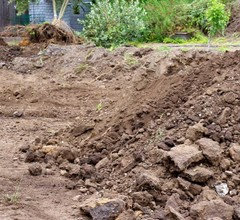
Original Author11 years agohere is a close up of our dirt piles & clumps after digging them up...
- 11 years ago
What's at the very bottom of the jar? Is that just glass (optical illusion)? Sand and gravel sink to the bottom of the water instantly upon hitting the water. Did you take a picture at 2 minutes? 2 hours, and 2 days? With my sand I could have taken the final picture at 2 milliseconds after dropping it in the water. It looked like soil but ended up being pure white sand with black organic matter floating on top.
If you get a soil test the reason for your jar test might well be exposed. Hint: salts - 11 years ago
Well, after 12 hours I can tell you that the clay portion of your soil isn't very large, at least. :-)
Montel, can you do two things for us?
Take a little bit of soil and put it in a dish. Pour vinegar over it, and stick your ear down by the stuff. Do you hear a sizzling noise? You probably won't, but I just want to make sure due to the bits and pieces I see in the jar.
If not, shake the jar very, very well. Then photograph it after 2 minutes. Photograph it again at 2 hours.
Normally we'd want another photograph at 2 days, but I suspect we aren't going to need that and I can probably extrapolate from the 2 hour photo.
If you do hear a sizzling noise, replace the water in your jar with half vinegar, half water. Don't seal the jar or it might explode! Just put your hand over it and shake it over your sink, then set it aside and photograph it at 2 minutes and 2 hours.
While I already have a read on your jar test, I'd rather not make an assumption on it and would much rather have the photos in-hand (or on-screen as the case may be) before saying anything!
montel (CA US 10b/Sunset 16)
Original Author11 years agoOptical illusion on the jar bottom I think...
Alright I think I
get the idea of where this might be going...We are very close to some
limestone quarries...that would make our soil high in most likely
calcium carbonate? So high PH soil?
The soil test last night
after two minutes showed no settling, just uniform muddy water. I will
re-do it and photograph it. I will also try the vinegar tests.
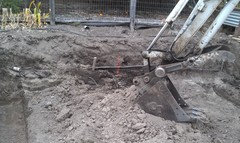
Here is shot of the cross section of another part of our dig...just for kicks.
- 11 years ago
Hence the vinegar; if it's calcium carbonate in there, the vinegar will dissolve it and give us a better read on your particle test. Some of those particles looked a little suspicious, but maybe, maybe not. You could just have soil that color.
It bears repeating, don't seal the jar after adding vinegar. The pressure builds fast.
I'd definitely get a Logan Labs soil test. Or UMass if you prefer, but those are the two best ones (I have a personal preference for Logan, but can read either). You're currently in a state where we can easily correct the soil. It can be done after grass or garden is already there, but it's always a good idea to start your lawn with the best soil you can. For $25 plus the materials to correct it, you can save yourself thousands of dollars worth of problems. Plus well-supplied lawns grow great root systems and don't require quite as much water. Not that I expect much of an issue with buffalo grass in that department.
montel (CA US 10b/Sunset 16) thanked User - 11 years ago
Yes the pressure builds fast. It's not quite Mentos/Diet Coke fast, but it's faster than you'd think.
montel (CA US 10b/Sunset 16)
Original Author11 years agolast modified: 11 years agoOK here are part of the new tests!
Vinegar did sizzle immediately - little bit of gas coming off
Did 4 inches of new dirt - added half water and half vinegar - shook with hand over top to completely mix contents - pressure built up right away.
Once the jar was set down it started to foam - I have a 2 minute photo below
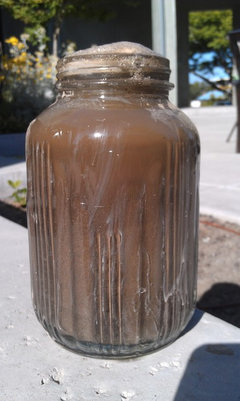
I also took a photo after 30 minutes just for kicks - still foaming

montel (CA US 10b/Sunset 16)
Original Author11 years agoNo wonder my blueberries never liked my soil!!! I have high alkaline soil
- 11 years ago
Heh! Yeah, that's got some (a lot) (tons) of free calcium in it. Definitely get a Logan Labs test. Any shortage of magnesium, potassium, or phosphorus is critically important to correct in a high-Ca soil as it limits the ability of the grass to uptake the other three nutrients. Some other balancing is also important.
On the up side, high calcium soils aren't any barrier at all to a gorgeous lawn, and actually tend to have some advantages.
From the 30 minute image, your jar test is essentially over at that point (although I still want to see the 2 hour photo).
As of now, your soil is around 2/3 sand, 1/3 silt, or a sandy loam. There's nothing appreciable left in the water at this point (I can't see through the water, but it's not fully opaque, either).
It's a workable soil, with OK water retention (although nothing spectacular), and middling EC of around 10 (a good place to be, although your EC will come back high due to the excess calcium and require adjustment).
- 11 years ago
Blueberries can rarely be convinced to flourish in higher-pH soil (it's easier with most more-forgiving acid loving plants like rhododendron, azalea, and other evergreens). The key there is to use lots of late-stage organic matter like peat moss when planting, mixed into the soil well, and fertilize with acidic stuff like ammonium sulfate. Applications of ferrous sulfate will both counteract the natural tendency of the plant to suffer some chlorosis, plus help acidify the soil a little bit.
That's if you have your heart set on those. For the most part, I'd try to choose plants that are tolerant of your pH, whatever that turns out to be from your soil test. There's no sense fighting nature.
montel (CA US 10b/Sunset 16) thanked User montel (CA US 10b/Sunset 16)
Original Author11 years agoThanks so much - learning as we go here.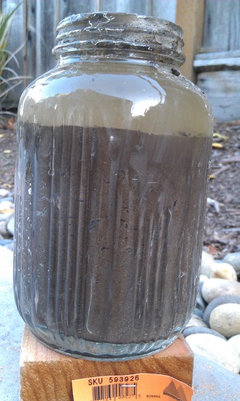
The 2hr photo with not as much sun isn't quite as easy to see the layers.
- 11 years ago
No change, I'm sticking with the 1/3 silt, 2/3 sand. You have no clay, so the test is over at this point and you can discard the sample. Although the water isn't quite clear, it's not even all that opaque any longer--more translucent even in the limited light.
In this case, pour off the water/vinegar mix down the drain (or the toilet considering the bits of sediment in it). Rinse the soil repeatedly until the vinegar scent isn't so offensive, then toss that back into the yard. The tiny amount of remaining acid won't matter in the slightest and vinegar won't harm the soil profile or biology once diluted or evaporated off.
montel (CA US 10b/Sunset 16)
Original Author11 years agoNo problem - will discard it in the morning - we have lots of tractor work to complete, and tons of soil movement, so no worry about acid or vinegar in the soil.
I am surprised at not having clay - but that is why you ask the experts.
Based on the tests is sulfur in my future? I can amend the soil long before we are ready to plant.
Thanks again for the education and help!- 11 years ago
I am surprised at not having clay
You and 99% of all of us. Most people who complain or otherwise acknowledge their clay just have an ionic metal imbalance from the upper left side of the Periodic Table of Elements. There's no way to guess how bad that is, so the soil test is needed to "un-clay" your soil.
- 11 years ago
+1 David. Clay is actually an extremely rare soil to have. I was incredibly surprised to have as much as I do--almost 40%--but the geological survey shows that I'm in a clay area that's about 2,000 feet wide. I have no sand to speak of.
Soils can change quickly in very small distances. My mother, 0.8 miles away, is 60% sand, 40% silt, no clay, or a soil very similar to yours.
Without seeing the soil test, I don't know if sulfur is appropriate. Generally, it isn't, but you're in a special situation there as it can be dug in.
With excess calcium, it seems unlikely. Unless I were to recommend toxic (or at least damaging) levels of sulfur, we can't get rid of your calcium excess. Since you really want to end up with a lawn at the end of this, toxicity isn't a good idea.
If you've decided on the Buffalograss, the stuff is incredibly tolerant of a wide range of pH levels (like most grasses). It doesn't particularly care if the pH is alkaline, so long as the soil isn't salty. So I'm more inclined to account for sodium levels than bother overmuch with calcium.
montel (CA US 10b/Sunset 16)
Original Author11 years agoAlright I now have my soil testing reports back.
Below is the report - the original soil I tested above is the first column. The second is more rocky soil in our front yard...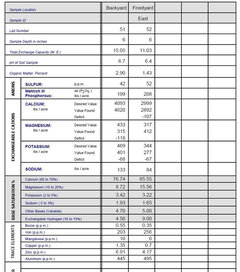
What are my major issues with the soil. I will be growing other fruit trees and shrubs in addition to a planned lawn. Also, my front yard has a small patch of lawn that is in pretty bad shape that I want to rework this fall. Thanks!montel (CA US 10b/Sunset 16)
Original Author11 years agoThank you morpheuspa.
I don't think any soil was brought in for the site - however the back soil is from many feet down as we just excavated the back yard for a pool - so some of the dirt is from 6-8 feet lower than the original top surface. Most of the top surface soil was taken out during our excavation - what we had left was from various digging.
Before any planting in 2010: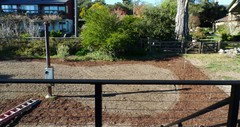
After our Yard Was Done in 2011:

And then excavation started 2 months ago: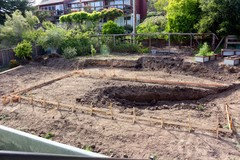
And finally we are at this point now:
The upper left corner of the last photo is where we want grass for the back area...
Below is a picture of the excavation right next to our front lawn - this lawn is pretty sad, and is going to be killed off and re-done in September I think...bermuda has totally taken over the "no mow fescue"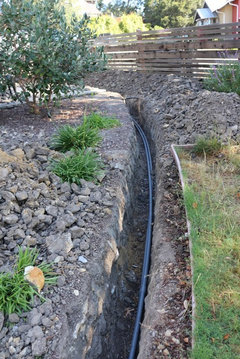
Here is the front lawn just over a year ago...
So it is a pretty small lawn area to fix...
- montel (CA US 10b/Sunset 16) thanked User
- 11 years ago
I don't think he meant to trivialize the project. He meant it was very small and would be fairly "low energy" project to fix due to the small size. I think a lot of Californians will be doing landscape make-overs to minimize their lawn size. I'm going to be doing that at my new house in the Texas Hill Country.
You mentioned low mow fescue. Would that be Marathon III, or II, or I? The dwarf Marathon fescues are extremely popular in California even extending far out of their range into the deserts. For your location Marathon should work even in a drought. If there's any trick to getting the Marathon to perform it would be annual reseeding in the fall, deep and infrequent watering, mulch mowing at the middle of the lawnmower deck, and fertilizing 3x per year (late spring, early fall, and late fall).You said you were going with UC Verde buffalo. I see steps leading from the pool up to the grassy area. Are you planning to put patio furniture, lounge chairs, tables, blankets or anything that might create shade up there? Because the buffalo will not tolerate ANY shade. Also if your back yard is not facing directly to the north, the shade from that fence will thin out the buffalo the closer it gets to the fence. Half a day of full sunlight is not enough. You might need something else right up next to the fencing.
montel (CA US 10b/Sunset 16)
Original Author11 years agoThanks Dchall - Yes I understand that the scope of what I need in size is what makes it easier to deal with - no huge spaces - and nothing growing currently - so easier to correct now.
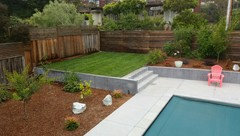
Our top area above the steps is going to be some sort of grass - I just looked at it at 4PM and there is a strip of shade about 2ft inset of both fences. That back corner is almost due west - so yes we would have trouble with buffalo grass right up to the fence. We are not planning any permanent chairs or tables up on the flat area - it is really planned to be our little play yard - and our only flat grass.
We had a grass specified as Delta Bluegrass No Mow or Native Grasslands - that our landscaper was supposed to put in - I think he substituted a locally available product that was from a different company California Shade Fine Fescue Blend from Greenfield Turf.
I think based on the company he buys from, and the recommendation later for a tougher Greenfield grass for our backyard that he put in for us. The fescue grass did great the first year, and without knowing about reseeding it over the next years it got worse and worse - and was overrun by bermuda...
Alright then, what are some options with buffalo grass out? I will only have that back aprox 24ft x 24ft section in and our even smaller section out front. The front is east facing and gets some shad from a some oaks and the house.- 11 years ago
The fescue you started with should be fine. I suspect it was either Marathon I, II, or III. Those are the most popular dwarf fescues in California. For most of CA they are unsuitably water hogs, but if you live a mile from the ocean, they should do well. It would be better if you were in the morning fog zone, but you do have cool weather all the time. Seed for Marathon should be available for overseeding in the fall if it should thin out. It's easy enough to keep up with overseeding as long as you know you need to do it. Dense turf is the best way to keep bermuda out. If you pick Marathon even though it is a dwarf variety, I would mow it higher. Maybe not at the highest setting, but higher than the 'dwarf' moniker would make you think. All that means it that it grows slowly. It still grows.
If your community allows you to water deeply and infrequently it should work. Some of the CA communities have rules that essentially forbid a lawn. For example you might be limited to watering for 15 minutes every other day. That's exactly backwards. You, in your location, should be watering a full inch every 2-3 weeks with temps in the 80s or 70s. A full inch might take several hours to apply depending on your watering system. If you have an underground watering system where the water is applied directly to the roots, there's really no way to know how much water you're applying. The general idea behind deep and infrequent watering is to apply water until it goes deep into the soil. Then allow the soil to dry out completely at the surface so weed seeds cannot germinate. If you had 200 square feet of grass and wanted to apply 1 inch of water, that would be 125 gallons of water. Translating that to smaller measurements you get 9 gallons per day or .75 ounces per minute to apply 125 gallons over a 2-week period. That amount is far less than a tiny stream out of the faucet. It's a drip. If you had a way to meter that out you could simply leave it running all the time. The surface would never get wet and the soil should never feel soggy. Hmmm. I wonder if that would work like that???montel (CA US 10b/Sunset 16) thanked dchall_san_antonio montel (CA US 10b/Sunset 16)
Original Author11 years agoThe front lawn area has the Hunter MP Rotator heads that apply water pretty slowly. We don't have minute restrictions or day restrictions - just no watering by spray from 10AM - 5PM.
We are on rationing as far as our total water use. With some front lawn watering and drip watering all of our plants around the house we average about 5-6 units of water per month total. That is below our allowed 10 units.
Our back grass area we are contemplating using subsurface irrigation - but may stick with the MP Rotator heads.
The front lawn I am planning on doing this fall - kill what is there and then re-seed or even re-sod as it is such a small space. If I sod it would be in late October as that is when our rains typically start.
Choosing Marathon III I am not saving much water - but I don't need much with a 200-300 sq/ft space. It also looks like Marathon III is more a Southern California option
We do get some morning fog most summer days - but we burn off really quick and are in a much warmer zone than most of the Santa Cruz area.montel (CA US 10b/Sunset 16)
Original Author10 years agoBack for the 2016! We are finally getting ready to plant our grass area. We were waiting to see if the drought in our area was going to be terrible again, but we got lucky, this year at least, and our local reservoir is 100% full now. We received close to 40" of rain this season just at our house. With only 500 sq/ft of new lawn we will use very little additional water.
Right now the 500 sq/ft lawn spot has been weeded, and was just topped with a thin layer of compost/sand topsoil mix to help further even out the area. For now I am trying to find a good sod to put down. We don't get Marathon sod up here in Northern California, at least any that I can find, so I am looking at the possibility of using fescue from West Coast Turf called "West Coaster Tall Fescue".
I have also looked at some others as well. Looks like I might need to buy 1000 sq/ft of the stuff So I am contemplating using it to replace my small front grass area that was taken over by bermuda.
I have some good organic fertilizer ready, and the top soil/compost/sand mixture had some slow release fertilizer added to it.
I am planning to drag a wood pallet around the yard a bit to further flatten the area. It has been raked and tamped down to get the area flat - 30"-40" of rain helped to even everything out. Drainage is great with our new retaining wall and french drain.
What other sod types should I be looking for? In addition to adding
some of the epsom salts, milorganite with a touch of borax (as recommended above) - what else should I be doing?
Thanks!!!montel (CA US 10b/Sunset 16)
Original Author10 years agoJust an update - we have selected a dwarf fescue sod blend from Delta Bluegrass Company (Bolero Plus). The gardening guy we are working with loves this sod and thinks it is the best grass he has used locally in his 30+ years of work. I had a hard time getting the other sod from West Coast sod, so that is fine. I think it will work for our location.
I am going to put this Sod in our back area and also in our little 250 sq/ft front lawn area as well. The front lawn was overrun with bermuda so I have been spraying and digging the bermuda up in anticipation of getting new sod to put down in that location. We are just waiting now for all the work to be done...
montel (CA US 10b/Sunset 16)
Original Author10 years agolast modified: 10 years agoWe finally have new sod! We are now watering twice a day and have our various items morpheuspa suggested last year. I have milorganite, three team mule borax, and we had starter fertilizer added with the sod and corn gluten meal under the sod for weed prevention/organic fertilizer...I will follow the tips I was given and see how things go.
I expect things to be pretty simple for the first few months - just need to get the grass established and then get a good watering schedule. I have 2 types of sprinklers so will have to water each lawn differently.
Thanks again for the help, I will drop back in if I run into problems or need other help.





User