Software
Houzz Logo Print
cow2215

help! - trying to diagnose waterfall/pond leaking, not sure where

11 years ago
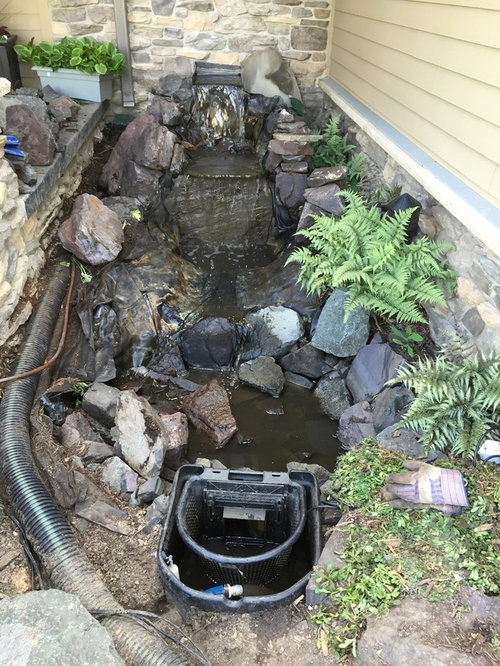

Hi all,

Would greatly appreciate any advice. Our home has a decorative waterfall/pond by the front entry that was installed by previous owners when the home was built ~10 years ago.

Getting it up and running this year, i noticed that it now loses water fairly rapidly, I have measured it as ~1.5gal/hr. The loss only happens when the pump is running, ie if the bottom pool is filled, there is no appreciable water loss if the pump is not running.

We live in MN, my "winterizing" consists of pulling off enough water to have the water level in the skimmer below the return outlet, and removing the pump.


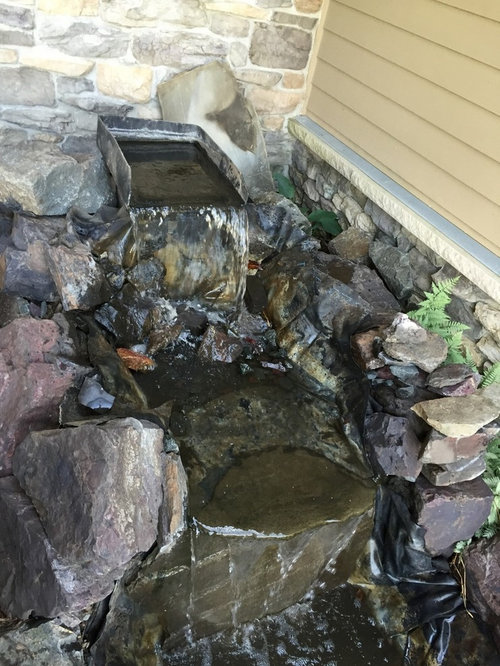
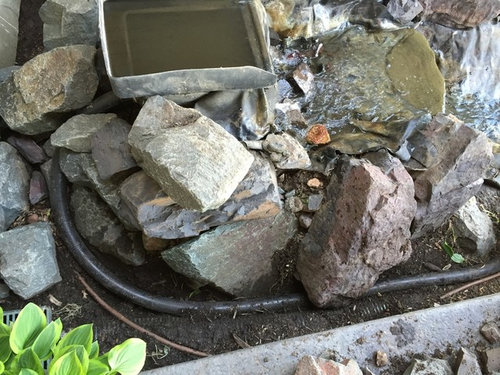
To give some sense of size, the bottom pool is ~3 ft round, and the return hose runs about 10 feet to the top. There are two "falls", thus two flat "run" areas before returning to the bottom pool. Top run has a large flat stone that the liner is foam glued to, bottom run has loose stones (removed). Total drop is ~4 feet.


I thought splashing might be an issue, but loss still occurs even after removing most of the decorative stones and eliminating any splash.

I have also cleared out most of the stones on the two "run" areas, and pulled up the liner at the edges. It looks to be grossly intact, but hard to say that there isn't a small crack somewhere.

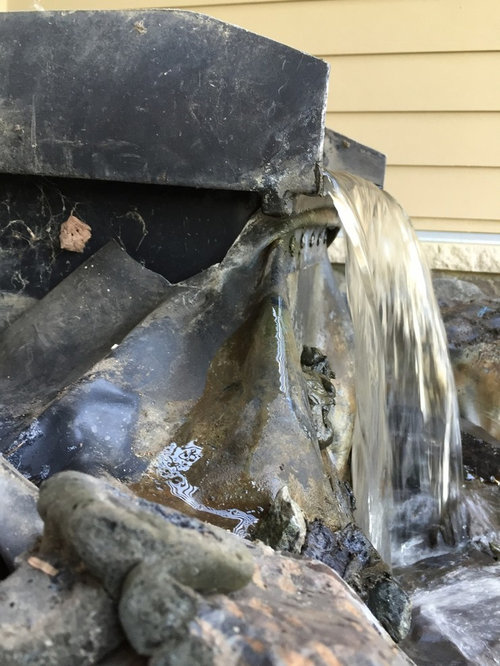
The construction of the pond seems to be solid, the liner appears to be one sheet that was attached to the top outlet by screws; the initial outflow at the top is via an overhang so there is no direct running water over the screws.


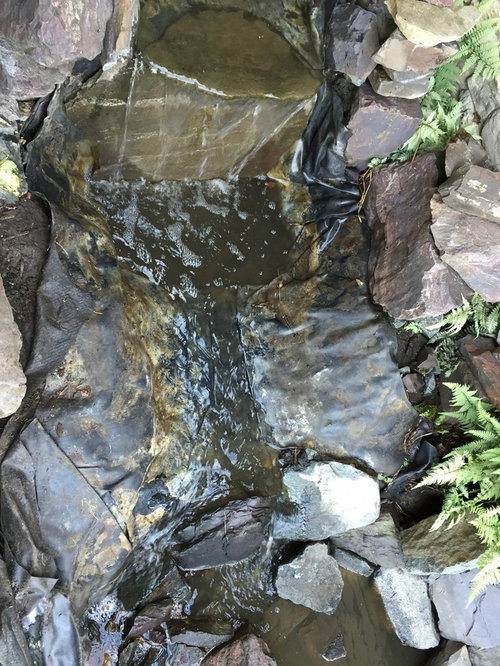
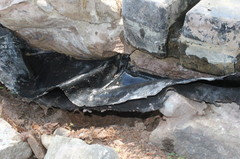
Towards the bottom, on the lower "run" area, there is a fair amount of folding of the liner, but again unfolding these the liner appears grossly intact. There appears to be a seam running across the direction of water, but this looks to have been rubber glued and appears intact.

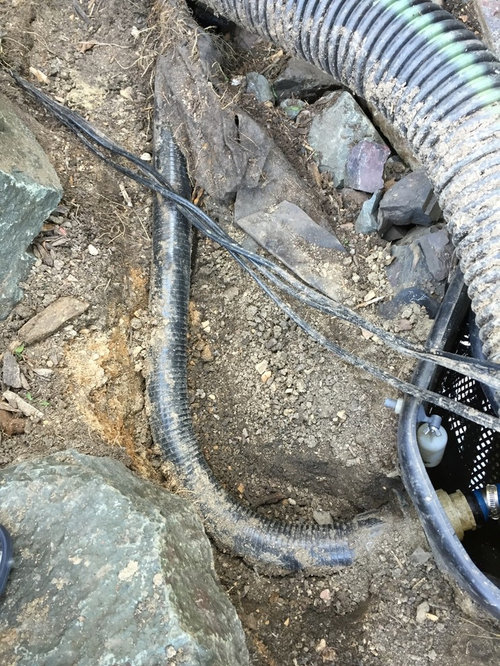
I have also exposed the entire return hose. Looks to me like a flexible but hard-walled spa hose, the type that is rated to ~60psi. I have not found any obvious areas of leakage along the pipe even when the pump is running, so I'm pretty confident this isn't the source.


Do I need to just bite the bullet and pull up the rest of the stones (some are heavy!) and replace the liner? Or should I evaluate other areas of failure?

Comments (8)

  • 11 years ago

    cow, In your first pic, what is that long rectangular gutter looking thing on the wall behind the pond?

    cow2215 thanked User
  • 11 years ago
    last modified: 11 years ago

    Chas, thanks for your comment. I did dig up and expose the entire return pipe (last two pictures) and though the soil is generally moist, there are no wet spots that would indicate an active leak. Same for the housing connections at the top and origin/botton.

    Re evaporation, I don't remember it losing water this quickly vs last year (it's our 2nd year in the house), that's why i started investigating. But according to an online "drip calculator," losing 1.5 gph is equivalent to 6 "drips" a second. Not hard to imagine that splash and evaporation would generate this?

    Re liner - is it possible that these liners just harden and crack over time? I'm estimating it is ~10 yrs old.

  • 11 years ago

    Butterfly, if you are referring to the vertical member, it is in fact a downspout/gutter. it empties into the green drain box, which in turn empties into the 6" corrugated tube, away from the house.

  • 11 years ago

    My liner is only eight years old, but it is still completely flexable. I have never heard of them hardening. The normal use for this stuff is on roofs. Hot roofs!

    Re leaking: Your point about a difference from last year is certainly a good one although I suppose you might consider questioning the clarity of your memory. I have a long stream and because I like to make it appear natural, the liner edges are close to spilling in various areas. They occasionally get pressed down by the dog or clumsy me and with all my plants, they are often hard to detect. When I get desperate, I attach lengths of pipe to the outlet at the top of the stream, either part way or all the way down to the pond so that part or all of the stream is out of circulation. If you could connect something just before the spillway that gets directed back to the pond, you could determine if the loss is in your falls etc.


  • 11 years ago

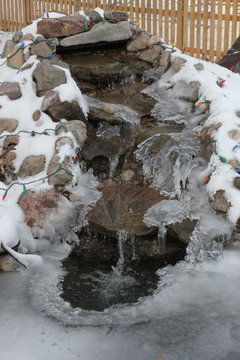
    I was just thinking the same thing as chas045. Last winter was our first with our new pond. We'd just completed it in fall. We didn't know if we should keep the waterfall running over the winter, but before we could make other plans we got lots of snow & sub-freezing weather that didn't stop until there was ice on the sides of the waterfall stream. By then it was too late to drain the filtration system so we just continued to run it all winter, and there was nothing we could do about the ice build-up. Anyway, in spring we noticed the pond losing water much faster than normal. What we discovered was the ice (or combination of ice & dirt settling on the new waterfall structure) had cracked the mortar around the rocks that formed the sides of the waterfall on one side, right at the top, and also right under the waterfall box (see close-up pic). The dirt-covered structure in the upper right is the waterfall spillway.


    Ice formed mostly on one side, as you can see in the photo, and that's the side that eventually leaked. We are in VA so you could have it even worse in MN, even without your waterfalls running in winter.

    This allowed water to seep behind the rocks. Once it got behind those rocks, it made it's way down behind all the rocks on that side - between the rocks & the liner. But then near the bottom of the waterfall we had a steeper section & the water made it's way over the top of the liner & out of the pond. Once some of the rocks hiding the liner were removed, we could see where the water was running over the top. We never could tell it was leaking by looking around the landscaping there either, as it never appeared wetter than elsewhere.

    cow2215 thanked 5turtles
  • 11 years ago

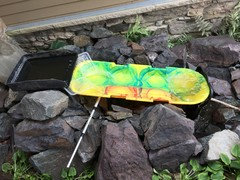
    Chas, your suggestion to divert ended up being the right one. By diverting outflow to the bottom spillway I was able to confirm no meaningful leak over ~6 hrs (picture for entertainment purposes only):

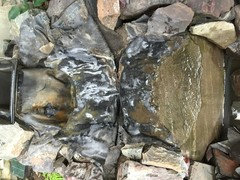
    Once I narrowed down where to look, it turns out that the liner is in fact discontinuous, and the lip of the upper liner was glued using black foam to the flat stone below. In the picture below, the Rorschach appearance is from liner pulled back, with stone and foam below. As I pulled it back, it was evident that in some areas there had been regular water (not just wet, but some sediment, etc) Just upstream of where the foam ends is exposed fabric liner and dirt underneath:


    So, my extremely helpful gardenweb friends, the question now is: How should I repair this? I would prefer to not go to the trouble of replacing and relining the entire liner in one piece (as it should have been done before), so is there a better bonding agent that I should use to glue the liner down to the stone? Or should I just use the same black foam stuff (Great Stuff?? and accept that I will periodically have to redo?

    Thanks!!

  • 11 years ago

    Never mind - started new thread on how to rebuild (more) correctly. Thanks!