Software
Houzz Logo Print
david90531

Share your windowsills :)

11 years ago
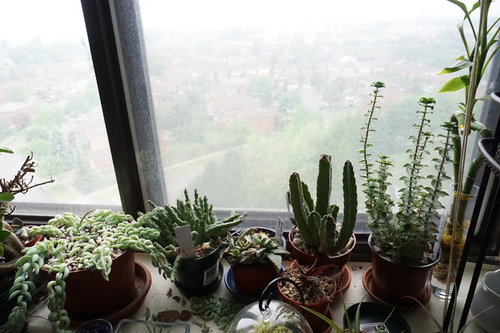
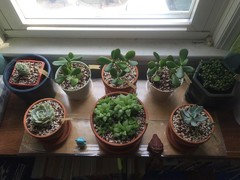
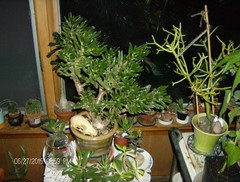
I thought it's about time to share my windowsill(s) after a year of growing succulents, these plants are truly a joy to own and nurture, so many different forms and varieties yet to explore. I would love to see some photos of others' windowsill gardening. Indoor growing for succulents had proven to be quite challenging, I was especially worried when the harsh Canadian winter came, but so far I'm happy to say that I've had fair amount of success for most plants that landed in my collection, and definitely learned to appreciate which varieties belong to the sill more than the others.


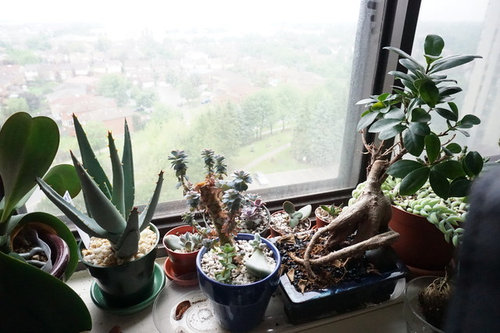
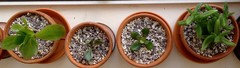
Starting off with the not-so-pretty ones.... These are sitting on my secondary windowsill, they're either dormant at the moment or recovering from repot slash waiting to be pruned and repotted... also mixing some bonsai and bamboo in there


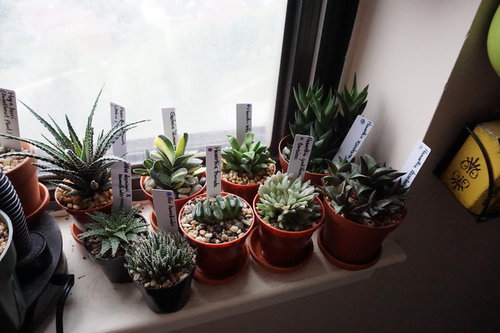
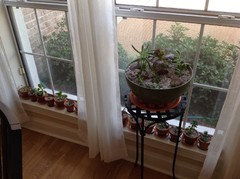
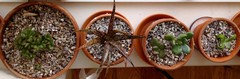
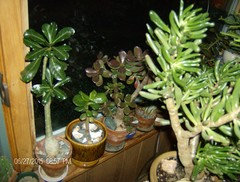
And here's the main windowsill: The Haworthia/Gasteria section (with two Haworthia-like Aloes), currently in love with Haworthias for all the right reasons: less light requirement and just simply beautiful. They're at a more shaded area of the sill, although I rotate them like all my other plants, especially during summer when I can open one side of the window


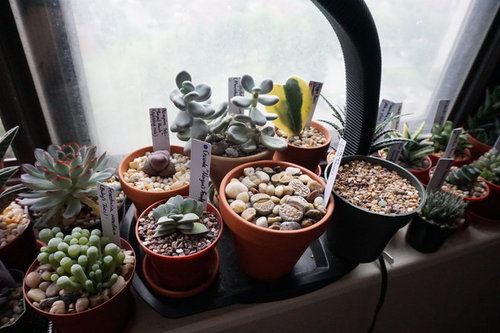
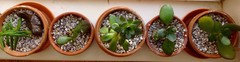
These ones are under grow lights much more than the others generally speaking. The Pachyphytum recently fell off and had to repot it, still in recovery mode....


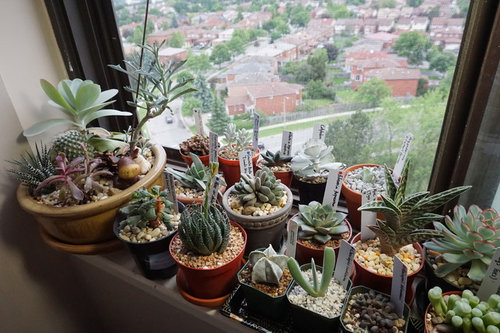
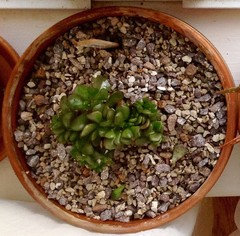
The rest of them. All very tightly packed, wherever I can fit more I do it xD. The dish garden definitely needs some pruning/repotting, after a year some plants had become less attractive but still healthy for the most part...


Look forward to seeing everyone's windowsills :D

Comments (37)

  • 11 years ago
    David
    I don't have windowsill display, just wanted to say that all your plants look fantastic. So pristine and healthy looking. Great collection of haws!
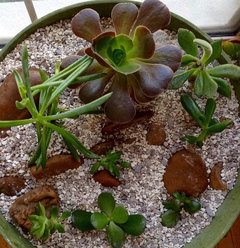
    The tall plant in your dish garden - is it Senecio kleiniiformis? And dark green pot next to it - Adromischus cristatus?

    Rina

    DavidL.ca thanked rina_Ontario,Canada 5a
  • 11 years ago
    @Rina thanks always for the kind words. Correct ID for both plants, the dish garden was made pretty much exactly a year ago, the senecio bloomed twice and started to lose some lower leaves when dormant, that's the one I'm planning to do some pruning and make it look nice again, it also had two pups that's growing really slowly.

    I got the Adromischus by accident, it was laying on the ground at Rona, I picked it up and the worker said just take it-.- clearly don't care about these poor little things at all. It has grown a bit taller, with lots of aerial roots showing, I think it is one of my windowsill plants that would love some more light, but it's doing alright otherwise.

  • 11 years ago
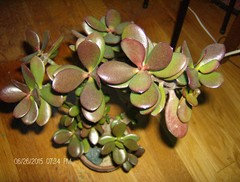
    Very impressive David. Love the way you arranged the plants. Very clean and tidy and your plants look healthy and quite happy. Great eye-candy!

    DavidL.ca thanked Neil
  • 11 years ago
    last modified: 11 years ago
    My cactus and succulent collection here at our small
    retirement Town Home consists mostly of miniature species, growing in small
    containers, maintained indoors on south facing window sills in 2" (5cm) - by 3"
    (7.5cm) deep, 2¾" (7cm) and 3¼" (8cm) square plastic pots, or outdoors in plant
    boxes under 30% shade cloth as weather conditions dictate.

    During cold days, and at night during the
    winter months, I maintain my plants in small square plastic pots indoors on
    south facing window sills that receive full sunshine. On sunny winter days, when
    the temperature rises to around 60°F (approx. 16°C) -- which happens quite
    frequently in southern Arizona -- they go outside on the patio, coming inside as
    the temperature drops at nightfall. With the arrival of spring - when the
    daytime temperature climbs into the 80's F (mid 20's C) and the nighttime
    temperatures are in the 50's F (10's C) - they stay outside until the arrival
    once again of winter temperatures.


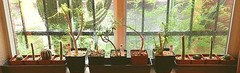
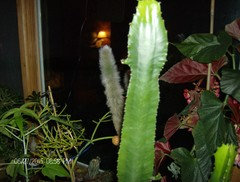
    My windowsills last winter -- mostly January.

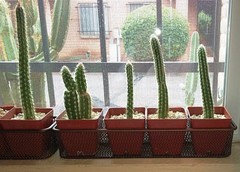
    Above: mixed Brazilian cacti and Euphorbia balsamifera

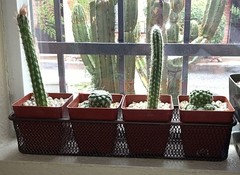
    Above: Arrojadoa dinae and Discocactus buenekeri

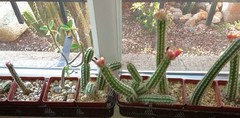
    Above: Arrojadoa dinae and Euphorbia balsamifera ssp. balsamifera

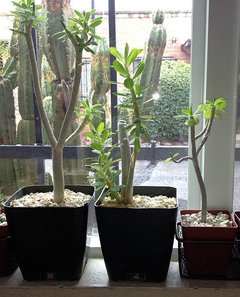
    Above: Euphorbia balsamifera ssp. adenensis

    Above: Arrojadoa dinae (rooted cuttings)

    JP Zone 10a Tucson Arizona

  • 11 years ago
    David
    I aske about 2 plants since I have both; my S. kleiniiformis is now very 'long', probably badly etoliated and yours is more compact. A. cristatus is hairy and looks very similar to yours.
    Rina


  • 11 years ago
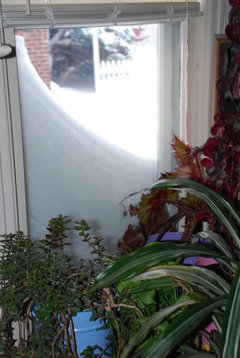
    My window sills are empty as all C&S are outside now. In some winters, however, it can look like this:

    That's about a 5 foot drift that one storm blew up against the window.


    tj

  • 11 years ago
    @JP very nice, thanks for sharing! I'm definitely more of a succulent person, but if I had more space I think I'd definitely venture into the cactus world too.

    @Rina I see, the dish is on the sill year-round and usually gets a bright spot but not the brightest, I also don't have it under grow lights. Sadly most of the plants I've chosen in that dish garden require higher light except for the H. attenuata.

    @tj Thanks for the share :) Haha I definitely remember days that I lived in a house and the snow gets to so high up... I sure wish I can bring my plants outside some day

  • 11 years ago
    last modified: 11 years ago

    DavidLca wrote: ".......... I'm definitely more of a succulent
    person, but if I had more space I think I'd definitely venture into the
    cactus world too ..........."

    I understand, David. Incidentally, I do not grow any large cacti -- or Euphorbias -- on my windowsills. Here are my plant selection criteria:

    • Relatively "shrubby" and thin stemmed species that are of light weight.
    • Do not require a cold winter rest to produce flowers.
    • Can be grown to maturity - producing flowers and fruit - in small
      containers.
    • Approx. 12 inches (30 cm) maximum height.
    • Can be easily propagated via cuttings or freely produced offsets.


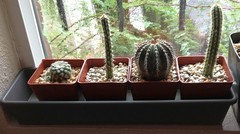
    Above photo:
    Uebelmannia pectinifera (second from right) is the largest globular cactus I grow on my windowsills --
    -- and Arrojadoa dinae (far right) is the tallest columnar cactus.

    Both growing in 2¾" (7cm) square plastic pots.

    JP

  • 11 years ago

    tsugajunkie wrote .........."My window sills are empty as all C&S are outside now. In some winters, however, it can look like this" ..........:"That's about a 5 foot drift that one storm blew up against the window."
    Shades of my youth -- snow drifts on the window -- I never experienced one that high though, tj!

    JP

  • 11 years ago

    Very cool. I also want to start to use more square pots, I think they're optimal for windowsill growing, I think I could save some space and perhaps stuck more plants on there too. I have trouble finding them at local stores but there are some online stores

  • 11 years ago
    last modified: 11 years ago

    David
    You could get many pots for free at places like Loblaws and some garden centers - they actually encourage ppl to bring empty plastic pots for recycling

    (only in season for Loblaws). You can choose the right size and, obviously, only undamaged ones. If you wash them with some bleach, they will be sterilized.

    Obviously, you can always purchase new...

    I like square pots, they seem to be more stable (I guess they support each other well) and def. save little space.

    Rina

  • 11 years ago

    Thanks for the tips Rina. Do they have the squared plastic ones though? I've always only seen round pots but maybe I need to keep an eye out

  • 11 years ago
    last modified: 11 years ago

    DavidL wrote: ".......... I also want to start to use more square pots, I think they're
    optimal for windowsill growing, I think I could save some space .........."

    Yes, David that is so. Please note that I have narrow windowsills. Also, light weight is of the utmost importance to me due to my infirmities and the fact that I transport many of my windowsill plants back and forth to the patio. BTW, I haven't used porous clay pots for growing either my windowsill or large specimen cacti -- Pilosocereus, Micranthocereus, Discocactus, Melocactus, etc. -- since about 1964.

    Of course, you may wish to include some Bonsai -- or indeed round porous clay pots -- in order to attain a pleasing aesthetic display.

    Rina wrote: "You could get many pots for free at places like Loblaws and some
    garden centers - they actually encourage ppl to bring empty plastic pots
    for recycling .........."
    " .......... I like square pots, they seem to be more stable (I guess they support each other well) and def. save little space".

    Excellent information, Rina.

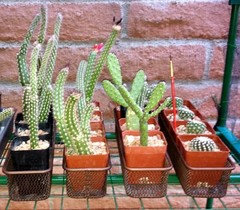
    I maintain my windowsill plants in silverware trays (Bed, Bath & Beyond) for ease of carrying to the patio and back. Here are three that I staged in the open on the patio for photographic clarity:


    Above: Arrojadoa dinae growing in 2¾" (7cm) square plastic
    pots


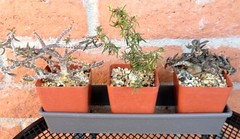
    Above: Pereskia portulacifolia growing in 2" (5cm) - by 3" (7.5cm)
    deep square plastic pots


    Above: Euphorbias growing in 3¼" (8cm) square plastic pots - left to
    right:
    E. cylindrifolia x didieroides, E. sakarahaensis, E. cylindrifolia
    ssp. tuberifera

    Here are trays of plants growing on the patio under 30% shade cloth:

  • 11 years ago

    jp
    Your display is very nice. I really like the uniformity - pots same height, color and distance from each other , and uniform top-dressing. And was wondering where you got your baskets - not only makes carrying them easier, but they look great.

    David I have found enough square pots, but at times there were only round. So I just pop in if passing by the place. It has been a good source of extra pots for me.

    Both of you are very organized and your displays are pleasing. I should try for something similar...(first thing would be getting rid of extra cuttings!)

    Rina

  • 11 years ago
    last modified: 11 years ago

    Rina:
    Thank you. I must admit that I am primarily interested in the condition of the plants -- their vigor and health -- rather than the appearance of the containers I am growing them in (but I do understand that most growers do give great weight to that).

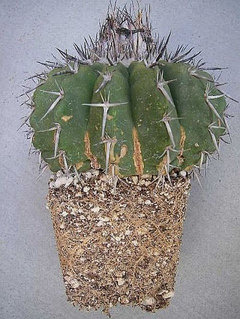
    I forgot to mention that another virtue of plastic pots for me is that I can easily slide the plants out (after a little gentle manipulation) in order to examine the condition of the root system -- which I consider of paramount importance -- then return the plant which then grows on without interruption. As an example here is a Discocactus placentiformis whose epidermis had split along the lower ribs (not uncommon in this genus) after enduring several successive nights of severe Arizona summer thunderstorms thereby taking up excessive amounts of water. As you can see, the root system is very healthy, ramifying throughout the soil mass. This plant is still thriving and produces abundant flowers and fruit:

    I seldom use any top dressing, Rina. I purchased the carry trays (kitchen silverware) at Bed Bath and beyond.

    JP

  • 11 years ago

    jp
    I see, so is it mostly perlite? I thought it's gravel on top (that would add to weight). But I see from your last photo that there is perlite.
    I use perlite, but also chicken grit. Agree, it is so much easier to inspect the roots.
    Rina


  • 11 years ago

    Rina:

    I don't use any perlite.

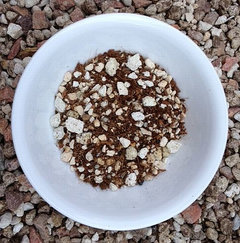
    My present soilless mix consists of equal parts of raw pumice -
    unscreened but washed to remove dust - and washed coco
    peat (coir).
    After the first watering, the pumice predominates on the soil surface giving the appearance of top dressing.

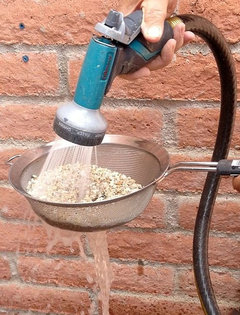
    Preparation: I wash out the dust using a fine sieve in conjunction
    with a "power spray head" garden hose as dust tends to
    migrate to the bottom of containers where it can form a
    drainage impeding "sludge".

    Washing out dust using a "power spray head"
    garden hose and fine sieve
    Washing continues until the water runs from the sieve
    reasonably clear

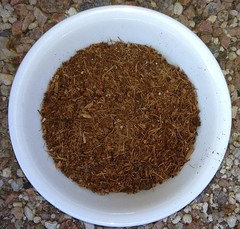
    Although my coco peat supplier claims all of their coco
    coir products have been thoroughly washed to remove
    salt, I wash my coco peat in the same manner as the
    pumice just to be sure any residual salt is eliminated.

    Washed coco peat (coir)

    Mixed growing medium

    I add the Manufacturer's recommended amount of Florikan 17-5-8 Nutricote Advantage Controlled Release
    Fertilizer
    to the mix to provide plant nutrition
    for the first few months, hydrating the plants using
    just pH adjusted water during that period.


  • 11 years ago

    jp
    I didn't realize that it was pumice!
    Thank you for additional info & photos.
    Rina


  • 11 years ago
    last modified: 11 years ago

    You are welcome, Rina.

    I would like to add my own mantra relating to soil for container grown cacti & succulents:

    There is no universally correct soil mixture that will insure optimum growth. Your own mixture should offer adequate support for your plants and provide sufficient nutrition. It should be based on the type of plants that you grow, your growing environment, your climate, and the type of containers you use. I think the most important considerations should be quick drainage and root aeration -- characteristic of a mineral based soil mix that is generally coarse textured and open -- one that does not retain excess water very long.

    JP

  • 11 years ago

    JP, do you have an online source for those pots?

  • 11 years ago

    I don't, Andy -- I get mine from a local C&S Nursery.

    JP


  • 11 years ago

    My main windowsill:

    I had a sempervivum and a kalanchoe blossfeldiana but I moved those outside. May fill up those empty spots soon if I can't control myself.


    What I call the propagation station. I went away on Friday and came back Sunday night to find that everything in the first four pots had rooted

  • 11 years ago

    @btelbtel Love it! Also very neatly arranged, the propagating area looks very nice also, unlike mine... I'm sure you'll fill up the empty spots in no time!

  • 11 years ago
    last modified: 11 years ago

    Very nice btelbtel.

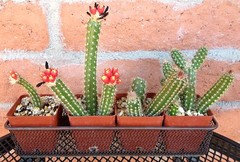
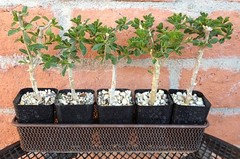
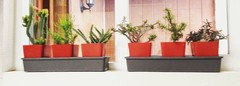
    Euphorbia's on my Kitchen windowsill:

    Left to right:

    E. baioensis, E. genoudiana, E. petricola, E. cylindrifolia x didieroides, E. sakarahaensis, E. cylindrifolia ssp. tuberifera -- all growing in 3¼" (8cm) square plastic pots -- equal parts washed coarse pumice & washed coco peat (coir) -- no top dressing.

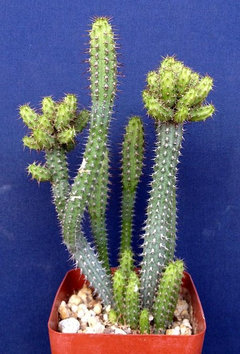
    The tallest plant is E. baioensis -- approx. 8":

    JP

  • 11 years ago

    Awesome!

  • 11 years ago

    Thanks David. Did you have any luck locating any square plastic pots yet? If you can't find any (I don't know why they are suddenly so scarce) and you really want to try some I can send you a few.

    JP


  • 11 years ago

    @ewwmayo Love it! Thanks for sharing :D We have quite many of the same plants! Can you post a single closeup of your Morgan's Beauty? It looks great! I love the uniformity of terracotta pots too :) From your user name (ON,CA) do you live in Ontario as well?

  • 11 years ago
    last modified: 11 years ago

    It's a cloudy day to get good photos, but here they are! This is an eastern exposure but it stays very bright since the window extends up about 14 feet giving the room lots of light.

    Photo 1: I only have a name for #2 in this set, Crassula ovata ssp. obliqua variegata "Tricolor Jade". (If you can name any of the others I'd appreciate it.)

    Picture 2: The first plant on the left in Echeveria Cubic Frost Crested "Elite". It is still recovering from being shipped to my home a week ago. I figure #2 is an aloe and #3 a jade, but I can't find #4.

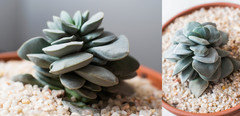
    Close-up of #1

    Photo 3: #1 Crassula tetragona "Mini Pine Tree", #2 Unknown, jade?, #3 Unknown, #4-5 Unknown, perhaps jade?

    Picture 4: Crassula ovata "Gollum" (This little guy got left out of the previous photo.)

    Photo 5: Except for the Aeonium garnet or velour, I don't have names for these. The large plant at 9 o'clock may be "Blue Chalk", but that's just a guess after some googling.

    I grew almost all of these plants from cuttings that I received on December 8, 2014. Considering how young they are, I think they're doing pretty well. I am having a lot of fun with this new hobby. :)

  • 11 years ago
    last modified: 11 years ago

    Last photo - large plant @9 - I think it is peperomia ferreryrae.

    You have few jades there and I believe some echeveria - but difficult to tell from your photos (close-ups would help)

  • 11 years ago

    Thanks rina! I'll take some closeups on the next sunny day.

  • 11 years ago

    It would be good if you number your photos - easier to follow...Rina


  • 11 years ago

    I have room outside for my plants, but keep many inside due to pests like squirrels and insects...

    Christopher


  • 11 years ago

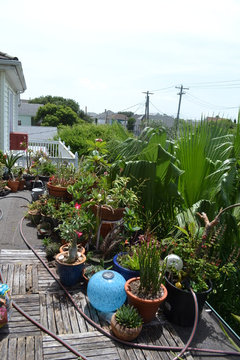
    no succulents or cactus in the windowsills, they are all out here on the porch roof


  • 11 years ago

    But in your climate, they could stay there all year long, I take it.

    Christopher


  • 11 years ago

    Chefmomster - Cloudy day and the pouring rain kept me in, I think we had the same idea. Your Haworthia retusa (I think?) looks like it's doing very well with all those pups.

    David - I don't get bright sun all day either, so I'm keeping an eye on which of your plants are doing well! I live in the GTA West. It's fun to have plants in common. =)

    Where did you get your different Haworthias? They look so awesome! Your Aloe variegata also has a really great shape. Also, what is the lumpy plant between your Cheiridopsis and Aloe? Is it a cactus?

  • 11 years ago

    I have to bring things in if a hard freeze or hurricane are predicted.