Software
Houzz Logo Print
rnatalie

Draft changes to 2017 code

11 years ago

Just perusing the newly released draft of what will become the 2017 version of the NEC. Here are some interesting changes that will apply to many of you.

GFCI: The existing codes have (for a long time) required 120V 15A and 20A receptacles installed in certain places (kitchen countertops, laundries, garages, outdoors, unfinished basements, near sinks) to be GFCI protected. This has been extended to include 240V receptacles as well.

GARAGES: The garage now requires its own 20A circuit for receptacles. Each car bay requires its own receptacle at a minimum.

AFCI: There is no longer any qualification on the rooms. All 120V 15A and 20A circuits serving outlets and devices require AFCI.

WALL OUTLETS: The spacing rule exclusion for sections of wall that have fixed cabinets on them (which used to not require receptacles) is qualified by stating that they must also not have countertops. If there's a countertop there, you'll need to follow the wall receptacle spacing rules over them.

KITCHEN PENINSULA: Slight changes to how the peninsula receptacle requirements read (where the measurements are taken and that you can use a wall receptacle on short peninsulas).

POOLS: Bonding terminals must now be copper, copper clad, or stainless and listed for direct burial. Certain underground wiring is now permitted closer than 6' to the pool. EMT is no longer permitted indoors on pool circuits. You can now put duplex receptacles in near the pool (provided they comply with the other requirements. Requirements for GFCI on pool lighting clarified. Bonding rules clarified.

Comments (7)

  • 11 years ago

    Ron-
    Thanks...that was both useful and clear.


  • 11 years ago

    I'm not sure what a neutral wire has to do with the subject of GFCI.


    The Official Version of the first draft is up on the NFPA page, just go to the NEC page and click on next edition. http://www.nfpa.org/codes-and-standards/document-information-pages?mode=code&code=70&tab=nextedition

  • 11 years ago
    last modified: 11 years ago

    I should have said a completed version of the first draft that I don't have to sign up and reregister for every time I get a new phone and can't find my old passwords etc.

    In my experience, a fault from a hot wire to ground will usually trip a standard breaker before it trips the GFCI, making the advantage of the GFCI more theoretical at that point than practical. A standard circuit breaker is already designed to trip for both over current AND short circuits (faults to anything grounded). A submersible pump, for example, is either running in perfect condition or tripping a breaker anyway. One of the biggest advantages to using a GFCI has always been that it will also sense a fault from neutral to ground which increased the chances of catching any problems earlier than with just a standard breaker. Without a neutral, the percentage of the likelyhood that it will be any benefit is less than the reasoning the CMP gives for not requiring the home run of a circuit to be AFCI protected.

    "CMP-2 also chose to delete 210.12(A)(4)(d), which required listing both the outlet branch-circuit (OBC) AFCI outlet device and the branch-circuit overcurrent device as a “System Combination.” This revision will basically allow the OBC AFCI outlet device to be installed at the first outlet of a branch circuit to provide the necessary AFCI protection. Substantiation for this revision provided significant statistical assurance that the “home run” portion of the branch circuit is protected from parallel arcing faults and the arcing for “hammer-damaged cable” exhibited arcing in less than 10 percent of the surge events and exhibited arcing that lasted over a single half-cycle."

    You can always argue that more redundant protection is always a good thing, but between these two changes, they are being completely inconsistent, and it sounds like these codes are being driven more by capitalism than consumer safety.

    I also realize that a GFCI is supposed to protect against much smaller faults that won't trip a breaker, such as through the resistance of a human, but equipment grounding will still cause a breaker to trip before a GFCI would be necessary in all but the most unlikely of circumstances. To put it simply, a hot wire fault to something grounded before the current is regulated by any resistors is going to trip any standard breaker. A fault to ground after the resistor is only possible if the return current is on a neutral conductor, for which a GFCI is necessary to interrupt the current.

    I am sure that I can come up with some scenario where a GFCI might be of minimal advantage on a 240 v circuit, but most of those are already required to be GFCI protected. GFCI protection for a 240 v receptacle intended as a disconnect for most fixed in place or permanent equipment without a neutral where it isn't already required is more of a nuisance compared to the more tangible benefits when used on equipment with a neutral.

  • 11 years ago

    You seem to have completely missed the point of GFCI. The GFCI triggers at milliamps not at the circuit ratings.

  • 11 years ago
    last modified: 11 years ago

    The POINT of a GFCI is for the protection of personnel.

    "210.8 Ground-Fault Circuit-Interrupter Protection for Personnel"

    The fact that a GFCI is capable of tripping at milliamps is merely the method employed attempting to further protect personnel, and far from the actual "point".

    Just because a GFCI will "trigger at milliamps" does NOT in any way limit the current to milliamps. THE CURRENT THROUGH A GFCI CAN STILL BE FAR GREATER THAN WHAT IS REQUIRED TO TRIP A STANDARD BREAKER IN LESS THAN ONE CYCLE. That is why the standard breaker will usually trip first when the fault is between a hot wire and ground.

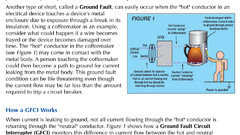
    The standard explanation for the need for a GFCI looks like this.

    The problem with this explanation is that it is completely fictitious. The "metal body" is required to be grounded. This means that a standard circuit breaker would have already tripped long before you ever woke up and smelled the coffee.

    There are simply too many instances where a GFCI doesn't provide anything more than a theoretical benefit and costs much more in damages from nuisance tripping to warrant such a broad blanket code. To have to run around the house before you go to bed every night to make sure your sump pump circuit etc hasn't tripped is rediculous. The fact is that unless you are dragging a freyed extension cord through the mud, almost every instance when a GFCI trips without the standard breaker tripping instead, or also, is due to a ground fault that occurs AFTER the resistance in the circuit. In other words, on the neutral. Furthermore, the vast majority of the time a GFCI trips, it is NOT due to a small current running through a human, but due to a frayed NEUTRAL conductor touching the metal appliance body or the grounding conductor in a cord or cable. This just gives false credence to people who don't understand what a "point" is, or how a GFCI attempts to meet its goal. While that type of tripping can help prevent a potentially dangerous situation, it is NOT the point of the milliamp rating of a GFCI. It does, however, inadvertently protect more people from shock than the ACTUAL point when a neutral is present, or for that matter, on occasions when a grounding wire is not present.

    But, again, 99.9% of the time a GFCI trips, it is NOT due to a current running through a human, which IS the point of the milliamp rating of a GFCI. Yet it is all the neutral to ground tripping that tends to point out potential hazards otherwise missed by a standard breaker that fuels the push for GFCI devices to be installed everywhere, not the actual point of the GFCI. The metal body of a coffee pot can only become a threat in new construction if there are other code violations at work, and if that is the case, someone has also probably removed the GFCI already as well, making the code moot. A GFCI usually trips long before the "point" of the milliamp rating is ever necessary, JUST LIKE a standard circuit breaker does. The urgency to protect a person from a 3' section of cord in a location where it is unlikely to EVER get any wear or damage is extremely over hyped. A GFCI was not deemed a necessity 15 years ago, and I doubt that there was some cosmic event that aligned a bunch of stars to make it necessary now. It is just corporate money making this decision. The number of things that would have to be wrong and circumstances to allign for the "point" of a milliamp circuit protection to actually play out as described in the situation illustrated above for SOME of the locations the new requirements mandate is less likely than winning the lottery TWICE.


  • 11 years ago

    I'm sorry, but I'm going to have to very much disagree with you. Your argument is entirely specious. If the personnel injected himself between the hot and neutral lines that would be one thing. The GFCI WILL NOT protect that, People are regularly saved by what would be substantial currents on the hot side.

    And your arguments on 240 is inane as well. While there isn't any neutral in those circuits, grounds (which are still at 120V potential to either leg of the circuit) are present EVERYWHERE. In fact, your specious argument on being on the "far side of the resistance" doesn't even apply as both sides of the resistance are at a dangerous potential compared to ground.

    But you know much better than the boys at the NFPA, UL, and the CPSC so go on doing what you want. Just stay away from any facility I have to live or work in.