Software
Houzz Logo Print
crazycjj3

Crab Grass?

11 years ago
last modified: 11 years ago

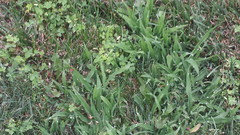
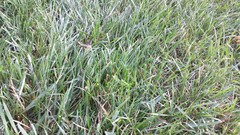
Is this crab grass or some other grass/weed? Thank you.

Comments (27)

  • 11 years ago

    That would help.


  • 11 years ago

    Looks like crab grass along with oxalis/black medic. Both of these are symptoms of improper care.

    Where do you live?

    How are you watering? How often and for how long?

    How high/low are you mowing?

    Do you know what kind of grass you have?

    Chris thanked dchall_san_antonio
  • 11 years ago
    last modified: 11 years ago

    Just purchased the house. Trying to get the lawn under control.

    House is on Long Island

    Water on even days for 15-20 mins a zone.

    I just moved the mower to the 2nd highest to try and shade some of the weeds out.

    I am unsure of the grass type.

    The lawn has spots of nutsedge and white clover that i have been trying to get a hold on.

  • 11 years ago

    First of all that photo you took could be the poster photo for crabgrass. NICE JOB!

    You're watering too frequently and likely not long enough. Put some cat food or tuna cans out and measure how long it takes to fill the cans. Do that for each zone because they will be different. The time it takes to fill the cans is the time you should be watering the various zones. If you are getting temps in the 90s then you should be watering 1 inch, all at one time, once per week. There are a lot of factors that go into the frequency, but they boil down once a week with temps in the 90s, once every 2 weeks with temps in the 80s, and increasing by a week with 10 degree increments. Deep and infrequent watering works in Phoenix and in Vermont. It should work for you. There are a couple reasons for watering 'deep and infrequently.' In your case it would be to keep all your weeds out. Weeds need frequent watering and moisture at the surface for the weed seeds to germinate. Once you stop doing that and allow the soil surface to dry out completely, you'll stop seeing a lot of those weeds. Nutgrass is a swamp type plant, so that says something about how moist your soil is under the surface. I've been very successful at ridding my yard of nutgrass since I've been doing deep and infrequent. Of course this year Mother Nature had other plans for Texas, but still I have no worries that it will go away when we go back to the normal drought conditions.

    Moving the mower higher will help with new weeds, but you'll have to spray or pick out the clover and oxalis. Are you sure
    it's white clover? I didn't see any clover in the picture. White
    clover gets globular white flowers. The oxalis gets tiny, flat, yellow
    flowers. If you spray use Weed-B-Gone Chickweed, Clover, and Oxalis
    killer. Regular Weed-B-Gone is not a high enough strength to take those
    weeds. You'll have to spray once to knock down the plants you can see
    and again in a month to kill the new ones that sprout from seed. The Weed-B-Gone will not touch the nutgrass. Nutgrass is in the sedge family - it's not a grass at all. There is a spray for that, but I would hold off until you get on the deep and infrequent watering schedule and see what happens. But that's me. You might not have my patience for waiting for the weed to die out. If not the nutsedge killer is either Sedgehammer or Image. Follow the directions on the label.

    Chris thanked dchall_san_antonio
  • 11 years ago

    Thank you. I have re-programmed my sprinkler system for less often, but longer as you mentioned for a deep soak.

    I have been having success with pulling out the nutgrass as it sprouts, hoping to use up all the reserves and kill them off after a round or 2 of that. There is not too much, just a few small manageable patches so far.

    It is definitely white clover, i have been hand picking those and the other random weeds and put a layer down of weed-b-gone on the larger patches.

    What is the best path of action for the crab grass section. I will have to post a picture of that because there is this one section that just filled up with it.

    80% of my lawn is in good condition, but the last 20% is where the previous owners dog/children were, so lots of bare spots that are now weed infested.


  • 11 years ago

    On the up side, crab grass dies at frost. So if you keep it mowed, it won't output too many seeds from this year's crop.

    On the down side, what seeds it can put out is more than enough to bring it back next year--and there are plenty of seeds still in the soil. Waiting.

    On the way up side, crab grass dies easily with one shot of Weed B Gon Plus Crabgrass Control (available at any big box store). Reapply as necessary when crabgrass re-sprouts, plus consider using a pre-emergent like Dimension or Barricade next spring to stop new sprouts.

    That spray will also take out most incidental weeds, but won't do much for your nutgrass (nutsedge) problem.

    Sedges can survive many, many removals (ask me how I know...) Tenacity or Sedgehammer take them out, however. Round Up may or may not as it simply kills too fast, removing the existing greenery but not killing all of the extensive system of root nodules (and Round Up will kill any plant it touches, so it's not for use in lawns). I've had mixed, but generally good results, using slower-killing broad-spectrum herbicides in the garden, but those wouldn't work in grass as they'll also kill the grasses.

    So if you can't get it out by pulling, use Tenacity, Image, or Sedgehammer (Tenacity can be stored for at least a year, Sedgehammer goes bad much faster, Image I don't know).

    Three, that lawn is starving. I never recommend feeding in July, so let's hold off a bit. Around August 1, you can apply Milorganite or any other organic. Or you can use any synthetic fertilizer around September 1. Dealer's choice.

  • 11 years ago

    Morpheus or anyone else, how have your results (or heard how it works for others) been with Weed B Gon Plus Crabgrass Control? I bought Drive to take care of my problem and have overall been pleased although there are large patches of it that just aren't going away. These areas are much more established so maybe that's the reason. Drive is a little pricy so if the Weed B Gon product really does work then I may give it a shot.

  • 11 years ago

    I've used it and it does work, but may require two shots in some areas.

  • 11 years ago

    Ditto, but like most post-emergents, it doesn't work very well or at all on mature CG. Applying Dimension or Barricade in the Spring and then diligently spot spraying any newly emergent plants throughout the Spring and Summer with WBG Max has eradicated it from my lawn.


  • 11 years ago

    Assuming you'll be spraying to kill the crabgrass and other weeds before the first frost, then you'll have bare spots that need to be filled THIS FALL. Since you don't know what kind of grass you have you'll be taking pot luck at matching the new grass seed with the existing grass. I would get a good seed but not the world's best seed. Since crabgrass grows in full sun you can use just about any grass to fill in. Look for a box/bag of seed with low Weed and Other Crop content. Zero is best but you might have to settle for 0.2% or so. Start looking now. The idea is to form a dense turf this year before the first frost so it will be ready for the summer heat next year. Dense grass fights off weeds, too, so you can look forward to a much better looking lawn next year.


    Here are a couple of general differences between the two most popular grass seeds you'll see in the stores. Fescue will remain green all year. Kentucky bluegrass almost always goes dormant (tan colored) in the winter. Fescue thins out for various reasons and will not refill itself. It needs to be reseeded in the thin spots every year. Kentucky bluegrass forms a mat of grass and will refill if it gets damaged. Read the labels carefully. There is a substandard form of fescue called Kentucky 31. Calling fescue Kentucky is simply confusing. Any grass seed with Kentucky 31 in it will give you a weedy look from now on.

  • 11 years ago

    On Long Island, with a slightly more moderate and much more ocean-influenced climate than I have, Kentucky bluegrass can probably be convinced to stay green all year. Or at least most of it, with the exception of January and February.

    The key there is a good soil balance, and feeding properly in fall (when most food should be applied to KBG).

  • 11 years ago

    >>>Fescue will remain green all year. Kentucky bluegrass almost always goes dormant (tan colored) in the winter.

    Where in the world did you get that?

  • 11 years ago

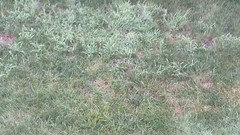
    How can you tell that lawn is starving?


  • 11 years ago

    >>How can you tell that lawn is starving?

    The color, quality, density, and growth rate compared to the weeds. Assuming that's not in deep shade (where crabgrass wouldn't do well), we're left with a resource shortage.

  • 11 years ago

    What about the color is different? I'm trying to learn what a hungry lawn looks like, but that grass looks pretty dark green to me?


  • 11 years ago

    It's kind of dull. Look at the blades--notice that kind of grayish hue? It's nothing extreme, but it's definitely there, and it's there in a lawn that's not terribly dense.

    The dark tone runs counter to my statement, but I'm still sticking with it due to the fact that the crabgrass is effortlessly overgrowing the lawn.

    One other thing I notice is that the blades run every which way, and just look kind of tired. That can be indicative of poor feeding or low levels of water. And in this case, the crabgrass doesn't help you figure that out--CG looks great even in severely dry conditions.

  • 11 years ago

    Thanks!


  • 11 years ago

    When the CG is gone, what should I put there so new weeds do not just re-grow in? Definitely not a good time to seed from what I understand.

    The previous owners left a lot of dirt spots that all turned to these weed patches.

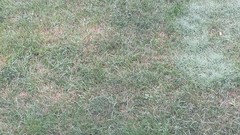
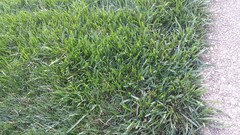
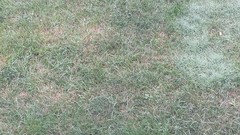
    Also, are you able to ID grass if i send a close up picture. 85% of the grass is similar, but there are a few random squares that are a different color/type of grass.

    CG trouble spot across the top.


    Different type of grass on the upper right


  • 11 years ago

    >>>Fescue will remain green all year. Kentucky bluegrass almost always goes dormant (tan colored) in the winter.

    Where in the world did you get that?

    I got that from owning a house in Dayton, Ohio for a spell and from reading lawn forums for 12 years. Which part do you disagree with (probably should start a new topic if it's worth discussing)?

  • 11 years ago
    last modified: 11 years ago

    It's just that my experience is that KBG almost never goes dormant (tan colored) in Winter. Especially if winterized. If it's been an especially hard Winter [extremely cold with persistent wind and little snow cover or prolonged snow cover-+6 weeks], there is light to moderate blade tanning but nothing close to the look of a real Summer drought dormancy. I'm pretty sure any KBG lawn owner would say the same. On the other hand, it is not unusual for fescue lawns around here to start many a Spring almost totally tan/grey. Maybe you were thinking of Zoysia?


    Edit: The reason I brought it up here is that I think that it just isn't a reliable indicator of KBG for purposes of identification.

  • 11 years ago

    yardtractor I agree. I mean, dchall has forgotten more than I know, but my KBG came from the sod farm two Octobers ago, and it was very green all through a cold NJ winter, probably because of good resources. Then, last winter it stayed green all the way through again. I did winterize and even took photos and posted on another thread because it was much greener than my neighbor's KBG. He probably didn't winterize. I forget if it is the P or the K, but one of them helps with winter hardiness!

    Just my experience.


  • 11 years ago

    While both P and K (and iron, don't forget the iron) help with winter hardiness, the K is the real kicker.

    Winter domancy depends on your winter weather. Two years ago, mine went mostly dormant for winter, a rarity, but temperatures were under 20 most of the time, winds were stiff, and there was very little snow cover for the early part of the season.

    Last year's weather was nearly identical, but with far more snow. The lawn went about half dormant.

    My mother's lawn did the same, and it's a simple builder's tri-mix. The fescue and rye didn't perform much differently than the KBG, they all looked the same, and outperformed all the surrounding lawns.

    However, other area tri-mix lawns went fully dormant over the winter (including the KBG) and do so almost every year. Very poor fertilization and no soil tuning are the cause there.

    I can't imagine keeping a lawn green over winter in North Dakota consistently. I can't imagine that it's a major issue to keep a Pennsylvania lawn green over winter most years as I manage it. New Jersey is a snap due to the warmer weather, ocean influence, and more urban (heat island) settings.

    Areas north and west, with consistently colder weather, will vary.

    So you're both kind of right, just talking about different climates. But it isn't a defining characteristic of KBG that it'll go dormant in winter. I have photos during an ice storm of my deep green lawn surrounded by an ocean of brown.

  • 11 years ago

    I hope I didn't leave the impression that KBG will not go dormant given conditions (climate or weather). I just wanted to clarify that it was not an annual trait like, say, Zoysia for purposes of identification.
    A more dependable alternative: http://turfid.ncsu.edu/ItemID.aspx?orderID=GR&orderDesc=Grass

    Sorry for the derailment OP.


  • 11 years ago

    Let's get back on track here

  • 11 years ago

    Ball's in your court Chris. What type of grass do you have?


  • 11 years ago

    When the CG is gone, what should I put there so new weeds do not re-grow in?

    I am not sure of the grass, but will post images below if anyone can ID. 85% of the grass is similar, but there are a few random squares that are a different color/type of grass that i will post at a later time.