Hi All -
I'm having problems with our perennial rye lawn. I live in Oregon. I'm going to throw a lot of information and pictures at you and I hope that somebody can help.
History:
We excavated our lot in September 2013 to prepare for construction. The lot was primarily dirt when we finished our house in May 2014. We had our irrigation system installed late July. We immediately started watering to encourage weed/grass growth. We sprayed anything that would grow with Glyphosphate twice before seeding. We had our perennial rye hydroseeded the second week of October in 2014.
Up until about 2 months ago our lawn looked absolutely beautiful. I mow my lawn between 3-3.5" and I was manually removing all weeds and non rye grasses. I was really working hard to have a perfect lawn I'm willing to put in the work to keep it looking great. Unfortunately, it looks pretty bad now.
Background on the series of events that led to my lawn looking worse:
1) I aerated, top-dressed, and overseeded a lots bare spots and fertilized with a starter fertilizer in mid April. We watered 5 times a day, 15 minutes per zone. I used the same watering schedule when we initially planted our lawn in October. A few spots didn't take so I reseeded after about 6 weeks and continued with the watering schedule for about 7 weeks (until early June).
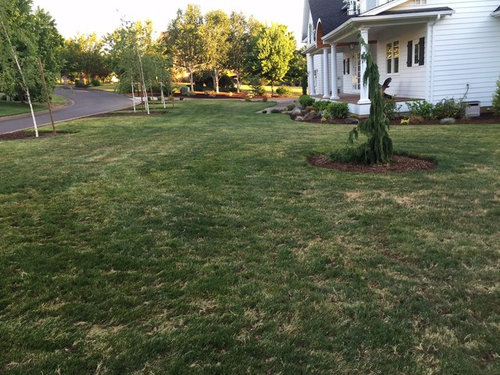
Here is what our lawn looked like on May 18, about 6 weeks after reseeding:
- Late May - lawn was starting to yellow in spots. I thought that the lawn might have a fungus because of the frequent watering and warm nights.
3) June 3: In addition to a potential fungus, I thought that the lawn might be lacking nutrients so I hit it with some milorganite. I also applied some corn meal at the same time (corn meal for an organic way to treat a potential fungus).
4) June 5: All the seed from the reseeding process had germinated so I changed the lawn's watering schedule AND left town for 7 days. I I wanted to start encouraging deep root growth so I reduced the watering schedule detailed in step 1 to watering every 3 days for 45 minutes a zone. Stupid! Unfortunately, the day after I left the watering schedule took effect AND we were hit with 4 consecutive 95-99 degree days. The lawn was only watered once during that time period. I was at work and I didn't hear about how bad the lawn was looking until after day 4 of the 95+ degree weather. I asked my wife to start watering daily again, 45 minutes per zone (1 time a day).
5) When I returned from my 1 week trip the lawn was in pretty bad shape and I lost some of the reseeded grass. I figured it was all due to the hot weather and I panicked, changing the watering schedule to 45 minutes a zone, 3 times a day. Here is a picture of what the front lawn looked like June 22 (notice the difference between this picture and the first picture, which was taken just over a month earlier). This is the front yard, the back yard looked a lot worse.
6) Fearing I might lose the lawn, I had the company that sprayed in our original hydroseed to take look and they said that they were having trouble shoving a screw driver a 1/8" into the soil in most of the yellow spots. The soil was compacted and the water wasn't being absorbed. They said I should irrigate in shorter, more frequent bursts so that the soil had a chance to take in the water. I switched to watering 15 minutes per zone, 6 times a day.
7) Trying to help, I aerated the entire lawn mid June to help with water absorption.
8) Finally, I hit the lawn with some baby soap sprayed from a hose end sprayer. This seems to have really softened up a lot of the spots that I could not put a screw driver into about 4 weeks ago. I'm actually getting a lot of mushrooms in the lawn now. Weird.
9) The NW has been hit with some really hot weather this summer which is going to be tough on any lawn, especially a young lawn like ours. I bet we've had about ten 90+ degree days in the last 2 weeks.
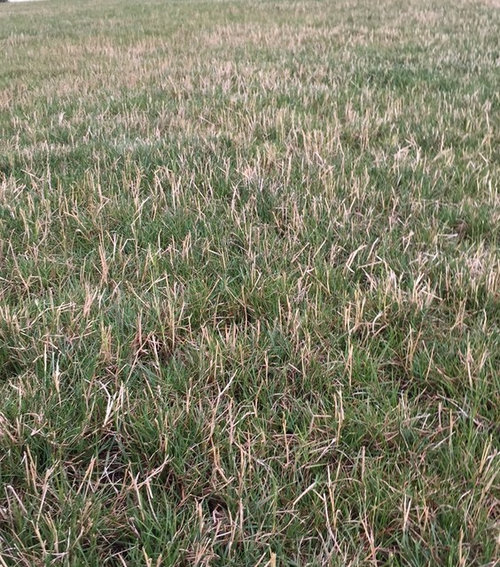
My lawn is slowly greening up again and I'm actually seeing some great growth in the areas I reseeded, but I have a lot of dead, yellow, thick sheaths that I don't know what to do with.
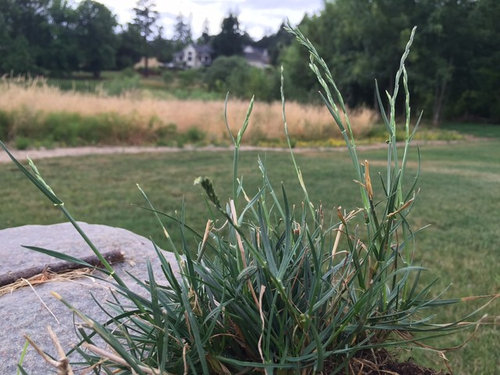
Here are some close pictures of the worst areas:
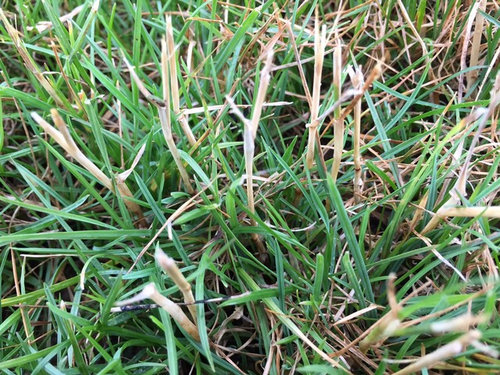
Closer:
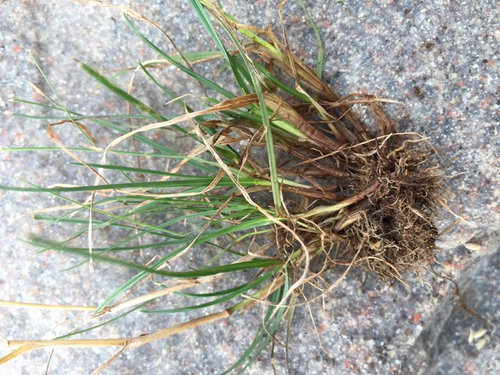
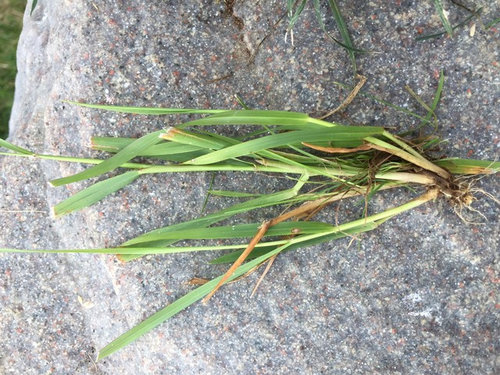
Plucked from the ground:
Questions (please forgive me if I'm using the wrong anatomy terms):
a) Are the brown, dead sheaths perennial rye or do I have some native grass that has invaded my lawn? Note: I was really diligent in manually removing any non perennial rye grass up until June so I can't imagine noxious grass invaded and grew that large in such a short amount of time.
b) If it is perennial rye, how do I get rid of the dead, yellow sheaths and why are they forming? I prefer the much softer grass blades and I'm not sure what I did wrong to get the thicker sheaths?
c) I mow once a week but some of the grass grows really, really quickly and it usually has some sort of seedhead. Here is a clump that I pulled from the ground. It seemed to want to come up all together so I assume it's all the same type of grass and I assume it's perennial rye. This was mowed 6 days ago.
I'll admit, almost everybody's lawn looks really bad this summer because we've had several 90+ degree days over the past few weeks. I want to make sure that I'm doing what I can do t maintain and potentially improve what I have with the goal of 'fixing' it this fall. I definitely don't want to make things worse. I'm hoping that some other grasses haven't invaded my lawn and I'm really confused with the thick sheaths next to the soft blades. A good 3/4 of the yellowing in the lawn is due to these thick, dead sheaths.
I know that I have at least 1 different type of grass in a few random areas at the bottom of our lot but I'm not sure what it is yet. Here is a picture (it's a lighter green with larger blades when compared to the rye):
d. I've been manually plucking these clumps of grass but unfortunately I think I'll need some sort of herbicide this fall or it's going to over take the rye in spots. What type of grass is it?
I realize lawns take patience and that I've thrown a lot at it over the last 3 months. I hope whatever I'm seeing now can be corrected this fall. I've given you a lot of info and asked a lot of questions in this post. I apologize for info overload, I just want to get it righ! Thanks in advance for the help!! Have a good one......











blackdirt_cowboy
PKponder TX Z7B
Related Professionals
Palm Bay Landscape Architects & Landscape Designers · Tampa Landscape Architects & Landscape Designers · Anderson Landscape Architects & Landscape Designers · Chatham Landscape Architects & Landscape Designers · Cowansville Landscape Architects & Landscape Designers · Orlando Landscape Contractors · Roanoke Landscape Contractors · Sterling Landscape Contractors · Emporia Home Builders · Manhattan Home Builders · Lake Charles Home Builders · Syracuse Home Builders · Madison Home Builders · Gillette Home Builders · Rock Springs Home BuildersUser
Bryce NOriginal Author
User