Software
Houzz Logo Print
laticauda

clumping lithops

11 years ago

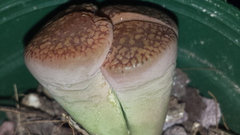
I didn't get a picture, but I found this with two perfectly desiccated leaves and decided it was worth the exorbitant amount of money they wanted for ONE Lithops.

Anyway, I've always wanted one that had clumped. Now I just gotta make sure I don't kill it.

Comments (26)

  • 11 years ago

    Anyone know what it is that causes clumping? Is it more prone in certain species more than others?

  • 11 years ago

    Any Lithops gurus out there?

  • 11 years ago

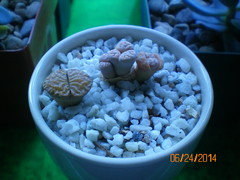
    I really don't have much experience growing Lithops, but I have seen ones similar to yours grow in beautiful clumps at a particular nursery I've been to:


    Here is my clump of Lithops, which I just repotted today. It's a little plump (it came that way), but I hope to get it under control over the next few months:

  • 11 years ago
    last modified: 11 years ago

    Hm...those are community pots (which I've read kills Lithops because each one needs it's own watering program for the individual plant but I've never personally dealt with them so can't say from personal experience. How much does one of those pots cost? It may be worth it for you to buy them and pot them up individually. You may even be saving their lives....or dooming them to a long and torturous death. Kinda like me with mine!

    This one naturally split and grew into a natural clump. Both of those bilobes emerged from just one set of leaves. They share one taproot.

  • 11 years ago

    Each pot was $9, single Lithops were $3, which is the cheapest I've seen to date. This nursery was quite far away from I live. Normally I see single Lithops for at least $6 each, which seems a bit much for a tiny 2" pot.

    When repotting mine, all the roots were a single tapered cluster as if it was a large single tap root. The soil was extremely hard and I really had to blast it with the hose sprayer and pick it apart with my dental pick. Perhaps I should have soaked it in warm water, but I was worried about exploding them? The roots looked quite healthy.

    It would be awesome if someone else chimes in if it's possible mine are one root with many heads?

    I have seen a few GW members grow Lithops in community pots. They look very interesting and have been quite successful. Of course, I think there is an extra level of patience and experience that's required, since each Lithops may not synch up growing stages with the others.

    Based on what I've seen, new Lithops leaves can grow in pairs, triplets (rarely), or quadruplets. Honestly, I never took special note of which species was growing leaves like that since I never expected to own any/many Lithops myself.

    The plant I posted above was an unexpected purchase and I was already happy enough with my single Lithops bromfieldii var. insularis cv. sulphurea (I think).

    Hopefully either of us don't lead our Lithops to a slow and tortuous death. =P

    laticauda thanked ewwmayo
  • 11 years ago

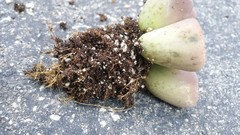
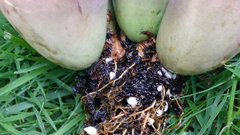
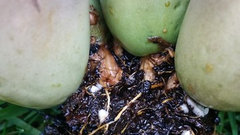
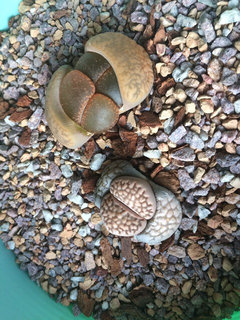
    As a follow up, I just repotted another Lithops clump. Took some additional photos to show what Lithops tap root looks like and, in particular, what it looks like for a clump.

    I believe this is a Lithops hookeri, due to the colouration and size. My second best guess would be Lithops aucampiae. They look similar to yours, laticauda.

    Here it is dry:

    Here it is overall. The roots were just one mass. It's always cool to see the whole fleshy body of Lithops!

    Took a closeup of where all the stems stick out.

    I didn't break it apart further, since I didn't want to damage them, but it appears that they are joined. If they were 6 plants grown separately then stuck together, I would have expected them to separate easily - like normal succulent pups.

    Last photo - repotting completed:

  • 11 years ago

    Let me show you what I mean :)

    I cannot separate mine as you have yours. They are one plant. That whole thing came from one plant that had only two leaves/lobes (?)whatever the correct term is(?).


    I could be totally wrong on this and if so, someone correct me Yours are multiple plants that were planted together as seeds or as seedlings. Their fine roots have intertangled with one another and they probably should have been separated long ago (from what I'm reading, which doesn't really say much cos anyone can write anything on the internet) to prevent watering issues in the future.

  • 11 years ago

    I do understand what you meant about 4 leaves on one stem. They can grow with normally 1 or 2 pairs of leaves, but can be 3 leaves sometimes. Despite being just a beginner at growing these, I have been reading a lot on them for the past while! =)

    Here is my source: Lithops Hookeri Description of Llifle

    Description: Lithops hookeri is a medium to very large species, up to 46 X 35 mm, usually about 30 X 23 mm. with up to 10 or more heads (mostly 2-4).

    Bodies (paired leaves): Obconical, truncate, top surface flat to slightly convex. The face is elliptical more or less equal. The fissure is shallow 3-7 mm, the lobes are conjunct.

    Here is another source: Terry Smale (apparently friends with Steven Hammer? Despite the ugly website, has many written publications.)

    Sometimes, two new heads will develop inside the old one and by this method the plant will eventually form a clump; the record was a plant of L. salicola comprising over 350 individual leaf pairs.

    The record holding plant is also mentioned on Cactus-Art, which also discusses clumping Lithops. Kind of wish I could see a photo of this plant!

    If we're talking about community pots, here is the most interesting one I've seen to date (NOT my photo):

    LITHOPS bowl containing all 35 species. It was made up specially for an exhibit in the NCCPG Heritage Marquee at the 2004 Hampton Court Flower Show.

    A guess the number of plants competition to raise money for the NCCPG was organised. It was won by a lady in Kent with the correct number of 149

    The Bowl has been awarded a Cultural Commendation by the R.H.S

    Source: http://www.abbeybrookcacti.com/lithops.htm

  • 11 years ago

    I appologise for poor quality photos...this one grew body with 3 leaves + another body with 2 leaves:


  • 11 years ago

    Wow! That's amazing! Is that species prone to clumping like that? If not, what do you think you did to cause this to happen?

  • 11 years ago

    Rina, here are more like yours -weird triplets! http://www.cactiguide.com/forum/viewtopic.php?f=12&t=35808&sid=6867bcd5b603b33e5a751a3b404fa8e0

    Laticauda, Iann on those forums is very knowledgeable and speaks about specific species and his general observations of this Lithops behavior too (in that same thread).

    laticauda thanked ewwmayo
  • 11 years ago
    last modified: 11 years ago

    Apparently, I turned off my alerts for thisnthread, how do I turn them back on? EDIT: k. Fixed it.

    Anyway, thank you, Erika. Your clumped lithops looks like two separate bodies, perhaps they are connected underground? Will mine eventually separate like this?

  • 11 years ago

    I have its twin. And it just multiplied for me this year, producing a "clump". It has not yet flowered for me, and j really want to add more to this pot but also don't want to disturb these two. So I've let it be for now.

    I just realized I haven't taken a recent photo of it the old leaves are completely gone now. And I have resumed watering


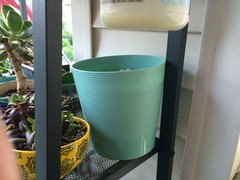
    And here is a side view I the pot if your curious it's about 6" tall. I know they have deep tap roots so I looked for something tall and realitively narrow

  • 11 years ago

    Hello laticauda,

    Yes,
    they do look like separate plants but they have one root. If you brake
    them apart tgough, one that ends up without the root can be rerooted
    quite easily. And yours will separate eventually too, they were just too cramped inside old leaves so they stayed cuddling for this season :)

    deva33 your lithops look very nice. When you repot them in the future I'd suggest to rise soil level almost to the surfase. This way the light is not blocked by the rim of the pot (helps to avoid etiolation) and you have a full view of those pretty knobbles. Lithops usually flower in autumn, so yours still might.


    laticauda thanked damnsoul
  • 11 years ago

    I hate this website and touch screens forever.

    *shakes tiny fist* *everyone laughs*

  • 11 years ago

    which website do you hate?

  • 11 years ago

    I'll type up a really long reply, sometimes even with pictures and sometimes in a flash it's all gone.

    I just end up posting some compliant instead of retyping what I was going to say.

    It's just frustrating, but I keep coming back so I guess I shouldn't complain so much.

  • 11 years ago

    I don't know what problems you have with posting - while it does happen sometimes, it's quite seldom (disappearing post). I never had one to disappear since I joined 4yrs ago, unless I hit wrong key.

  • 11 years ago

    Yes, I believe it has to do with it being a touch screen or when you wake it up, sometimes it refreshes the page.

    These things are touchy.

  • 11 years ago

    Very cool. I've gotten into lithops again, but the closest place that sells them is 30-40 minutes away.

  • 11 years ago

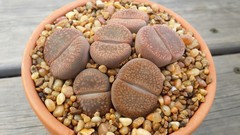
    Erika. do you know the species of lithops to the far right in your photo? It looks just like the one I have. Thanks, Jack

  • 11 years ago

    Hello Jack,

    Sorry, I did not sow it, I bought that one, it was a mix so no label. Some sort of L. hookeri I believe.

  • 11 years ago

    I agree, looks like L. hookeri to me as well.

  • 11 years ago

    Thank you

  • 10 years ago
    last modified: 10 years ago

    How do you water this? I have a lithop with two heads. One of the head, old leaves are dried out and the new leaves are getting soft :( but the another head, its not dried out completely.

    what should i do? i cant water my lithop since one of the head., their old leave is there. Also, the new leaves are growing another pair of new leaves inside them.

    http://forums.gardenweb.com/discussions/3777003/lithtops-problem-leaves-water

    Any advise , i would be thankful.

    Thank you,

    Danny