Software
Houzz Logo Print
cottagegardenfee

Weed infested, steep, long slope -- HELP!

11 years ago
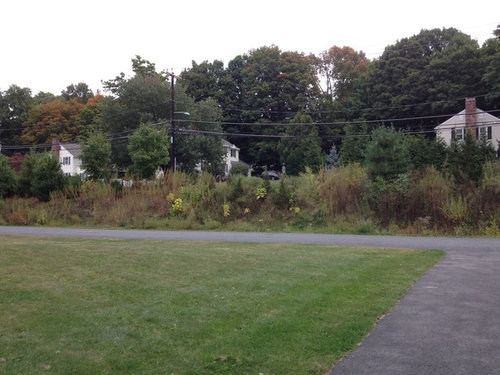
Hi, all, I'm doing some volunteer landscaping at a local high school, and would like to transform a large, long, steep slope into an example of sustainable landscaping by using low-maintenance, native and xeric plants. The site is currently a devil's lair of weeds, including bittersweet, crown vetch, bindweed, garlic mustard, and hundreds of others. The soil is very loose. The high school has to use only organic, safe solutions, so Round Up is not a possibility. The weeds are truly overwhelming. Yet the site has the potential to show people how beautiful some of our native New England

plants are, and how we can make something amazing without using chemicals. I have some experience in gardening and landscaping, but would welcome ideas. It will take many years to get to a reasonable landscape, I think. You should see me drool over Piet Oudolf's naturalistic landscapes, but I know this isn't a possibility in this case. This photo doesn't show recent plantings, such as asclepsias tuberosa, ninebark, false indigo, coreopsis, prairie dock, ironweed, russian sage, agastache, etc. Thoughts, please?

[[(https://www.houzz.com/discussions/weed-infested-large-steep-slope-wish-to-plant-natives-xerics-dsvw-vd~3232420)

[[(https://www.houzz.com/discussions/weed-infested-large-steep-slope-wish-to-plant-natives-xerics-dsvw-vd~3232420)[[(https://www.houzz.com/discussions/weed-infested-large-steep-slope-wish-to-plant-natives-xerics-dsvw-vd~3232420)

Comments (7)

  • 11 years ago

    I find Roy Diblik (he is Peit Oudolf's plantsman for the Lurie in Chicago among other thing) provides some really interesting models for this kind of work.

    http://blogs.nybg.org/plant-talk/2014/04/nybg-shop-in-the-garden/the-know-maintenance-perennial-garden-an-interview-with-author-roy-diblik/

    However I want to second what mad-gallica said about maintenance.
    While I still consider myself an amateur in my own garden, I have spent many
    years in and around professionally managed landscapes. Remember, those Piet Oudolf
    spaces you (and I!) drool over are almost all professionally staffed as well as
    primped and polished for their photo shoot.

    When these landscapes are described as “low maintenance,”
    they are being compared to older models of institutional and commercial
    landscapes where new annuals were often planted two or three times a year and turf
    had an aggressive weed, feed, irrigate, mow, do-it-all-again schedule. If there
    were perennials, they were in those beloved and frustrating mixed borders where
    you have to divide the iris without disturbing the peony and cut back the
    grasses without tromping on the emerging bulbs. Compared to those plantings,
    large swaths of perennials with similar needs are low maintenance, but only compared
    to those plantings. Nothing will be
    lower maintenance than what is on that banking now!

    One of the really important and underrated factors in successful
    naturalistic plantings on campuses and large institutional gardens is that they
    receive regular attention. The staff
    may say something like, “All it needs is clean-up in fall and a little infill
    planting in spring and that’s it!” What they don’t talk about (and sometimes
    don’t even see themselves) is that these pros are looking at the plantings
    every few days, if not daily. When they spot a tendril of bindweed, they whip it
    out in an instant – quick and easy. That
    is very different from the bindweed insinuating itself undisturbed for months
    until the next seasonal clean-up. By then the low maintenance landscape becomes
    a high maintenance nightmare.

    That said there are some good native options for your site – asters come to mind with the bonus of
    blooming later when school may be in session and more folks might be around to
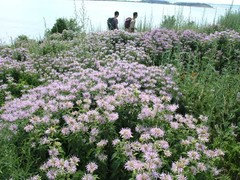
    enjoy your work. Bee balm (Monarda fistulosa)
    did well on Spectacle Island in Boston Harbor. It can be too much in a regular garden but might work really well in the setting you have.

    http://www.landscapeonline.com/research/article.php?id=18491

    New England Wildflower Society has some good options and even kits of plants.

    http://www.newfs.org/store/meadow-kits.html


  • 11 years ago

    Ultimately you have two options. You can weed it every week or two. Or you can plant a lot of very aggressive native shrubs, weed until they get big and established, then maybe you can get away with weeding a couple times a year. Choleberry is one of the few plants that can choke out poison ivy.

    This is a site with plants recommended by the State of Massachusetts for Landscaping a Coastal Bank.

    These plants were chosen partly for salt tolerance, but partly for erosion control. Most of them should be xeric.

  • 11 years ago

    Mulch, mulch, mulch........

    i have a slope in my front yard and while it was being established we had yards and yards of mulch delivered to help smother weeds/grass, control erosion and help with moisture control. We did that for about three years. We no longer have to mulch at all. Some of the weeds you're dealing with can be a bit more of a challenge.......

    shrubs, shrubs, shrubs.......

    shrubs generally equal low maintenance if you choose wisely. They'll fill in a lot of ground and with a nice variety, the slope will not be boring. Especially if you use roses that bloom all season. 'The Fairy' is one of my favorites for continual bloom.

    then fill in with easy perennials like single peonies that don't require staking and can really make a statement, blocks of daylilies, asters, etc.

    There is no way around a fair amount of maintenance for the first 3-5 years with regular watering, weeding, etc. Again, mulch helps a bit with this. But once everything fills in and becomes established, most shrubs and easy perennials can do well with rainfall. We rarely water our slope and it is filled with shrubs and perennials.

    i weed the slope once or twice a season just as Ed mentioned above.

  • 11 years ago

    Thyme speaks from experience, and while I have no personal experience with this type of project, those suggestions are what I was thinking I would do in this situation. Lots of native shrubs, lots of mulch, and regular maintenance - hoping it would decrease over time! There are so many beautiful native shrubs that the area would certainly look lovely.

    As far as prepping the area, I think there's nothing to do but roll up your sleeves, get on your knees, and start pulling weeds! I would lay down at least newspaper or cardboard as you weed to help keep the cleared area cleared. If you wanted to plant this fall, I don't think I would mulch just yet, as it might be more work to pull back the mulch to plant, so I would hope the paper/cardboard would work temporarily, plant the plants in fall, and then mulch. If you are planning on planting in spring, then you might want to to mulch now - but honestly, I think I would wait till fall and mulch with shredded leaves - they break down easily into the soil and I find with old leaves it's not quite as important to completely pull them back to plant.

    Does the school have some kind of gardening club? If not, perhaps look into getting one up and running. School gardens (both vegetable and flower) are becoming very popular as a teaching tool across all curricula, and perhaps you can find a teacher or parent who may help get a group started - or approach the PTA,etc. There is even funding out there to be found for this to help you get started on this project. Often master gardeners-in-training take on school garden projects as part of their volunteer requirements, so that may be a source of info and physical help as well. This page is a bit outdated, and more geared toward vegetable gardens, but perhaps will give you some ideas to get started on the "help/maintenance" side of things: http://ctnofa.org/School_Resources.html

    Kudos to you for taking this on! It's very exciting! Please keep us posted as to your progress. I look forward to seeing what you do with this space!

    Dee

  • 11 years ago
    last modified: 11 years ago

    You have an admirable goal, but I am another soul that wants to weigh in on the side of caution as far as perhaps getting into a project that's potentially unmanageable. So I have a bunch of questions and comments as well as some links to add to what others have said.

    Can you get a group of volunteers to meet and help on a regular basis in maintaining this? I know the Peterborough NH parks' gardens are all volunteer maintained, but they meet once a week in the early morning for a few hours and there are several in the group. The man who is the designer and organizes the crew has a list of specific tasks each week. Here's a link to the part of his blog that discusses the setup of what he calls a public-private partnership, so the gardens were installed by the town dept. of public works, but are maintained by volunteers about whose work he occasionally writes. You can also click on each garden on the right side of the page for more info. His are more traditional looking gardens that what you are envisioning, but both need maintenance. One of his most useful pieces of advice to my mind is "Design only what you can maintain at the highest level. Long-term maintenance is the key."

    Are you interested in only native New England plants? It seems as though you want to include them, but also some hardy, low-care non-native perennials (Russian sage.) By nature, New England is naturally a forest, so does your goal include woody plants such as trees and shrubs? If not, you will have considerably more work removing woody plants that will try to move in courtesy of the natural ways plants seed themselves into new territory. The books of William Cullina (former director of the New England Wild Flower Society (NEWFS) and current director of the Coastal Maine Botanical Garden) will be of help in finding natives that suit your situation as will the many resources of the NEWFS.

    Because that is a cut bank, it is subsoil and not all plants will be happy there with low nutrients and fast drainage, so keep that in mind when choosing plants. You might want to get a soil test done. The area at the top will be much drier than that at the bottom, so plan and plant accordingly. Michael Gordon of Gardener's Eye says, "Prepare soil properly from the onset" which in your case (since you can't dig other than to plant on that slope) may include adding some slow release fertilizer, some compost and as Thyme2dig says above, mulch, lots of mulch. Mulch in the short term will discourage weed seeds from germinating and help maintain even moisture, and long term will add to the soil fertility. I would recommend either curls from a wood turner or chips from a tree service or the crews that maintain the local power lines since both will break down well and until them be more stable on the slope than some other mulch options, and either is free.

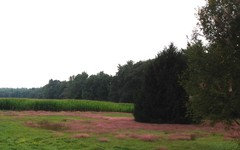
    Have you got the support of whomever does the maintenance for the rest of the property as well the administration? For instance, many of the plants you will want to use are spreaders, either by seed or by runners. If they seed over into the lawn in your photo, will that cause issues? As an example, my back field (quite nutrient poor, sandy acid loam on a very slight slope) has two of the grasses mentioned in the meadow kit from the NEWFS, Eragrostis spectabilis (purple lovegrass) and Schizachrium scoparium (little bluestem). Both are happy in the poor soil, generally low maintenance (the field gets mowed twice a year) and gorgeous in fall. In this photo the lovegrass is the broad swath of red-purple and the little bluestem is the darker, taller grass that shows in a couple of clumps near the edges of the lovegrass.

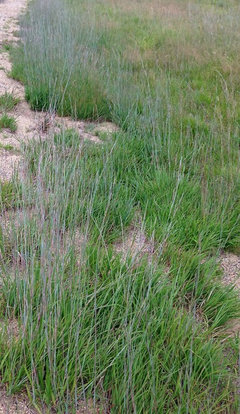
    Here's a photo of little bluestem from closer up taken on my way home today. As perhaps you can tell, it is growing in the sandy area along the edge of the road, so it's fine with poor soil. This is just the wild type, but you can also get named varieties that have more of the bluish tones or more of the reddish tones. I think it's really attractive.


    However, the lovegrass's seedheads behave like tumbleweed, shedding seed as they move, so I find lovegrass in the gravel drive, the veggie garden, etc. Another issue might be the maintenance crew weed whacking your garden, not realizing that it was a deliberate planting. I once had someone hedge prune a lovely shrub to a sheared blob in a public garden I had planted.

    Is there a water source to get plants established, either hoses from the school or a tank on a truck? All new plantings will be more successful if you can water them when rainfall isn't adequate.

    I don't want to discourage you, but setting realistic goals will be the key to your success. If there is a local garden club or other group that can be persuaded to see your vision and help consistently , all the better. Steps in order:

    -Figure out what's there, what can stay (I think I see a few shrubby white pines, for instance) and what to remove.

    -Create a design (including a plant list) that can be implemented in stages while still maintaining what has already been planted.

    -With whatever help you have available, implement the first stage.

    To give a sense of scale, a few years ago, I put in a large mixed perennial and shrub border that's probably 70'x15', working on my own, but with a tractor at my disposal, and the area had already been cleared. It took me 3 full seasons to plant: the first year doing prep, woody plants, and mulching for the first chunk; the second year adding perennials and adding another 15'x15' piece and the third year planting the additional piece and replacing plants that didn't do well from the first two seasons.

    So take creating it in chunks, but plan the whole thing before your start.

  • 11 years ago

    Hi, I have spent the last six years working two hours per week on what was initially a weed infested slope and is now the Himalaya garden in The Sheffield Botanic Gardens UK. Initially there were two of us working on the slope and gradually we have been joined by up to four others, some people move on to other things. You can see from this that a project such as yours will need sticking power and a bit of flexibility, plus a welcoming smile for anyone brave enough to work on a slope, there are specific skills needed as well as a good level of fitness.

    You don't say what aspect the slope has or is there is a lot of run off from the road that appears to run behind the slope or indeed what soil type you will be working with. all of these things will determine what plants will be successful with minimum care. and unless you and a team are going to work full time on this project you have to think minimum care.

    If you have not already done so do a trial dig in several areas of the plot to see if there is clay, gravel, a lot of stone scree or rubble from the building on the school site, what is there will determine what will grow. You may have to think of preparing small areas to take the plants you obtain.

    Another thing to consider is the prevailing wind direction. Wind blown seeds can make spring a hard to cope with season as they will get going long before any cultivated plant show signs of growth. so work from the end of the slope that the wind comes from toward the other end. That way you are clearing the wind blown seed weeds as you go.

    The first thing I thought about this project was the school should be prepared to put some effort into the project. How are they going to do this. Will they have pupils help with the work? Will they provide finance for plants? Will they have an education program running alongside the project. Will there be any facility to raise seedlings and bring on plants for the area. This is a large area and will eat up money as you progress. Mulch and compost are best friends on getting an area to support all but the toughest plants. You will need large quantities so begin looking for local suppliers and prices. Then take a good walk around the local gardens speak to the home owners and gardeners about what does well and how long the plants have been there take a notebook to help you remember Look at the aspect of the garden you are examining as well as the plants. The amount of light and shade as well as the soils type. There is a lot to consider.

    Make a rough plan of what you want the area to look like. Get Ideas from the pupils/students about how they might want it to look. Is there a biology/general science/chemistry class can the teacher use the area as a resource and explore plants and soil types in the area? This could be a useful start and save a lot of heartache on lost plants from an inhospitable environment both pupils and the earth. Remember this is not just the school territory it is the territory of all who work in the school and you need them behind what you propose to do. Now you have official permission you need the approval of all the school and the inclusion of all who work there. How about leaflets and notices to ask for help and ideas distributed through the students and to the teachers asking for specific skills. the art class might come up with a border design the science class a chemical analysis of soils botany/ Plant biology with the types of plant that are already thriving there and their specific needs.

    Start your planting with perennials that are bomb proof. This gives colour and interest to the students especially if they plant and water them through the first season. you need students on board or they will maraud. Add any trees and protect the trunks from deer and rabbits. Fruit trees can provide interest and food. Add any shrubs as you see the area develop.

    Lots of luck with this and I hope you and your team have staying power.