Software
Houzz Logo Print
whirlwindgirl

Drought tolerant plant choices

11 years ago
last modified: 11 years ago
We are hoping to replace our weed and dirt front yard this fall. I'd like to go drought tolerant (I know supplemental water will still be necessary, especially to get things established), relatively low maintenance and informal cottage in feel.

It is a small yard and we plan to redo the walkways as well. We are also planning to remove the old irrigation system that doesn't work well and are hoping to replace it with either drip irrigation or soaker hoses. We would use wood mulch around the plants and rocks in the strip between the sidewalk and the street.

We are in the East Bay of San Francisco in zone 10a. (Editing to add, sunset zone 17) The front yard gets full sun to part shade.

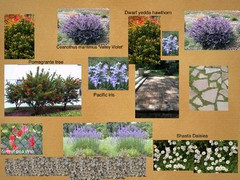
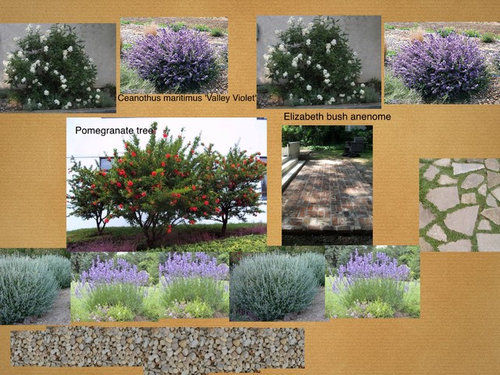
I am a fairly beginning gardener, especially in this zone, and one thing I have noticed I'm not good at is getting a mix of textures. We have noticed in walking around that we definitely prefer yards with repetition of plants. I want a limited color palette and do not like orange or yellow flowers. I have tried putting together a mood board to help me visualize how the plants I'm considering go together.

The labels are fairly small so here's a list of plants:

Rosemary and lavender as a sort of informal hedge in the front,

thyme in the spaces around stepping stones,

bush anemone (Elizabeth),

ceanothus maritime (valley violet)

and a pomegranate tree.

I would appreciate any thoughts on these plant selections!

Comments (37)

  • 11 years ago

    Do not use soaker hoses, you'll regret it. The water in CA is generally too hard and will clog soaker hoses quickly. If you want to use drip, use drip tape like Netafim. If you have an irrigation in working order, I don't necessarily recommend going to drip. It is possible that you might be able to change the emitters to MP Rotators and increase efficiency that way.

  • 11 years ago

    I have Netafim because that's what the contractor pressured me into using although I really wanted the MP Rotators. I can't say that I've had trouble with the Netafim other than the occasional puncture which is easy enough to repair. It is, however, much harder to monitor.

    Obtaining a mix of textures is tough with drought tolerant plants because they tend to be small, dusty, rugose leaves. Sword shaped leaves are an option. You could add New Zealand flax, yuccas, Kniphofia, aloes and native grasses to your list. I haven't really had much success with the grasses, though, as they seem to require more water than I provide. Think hard before planting agave.

    Manzanitas do well for me with small, shiny leaves and nice bark and come in sizes from low growing ground cover to small trees. The Carpenteria (bush anemone) has been a problem for me. It's a painfully slow grower and is an aphid magnet. I have better luck with manzanitas. They don't grow any faster, but they don't have curly leaves, either. I've never grown Rhamnus, but it has a bigger, somewhat shinier leaf and might be a shrubby option for you.

    Small flowering native perennials that do well for me are Achillea, Erigeron (Santa Barbara daisies and Wayne Roderick), Eriogonum, Berlanderia, Epilobium, Tagetes lemonii, Monardella, Agastache (Black Adder is my best one) and Mimulus. Non natives like Geranium Rozanne and Sedum Autumn Fire offer some different textures and Rozanne, a sterile hybrid, never stops blooming. Except for the sedum, these all bloom more or less all year here in San Diego, Of course, there are also a ton of sages that are worth trying, but they have shorter bloom periods which they frequently make up for with silver or chartreuse leaves and really low water requirements.

  • 11 years ago

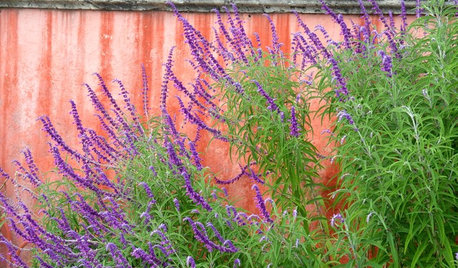
    Pereskovia, Verbena de la Mina, V. bonariensis (leave the seed heads for the goldfinches!)

  • 11 years ago

    Creeping thyme is the most vigorous spreader. Thyme gets about sixteen inches tall and bushy when flowering. Different thyme have different color flowers, usually white to purple. Lavender come in different sizes and color option. At the very least know the size of the variety for initial placement. I would advise you to learn to groom them proper becayse the first two years are key to a healthy looking lavender bush.

  • 11 years ago

    Thanks everyone!


    Our water is is actually quite soft. Some nearby communities have hard water, but not us. Our current irrigation system is not in working order. It has turned on and then not off (I was home thankfully), the sprinkler heads are constantly being damaged, the pipes are quite old, no one can figure out how to program it--no manual when we bought the house and it doesn't work the way it looks like it should. We really just want it gone.


    I looked at figs and I can't remember what swayed me to pomegranate. I don't mind pruning once or twice a year but no more than that. I don't understand what dormant means in this context? I saw that pomegranate trees are evergreen. Is that wrong? The tree does not have to be a fruit tree, though it would be nice. It does have to stay small.


    I keep looking at manzanitas. But they seem to be very, very slow growers and most seem to eventually get too big for my small yard. I think that I also saw that they won't tolerate any watering once they are established? That seems tough in a garden with other plants. I will take another look--do you have a particular one to suggest? I started out wanting roses for those two bushes--they are to be foundation plants on either side of a big picture window. But even the low care roses (I was eying icebergs among others) seem to come with reports of fungal problems and this spot would be part shade.


    I am trying to avoid the yucca and grasses and other plants that look more desert or meadow to me. I'd like to end up with an English cottage garden look to the extent possible. Maybe I am failing to visualize how the combination would look though.


    I have thought about Santa Barbara daisies--they are lovely and I see them thriving frequently in my area. I thought I might add some later. I kind of want to get the "bones" of hardscapping, tree and shrubs in place and then see where/if there is space to fill in.

    I will check out all the other suggestions! Thank you!


  • 11 years ago

    Pomegranates are deciduous, not evergreen, they lose their leaves in the winter. Most varieties can get quite large, 10 feet or more, although I think there are some dwarf varieties.

  • 11 years ago

    Hmm, so we are in a coastal area and I'm reading that they keep some of their leaves in coastal areas?


    UC Davis on pomegranates

    But I'd be happy to hear suggestions for something else that might be better for us. And I will read on figs again.

  • 11 years ago

    I live in Riverside county where it gets quite hot. I have 2 Violette De Bordeaux trees in ground, and mine are like short bushes. One is 6' wide and 3' tall. The other is smaller, but I prune them like that so they don't block our view. That variety loves cool weather, and if you are coastal, it would be a good one for you. My pomegranates do lose their leaves in winter.

  • 11 years ago

    just a comment on the color. I did a red and blue theme in my drought tolerant landscape, but the colors don't really stand out against the mulch. my husband has been adding yellow plants, and the yard looks better. I know you said you don't like yellow, but since a lot of the plants you are interested in are purple, you might reconsider. Contrast is better than colors next to each other on the color wheel.

  • 11 years ago

    I don't know about real coastal areas but in the LA area valleys they are definitely deciduous.

  • 11 years ago

    In coastal San Diego, both figs and pomegranates are deciduous. There is nothing wrong with that. The pomegranates have flashy white (rare), orange or red flowers, but the figs do not flower. Figs can be very large and drop a lot of fruit, but they can be aggressively pruned (the sap is irritating). Pomegranates make more of a fountain shaped, large bush. There are dwarf forms of both.

  • 11 years ago

    Some manzanitas tolerate summer water, some don't. My "Carmel sur" groundcover gets some water and does fine.

    Roses are grown for their flowers, not their shape or foliage. Some of them are fairly drought tolerant and fungus and blackspot aren't generally a problem with drip irrigation and low humidity. I enjoy other people's roses, but don't grow them myself. I would only grow them buried in a large mixed border which I will never have room for.

    Here are some nice pictures of California-appropriate plant combinations which, while not exactly English garden flowers, make pretty mixed borders:

    http://summer-dry.com/blog/


  • 11 years ago

    I have neighbors with rose shrubs that stand on their own. I assume they are willing to spray and fuss with them though.


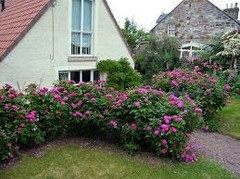
    Here is one rose I was eying, but then I read that it suckers and is hard to contain.


    I think the contrast thing is a matter of taste. I know people who love white kitchen cabinets with black countertops and people who love white kitchen countertops with white countertops. I have always tended towards low contrast color schemes. There is also the color of the house to consider and so on. I feel quite settled on avoiding yellow and orange flowers.


    Thank you all so much!

  • 11 years ago

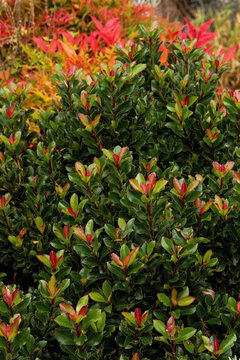
    Any thoughts on pineapple guava?

  • 11 years ago

    Any experience with dwarf yedda Hawthorne?


  • 11 years ago
    last modified: 11 years ago

    For some different textures, consider Acanthus mollis for big, broad leaves, and a bulb such as Watsonia for long narrow leaves.

    Note: In some countries Acanthus mollis is classified as an invasive species. In California some consider it an aggressive weed. I have no trouble controlling it in my yard.

    http://www.issg.org/database/species/distribution_detail.asp?si=1663&di=53646&sts=&lang=EN

  • 11 years ago

    I haven't ever grown anythingbut the regular Indian hawthorn. You can't kill it. It's certainly a ubiquitous landscape plant. There are a couple in my yard that I suspect were bird planted.

    Acanthus mollis is summer dormant without water and it is on the invasive list.

  • 11 years ago

    I'm okay with ubiquitous, especially if it's so common because it is so easy to grow.


    Thank you all so much! I really appreciate the help with my project.

  • 11 years ago

    I tried to find Acanthus mollis on official lists of invasive species for California but had no luck - if someone can give me a link to such information I will edit my previous post to remove Acanthus. I don't want to recommend an invasive species.

  • 11 years ago
    last modified: 11 years ago

    http://www.issg.org/database/species/ecology.asp?si=1663

    http://davesgarden.com/community/forums/t/678526/#b

    Acanthus is not sensitive to glyphosate so it is difficult to control here in SD in native plant restoration areas. If you are going to plant it, it should be planted with 2' deep root barriers and not allowed to go to seed.

  • 11 years ago

    Pomegranate flowers and fruit are pretty, and the tree is more like a shrub than a ball on a stick, which is also attractive in a landscape. Another low grower which you may like is scuttelaria suffrutescens, Texas skullcap. It dies back a little in the winter, but comes back larger every year.

    One way to see what will thrive is to take walks in your neighborhood and see what looks healthy and what appeals to you. You can also get a sense of how large some of these plants can become. Check out the Sunset Western Garden Book as well. If you don't have, one, they are at almost every library.

    Texas rose skullcap

  • 11 years ago
    last modified: 11 years ago

    We have a rose geranium bush growing in the front where it gets very hot and dry. This bush is very prolific and vigorously spreads even though it does not get much water, and the soil beneath it is terrible hard clay. The bush grows 3-4 feet high, and seems to thrive where most other plants would bake in the sun and wither, it has spread to 10 feet wide. We did not originally plant it either. It was growing in planters, and wherever those planters were set on the ground, even hard dry clay soil, the roots made their way out of the little drainage holes in the bottom of the planter and established themselves into the ground, propagating a new plant. These things can get a little invasive in your yard if left unattended for a long time.

    One of the roses we have growing is Persian yellow, something interesting and less common, more related to wild roses than the modern varieties, and is also much more drought tolerant. It tends to only bloom once a year, but produces deep yellow blooms. Persian yellow is not cold tolerant at all, but that's not a problem in Southern California.

  • 11 years ago

    Jxbrown, just because a species is invasive in one location that doesn't mean it will be invasive in all locations. Acanthus isn't listed in CA, and it is planted all over the place so we should have seen some sort of invasion by now if it was going to happen.

  • 11 years ago
    last modified: 11 years ago

    That is true, but by the same token, several of the "low-maintenance" species that were widely planted in Southern California are a little invasive. Invasive = vigorous and able to thrive through the hot dry summers, apparently

    Bradford pears behave themselves in this climate, though they have been known to spread invasively in more humid parts of the country.

  • 11 years ago
    last modified: 11 years ago

    I have been reading about all of the suggestions here. And I tinkered a little with my plant selections. I took out the bush anenome and added Hawthorne and added pacific iris and Shasta daisies. I also took out rosemary because most varieties seem to get too big for my purposes and also because it seems to get woody over time. I am thinking three or so different varieties of lavender for extended bloom and some height variation. I keep coming back to the pomegranate. I think I just like the shape. (I also added annual sweet pea for a trellis on the side of the house.)

    Thanks so much for all the help!


    *************************************************************

    editing to add a plant list in case that makes it easier for anyone.

    Lavendar

    shasta daisies

    thyme

    pomegranate

    Dwarf yedda Hawthorne

    ceanothus maritime (valley violet)

    sweet pea

  • 11 years ago

    I love my pomegranate they are so easy and beautiful

  • 11 years ago
    last modified: 11 years ago

    Yes, pomegranates grow great in the hot dry Mediterranean climate of Southern California, as long as you are within 15 miles of the coast. The coastal influence prevents the air from getting too dry, even if it does not rain so frequently. I am not sure why pomegranates are not more popular here. I think perhaps they would have higher fruit yields if they got just a tiny bit more winter chill than they do here (they like about 150-200 hours, and we only get about 70-120 hours). I am not sure how well they would do in the more desert climate further inland though.

    Further inland it can paradoxically get a bit colder in the winter (especially in the night), even if temperatures are higher the rest of the year, so that might at least better put them within their most optimal chill range. Though most fruit trees do not grow as well in the baking hot desert and desiccating dry air, and this would also make them require plenty of irrigation.

  • 11 years ago
    last modified: 11 years ago

    Parker, I don't know where you are getting your info about pomegranates but I'm 25 miles from the ocean and pomegranates don't need any supplemental summer water once established. There are poms in my neighbors yard that have been there for decades and they only have a bout a foot of sand over bedrock on a southfacing hillside that regularly gets 20-30 mph winds. Poms are a good choice for zones 19-24.

    Invasive also doesn't just mean able to thrive and make it through hot dry summers. In this context invasive has a very specific meaning. An invasive species is a non-native species whose introduction that causes economic or environmental harm or harm to human, animal, or plant health. In the context of plants, they are exotic plants that crowd out native plant species and the animals that feed on them. The vast majority of exotic plant species, even the ones that thrive in our long dry summers, aren't invasive.

  • 11 years ago

    i like your plant choices ! i am quite enamored of ceanothus ssp at the moment...i just collected some fresh seeds of our native ceanothus (which i have id as Ceanothus integerrimus)


    i also have been looking into drought tolerant plants, especially ground covers and /or landscaping elements...type plants/shrubs etc. i think you are on to a good start, those should all do well for you once established.


    they do say the same of ceanothus, as they do manazanitas - that they should have NO supplemental watering. basically the only way to kill them is to over baby them with watering, so i have read and researched...


    i have some large "yarden" areas, replacement for grasses, which get no watering and somehow keep on keeping on. also i like many feral / native / naturalized plants, and many of these are very drought tolerant, like things that grow in the forests and other areas without any human intervention. so anywho heres some thoughts, that i either have growing or have thought about/researched that should grow without watering. if these ideas are of no use to you, throw them out the window obviously =) but heres some food for thought.

    almond (despite recent weirdness i know its extremely drought tolerant)

    pistachio

    hazelnut (stays shrubby)

    olive

    fig

    elderberry

    grapes

    plums are pretty hardcore and tough all around. iffy to say they are completely drought tolerant, but they are close. they are just really tough and resilient all around.

    mahonia - oregon grape

    oregano

    pineapple weed/chamomile is surprisingly drought tolerant

    wild strawberry

    wild violets, viola, any kind of violet

    chicory

    self heal

    feverfew

    all salvias - sage

    calendula

    i've also found nigella of all types to be tolerant of dry conditions...


    well surely theres more, but enough for now...


  • 11 years ago

    So many great ideas! Thanks to everyone. After the front yard, hopefully this fall, I'll be doing the backyard, hopefully next fall. And, of course, I may have trouble finding a plant or something might not work out so I may need to make substitutions for the front yard plan too. So I am sure I will be referring to this thread often in the next year or two. I really appreciate the help!

  • 11 years ago

    Someone else may already have mentioned this, but the California Native Plant Society has a nice resource at: http://calscape.cnps.org/ When you enter your zip code, it pulls up plants that would naturally grow in the area. The plants are listed in categories, like plants for shade, part shade, sun, ground cover plants, treees, hedges, etc. Clicking on any of the listed plants brings up a description.

    Happy gardening to you!

  • 11 years ago

    Thank you!

  • 11 years ago
    last modified: 11 years ago

    Suzi, i know you were offering this to OP, but i would love to grow a fig...any chance of me sending to a SASE for dormant cuttings? I'm in Sacramento. :-)

  • 11 years ago

    ^^^i so had the same thought =) ^^^ but ah...i have so many plants and stuff...gotta deal with what i got first, i keep telling myself.

    those figs though are lovely, one of my most wanted types....

  • 10 years ago
    last modified: 10 years ago

    Another one I thought of is Myrrh shrub (Commiphora myrrha). It may not look the most attractive but it has a pleasant aromatic smell.

    Myrrh was one of the gifts given to baby Jesus, the resin is used in incense.

  • 10 years ago

    for fruits, Fig and Arbutus ("strawberry tree") are very drought tolerant.

    natal plum is very low-maintenance in zone 10 southern California

Sponsored
Custom Home Works
Average rating: 4.6 out of 5 stars10 Reviews
Franklin County's Award-Winning Design, Build and Remodeling Expert