Software
Houzz Logo Print
breathnez

Short soil temperature study

11 years ago
last modified: 11 years ago

This is by no means a highly structured study, just a one afternoon experiment to see what soil temperatures I get for the purpose of evaluating root health in gritty mixes.

Time of day: 1:30-2pm.

Outside temp: 96F, humidity 47%, clear sky

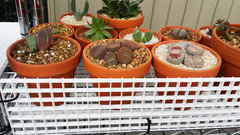
Pots: clay

Thermometer: metal, with temp range 60F-220F

All plants watered deeply at approx 9am

In a mix of 2/3 granite chicken grit(#2) to 1/3 pine bark, on the south side of the pot (where sun hits the side of the pot) the soil temperature reached a whopping 106F, and on the north side 102F.

In a 50/50 mix of the #2 chicken grit and pine bark I found the temp on the south side of the pot to be 97F (didn't measure the north side).

In a 50/50 mix of pumice and pine bark, the temp on the south side of the pot reached 96F.

For comparison, in a mix of #1 chicken grit and pine bark the temp on the south side of the pot was 92F. Here I did measure the north side of the pot, which in this case was also in the plant's shade, and the temp was 89F.

I did not expect to see such a temp variation between north and south sides of the pot.

I did not expect to get readings so far above ambient temp.

I did not expect that pumice would not be able to provide lower temp.

I did expect to see lower temps with a higher proportion of bark.

I did expect to see lower temps with smaller particle size (#1 chicken grit).

Searching with google, I did not find warnings regarding high soil temps for succulents and cacti, but did find some regarding plants in general and non-succulent bonsai:

https://www.evergreengardenworks.com/rootheat.htm

http://www.bonsai4me.com/AdvTech/ATheat_and_high_temperature_damage.htm

My conclusions so far are broad, and perhaps are similar to plain common sense: variation in water retention components(in this case pine bark) have a significant effect on soil temperature, as does grit particle size(in this case #1 vs #2 chicken grit) presumably also b/c of greater water retention.

I would love to hear of any other experiments people are doing, any information regarding cacti/succulents and root temperature, and any ways to improve this kind of experimentation.

ez

Comments (9)

  • 11 years ago

    Great coincidence! I didn't mention in my data that I was measuring 2-3 inches into the soil. Sorry for that omission. Were you measuring surface temps or in the soil?

    ez

  • 11 years ago

    Very interesting comparison. Im going to assume that plastic pots which are darker in color are much hotter than lighter ones and that plastic retains heat far better than terracotta.
    Will definitely be misting the sides of the pots during the hottest days, ty!

  • 11 years ago

    MintyLemonade - Yes, darker plastic pots would be much hotter than lighter ones. I didn't test it, but I expect the sides would be at least 10°-15° higher, maybe even more? Maybe I can test it in a couple days. Side note: The reason plastic pots are black is because black plastic lasts longer than white plastic when exposed to sunlight.

    ez - No kidding, right? My measurements were surface temps only. My probe thermometers are strictly for BBQ and oven roasted meats. My glass/mercury bulb thermometer would have been too fragile.

    Further thinking about soil temperature, I expect it to be a linear gradient from one side of the pot to the other, as we mix soil uniformly. So if the roots are in the middle, it would be (sunny°-shaded°)/2. Which would also be the average root temperature. Similarly, I guess top-bottom surface temperatures could be used.

    Of course, this is my expectation and you can confirm if it's true or not?

    Variations in the soil mix simply delay heating up the pot. The specific heat capacities of gritty mix are:

    • Granite/clay/stone is 0.2.
    • Pine is 0.6.
    • Water is 4.19.
    • Dry Soil is 0.19.
    • Wet Soil is 0.35.

    Assumptions:

    1. Dry/wet soil is just a 15% difference, so I expect a smaller difference between dry/wet gritty mix components. Overall... it doesn't really make a difference either.
    2. The amount of perched/held water in our mixes is extremely low, so I would consider that negligible.

    Soil Mix Conclusions, based on heat capacity (so far?):

    1. 50/50 mix of grit/bark will take 1.5x longer to heat up than 50/50 grit/turface.
    2. 50/50 mix of grit/bark will take 1.3x longer to heat up than 1:1:1 grit/turface/bark.
    3. If your pot is recently watered, it will take 1.15x longer to heat up than a dry pot.

    Evaporative cooling:

    This is much more complicated and honestly I'm not that familiar with it. There was a paper I found about thermal analysis on clay pots, but I'm not so sure how useful it is.

    To do any useful calculation, I think I would need to weigh a dry vs wet pot to determine how much water the pot holds. Then figure out how much cooling that amount of water can provide under typical summer conditions.

    Maybe that's a good experiment for later in the weekend or other people who weigh their pots to figure out when to water to chip in.

    breathnez thanked ewwmayo
  • 11 years ago
    last modified: 11 years ago

    I am measuring temps at the roots, and now I can go back and repeat the experiment while using various insulators on the soil or around the pot to try to moderate the temps. The earth does a good job of insulating roots, but we lose a lot of that in pots. That may explain a summer slowdown in the growth of some potted plants. When able, I have been moving pots out of the sun during the worst heat, but that gets tiresome and can't be done at all when I'm at work.

    ez

  • 11 years ago

    Ez, awesome! I'm really curious to see if that helps and by how much. What materials are you thinking of using? Moving pots in and out is tedious... I am not so sure it's worth it for the heat.

    Today, I fixed up a sun-shield for my pots with some leftover egg-crate for lighting. Will check tomorrow to see the difference in temperature it makes.

    Also did some additional measurements and calculations this afternoon. I watered a 6" pot for a few minutes, using up an entire small watering can. My resulting water retention numbers look similar to what was listed by the Pacific Bulb Society on Growing Mediums.

    Pot weight wet v.s. dry (6x5" terra cotta pot with 1:1:1):

    • 521g: empty pot
    • 521 + 1194g: gritty mix dry
    • 521 + 1194 + 147g: gritty mix wet
    • 521 + 1194 + 132g: gritty mix wet, tilted 45 degrees, then shaken
    • 521 + 1194 + 115g: gritty mix after 3 hours in full 30°C sun.

    Watering conclusions, based on weight:

    1. 15mL perched water in my gritty mix, which is 1% of the total pot volume.
    2. 132mL water absorbed in my gritty mix, which is 8% water retention of the total pot volume.
    3. 17mL water evaporated from my pot in 3 hours of full afternoon sun, which is 11% of the water that was absorbed.

    Pot heating v.s. size:

    • Evaporation of water isn't very high (5.6mL / hour), so I assume cooling by evaporation is negligible for my 6" pot.

    • 6" Pot: 6" wide top x 4" wide base x 5" height - 1630mL.

    • 4.5" Pot: 4.5" wide top x 2.5" wide base x 4" height - 648mL.

    • 3.5" Pot: 3.5" wide top x 2" wide base x 3.25" height - 324mL.

    Pot size conclusions, based on volume:

    1. 3.5" pots will heat up 2x faster than 4.5" pots.
    2. 4.5" pots will heat up 2.5x faster than 6" pots.
    3. 3.5" pots will heat up 5x faster than 6" pots.
    4. My 6" pot of gritty mix should dry up completely in <3 days of similar weather like today (normally I water every 2 days).
  • 11 years ago

    Ez and Mayo, terrific job on pulling up this topic on soil temperature for discussion. Mayo, I love all your analytical data posted here, it's extremely precise and informative. I wished I would have done the same for my experimentations, but my findings are usually for personal use, so I merely just scribble some notes here and there and estimate my conclusions. Nothing compared to this! So it's super helpful!

    As you might have recalled from my recent post, I had lost some of my newer plants to root rot and dissection of roots/burnt roots. As a relatively new grower like myself, we are often heavily criticized for our mistakes by simply pointing out and adjusting our light and watering conditions, but completely omitting temperature and humidity situation into each case.

    I personally was baffled by some of the comments that I had received to stretch out my plants even further by abstaining water for a longer period despite the heat, now knowing that the roots can also die if water isn't maintained to quench and cool the roots in a container at a higher interval as compared to those naturally grown in the ground.

    I also believe, plants (even succulents) naturally shuts down and go into a temporary dormant state to cool when roots are stressed at a very hot temperature and also when moisture is available enough to cool it. Vice versa, when its too hot, plants goes dormant unknowingly, roots stop taking up water, roots rot and die, even at a faster pace because fungus loves heat.

    On and all I've learnt many cool stuff, and good to note:

    1) Usage of white/lighter colored top dressing as a natural heat deflector to protect the soil and roots from burning.

    2) Misting terra cotta pots on very hot days to gently wick moisture into the soil and using the pot as a natural barrier against the heat is absolutely a brilliant idea! (Why didn't I thought of that?)

    3) Sometimes shade is power, I'm with EZ on this one, it gets very grueling to constantly move plants back and forth. But for this week, I moving them into a more shaded corner as the temperature rises. I rather have them with lesser sun throughout the day than burning all day with the risk of cooking the roots and watering more frequency.

    4) Never repot plants during summer, or never buy bare rooted plants in the summer. I think this is the hardest lesson I will have to learn and am still learning how to get around it. Helping newly arrived stressed plants to cope with heat, after being potted up. I believe newly potted plants should just be kept dormant for a longer duration, by reducing water to allow it to coop with the heat until temperature gets better before resuming watering to encourage establishment and root growth.

    Keep up the good work guys!! Temperature is definitely a very crucial factor for root health and plant growth, but do you think we can find a way to measure humidity and see its relationship between high temperature?

    Cheers,

    Bernard


  • 11 years ago

    Thx Bernard, we've had a cool down of late but I'm sure it will jump up again so I can continue my part. I thought of you and your situation when reading another thread. Cactusmcharris uses a double pot system to keep roots cool. Might be useful to you. Read THIS.

    ez

  • 11 years ago

    ez! Thanks for the thread!!

    Super enlightening - it's one of those, why didn't I thought of that moments.

    I'm gonna test this out this weekend on my recovering plants.

Sponsored
Mary Shipley Interiors
Average rating: 4.8 out of 5 stars34 Reviews
Columbus OH Premier Interior Designer 10x Best of Houzz