Software
Houzz Logo Print
hzdeleted_21934719

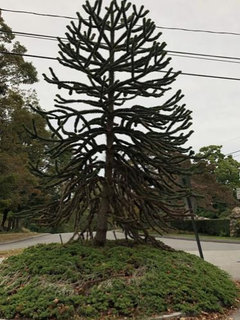
Monkey Puzzle tree?

11 years ago

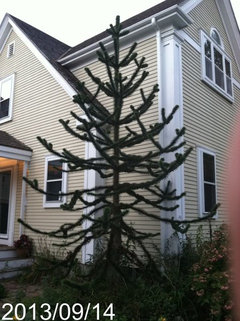
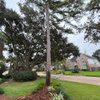
I shot this picture today on Long Island. Is this Monkey Puzzle? It's over 20 feet tall.

Comments (45)

  • 11 years ago

    hhhhmmmm...doesn't quite look right, but I could be wrong

    do you have a better pic?


  • 11 years ago

    Looks like a true fir (Abies).

  • 11 years ago
    last modified: 11 years ago

    I feel like by now with so many people keeping an eye open for them, we must know about almost all of the truly large monkey puzzles on the east coast. I suppose a couple could be squirreled away in private collections, unknown to all but members of the IDS lol.

    I'm almost sure the last time I was at Longwood I noticed the one they had planted was gone after the recent cold winter(s), but it was in that confusing rabbits warren of gardens SW of the conservatory and I suppose I might have made an erroneous assumption about where it had been before. I'll check for sure the next time I'm there.

  • 11 years ago

    No, I couldn't get a better picture because their was an embankment and could not get closer to the tree. I had really once wanted one of these but as one of the posters observed (maybe it was you), that in most Eastern areas where winters are mild enough, the problem is summers that are TOO HOT; and in eastern sections where summers are cool enough, winters are too cold. However, this was in a botanical garden near the North Shore of Long Island (good microclimate). Unfortunately, no one around to ask (even staff). Only really dedicated plant nuts visit these places in mid summer. I do note, that when I got home to NJ, it was a least 10-15 degrees hotter. When I realized that success with a Monkey Puzzle depends on worrying about winters that are too cold AND summer that are too hot, I gave up on my quest to add one to the collection.

  • 11 years ago
    last modified: 11 years ago

    Yes, well, if there were mature ones on the east coast, Long Island would be a logical place for them. My sister in law is from there and laughed when I asked her if anybody in her family thought of the summers on the island as being cooler than elsewhere in the NYC suburbs, but the fact is they are - slightly at least. (there was a humorous NY Times article addressing this issue too, some years ago) The best "collection of private collections" of rhododendrons east of the Rockies are there. (IMHO; though some in coastal Maine and NS would reasonably argue that theirs are equal or superior...)

    I suspect the winters like 34, 63, 77, 85, etc. are just too cold there and kill them off. The issue being, among others, that the plants are already weakened by the summers still not quite being to their liking. Chile is the Med/PNW type climate the least likely to get hot in summer; even well north (their south!) of the range of MP, it hardly ever goes above 90F and in its native range nights are always in the 50s, if not upper 40s, in summer.

    The Barnes in Philly might have gotten lucky with a form that is both particularly heat/summer rain resistant and cold resistant. In an ideal world someone would be trying to micropropagate it or at least graft it onto A. angustifolia to plant in places like NC or SE VA.

  • 11 years ago
    last modified: 11 years ago

    Was it at Planting Fields? They had a small (10') one in spring 2013. I'd be surprised if it is still there. They have a lot of Abies, so I'm guessing you might have been there.

  • 11 years ago

    YES, PLANTING FIELDS!

  • 11 years ago
    last modified: 11 years ago

    Haha...a well-informed guess is the best guess.

    "winters like 34, 63, 77, 85" AND...2013,2014!

    I think you would have spotted the real mccoy if it were still there. It was in the main woodland garden that's in front of and to the left of the mansion entrance. Prominently placed, of course.

  • 11 years ago
    last modified: 11 years ago

    for reference, the one in Bethesda (sorry I see now postimg has shrunken them):

    http://forums2.gardenweb.com/discussions/1679225/a-few-somewhat-noteworthy-trees-in-suburban-dc

  • 11 years ago

    Did not have time to get to the Mansion, went to Coe House (his mansion), greenhouses, Camellia House, and several other areas instead. Will eventually return though. The trip to the arboretum was supposed to be a side trip to a family function..., had no idea the grounds were so massive (a few hours not enough, you need at least a day!) Will hit his wife's 'Mansion' next time and look for more potential Monkey Puzzles.

  • 11 years ago


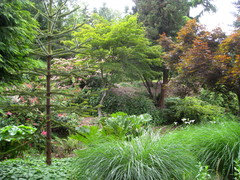
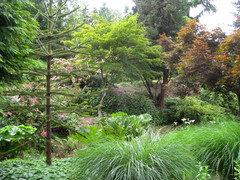
    Here's one in my garden. Zone 8a, near Seattle.

    Looks out of place, doesn't it? Since when, does it not look out of place?

    Jurassic Park, maybe.

    Mike


  • 11 years ago

    Well, it doesn't look out of a place in a forest of monkey puzzles...

  • 11 years ago

    From what pictures I've seen, the whole forest looks out of place. ;-)

    Mike

  • 11 years ago

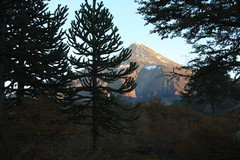
    Since when does it not look out of place?


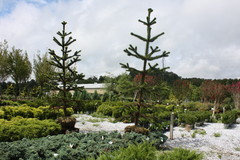
    It didn't look out of place when I took this pic at Conguillio Nat'l Park in Chile. Here everything else gives way to MP Trees including the Notofagus.

  • 11 years ago

    Nice picture!

    That place is on my bucket list.

    Mike

  • 11 years ago


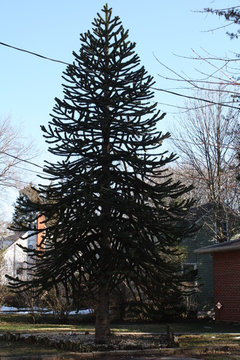
    A rare sight in eastern US. This one is in a Baltimore City neighborhood. MP is stiff and formal but no more than Col. Blue Spruce and consider how popular they are.

  • 11 years ago
    last modified: 11 years ago

    I read a thread awhile back on this site regarding Monkey Puzzles and Long Island seems to have a good micro climate for growing them. The ocean keeps Long Island cooler in the summer and warmer in the winter compared to inland locations.

    There's a 40 ft Monkey Puzzle in Staten Island which I saw on Google Maps street View (the location was posted in that thread). I saw a large Monkey Puzzle in front of someone's home when I was in Suffolk County. I didn't get to look at it for long but it was at least 15-20 ft tall.

    There's also a 10-12 ft monkey puzzle right around the corner from where I live. It's been there for years.

    I have a 10 ft tall Monkey Puzzle in my back yard which was planted in the fall. It seems to be doing okay (except for some needles browning).

  • 11 years ago

    "There's a 40 ft Monkey Puzzle in Staten Island which I saw on Google Maps street View (the location was posted in that thread)."

    What thread, can you repost here?

  • 11 years ago

    Was it this one:

    https://www.google.ca/maps/@40.536984,-74.192392,3a,75y,156.2h,90t/data=!3m6!1e1!3m4!1smL5Lvy_gr7pjG0N6tscxEQ!2e0!7i13312!8i6656

    It's certainly not 40' but if it is still there (we've had 2 very cold winters since the date of that photo) I'd be willing to call it the 4th mature one. (so, 2 large ones: Barnes and Bethesda, then the Baltimore one, then this one. I keep meaning to check on the one across from Dumbarton Oaks, if still there, it would be a fifth.)

  • 11 years ago

    Yes, they were both cold winters with long periods of below normal temps, but there was a DEEP and persistent snow pack in NJ and Long Island. Might have kept the ground warmer. And that one in the picture is getting a LOT of heat off the house in winter (microclimate does make a big difference!).

  • 11 years ago
    last modified: 11 years ago

    This species forms a full sized tree so anything under, say, 60' is not mature - and is certainly not a large example. About 10 years ago Seattle had a few over 60' and multiple others in the 50s, while Britain had some in the 70'-95' range - in suitable climates this is a landmark tree.

  • 11 years ago
    last modified: 11 years ago

    haha...bboy I soooooo could have guessed you'd say that. In fact I would have been disappointed in you if you hadn't.

    by large I mean "on the typical comparative scale of landscape plants" not "as large as the species can be." Especially for something rather slow growing. I myself saw several monkey puzzles in the PNW, and none were much bigger than the Bethesda tree. Sure, there are larger ones somewhere. Does that make various 40 footers small?

    I'm sure if someone had a 100' Sequoia in their yard, be it on the west coast or east coast, they would call it a large tree...even if it were nowhere near as large as they can get, and was in fact relatively very small compared to how big they can get. (ca. 400 ft.)

    The Bethesda one towers over the standard 2 story suburban house these days. People would say that was a large tree if it were a Picea abies...Ostrya...or Magnolia. The Barnes one was planted in the 60s and, since the Bethesda house cannot possibly pre-date that, seems to be growing more slowly.

    Think of it this way: large trees could destroy cars if they fell on them, small ones could not LOL. (although I think even a very small monkey puzzle could do a number on a car's finish, at least)

  • 11 years ago
    last modified: 11 years ago

    Likewise, the term "mature" has been debated here before, with someone suggesting a plant wasn't a mature until it started flowering. Obviously these are just semantic questions, and we sometimes say young adults are "mature" well before they reach or are approaching dying-off age (80) but on other cases reserve the term for people who are...e.g., "a development/community for 'mature' adults". (55 and over)

    To me and I think most people, people say mature to mean a settled landscape specimen that has grown for a few years and proven itself in a particular climate and garden setting, and/or is providing the intended landscape effect. These monkey puzzles clearly have a different effect than one just bought for $500 at Merrifield Garden center that is only 5' tall LOL. (Yes, that's what they sell them for around here. Makes it all the more hilarious that the vast majority of them die) You're not really going to picnic in the shade of a 5' monkey puzzle, unless you're a mouse.

    I'd say an Agave was mature when it was in the ground a couple years and grown to close to full size, where it was 5 or 20 years old; not the couple weeks after it had flowered and was getting ready to die.

  • 11 years ago

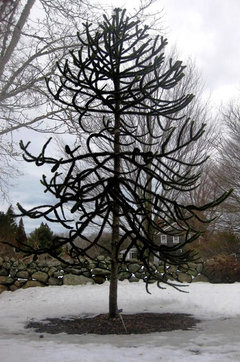
    Polly Hill Arboretum, Martha's Vineyard (MA). A couple similar size ones on the cape as well.


  • 11 years ago

    Gonna try one here now. Love that Jurassic look!

  • 11 years ago


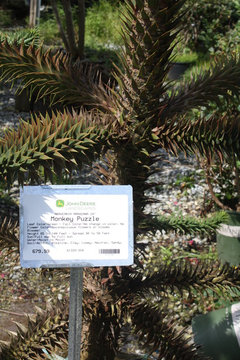
    $679.99 is what these retail for in Maryland. I guess the idea is to put them in the ground and enjoy them for a couple of years. When they turn brown and die remove them.

  • 11 years ago
    last modified: 11 years ago

    And JD Landscapes is technically a wholesaler. I last saw them at Merrifield, a good bit smaller, for $500!

    Glad to finally have a better pic of the Polly Hill one. It's very odd looking, though I remember the one off an island in Nova Scotia had a similarly open habit. Maybe something that happens to them at the limits of their winter tolerances. IIRC the one at Polly Hill has been there for ages so is growing very, very, slowly.

  • 11 years ago
    last modified: 11 years ago

    A user @runktrun posted this about Polly Hill monkey puzzles on the New England forum: "Polly Hill Arboretum has three Araucaria growing two were started from
    Thompson Morgan seed in 1968 the third was a seedling from Arnold
    Arboretum in 1980"

    If I get out there this summer, I will try to confirm that info. I wonder if the one in the image above is the 1980 seedling. If so, that's extremely slow growth... maybe it's a newer one.

    Here is another picture posted on the New England forum of a Monkey Puzzle in Barnstable, MA. Looks better than the Polly Hill one, maybe micro climate because it was planted so close to the house... Also, Polly Hill is very Shady! I have quite a bit of shade on my property as well, so it was interesting to see what they could grow there. I would bet the open form is actually a combination of shade and the removal of freeze damage over the years

  • 11 years ago
    last modified: 11 years ago

    Thanks that just underscores the point I was making. Polly Hill has some of the top notch horticulturalists in the US, probably.

    "Polly Hill Arboretum has three Araucaria growing two were started from
    Thompson Morgan seed in 1968 the third was a seedling from Arnold
    Arboretum in 1980"

    In the PNW or British Isles, even a rank amateur would have had at least 2 giant monkey puzzle trees by now.

    I too recall reading elsewhere that the Polly Hill one is shockingly old for how small it is, that article/post had no specifics.

    Yes I can also confirm all the old T&M catalogs I had as a kid listed this species LOL. I grew another UK garden classic, Genista aetnensis from T&M seed, it was the first tree or shrub I raised from seed when I was only about 12.


  • 11 years ago
    last modified: 11 years ago

    BTW hard to tell but I hope the Barnstable one is never going to get too close to that house. Razor sharp monkey puzzle branches flapping in a New England hurricane could be damaging to that pretty trim and paint job.

    This is one reason I never wanted to try one. When I first saw a full-sized one in the PNW I was amazed but also somewhat horrified. The needles seem to get tougher w/age, and I'm sure could draw blood if scraped across the skin. (IIRC the first we encountered was in extreme SW Oregon, my family one summer drove from San Fran to Victoria. Of course there are some in the Bay Area we just didn't see them.) As I've said a few times before, it's like a piece of rebar with hundreds of industrial razor blades welded-on. BUT I wish every person who appreciates nature can get to see one in person in their life, to know how strange a tree can really be.

  • 11 years ago
    last modified: 11 years ago

    Squirrels can't climb them. The branches make good poles to hang bird feeders from.

    The Monkey Puzzle Tree is one that you either like it or hate it. No in between. It took me a while to acquire one. I wasn't in a hurry. Where would I put it so it looks like it belongs? Finally I decided to make an area with a Jurassic era look. I have a few plants in pots that would be appropriate for that area that I'm going add to this Fall.

    Here's one now I remember when I was a kid back in the early 50s. It was big then.......well, it seemed big then.

    https://www.google.com/maps/@47.76998,-122.387811,3a,75y,348.6h,108.22t/data=!3m6!1e1!3m4!1sOUBhh62hHO9K2hJ6W49idw!2e0!7i13312!8i6656?hl=en

    Mike

  • 11 years ago
    last modified: 11 years ago

    I wouldn't say I hate or love them, I just find them overall impractical for my gardening ethos. If I had quite a few acres and an area that was going to be semi-wild like a horse pasture, I might plant one knowing I'd never hassle with handling the branches or whatnot. Or likewise if I were deliberately planting a "sinister" garden, I'd put one in there LOL. I don't have the room for such things.

    (I'm not a fan of the thorns on roses either, but it isn't exactly why I don't collect them. Most of them just seem boring to me. OTOH I made an exception for Zanthoxylum simulans, since it's a temperate-growing spice which is kind of rare. If you wanted a garden of menacingly thorny or prickly plants, you'd have to have both Araucaria and Zanthoxylum!)

  • 11 years ago

    @ davidrt "The needles seem to get tougher w/age, and I'm sure could draw blood if scraped across the skin" — absolutely yes they can!


    Once saw a Monkey-puzzle in a botanic garden with a ladder leaning on it. I asked the head gardener if I could go up the ladder to pick myself a cone, his reply was "Yes, but strictly at your own risk. The ladder was there for a student to get a cone, and we've just had to rush him off to hospital after he grabbed a branch to steady himself". Well, I went up the ladder and was very careful, so didn't need hospitalisation myself ;-)

    I've still got the cone, too :-)


    Resin


  • 11 years ago

    Monkey Puzzles at Bicton is a short youtube about MP trees at Bicton College which were planted around 1840. The champion is 27m or 88.5 ft. The narrator explains that the mild climate of Britain causes the trees to not only grow faster than their native climate but they also age faster. Some of the original trees have been already removed. Considering that MP native habitat includes 2,000 ft plus in elevation in the Andes Mountains, nutrient poor, volcanic soils it is easy to see why they grow so slowly in Chile & Argentina. OTHO Britain is a foreign and unnatural habitat. Cedar of Lebanon might be a similar example.

  • 11 years ago
    last modified: 11 years ago

    Great anecdote Resin, thanks for sharing.

    "is a foreign and unnatural habitat"

    Not as foreign and unnatural as ours - at least they grow at all!

    "Squirrels can't climb them." BTW love this too. Obvious, but hadn't occurred to me. One way to squirrel proof a bird feeder! Do birds land in them?

    Final note in case I haven't recorded this factoid for posterity before. Around the time I was told about the Bethesda tree in roughly 2000 (it was much smaller then), I visited Hill's Nursery in Arlington. Old Mr. Hill couldn't believe there was a real MP in the DC area and insisted it had to be a mis-IDed Cunninghamia. But then when I said I was sure it was one, he said someone else had told him there was a somewhat large one at or very near the curiously named "Navy Elementary School" in Chantilly/Fairfax. I feel certain around the time I obtained some piece of corroborating evidence, maybe someone on the old gardenweb or HP&S board said they'd seen it too. (I can't even remember the user ID I used back then, on this site!) In any case I never had a chance to go look for it until years later, and it was gone.

    This is plausible because in my earliest collection of garden catalogs from when I literally a kid, "Betty's Azalea Ranch" had them listed as one of the most expensive items. Catalog was from the mid 80s and the listed price was $400 IIRC. Yes, they had a big fancy catalog back then, surprising considering how the place went downhill. That was the nearest nursery to Navy School back then so it makes sense one might have ended up there. They certainly wouldn't have been a standard item back then in DC area plant shops. I think the first I saw myself, locally, was at APF, not Merrifield. Merrifield only got into the more outre stuff in the last 10 years. Their selection used to be a real yawn compared to Behnkes or APF. Hill really cared about horticulture as an art and probably would have tried some before selling them, hence his consternation at the thought of one maturing in DC LOL. I suspect he thought they were ungrowable due to his own failed attempts.

  • 11 years ago
    last modified: 11 years ago

    Also, as I think I've said before, I also have no doubt some number of them are just cut down when the ill-informed owner realizes he/she made a mistake. In the early 2000s there was a rather precious attempt at a DC area gardening magazine called grandiflora. I dutifully sought out a copy at some faux-country-general store in Leesburg. It was mostly a snooze but one article profiled a pricey garden somewhere in Loudoun Co. MuhLady had spent a ton of money with a firm to build things like haha walls, buy things like big boxwoods to create a stab at an Anglo-colonial formal estate garden. But they'd put a 4' MP in a little alcove of the house near a sitting area. Literally a few feet from a door to a bedroom or something. As much as a naif as I was back then in knowing these things, even then I thought "ha, we'll see how long that lasts!"

    Likewise one at a motel in Wmbg, VA, was put right near a parking lot hell strip, where it was going to bloody up the first tourist who inadvertently bumped into it. It was maybe 10' when I left W&M but was gone the next time I was there - 15 or so years later.

  • 11 years ago

    I cut one down that was about 35 ft. tall in a motel parking lot once. The owners decided to make additional parking spots where it was located. The lower limbs were already removed for safety's sake. The sap is white like latex. I wore a thick denim coat and leather gloves for that job!

    Mike

  • 6 years ago

    subtropix' thread is one of the better ones for MP tree. The discussion continues HERE on my thread which is primarily focused on eastern US.

  • 5 years ago
    last modified: 5 years ago

    Sandy soils and the relatively meso climate of Delaware and southern NJ seem to suit them. I vaguely recall hearing there was one at the now defunct Fairweather Gardens.

    There was a MP a little larger than this in the southern NJ pine barrens that an owner of a nearby nursery knew was going to be cut down for a building, asked me to query my erstwhile contact at Longwood. Although I'm sure they would have had the financial resources to have it moved, he told me doing such wouldn't be consistent with Longwood's 'plant acquisition policies' or some such. I assumed it was cut down but never really asked about it again.

  • 4 years ago
    last modified: 4 years ago

    It would be interesting to know if that one was planted after 2015, the last 'polar vortex' winter. It certainly doesn't predate 1994, which was the last "once in a century" type cold winter. The northernmost MP known to have survived that winter would be the one at the Barnes in Philadelphia, which recently died of root rot.

    Update: RTFA (LOL) and it would imply it does predate the PV winters of 2013-2015, and may have been planted in the 1990s, but after 1994. It does compare favorably to the Staten Island or Long Island ones we've seen in terms of looking healthy, so would currently be the northernmost on the east coast.

  • 4 years ago
    last modified: 4 years ago

    Jurassic Park, Can you post a photo of your Monkey Puzzle tree? Thanks

  • 4 years ago

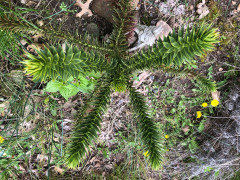
    I took the pic from above. It's about two feet tall. Purchased it mail order a couple of years ago, when it was really, disappointingly tiny!


  • 4 years ago

    Nice! Thanks for posting.

Sponsored
Daniel Home
Average rating: 4.8 out of 5 stars20 Reviews
Premier Interior Design Team Transforming Spaces in Franklin Co, Ohio