Software
Houzz Logo Print
juventusopp

Ataulfo Mango Seedling Question

11 years ago

Hello,

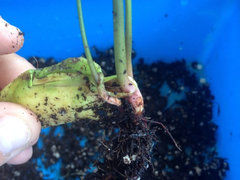
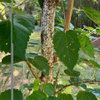
I recently planted an Ataulfo seed and it sprouted 3 days or so ago. I just noticed today that it has 3 sprouts coming up (picture attached). Is this normal or do I need to remove two sprouts to allow the clone to grow? (clone being the smallest sprout?)


Thanks in advance

Comments (21)

  • 11 years ago

    Atualfo is polyembryonic, the larger sprout is the cross, the hybrid seedling. The two smaller sprouts are the clones of the female parent, Atualfo. If you barefooted the seedlings you would probably find that these three seedlings can be separated and grown as individual plants.

  • 11 years ago

    Thanks very much. Could you please expand on how to barefoot the seed? I'm not familiar with mangoes at all. Thanks again.

  • 11 years ago

    holzinger

    there has been a lot of discussion about this, i dont know what is correct, but, it seems every time i think i understand it, i find a reputable source tells me i am wrong LOL

    i remember hearing from 2 people that the "vigor" has nothing to do with it, because the first few weeks the plant is working off the seed material anyway...

    -----------------------

    Propagation by seed is only recommended for poly-embryonic mango varieties such as Kensington Pride. Poly-embryonic seeds produce a number of shoots, one of which originates from fertilisation. The fertilised seedling is often weak and stunted and should be discarded. The other seedlings are clones of the mother tree.

    https://www.agric.wa.gov.au/mangoes/propagating-mangoes

    ------------------

    "Commercial nursery and NCGR-Miami standard practice involves removing all but the most vigorous seedling germinating from a single seed."


    But even using that practice, they found that up to about 1/3 were selected incorrectly depending on the cultivar.

    http://forums.gardenweb.com/discussions/2192518/the-true-polyembryonic-answer


  • 11 years ago

    Gently knock the seedling out of the pot, shake off the dirt from the seedling(s) and look at the seed. If it looks like pieces of a 3D puzzle stuck together, then you can separate the different seedlings into individual plants. If it doesn't look like they will separate easily, then just repot them and wait for them to get bigger before you try to separate them.

  • 11 years ago

    It doesn't look like its separated much. I think I may leave it until they've grown more then try.

  • 11 years ago

    Autalufo is true from seed I heard. As are all the Manila type Mangoes. But,some clones are better then others. I would plant as many as you can..and toss out the runty or slow growers and put all you're efforts into the ones that grow like rockets.

  • 11 years ago

    No,that's not true. I had Manila fruit and- great fruit -without any other Mango being within 200 miles OR 300. And the fruit were typical Manila's. Size and flavor.

    I think you got your definitions a little criss crossed.

  • 11 years ago

    I found this link useful for me.


    http://www.scielo.br/pdf/pab/v47n11/47n11a10.pdf

  • 8 years ago

    So did we settle on which of all the sprouts is the clone?

  • 8 years ago

    I think all were. Just thin to largest.

  • 8 years ago

    Holzinger said largest is the hybrid and the smallest were the clones. I think I’ll keep them all and see what happens. Hate killing plants hah

  • 8 years ago

    Conclusions


    1. Mango cultivars Manila and Ataulfo show

    polyembryony in more than 80% of their seeds, and

    the possibility of obtaining nucellar plants from them

    is high.


    2. Seed weight with the endocarp is an indicator of

    the number of embryos per seed.


    3. 'Manila' (44.4%) and 'Ataulfo' (14.3%)

    seeds had two to three genetically similar, zygotic

    embryos, and the primers OPA‑02, OPA‑04, OPA‑11,

    OPB‑07, OPB‑10, OPB‑12, OPC‑14 and SAP‑04 are

    recommended to identify the largest number of zygotic

    seedlings in mango.


    4. Zygotic seedlings are not always produced by small

    embryos located at the micropylar end of the seed.


    http://www.scielo.br/pdf/pab/v47n11/47n11a10.pdf


  • 8 years ago

    Its all a crapshoot from store bought fruit I would think. Manila fruit can be mostly green..and the Champagne ( Autalfo?) I planted from seed was a very yellow and all of it. But,Manila can also be yellow.

    Polyembryony= more then one embryo per seed.

    Nuclear seed= Pure and 100% identical to parent.

    Zygot..is a mix... I think.

  • 8 years ago

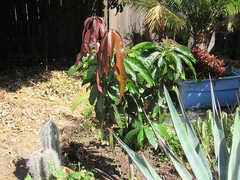
    This was from a box labeled "Champagne" that I'm told is really Ataulfo. Today after four years, and two of those in ground was very little growth. It crept to say the least and this year is leaping. 3rd flush so far and now flushes are getting some space in the nodes.

  • 5 years ago
    last modified: 5 years ago

    I have an Ataulfo seeding in a 5 g pot planted last june. This year it grows crazy the time between two finished flushes is two weeks. It was polyembryonic i saw 6-7 embryos in the seed, but only one came out, no 2-3 shoots. It starts to go a new flush again. I noticed mangoes in pot do not like manure or liquid ferfiliser high in nitrogen.

    Somebodys ATAULFO from seed is fruiting aldeady?


  • 4 years ago

    I'm here with the same question. How many years will it take to get ataulfo to fruit? Internet says that polyembryonic shoots could start fruiting within 2 years.

  • 4 years ago

    In my mild summers climate it took five years from seed. Its a bushy near 6' tall. Hotter summers could produce much faster growth no doubt.

  • 3 years ago

    Stan, Did you get fruit tasting like ataulfo? How many?

  • 3 years ago

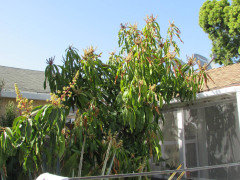
    Not many on its first real try. They were sweet just like market only better. Nice yellow skin.

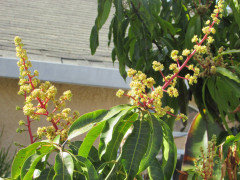
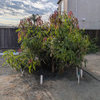
    Here's a pic from yesterday of the Ataulfo/Champagne and my taller Manila in flower.

    Champagne with colorful panicles.


  • 3 years ago
    last modified: 3 years ago

    It looks great. Hope you get good fruit set this time around.