Software
Houzz Logo Print
turtleturtlemeow

Jumping spiders in the garden

11 years ago
last modified: 11 years ago

Are Arizona jumping spiders good to have in a garden, or could they harm my plants? Would they hide in my fennel plants? I'm VERY afraid of them so I'm wondering if I should plant something to attract birds or repel spiders if they are bad or neutral to the plants.

Comments (28)

  • 11 years ago
    last modified: 11 years ago

    Spiders are passive predators of many insects. They do not eat plants. They do not harm people unless threatened. Spiders are beneficial in the garden.

    kimmq is kimmsr

    Turtleturtlemeow thanked kimmq
  • 11 years ago
    last modified: 11 years ago

    I was kinda hoping that they were evil and would kill plants on contact. Grrrr.

  • 11 years ago

    Please be thankful you have something beneficial. I've live in the deep south for almost 30 years. It's taken alot to get used too. 93% of insects are beneficial.

  • 11 years ago

    I'm just terrified of them.

  • 11 years ago

    Jumping spiders are categorized as active hunters, not passive at all. They actively prowl around during the day, pouncing on their victims.

    Turtle, the best way to address a phobia is to learn as much as you can about the object of your fears. Phobias are by definition an irrational fear.....there's nothing in reality to base your fear on.

    Do some Googling about jumping spiders....they are a favorite of mine, funny, active, smart. You may end up liking them.


    Turtleturtlemeow thanked rhizo_1 (North AL) zone 7
  • 11 years ago

    I'm afraid of all small brown spiders because of a spider called the spotted brown recluse spider. You may have heard of it as it is one of the most dangerous spiders in North America.

  • 11 years ago

    The Brown Recluse Spider is not one to live in your garden, in your house yes but not the garden.

    kimmq is kimmsr

  • 11 years ago
    last modified: 11 years ago

    They would have to be outside. They could be hiding underground or in my shed or wherever, but I'm still cautious of them.

  • 11 years ago
    last modified: 11 years ago

    Kimmsr, again.....your information is incorrect or misleading. Turtle is only apt to be exposed to the desert recluse, which is very rarely found inside, or even in urban areas.

    As far as the southern brown recluse goes, they are often (usually) found outside. That they are also found inside is what you are focusing on. Turtle will never see a southern brown recluse.

    Now, Turtle! You are being a victim of your own lack of information. Brown recluse spiders, no matter where they reside, are NOT deadly. I don't know that there are any reported and verified cases of death by BRS. I agree that their venom can cause a serious reaction in some cases and for that reason, we should educate ourselves about their appearance, behavior, and habitat.

    Most bites are practically symptomless. As was mine.

    Not only that, they never attack people. The incidences of biting always occurs when we accidentally put them between our skin and a shirt or weed we're pulling, etc. My spider was inside a pair of shorts that I had left next to the pool overnight.

    I live in an area where recluse spiders and black and brown widows are extremely common. Bites are very, very rare.

    Turtleturtlemeow thanked rhizo_1 (North AL) zone 7
  • 11 years ago

    I'd rather not chance getting a bite though. Have you seen what they can look like?

  • 11 years ago
    last modified: 11 years ago

    No one wants to be bitten, turtle. I'm suggesting that your fears are very much out of proportion to the reality of the situation.

    I'm suggesting that your level of discomfort would be greatly reduced by a little self education.

    I'm also suggesting that your basic knowledge about the Desert Recluse as well as spiders in general is very minimal. It's in that ignorance that your phobia has germinated and flourished.

    YOU are in complete control of overcoming this fear of spiders....called arachnophobia, by the way. You share this phobia with millions of people, including me! I chose to overcome my debilitating fear and hope that you do, too. My life is much better without that stupid burden of fear.

  • 11 years ago

    I do not have arachnophobia. If I saw a tarantula I would pick it up with little hesitation provided I'm not in south America. If I saw a daddy longleg, I would do the same thing. And with the colorful flower spiders. I am afraid of generic brown spiders because identification of those species are more difficult and I don't have a good enough memory to memorize the markings and be able to remember them with the variation that comes with the markings on individual spiders being slightly different. Its too complicated for me so I avoid contact with them. I have tried to memorize spider markings and figure out which are venomous.

    YOU DO NOT KNOW ME. I'd like to make that very clear. You do not have the right to tell me that I am ignorant or that my fears are stupid or to try to put a label on me because you think it applies.

  • 11 years ago

    Okay

  • 11 years ago

    Here is a map of the rough range outlines of the loxosceles spiders in the United States. http://spiders.ucr.edu/images/colorloxmap.gif

    If you'll image search the ones in your area (possibly loxosceles deserta, loxosceles arizonica, or loxosceles appachea if you're in Arizona), you'll be more able to recognize their shapes and colours if you do run into one, and you'll need not worry about jumping spiders that happen to be brown. Jumping spiders are your friends: they hunt down other bugs, don't leave big trap webs in your way, and some of them behave like little cats. That doesn't do much for a phobia, I'm sure, but at least arming yourself with some identifying information might help you deal with them after the initial spook.

    Turtleturtlemeow thanked Jon Biddenback
  • 11 years ago

    I don't think that map is accurate. It says there are no venomous spiders here, but I know we have black widows and I know brown recluse spiders live in the same desert as me.

  • 11 years ago

    The map is to illustrate the estimated range of different species of Loxosceles (recluse) only. Doesn't show any other spider genera at all.

    Turtleturtlemeow thanked rhizo_1 (North AL) zone 7
  • 11 years ago

    Oh, I misunderstood. I thought it was the name for all venomous spiders which in hindsight was not very smart. I had a spider and snake education class when I was younger that warned of the spotted brown recluce .

  • 11 years ago

    If you want to research the black widow and its relatives, the genus name for those guys is latrodectus. Fortunately, latrodectus spiders are also unmistakeable for jumping spiders, being fat bodied with long spindly legs, very different in shape.

    Latrodectus spiders can make you very sick, but they're also quite docile... it's hard to provoke one to bite. Most of their bites happen when one is accidentally squeezed between a person's skin and an unyielding barrier, trapping and crushing the spider. Avoiding their bites is very easy: shake out any clothing they might have access to and think is a good hiding place (like gardening gloves that have been left outside), and don't put your bare hand anywhere you can't see. Second one is a good way to avoid snake bites and scorpion stings, too.

    Turtleturtlemeow thanked Jon Biddenback
  • 11 years ago

    Can we please stop making this discussion about my fear.

  • 11 years ago

    Turtleturtlemeow, I also advise you to learn as much as you can about spiders in general. Many of them are very beneficial to gardeners, and speaking as an arachnophile, they're also very cool. And, though this is based strictly on anecdotal evidence, I suspect the learning might reduce the severity of your phobia. My wife-to-be is an arachnophobe... or, I should say, she was one. It was pretty hard on her; at one point she was surprised by a harmless long-bodied cellar spider (pholcus phalangioides) and had a psychotic episode, she freaked out so hard.

    When we moved in together, I did what I could to identify every spider she encountered for her, explain their habitats and habits, and whether or not their bites were medically significant. I told and showed her neat things about them, like how the tiny cat-like zebra jumping spiders (salticus scenicus) will notice you watching them, and watch you right back until they go on about their business. ( https://www.youtube.com/watch?v=5BC9Q-_Soag That's a LOT of zoom, those guys are tiny, about 1/5th to 1/3rd of an inch long.) I wanted her to get to know her arachnid neighbors, and understand which were hazardous and which were just scary. The more she learned, the less they set her skin crawling, and the more she started pointing them out and telling me what they were, though they still scared her, and she didn't want to get too close.

    One day, while she was showering, she was alarmed and called on me to check out a spider in the ceiling corner above the tub - it was doing something strange and she wasn't sure what to make of it. It was a cellar spider again, a big one - a female with a sac of eggs. As we watched her together, the spider took up her egg sac, gently cleaned it of dust and old web with her fangs, ripped out and reinforced a section of her web new and strong, placed the sac in the newly secured area, and then took up a defensive position between the sac and the steam rising out of the shower, all movements gentle and ever so careful. I actually heard a couple of soft "awwws" escape my woman's lips as we watched the spider.

    In those moments, watching the mother spider take good care of her babies, I think for the first time in her life, my woman saw a spider not as an alien monster. She saw an animal, and a caring nurturing animal at that. And ever since then, I haven't seen the first sign of the phobia from her. She goes out of her way to avoid hurting them, and even rescues baby spiders in danger from the cats, or just going unnoticed and smooshed. When someone else we live with picked up some poison to deal with a different pest problem, he got a stern warning: "You'd better not hurt my spiders!"

    I don't know if you can break your phobia in the same way, maybe what happened here was a fluke. But I don't think it will hurt you, learning more about the tiny animals with whom you share your home and garden. It might help.

    Turtleturtlemeow thanked Jon Biddenback
  • 11 years ago

    Sorry, poor timing, I was working on that post for a while, and your comment arrived just before I sent mine.

    Turtleturtlemeow thanked Jon Biddenback
  • 11 years ago

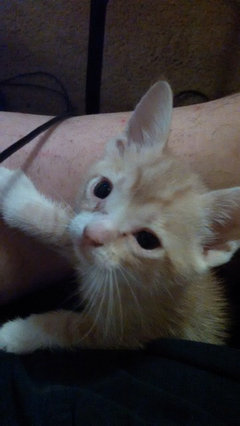
    Can I make it up to you with a pic of the six week old kitten in my lap?

    Turtleturtlemeow thanked Jon Biddenback
  • 11 years ago

    I appreciate your comment. It felt more kind and sociable than feeling like unsolicited advice if that makes any sense.

  • 11 years ago

    I'm just a guy who's fascinated with spiders, and trying to help. If it makes your day or your gardening a little easier, great. If not, I'm not pushing, I don't have a dog in this hunt. :)

    Turtleturtlemeow thanked Jon Biddenback
  • 11 years ago

    I do find spiders fascinating and if I spot them before I touch them I will watch them as long as possible. I even feed spiders sometimes when they have a cool web and I can find some winged aphids. If they touch me first though... :/

  • 11 years ago

    Caution is good. I have had two black widow bites and neither one was pleasant.

    It's reasonably easy to distinguish the jumping spiders from the recluse or widow families.

    Look at the body shape: jumpers have a very compact "chunky" body with the thorax and abdomen about the same size. (widows have relative big rounded abdomens). Bulldog body style.

    Look at the legs and the posture: jumpers have relatively shorter legs and hold them close to their bodies. Recluse and widows have long legs and they are often widespread.

    Look at the actions: jumpers are running all over the plants hunting for prey, or waiting on a leaf. Recluse and widows are passively in a web under something, waiting for prey.

    Turtleturtlemeow thanked User
  • 11 years ago

    Those are not what I have then.

Sponsored
Hope Restoration & General Contracting
Average rating: 4.7 out of 5 stars35 Reviews
Columbus Design-Build, Kitchen & Bath Remodeling, Historic Renovations
More Discussions