Software
Houzz Logo Print
inglewoodyard

tilling and seeding question

11 years ago
last modified: 11 years ago

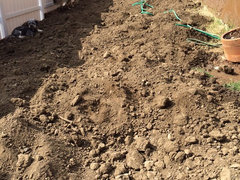
Wanted to throw my plan out there and get your guys' input. I'm in Los Angeles, about to seed some tall fescue in my backyard. It's about 15'x50'. Just dumped in a lot of dirt with tons of hard dirt clogs. It's all very moundy right now. I was going to rent a tiller from HD and break it all up, then level it out, then seed. I'm new to this obviously so hoping you guys could tell me if that sounds ok? Thanks!

Comments (13)

  • 11 years ago

  • 11 years ago

    Tilling is usually not recommended because once it settles, your lawn will be a bumpy mess. The ground on top will look nice after tilling, but you disturb the ground below and the top soil eventually settles into the grooves created by the tiller.

    In your case, tilling may be an option if you are set on doing it. If I were doing it where I live, I would till it, water and water some more and continue watering to help it settle and then use a chain link fence to grade the top. But, given that you are in LA and the whole drought thing, I don't know if that is an option for you.

    I don't know much about it, but maybe look into a Harley rake instead of tilling.

    Is fescue the common lawn in LA?

  • 11 years ago

    Great, thanks! Yeah, fescue is pretty standard in LA.

  • 11 years ago

    Make sure you grade the dirt so that water drains away from the house.

  • 11 years ago

    I really really REALLY wish you had written in here before getting the soil. This is a very bad start. Here are the issues.

    Yes fescue is fairly common all over SoCal but that doesn't mean it is socially acceptable in your drought. Unless you live west of I-5 in Orange County or west of the 405 in the LA area you should reconsider fescue. I can see by the hills that you are most likely more inland, so where are you? (note: I figured out where you are...see the last paragraph). LA is a big place with respect to climate and soils. About the only places to the west with hills like that are Palos Verdes and Malibu. Put it this way, if the weather forecast, "Late night and early morning low clouds near the coast burning off by 11," does not pertain to you, then don't grow fescue.

    I would suggest looking into two other grasses that can get by with much less water. Those are St Augustine and Shadow Turf (a variety of zoysia). Both of those will work in the narrow strip between the house and fence.

    Bringing in more soil is usually a mistake. Why did you do that? You can see how much work it's going to be to break up the clods. It might be easier to put a soaker hose in there and let the water drip into to soften them. Then break them with a shovel, hoe, or rake. I see there's a slope there, but was it unusually steep? Are you okay with water pooling up on your side of the fence when it rains? Or are there openings between the fence posts and the fence? It looks like a big puddle going to form about where the little dog is lying down. No grass is going to like standing in inches of water.

    The right way to do this would have been to leave the existing soil as is, get a soil test at Logan Labs, post it here, correct the soil chemistry, add organic fertilizer to correct the biology, kill off any vegetation already there, then seed, sod, or plug. You've got 10 times more work in just soil prep than had you not done that. Now once you have the soil declodded and leveled and grass in, you still need a soil test to correct the chemistry of the new soil, and you'll need organic fertilizer to correct the biology. So it's the same procedure, but you added tons of extra work with that new soil.

    Okay, I'm a dummy. I just saw your screen name. If you live in Inglewood, you are definitely in the morning fog zone. But being a touch east of the 405 you seriously are on the border of using one of the Marathon fescue varieties. I lived in Hawthorne over by Aviation for most of the 70s. Marathon should work. If you get Marathon III you may only need to mow it once a month and water it once every 3 weeks. This last point is very important, because virtually everyone in SoCal will advise you to water it every day. That is wrong. You don't even need to do that in Phoenix. With your climate (summer high temps in the 70s) you should NEVER have to water it more than once every 3 weeks. When you do water you should water deeply, 1 inch, all at one time. How were you planning to water that strip? I might be inclined to put in either drip irrigation or just lay a soaker hose in there. If you were to water a full inch on 15x50 feet of ground, that would be 460 gallons of water. If you turned on your soaker with a trickle drip out of the faucet you would be applying about 850 gallons per week. So you could turn on a soaker at a trickle drip and leave it on 24/7 for 4 days and not have to water again for 3 weeks.

    Well I've been my usual wordy and possibly helpful, but in this case confusing about your location. I am so adamant about getting the right grass for the SoCal drought that I'm leaving my rant in for future generations of readers. Please don't take it personally. Fescue is used all the way out to Palm Springs and it is just inappropriate east of, well, YOU!

  • 11 years ago

    Thanks for the advice, but I'm sticking with fescue as all my neighbors have had excellent success with it. I installed irrigation under this soil and plan to level and grade it, so no problems there. There was only hard clay to begin with, so I needed to add the dirt and irrigation system. All this soil, though cloddy, has already been tested, and is part of another guy's lawn system. It was left over and he had success with it. I just need to find the best way to break it up, level and grade it, as my original post implied.


  • 11 years ago

    How much time does the dog spend in the yard? That will be a big factor in any grass that you plant

  • 11 years ago

    I installed irrigation under this soil and plan to level and grade it, so no problems there.

    Okay, but your question is how to level and grade it, so there are problems there. You started off with soil that may have seemed like clay, but I can 95% promise you it was not clay. And I can 100% promise you that the old soil could have been fixed a lot easier than this new soil can be leveled. And if this new soil is not fixed in both chemistry and biology, it will soon resemble your old soil except this stuff is 4 inches higher than the old stuff.

    Generally you level a yard by dragging a screed over it or by dragging a drag over it. The screed would require a guide along both ends for the screed to follow. The drag is more free form. A drag can be made from a piece of wood but the better ones are made from a wire mesh that allows the soil to pass through. Chain link fence with a little weight on it works okay. The big problem is you cannot level it until you have pulverized all the clods. If you try to level it with a drag of any kind it will end up pulling the clods along and creating gouges or furrows - which is the opposite of leveling. "Normally" we don't deal with clods like this because normally the owner writes in before starting anything to ask how to level their yard. If we absolutely cannot talk them out of adding more top soil, then we suggest using sand, because it is not cloddy. I'm trying to think of some sort of a high production roller system or a grinder but nothing is coming to mind. You could spread the clods on the driveway, cover them with a sheet of plywood, drive over them, sweep up the dust, and return it to the yard.

    If you have any problems with getting enough water on the fescue, please write back. Once it is established, then the deep and infrequent watering should work fine in Inglewood.

  • 11 years ago
    last modified: 11 years ago

    Thanks so much, some really excellent advice. I'll have to really think this through. I'll post my results next week when I'm done. Thanks again everyone. :)

  • 11 years ago

    When you say deep and infrequent watering, what do you mean? So when it's established, I just soak it real good then wait a few days for the next watering? How infrequent? Again, thanks for the awesome advice.

    FWIW, the soil turned out great. I spent a few hours really soaking all the dirt which made breaking up the clods a snap with garden rakes and shovels. We then dragged a pallet across the soil to level it. Getting ready for seeding now. Thanks everyone!

  • 11 years ago

    How did I miss defining deep and infrequent??

    Deep means 1 full inch all at one time. Infrequent is variable depending on the temperature. In your location it will not vary much all year long (I so miss that about living there). You'll have to figure out the time to water for yourself. Place some cat food or tuna cans around the yard and turn on the sprinkler. Time how long it takes for your sprinkler to fill the cans. That's your time for watering.

    Infrequent depends on a lot of factors but when you put them all in a basket, the air temperature seems to predominate. When air temps are in the 60s, water once per month. Yes, month. When temps get into the 70s (most of the year for you), water once every 3 weeks. If temps get into the 80s go to once every 2 weeks. For that one week per year when the Santa Ana winds send the temps into the 90s, then you can water once per week. But be sure to back off again when the temps fall. The idea for this is to keep the soil relatively dry at the surface. Weed seeds need continual moisture (frequent watering) to germinate. When you stop giving the weeds what they need, your cost for herbicide drops considerably. This watering also develops deep roots which pull moisture and nutrients from deeper in the soil. I realize everyone will think you're crazy for not watering daily, but this drought plays right into your hands once the grass is established. Getting the full inch is what makes it work. The soil surface will dry out completely in a few days but the grass itself will look just fine because of the deep roots.

    Also I have to assume you will be fertilizing conventionally with chemical fertilizer. I would ask that you make an additional application using an organic fertilizer to keep your soil biology happy. I think most people who have hard soil or think their soil is unhealthy simply have exhausted the food supply for their soil microbes. Organic fertilizer is that food supply. My favorite organic fertilizer is ordinary corn meal. I get it at my local feed store. You may think you don't have feed stores in your location but you'd be mistaken. Here's the easy ones. If you go to Palos Verdes, Rolling Hills, or San Pedro, they have horses up there, so there are feed stores. My second favorite feed is alfalfa pellets (rabbit chow). You can get those at most pet stores but also the aquarium stores carry them for feeding koi. The application rate is 15-20 pounds per 1,000 square feet. You can apply any day of the year, especially in your area. You can apply the same day you use chemical fertilizer if you want to get it all done at one time. They don't interact at all.

  • 11 years ago

    Wow, that's the best advice yet; I'm all over it! Writing down all your tips for when the grass comes in. Thanks again. :)