Software
Houzz Logo Print
prairie_northrose

What is wrong with my rose?? Leaf tips crispy, plus yellowing.

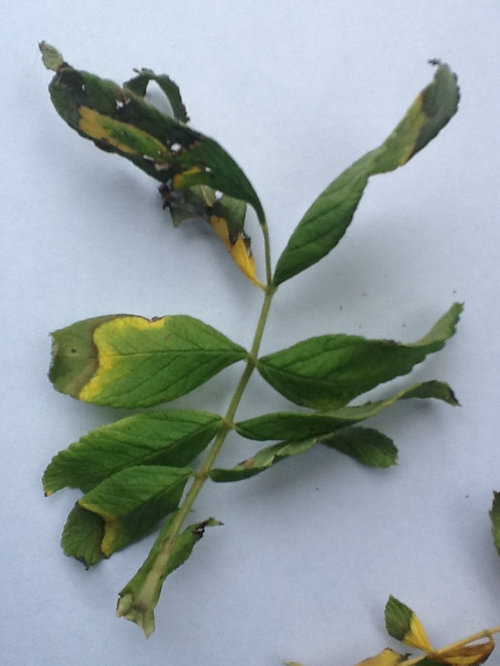
I am baffled by the leaves on my new rose. It is a rugosa type, variety Snow Pavement. Purchased about 10 days ago. It was pot bound, and I noticed the leaves doing this, so I quickly transplanted it to a larger pot with Pro-Mix HP and pinched off all its blooms until I get it's bed ready (will be planting it in the ground asap). I have not applied any fertilizer at all, although it may have been fertilized at the nursery, but seemed very healthy when I purchased it. At the nursery, it was kept outside on the hot pavement.

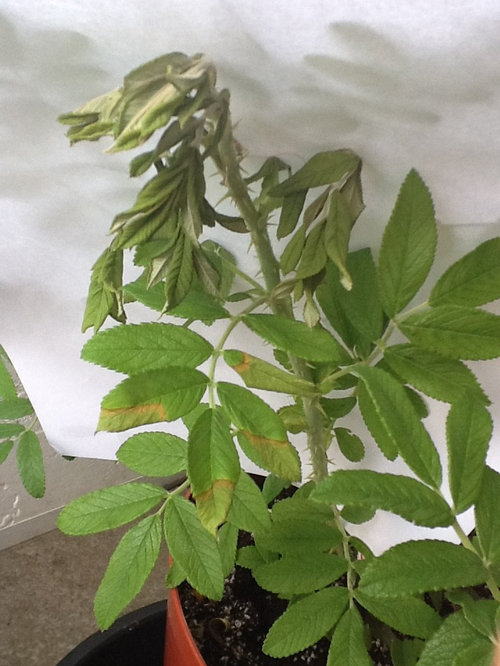
Lower leaves, leaf tips are drying up from the tips moving in, combined with yellowing of the leaf. The leaves are being affected very rapidly with perfectly green leaves, tips going crisp/leaves turning yellow within a day. Pictures of leaves removed today:


Some leaves are curling downward:

This I found very unusual - today I came across new growth that has dried up, with old growth beneath it still alive. You can also see a newer leaf with tips drying:


I am perplexed. Could it be issues from it being root bound? Heat? I've kept it in the shade and have been careful with watering. Any comments greatly appreciated. The rapid changing of the leaves concerns me.


Comments (9)

  • 11 years ago
    last modified: 11 years ago

    Hi Prairie_north: I check on Pro-Mix HP (65 to 75% peat moss, perlite, lime, wetting agent)

    http://www.pthorticulture.com/en/products/pro-mix-hp-mycorrhizae/

    "PRO-MIX® HP MYCORRHIZAE™ HP - high porosity

    PRO-MIX® HP, with its high perlite content, provides a growing environment which benefits growers looking for significant drainage capacity, increased air porosity and lower water retention. The added benefit of a fibrous peat moss and coarse perlite ..."

    I notice on the last picture, the pot is sitting against a black saucer, which means water won't drain fast enough. Rugosa HATES WET FEET. Rugosa is known as "beach rose" since it thrives on DRY & SANDY SOIL. The Pro-Mix-HP has fibrous peat moss, which doesn't drain well like sand, plus peat moss when gets too wet, become acidic. Tip-wilting is indicative of acid-burns ... years ago I had the same problem with one of my band in an acidic too wet potting soil. How to fix that?

    1. Take the saucer at the bottom out, and use 2 wooden planks to elevate the pot, to air out the bottom. If possible, drill extra holes at the sides around the bottom, to drain off excess water.
    2. pH-test the soil with red-cabbage juice. The best potting soils I used become "clear" in red cabbage juice, which means it's a good buffer & neutral pH. The exception is MG-regular-potting soil (green bag for indoor plants) with a higher % of peatmoss, means more water-retention capacity, that became light pink in red-cabbage juice

    I still have problems with the over 65% to 75% peat moss content. I would add more perlite. When I root roses, I use 1/2 perlite to 1/2 potting soil (already has perlite), yet that doesn't drain fast enough, I have drill extra holes at the bottom of the pot.

    Rugosa doesn't like fertilizer, so aim for fast-draining, that way you won't get minerals-accumulation either from your tap, or excess fertilizer. I really think the saucer at the bottom is the culprit. That's why stores put their rose-pots on wooden-planks, for best drainage and airflow to the bottom.

  • 11 years ago

    Thank you so much Jim and Straw! Jim, yes, she's being fussy, perhaps I need to remember not to treat it like the other roses I grow. Good tip, I'll check the roots again when I transplant it soon, perhaps they need to be teased out.

    Straw, I think you might be right about the saucer adding to the condition, I did not even think about it. The wet roots could definitely be a culprit of the very fast change in the leaves. I just moved it to a drainage shelf after reading your post.

    The fast changes are concerning to me. The only other time I had changes so quick was with two Sir Thomas Liptons (another rugosa type) which I had potted in Miracle Grow potting soil, then given alfalfa tea (silly of me in hindsight), the veins went yellow on young leaves the very next day, so I washed the soil off and repotted in plain soil. A few weeks after, it was against near a metal shed (in a black pot too), and the stems went yellow and leaves fell off immediately from the heat reflection. Lesson learned on that one. They are certainly happier in the ground now.


  • 11 years ago

    Thank you, Prairie_north, for sharing with us. I learn from you too.

  • 11 years ago
    last modified: 11 years ago

    Prairie_North: I looked over your pictures the 2nd time, and note what you wrote: "leaf tips are drying up from the tips moving in, combined with yellowing of the leaf. The leaves are being affected very rapidly ,,, tips going crisp/leaves turning yellow within a day." It occurs to me that the peaty soil becomes acidic when it's too wet, causing calcium deficiency. LEAF TIP WILTING is a sign of severe calcium deficiency.

    From Wikipedia: " Acidic, sandy, or coarse soils often contain less calcium. Uneven soil moisture and overuse of fertilizers can also cause calcium deficiency. At times, even with sufficient calcium in the soil, it can be in an insoluble form and is then unusable by the plant or it could be attributed to a "transport protein".[2] Soils containing high phosphorus are particularly susceptible to creating insoluble forms of calcium.

    Calcium deficiency symptoms appear initially as localized tissue necrosis leading to stunted plant growth, necrotic leaf margins on young leaves or curling of the leaves, and eventual death of terminal buds and root tips. Generally, the new growth and rapidly growing tissues of the plant are affected first. The mature leaves are rarely if ever affected because calcium accumulates to high concentrations in older leaves.[3]

  • 11 years ago

    An update: The rose is much better now it is in the ground. I think you were correct in it was having issues with poor drainage. This pot had much smaller drain holes compared to others, and when I pulled the pot off the root ball, the soil at the bottom was wet and compressed, and some roots starting to rot. Images of calcium deficiency matched what was happening.

    I liked this link:

    http://6e.plantphys.net/topic05.01.html

  • 11 years ago
    last modified: 11 years ago

    Thank you, Prairie, for the above link and the update on your rose. I will have to enlarge the holes on my pots. Here's an excerpt from your link that applies to my heavy clay (very high in magnesium): " In the case of the macronutrients, excessive amounts of Mg will compete with K (potassium) for uptake and can possibly induce a K deficiency." Yes, potassium deficiency with brown & yellow lower & older leaves are common in my tomatoes.

    Interesting to see the link showed zinc deficiency as brown & yellow margin on YOUNGER leaves. I also like the link description of nitrogen deficiency: "In some plants the underside of the leaves and/or the petioles and midribs develop traces of a reddish or purple color. In some plants this coloration can be quite bright. As the deficiency progresses, the older leaves also show more of a tendency to wilt under mild water stress and age much earlier than usual."

    Sulfur deficiency looks similar to zinc, and the link differentiates it well: "The reddish color often found on the underside of the leaves and the petioles has a more pinkish tone and is much less vivid than that found in nitrogen deficiency. With advanced sulfur deficiency brown lesions and/or necrotic spots often develop along the petiole, and the leaves tend to become more erect and often twisted and brittle."

    The only iffy picture for the link is manganese deficiency, which doesn't show well in tomato but rampant in my area (in trees and azaleas).

  • 11 years ago

    Yes thanks for the update prairie_northrose! Glad to hear things worked out... :-)

  • 11 years ago

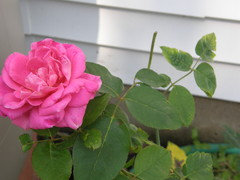
    I re-post this picture of Pink Peace which I thought the pale-margin young leaves was either zinc or calcium-deficiency, but thanks to Prairie's excellent link, "sulfur deficiency is pale young leaves ... the leaves tend to become more erect and often twisted and brittle" Not the pale & twisted young leaves in my Pink Peace.

    We get tons of rain recently, rain supplies sulfur and lowers soil pH ... pH of rain is 5.6. Pink Peace grew healthy & perfectly normal leaves. It was a BS-fest before from compacted clay made acidic with alfalfa pellets, so I dug that up that put lime in the planting hole. Will post pic. of its 100% healthy as of Sept. 10.