Software
Houzz Logo Print
pupillacharites

Rutgers/NJ - Tomato Tasting event

11 years ago
last modified: 11 years ago

I ran across this link to Rutgers semi-suburban tomato tasting event
coming up on August 24, at the Snyder Research Farm when trying to Google up the accepted weight of Rutgers historically. In case one of the several NJ/PA/NY tri-state area members wants to
go and check it out and likely meet some of the present tomato
researchers too. It is a 45-min drive west (Toward Allentown) of New Brunswick. Here is a picture of the 2012 Tomato Tasting event:

Snyder Research Farm, Pittstown, NJ Tomato Tasting Event of heirlooms and hybrids (link)

Here are past variety lists and a lot of useful info including directions (link)

There was just a thread here by Nitsua on the "Rutgers" tomato discussing how many strains there are (link), and I also learned elsewhere that the Rutgers "retro" resurrection (link) hadn't fizzled out. Putting 2+2 together, this is a main tasting event for that tomato and I thought to post it here.

You will get a chance to try out 3 versions and have your vote counted for the upcoming release of "Retro-Rutgers" (not an official name), re-constituted (haha!, from Campbell's Soup) to honor the 1934 original with the same original parent lines of the OP from which thousand and thousands of plants were grown to make the original selection. These parent lines were recently received from Campbell's by the present tomato-folk at the University, who then, using modern analytical techniques, got a project going to resurrect a more flavorful somewhat firm version today. The seeds will be generally available for distribution in January.

Happy tasting

PC

Comments (9)

  • 11 years ago

    Thanks, PC. I certainly be looking for Rutgers 250 next year.

  • 11 years ago
    last modified: 11 years ago

    Interesting, thank you for the heads up PC as i "may" try to make it there since it's an easy 45 minute commute for me. Please don't hold me to it though, but i am now considering it :)

    Otherwise i'm glad a date has finally been set to distribute the seeds.

    Steve

  • 11 years ago
    last modified: 11 years ago

    This is fun to read about, a great moment in tomato history. Here's a bit extracted from the 1934 Rutgers description they did for the release, to put the "original weight" and size to rest. You can also see why the original Rutgers variety is extinct today - back in '34 you could have seen it coming! I hope you find it useful Nitsua, and Steve that it whets your appetite for some awesome tomato tasting. I feel like taking a Greyhound and it is more than 45 minutes from N Florida! You bet I'll be growing this new "250" release, which I will always call retro-Rutgers, or maybe "Back to the Future Rutgers" :-)

    According to the blurb, Rutgers first pick (maturity): New Brunswick, NJ, was planted as early as possible and had the first harvest pass on August 7, 1934, and:

    "Seedsmen and growers are urged to select seed on the basis of this standard. The fruits are medium to large, similar in shape to Marglobe, except that they are more flattened at the stem end, with a very small stylar scar at the blossom end.

    The average size of the fruits is 2.7 inches by 2.3 inches with an average weight of 5.8 ounces. The fruit has a thick outer and inner walls, with very small seed cavity, producing few seeds. The flesh is firm and red. Ripening begins at the center so that when the fruits are red on the outside, they are well colored throughout."

    You can see that the University at that time made no attempt to insure the selection of the seed on their part. They left that in the hands of seedmen and growers. Saying 'urging' to a seedsman/grower is like herding cats LOL (or telling tomato growers how it's done whichever is easier)! The University made no attempt to keep a standard and instead encouraged others to make better selections appropriate to their conditions and needs. Under these conditions I'd imagine the base variety was generally gone pre-1950... but in its place many variants as seed savers and sellers existed based on its great genetics, which were mostly inherited from Marglobe, but Rutgers took Marglobe and made redder from the core out and more acid for canning/juice by the intentional cross and selection with the older Campbell's tomato variety, J.T.D., which was very acidic for that purpose.

    Cheers

    PC

  • 11 years ago
    last modified: 11 years ago

    Thanks John, here's one more link from the Rutgers' site. I just noticed it wasn't in the last post I did. There is some sort of bug sometimes when I post links, they sometimes get removed when composing the post - and I have to edit to get them back in - sorry about that. This one is the original 1934 full description of the Rutgers cultivar:

    Scientific Breeding Gives New Jersey the Rutgers Tomato (link)

    Top Honors:

    To the man behind the Rutgers tomato I write as a homage since no published articles or web pages seem to exist about him:

    We salute Prof. Schermerhorn :-) What a tomato!

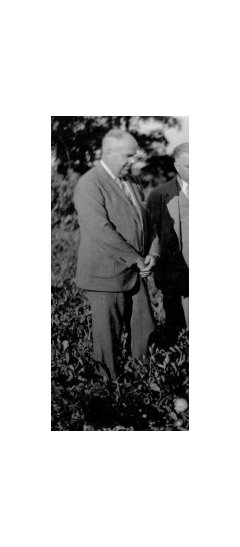
    Professor Lyman Gibbs Schermerhorn, Sr. (1887-1960)

    Born in Massachusetts, Lyman Sr. grew up on a farm and spent time in the city as well. Lyman studied at the Massachusetts Agricultural College where he got his B.S. He took a liking to vegetable culture and breeding as a young college grad. Looking for adventure and family, he married Lillian Tolman (1885-1966) born in New York City, whose family was originally from New England as well.

    Lillian grew up in New Brunswick, NJ. She left her work in preparation for the marriage, as Bursar and Typing and Stenography Instructor at the Rhode Island College of Agriculture and Mechanic Arts she had held for 5 years. Together they moved for his work to Montana when the state was in its infancy and developing from its recent territorial history. It's logical to think Lillian assisted Lyman to put his publication manuscripts in professional form and he did a few in a short time as a junior faculty member. This helped Lyman advance his career quickly.

    In Montana, Lyman took a position as an Instructor of Horticulture at the young and newly expanding Agricultural College of the State of Montana in 1910. By 1912 he had also been part of the staff of the Agricultural Experimental Station (Montana State University's present day Taylor Hall) in Bozeman, and then was promoted to become an Assistant Professor of Horticulture at Montana. He published an agricultural manual on how to best cultivate tomatoes in Montana at that time. While Lyman wasn't an outspoken proponent of pruning side shoots, he recommended that when it was done, that they be at most 4 inches long, and preferably smaller.

    Shortly thereafter, with the pressures of a newborn baby, the Schermerhorns returned back east to Rutgers College where Lyman was encouraged by a relative on the Board of Trustees, to join the faculty in 1914. World War I had been brewing but this was also the heyday of scientific breeding. Prof. Schermerhorn interacted as a young faculty member with colleagues breeding the Marglobe tomato which was a significant advancement and providing cutting edge excitement as a landmark in American Tomato history.

    ...And the rest is more wonderful history, Lyman started making selections for the Rutgers tomato in the late 1920's based on improving Marglobe, and it was released in 1934. :-) He also released a tomato variety named Queens (perhaps for the NYC borough?) which was a principal parent of the 1964 variety release from Oregon, Willamette. Additionally he bred a famous asparagus variety named Raritan, for the Raritan River of NJ. Lyman had only one infant who he named Lyman Jr. who attended Rutgers while his father made the selections for the famous Rutgers tomato.

    Lyman Sr. retired to live in NYC with his wife. His son was very athletic and participated on the Rutgers' swim team and then the track and field team and accompanied his father on occasion for selections before the release of Rutgers. In his 70's, the younger Lyman had returned to competitive swimming from his home in Bucks County (PA). At 80, the younger Lyman had just won a swim relay race, but sadly passed away before his time about 2 weeks later.

    Professor Lyman Gibbs Schermerhorn, Sr. photo credit Rutgers

    Respectfully

    PC

  • 11 years ago

    Are they going to give away free seed samples ?

    I might attend, though I am about 3000 miles away. hehe

    Sey

  • 11 years ago
    last modified: 11 years ago

    Sey, All the free seed samples you can eat :-), and if it's one of the three retro-Rutgers, rR's OP :-) I'm thinking R250 seeds will be available on a FCFS basis in January at a quite reasonable price if you gotta some connections ...

    Since Rutgers is now part of the State of New Jersey's public university system and agricultural extension, I think there would be no problem to save any of the seeds if you do promise to get a good taste of your sample which is the purpose of the event. We'd have to check to be sure since that's different from some private tomato tasting events in which seed saving is sometimes considered rude.

    Here's a picture from the 2014 Snyder Farm Tomato Tasting Event

    It might help plan the Great Seed Robbery if seeds are on lock down. I hear Anthony Curcio is back in Seattle ... the talent is there!

    Cheers

    PC

  • 10 years ago

    Rutgers 250 is now available. Sending in an order today.
    Rutgers 250 order form

  • 10 years ago

    I've always been a Rutgers tomato fan. Glad to see the original come back. I'm going to order.

    John A

Sponsored
Franklin County's Heavy Timber Specialists | Best of Houzz 2020!