Software
Houzz Logo Print
sunshine_1621

cover crop epic fail!

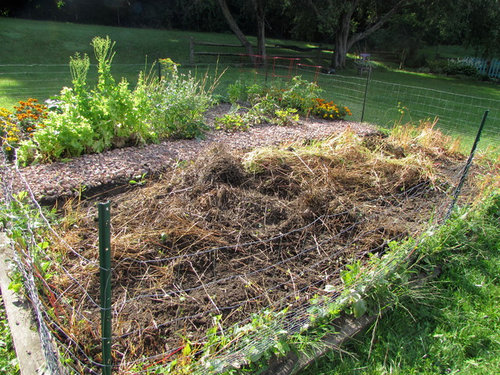
Well, there's no cover crop forum so hopefully someone can help me here. I have a 15'x15' veggie plot and half of it I don't use. So I figured I'll plant cover crops in one side and veggies in the other, and rotate every year. I sowed buckwheat seeds in the cover crop side a couple months ago and it grew to at least 6 ft tall (wtf!!). On top of that, I was a bad, bad gardener and I let it go past the flower stage. So now it's starting to grow again after I already hacked it down. Now I have a huge mound of buckwheat stems and it just looks like a horrible mess. Am I supposed to leave it in there to decompose? How do I kill the new sprouts coming up now? The initial plan was to do another seeding of peas/oats and let it winterkill so I could have a nice, nourished soil for next years veggies, but that entails cleaning up this awful mess first!

This is my first year with cover crops and I have to say I am discouraged... I can't do this every year! I guess my last question would be, what's a good suggestion for a low maintenance cover crop that will help nourish and feed my clay soil? Maybe just one I can use all season and that will kill itself, with minimal work from me. Does that exist?

thanks!!


Comments (13)

  • 11 years ago
    last modified: 11 years ago

    Well for such a small space you picked one of the biggest cover crops. Buckwheat is a great CC but it works for acre sized plots but easily overwhelms a small patch. Especially when you let it go to seed. That needs to be avoided with any cover crop.

    So how to fix - rake it all up and stockpile it somewhere out of the way to decompose into some great compost for next spring, till the patch well to wipe out the new sprouts and do it now before they seed again.

    Then I'd scatter sow something specifically for small patches, something that will be winter killed and is low growing - radishes, turnips, clover,or a mix of them etc. In the early spring as soon as the ground can be worked till it all in and then use your buckwheat compost as a mulch.

    Hope this help.

    Dave

    Edited to add - if you have a way you can chop up the buckwheat - even a mower will help - it will decompose much faster.

  • 11 years ago

    I agree with Dave. A mower could chop it up fine..

  • 11 years ago

    oy, lesson learned I guess. No more buckwheat...

    So, I do have a compost pile. Am I safe throwing all the stems in there now? I don't want it to start sprouting again! Do you think the peas/oats are not a good idea then for this small of a plot?

  • 11 years ago

    It's safe to dump them all there if you keep it working, if you turned or at least stir it up now and then. As seeds sprout just keep turning the sprouts back into the pile.

    Again, peas and oats are normally used in much larger areas - like where they can be mowed and turned in with a tractor. Peas will produce long vines that will tangle and dry hard and difficult to clear, oats grow tall just like buckwheat. Cover crops, to be most effective, need to be proportional to the area they are growing in and to the equipment and time you have to work them properly. Otherwise you make 2x the work for yourself and get 1/2 the benefit from the crop.

    Dave

  • 11 years ago

    cover crop didn't fail. buckwheat is a short term summer cover crop used for 4- 6 weeks. I planted some in an area that was waiting for fall crop to go in. the night after I planted it we got a pounding 3 inch rain. the buckwheat was up in 3 days filled in solid in less than a week. I tilled it in 5 weeks after planting and replanted the area to beets. where the buckwheat grew, there was not any weeds growing. It tilled in great, it was about 30 " tall. this is how the seed houses say to use buckwheat. I use rye and turnips or tillage radishes for overwinter cover cropping.

  • 11 years ago

    I guess I don't know what difference the size of the plot is where you put buckwheat. My area was 20' long x 3' wide. My equipment was my troy built pony. My troy built horse would have been overkill in this size area

  • 11 years ago

    I do have some medium red clover, am I safe with that? I read that it's winter hardy, I don't want it growing back come spring!

  • 11 years ago
    last modified: 11 years ago

    Been there done that with the buckwheat going to seed. Even after tilling in the volunteer buckwheat after cutting down the first crop I still had a lot that came up amongst the tillage radishes that I planted in late August as a winter cover crop. For your clay soil I would recommend the tillage radishes (Groundhog) which do a great job of breaking up compacted soil, improving drainage, mining nitrogen from the sub-soil, and adding organic matter. They winter kill and by spring there is not much left but some short stems, radish carcasses, and lots of deep holes. As a bonus they are also very good to eat when 6-8" long. I am planning to sow some this weekend.

  • 11 years ago

    <I do have some medium red clover, am I safe with that? I read that it's winter hardy, I don't want it growing back come spring!>

    Sorry, I thought I answered that above. You need something that is NOT winter hardy. If it is winter hardy then clearly it will come back next spring.

    < guess I don't know what difference the size of the plot is where you put buckwheat.>

    It is a plot management issue. Of course if you don't manage it correctly then it makes no difference what you plant or what size plot it is. And if you have the equipment (which most small plot gardeners do not have) to manage it correctly then you can manage any crop on any size plot. But small plot management is much easier for most if they use small-plot oriented cover crops.

    Then there is the cost factor. Why buy multiple pounds of expensive buckwheat or hairy vetch for a small plot when you can accomplish the same thing with a few inexpensive packets of radish and turnip seeds or plain old white clover more easily? Why have to deal with 6 foot tall crops in a small patch when you can do it with 4" tall radishes?

    Your choice but why make the whole process more complex or more work-oriented than necessary?

    Dave

  • 11 years ago

    Dave - you mentioned clover in your first post so I thought you were suggesting that it WOULD be winter killed, and that was contradicting what I read online. sorry...

    I will look into the groundhog radishes!

    I have since cleaned up the plot and all that's left is a good final till and a new sowing.

    thanks all!

  • 11 years ago

    I haven't done it myself, but I've seen small-ish areas (such as a 4' x 8' beds) sown in winter rye as a cover crop. Not sure what others know about using it, or what tools would be required, but I've seen how-to's showing it sown in the fall and turned over with as little as a fork in the early spring. I'm not sure how well a small tiller would handle it.

  • 11 years ago

    Sorry there are lots of different clovers so I should have been more specific using plain old annual white clover rather than assuming everyone knows the differences between which are winter killed and which are not. But winter kill is the important aspect.

    Dave

  • 11 years ago
    last modified: 11 years ago

    I did annual rye grass in a 4 x 12 raised bed last year. Planted in the fall. Mowed in the early spring. Then broke up and turned as well as possible into the soil with a hoe. Then allowed it to sit for 2 weeks, hoed it again and planted potatoes. It seemed to work okay for me and did not resprout during the summer. I will watch carefully to make sure it does not resprout this fall. It shouldn't because there were no seed heads.

    In another 4 x 12 raised bed, I grew winter peas. They grew so thick and lush I had to knock them down with a weed wacker. I raked 3/4 of the foliage up and put the cuttings in my compost pile. Then I turned what was left on the ground into the soil with a hoe.