Software
Houzz Logo Print
akamainegrower

Weight and Depth

11 years ago

Rhododendrons are my main interest, so in the last couple of years I have taken to growing some of the dwarfer,slow growing, and tender species in portable hypertufa troughs that I can move to a sheltered unheated space for the winter. The gritty mix is proving to be excellent for those species that require especially sharp drainage. It's drawback is the weight contributed by the granite. This severely limits the trough size. So what other non-absorbent, non-decaying componet might effectively substitute for the granite? Pumice? Granulated cork? Perlite? I should probably also mention that I do add a half measure of coarse peat to my version of the gritty mix.

My second question has to do with the depth of the hypertufa planters. I have made them to accomadate roughly six inches of planting media. Would the addition of a wick permit a reduction of the depth to say 4 inches? Would a wick be advisable for both the gritty mix and the 5-1-1 mix which I also use?

Many thanks in advance for any help.

Comments (9)

  • 11 years ago

    There really is no advantage in using the gritty mix if you're adding fine ingredients, like peat, coir, compost ..... The primary feature of the gritty mix is, it eliminates the limitations imposed by perched water because its large particle size doesn't allow water to be retained in the interparticular voids due to the large and structured particle size. You might consider a mix composed primarily of bark, with smaller amounts of peat and perlite added - the 5:1:1 mix IOW.

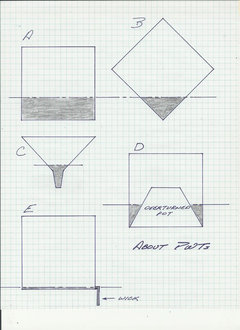
    There are several strategies that can reduce a soils ability to hold water that won't drain by the force of gravity alone. One is a simple tilting of the containers after/during rains or after watering, another is via use of wicks, as you mentioned, and another is including some ballast objects in the bottom of the troughs. See 'B' for the effects of tilting, 'E' for wicking, and 'D' for ballast.


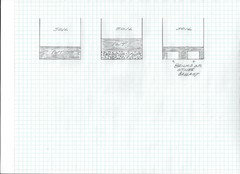
    The picture on the right (above) also illustrates how objects used as ballast can reduce how much water a container can hold between soil particles. The ht of a perched water column is a constant in any given soil; so, if you use enough ballast so it only takes a very small volume of soil to fill between the objects used as ballast, you can eliminate nearly all of the 'excess' water.

    Al

  • 11 years ago

    Thank you for the ballast suggestion. This would certainly solve the weight problem. The point about not adding fine material to the gritty mix is well taken. The peat I have used is not the fine dust sold by the millions of bales. It consists of coarse particles in the 1/8" range which do not break down rapidly. This is my attempt to replicate the kind of soil the so-called alpine rhododendrons grow in naturally. Pure gritty mix without any water retaining material would be excellent for those rhododendrons that grow epiphytically and require even sharper drainage.

  • 11 years ago

    Keep in mind that in situ plants don't always grow in their preferred spots. Very often, a plant is eclipsed from growing where it would grow best because of competition from more vigorous species - so where you FIND a plant isn't necessarily where it wants to be. Also, growing in pots is a game changer. It's probably a safer bet that the type of soil plants growing in situ are in would be lethal in a pot than to wager it would provide a happy place for a healthy root system. The physical (as in physics) applications between the two settings are very widely divergent.

    Hey - are you using the hypertufa for its rugged/earthy appearance by any chance?

    Al

  • 11 years ago

    The appearance of hypertufa was a factor. Not anything to do with with ruggedness or earthiness, though, except coincidentally.. I've had six large unmovable hypertufa troughs in more or less continuous use for 25 or so years and wanted the new smaller and lighter ones to be a reasonable match. I also could not think of anything that would be lighter than a thin layer of hypertufa over styrofoam.

    No question that plant competition may cause some to favor an environment less than ideal for optimum growth. The other side of that coin, however, is the desire to grow plants "in character", as alpine gardeners used to say. In other words, the plants should appear as close to their counterparts in the wild as can be achieved under garden or container conditions. I have not ever created lethal conditions in a container by following the guidance provided by a plant's natural habitat. Doesn't mean it can't happen, of course. As for a plant's relative "happiness", that's way to anthropomorphic for me!

    The thoughts of alpine gardening reminded me of the articles Jim Borland wrote about container media for the NARGS journal in the 80's. The main one appeared in the famous trough issue. He emphasized many of the same points you have and exploded some of the same myths about drainage and other issues. It ignited something of an ongoing controversy that went on continued for some time. Likewise, Edward Reilly in his book, Success with Rhododendrons and Azaleas, advocated a container mix very similar to your 5-1-1. He prescribed 3 parts bark screened to 1/4 inch, 1 part coarse peat, and 1 part coarse sand, the latter primarily to add weight so pots were not easily blown over. Roy Heath's classic book, Collector's Alpines, seemingly had a different medium for nearly every species. Don Wallace of Singing Tree Nursery just recently published online his recommendations for container media. The Bovees nursery - probably the most knowledgable growers of vireya rhodendrons in the US - has a recipe online as does the Rhododendron Species Foundation for some species. Point is, they are all slightly different and all effective.

    I do admire the research you have conducted and your willingness to help others. All of us attempting to grow things in containers, whether rhododendrons or tomatoes, owe you a huge debt of gratitude.,

  • 11 years ago

    Thanks for the kind thoughts. I wish you well in all your growing endeavors. The reason I asked about the rugged pots is, a friend of mine wires together some pretty interesting looking containers for a few of the more masculine bonsai he maintains. Have a look, here.

    Al

  • 11 years ago

    Very interesting and attractive containers. I imagine they would have to be protected from even mildly freezing weather to prevent spalling of the stone. There are also modern construction adhesives that would eliminate the need for the wires although as the copper develops patina it would only add to the distinctive look.


  • 11 years ago

    I'm not sure about the stone fracturing/blowing out from freezing water. I know he has plants in them that CAN be left out in northern MI winters (native larch, pine, spruce, .....), but not sure if he actually does leave them out. I do, but I don't have any stone pots like that. Lol - it does help me to identify the cheap Chinese pots that DO go all to pieces at just below the freezing point when water/ice is still expanding.

    Al

  • 11 years ago

    Most bluestone is subject to spalling - flaking off of layers - even when it is used flat on the ground for walks and patios. The pot slabs are in a verticle position and unless this is an unusually dense sort of bluestone, water would seep between the layers more easily and split the layers apart when it froze.

    A totally unrelated question, but have you ever considered writing a book about container growing? You have probably already produced much of the necessary content in the form of GardenWeb posts. You have many contacts for photographs, etc. I suspect that the horticulture press is experiencing much of the same struggles as the rest of the horticulture industry, but contacting Timber Press or another publisher with some sort of exploratory proposal would be a good beginning if you are interested.