

Abies in Missouri
I am going to plant a few fir trees around the property next spring and I was wondering which ones I should plant. the ones I think that are most likely going to grow here are Manchurian fir, Nikko fir, Canaan fir, Nordmann fir, and Momi fir. Are there any other firs you would suggest or are any of the firs on my list not going to do well here. Im located in hardiness zone 6 and AHS zone 7 in Central Missouri. I do want to plant around 500 fir trees and was wondering which ones were my best bet. Im not going to be watering them or taking care of them in any way. Just going to plant them and see if they grow. Thanks for your help.
Comments (82)

abel k
Original Author11 years ago+om:
Where I want to plant most of the trees there is hundreds of eastern red cedar. All the abandoned fields are covered in them. So I don't really want to plant trees that look very similar to them. That's why none of the trees like them are on my list. Im not really of fan of how they look when they get older. They don't get really tall and they don't have the majestic feel to them.
In my case I simply wont be able to water or take care of the trees in any way. The ones I plant by the house I will but not the ones in the woods. Im not really expecting most of them to survive but I really would be happy even if just a few do.
Spruceman:
We do get around 4 inches of rain in the summer months, Maybe a bit more in the spring. This year the spring was really wet and some of the seedlings did survive but I don't know what next year will bring. The way we water is we put 50 gallon barrels in the bed of the pick up and water some trees but those are the trees that are closer to the yard. I wouldn't be able to take any sort of care for the seedlings in the woods.
The biggest reason that I want to buy plugs is because it gives me more time to plant the trees. If I don't have time the week they come in its not a big deal. I could just plant whenever I have time. It is just difficult when an order of bare root trees come in and I have to plant them that day or the day after. It just doesn't give me a lot of time. This year I will dig a trench and put the bareroot in it. Somewhat "heel them in". The only time I could plant is Saturday and after work on the week days.
I am planning on planting some spruce this fall so I wouldn't be overwhelmed in the spring. I am planning on getting them from Musser forest because you did recommend them to me before on one of your post. I am planning on getting the precision sowed three year old Norway spruce and I want to get some oriental spruce but im not sure what size would be best. In their catalog they have three year old and five year old. The 5 years old aren't to tall and If I plant them in the fall they might get adjusted before the summer comes. This year I did have better luck with the smaller seedlings.
- 11 years ago
abel:
Thuja--the Northern white cedar (Thuja occidenbtalis) and the Thuja plicata, the Western red cedar, are not related to the eastern red cedar, which is a juniper. The Green Giants grow tall very fast, and in 25 or 30 years will be 60 feet tall in good soils, and still growing--eventual height unknown as of now--they are new. The Western red cedar in their best native environment grow to 180 feet tall, 20 feet in diameter (yes, diameter) and live for over 1,000 years. The Green Giant hybrids are a moderately narrow conical shape. The T. plicata are similar when young, and the T. occidentalis is just a bit broader in habit, but is very similar. They are slower growing and top out at a max of 80 to possibly as much as 90 feet, but are more commonly a bit smaller. Maybe I can post a picture of my Green Giants. At the moment, I am short of time, but later.
But, all that said, I can understand if you prefer other trees, and you can't plant everything that someone on this forum might like and recommend. We all do have different preferences.
--spruce
Related Professionals
Covington Landscape Architects & Landscape Designers · Baltimore Landscape Architects & Landscape Designers · New Bedford Landscape Architects & Landscape Designers · New York City Landscape Architects & Landscape Designers · Orlando Landscape Contractors · Elizabeth City Landscape Contractors · Hartford Landscape Contractors · Kenosha Landscape Contractors · Las Cruces Landscape Contractors · Bronx Landscape Contractors · Dubuque Home Builders · Erie Home Builders · Pittsburgh Home Builders · Phoenix Home Builders · Lancaster Home Builders 11 years agolast modified: 11 years ago
Spruce, always good to hear from you.
I surmise that your dry-ish Shenandoah Valley summers, and concomitant slightly cooler nights than mine, are helping you avoid disease problems with larches. It's noteworthy that as far out west as you are, it's also more common to see relatively healthy looking Picea pungens. OTOH closer to the Bay, even in the parts of Harford County with high rainfall where hemlocks naturally grow(!), many Colorado spruces look sick. Point being, you probably don't have the frequent clusters of storms I do dumping 2+ inches, several times, over a 1-2 week period. When what I jokingly call the "upper Bay monsoon" really kicks in. (the true bullseye of it, as I mention, is a bit west of me roughly over Bel Air, MD. although the pattern tends to be that they have more consistency thoughout the summer, and I have more spotty but heavier deluges in late summer and early fall.)
Over the years I've probably tried about 10 hybrids and 10 Japanese larches. They all eventually died, almost always after heavy rain events. Though I finally have one Japanese larch that seems to have laughed off the 15 inches of rain in June. It did flag for a bit and I assumed it was a goner, but it recovered. (excepting the Larix mastersiana, collected in China, which I've always stated was a class apart from the rest and appears extremely heat, drought, and excess rainfall resistant. It's very slow growing compared to the others - though faster than Pseudolarix!)
- 11 years ago
David:
Very interesting. I would not have thought that excessive rainfall would be a problem there. It must be a problem with the very warm climate AND the rainfall. At my timberland in the MD mountains, where there is lots of rain, larches do very well.
On the other side of the Blue Ridge at the Oatlands plantation, they had a very, very old larch in the bottom left corner of the garden, but it was destroyed in a storm a few years ago. The story with this one was that it was given to the plantation by Thomas Jefferson. It was a healthy and moderately large tree. If you go there and have a tour now, you may be told that the larch in the upper garden is the one from Jefferson, but that's a mistake. That tree is much younger.
Anyway, larch will grow well east of here, but I don't remember any at that National Arboretum. They may be there, but right now, I don't remember them or I may not have seen them. There are 70 or 80 year-old ones in the VA Arboretum, including European, Japanese, and the hybrid. All look very good, with the hybrid growing slightly better.
abel: here is a picture of my Green Giants, planted in 2003. They are about 30 feet tall. I planted 3 in 2003, and have planted several others in that little grove since, including two of the "Steeplechase" variety, which originated from a branch "sport" (mutation) on a Green Giant. This grove makes up a nice green "glade." It is one of my favorite spots, especially in hot weather.
- 11 years ago
Oops, the photo didn't appear. How do I include a photo? I clicked on the photo icon and uploaded--I thought--but no, it didn't work. Should I have used the "Houzz photo" icon, or what?
--spruce
 11 years ago
My larch died after heavy rains, also. Would love to see your 30' tall Green Giant's. Been wondering where you were spruceman, but see you've been busy.
Dax
- 11 years agolast modified: 11 years ago
Upload from your computer. Just try again. You'll see a circle spinning until the photo appears in this window box. If a lot of pixels then it takes much longer for the photo to appear as GW is resizing your photo.
Dax
abel k
Original Author11 years agoSpruceman:
Maybe you could use Photobucket like you did in some of your other post. I do want to see them. I had the perspective that green giants were just a hedge plant that you plant in rows to create a screen. Do you think that western red cedar could have some long term success here in the lower Midwest? if it does well here it could be a good replacement for giant sequoias. It doesn't look to much different. I planted 10 giant sequoias this spring and now im watching them slowly die. I doubt that they will make it through the winter.
Idaho sate nursery has some seedlings that are a good size for a decent price. Im thinking to plant them where i planted the Sequoias.
- 11 years ago
Dax:
Thanks. I tried earlier, but after 4 hours the upload didn't complete. So I have downsized my photo--I had forgotten the setting I took it with, and didn't double check it before I tried to upload it. So I will try again shortly with a much reduced file size. It was 900K, but I will try again with 87K. I am on a slow dialup connection--uggh! If that doesn't work, I will go to Photobucket, but I haven't used that site for a long time and have forgotten the instructions. I will look in my files to see if I can find them.
abel; I can't get my giant sequoias to grow here--I have planted two of the Hazel Smith cultivar, and they both got some kind of stem canker. I removed one, but still have the other, and it keeps getting the upper part killed by the canker, and then sprouts out, again and again, making a wide bush. I will probably remove that one also.
I think Green Giants will grow fine there--they are tough, and so far show good drought resistance. As for the straight western redcedar, I am not sure if they are as tough. The Green Giants may be very drought resistant, but the last time we had a really, really bad drought here--officially an "extreme drought" on the Drought Monitor--they were fairly small and I watered them. We have had a couple of moderate droughts since, and they have been unaffected.
As for the straight T. plicata, I am not sure--they may be just as tough and drought resistant as the Green Giants. They are native to the wetter areas of the Pacific NW, so many people assume that they require that kind of climate. But clearly, that's not entirely true. The cv "atrovirens" at the VA Arboretum has been g rowing for a while and is maybe 25 feet tall now, and seems to accept anything the climate here can throw at them, and thrive.
Some trees do wonderfully in climates as different as possible from their native areas. The best example is the baldcypress, the southern swamp tree. It will grow in any decent soil no where near any swampy ground, and is hardy at least as far north as central lower Michigan.
As for "long term"--there is no definite information on either the Green giants or the T. plicata in climates like ours and yours. But, as for the Green Giant hybrids, the Thuja plicata is extremely long lived, and the other "parent," Thuja standishii, although not growing so large, I believe is long lived also. These Green Giants may well eventually grow over 100 feet tall and live for hundreds of years. But to be honest, no one really knows. I am not aware of any disease. There may in some areas be a problem with bagworms, and I have found some on mine. But so far, no real damage. Has anyone else had a problem with bagworms? I think there was a post here not too long ago in which one person said he had to spray. But bagworms like lots of things, including blue spruce, larch, Leyland cypress, Virginia juniper, and others. I see no reason not to plant these. I control the bagworms here by picking them off, which sometimes is a bit of a nuisance, but well worth it for these beautiful trees.
In the Pacific NW, the T. Plicata is absolutely amazing--they get incredibly large, live incredibly long, and can be incredibly beautiful. I have spent a fair amount of time in the forests there, so I know, first hand just how amazing they are. How they will grow over the long term in our kinds of climate is really unknown. My own guess is that they will do very well, but I have no real evidence of performance long-term.
Well, you can try the T. plicata, or you could go with Green Giants--or some of both.
Until I find out how to post pictures, a picture of Green giants on-line that looks exactly like mine, but without my wife in the picture for scale is this one: http://i.waysidegardens.com/images/xxl/v1755.jpg
Yes, most people think of Green Giants as a screen, and they are good for that. But I have mine planted in a small grove of about 10 or so, each about 15 to 20 feet apart. I think the effect is magical. Of course, in 30 years, the crowns will close, and I will prune off the lower branches, which will eventually die, and I will have a dense little forest. But just thee of them, planted in a triangular group, can be wonderful.
Now I am a bit of a "whimsical, playful little puppy," so I have done something else with them. I have planted a "mystic circle," and have 18 of them in a perfectly round circle, spaced about 9 feet apart. In the middle I have planted a Bowhall maple, a cultivar of red maple--or is it a Freeman?--I forget. I like the idea of being enclosed in this circle, sitting under this nice maple, that turns golden in the fall.
Some trees become very popular, such as the Leyland cypress, and they are not really very good trees--some people think they have become a kind of plague of poor taste. Green Giants are almost as popular--they are available everywhere, but in this case, their popularity is well deserved. I can find no fault in them.
--spruce
- 11 years ago
I tried to post pics of my 30 footers,,,wouldn't work,,,just posted pics the other day
maybe just this particular thread
try this,,,,make separate post of GGs
ron
- 11 years ago
abel K:
I'm sorry--about the T. plicata here at the Virginia Arboretum; for some reason I forgot to mention that there is one older "straight" T. plicata that is perhaps something like 60 or 70 years old. It is growing very well and is quite pretty. Because it is in a very "out-of-the-way place," I would bet that I am one of maybe two or three people, if that many, who know it's there. It is growing tight in amongst a bunch of other conifers, but one side of the crown is exposed to good sunlight, so it is easy to see the foliage and judge the appearance and health of the tree. It looks quite healthy, and my guess is that it is something like 70 feet tall.
So, more evidence that the straight T. plicata will grow quite nicely in a climate similar to yours. But, you mention that you generally get days over 100, which are a bit more rare here, and you may have a bit more summer humidity than we have. Also, you get more summer rain, which should be good.
--spruce
 11 years ago
Good to hear from you, Spruce.
As to the pitch/loblolly pine hybrid, this is my fastest pine. The top got hammered several yrs in a row by stem-weevils, but eventually a replacement leader emerged out of the mess, below after 10 seasons (last fall). Even some cones:
- 11 years ago
Dax:
Funny thing with the picture I sent. I downsized it even more than I said I would--to 25 K--and it came up almost immediately. It is not a good quality picture at that resolution. Next time I post a picture, I will try at 75K and see how long it takes, and how it looks.
Beng:
My pitch/lob hybrids are growing very fast, but virtually all of them are damaged by some kind of shoot-tip moth (I think that's what it is) that kills the terminal buds. They are at 4 years after planting, averaging over three feet, but if they didn't have their terminal buds killed so often, I would guess they would be doing 4 feet. A few have grown over 4 feet this year, nevertheless.
AND, I read an article about them that said that IF they would make some effort to select the best strains of both the loblolly and the pitch pines for the hybridization, they would be substantially faster, and have more sustained growth. Maybe someone will start developing even better ones.
Oh, the shoot-tip moths get my loblollies also, but not the white pines. Those get a weevil occasionally.
Abel: Another thing we need to recognize about the T. plicata. Like the Douglas-fir, they grow in two different areas, the wet and warmer coastal areas of the pacific NW, and in the so called "Inland Empire" in Idaho and Montana. No specific separate varieties have been identified in these two separate areas, as they have done with the inland VS the coastal Dougles-fir, but there are clear differences in cold-hardiness. SO, yes, get the seedlings from the Idaho source.
--spruce
abel k
Original Author11 years agoThanks for all the information. I wasn't aware that the GG could get to be 100 feet tall. Well I really didn't know much about them. I have read some older post and it seems like T. plicata doesn't do as well as the Green giants in the Midwest. But I will try to do a bit of both. I guess I will be experimenting with trees for the rest of my life. Searching for that one perfect conifer. The reason I chose Idaho nursery was because I was thinking that they should have better drought tolerance then the costal strain. The more I read these post the more I realize how important is the seed source.
- 11 years ago
Abel, I'm not sure what I wrote-or more to the point, what you think I
wrote, regarding so-called eastern red cedar, as that plant has never been a favorite of mine. I never plant them. So what did you think I was getting at? I'm confused.The other oddity which has come up in this thread is larch supposedly not handling wet weather. This flat-out contradicts everything I know about this genus. Tolerance to high water tables is a given in many of the larch species and if you want to ever see them not looking well, view them in a drought year. Now there's your larch dying. Wet conditions? I still can't grock that one.
+oM
- 11 years agolast modified: 11 years ago
+oM,
Soil properties.... mine being loamy clay + extreme heat and drought + flash flooding on an again and again basis...and on that exact same day and on an exact parallel from each other, my larch and my Rhus chinensis died. I 'literally' observed it happening in slow motion over a period of two days.
Dax
- 11 years ago
Well, I know you to be a highly observant fellow so I'm not doubting you. It just flies in the face of what I think I know, lol. But even in your description, you make mention of extreme drought. Now that I know can make mincemeat out of larch species. Hmmmm?
+oM
- 11 years ago
And you. I know you've walked the block. Heat.... it has a lot to do with it. Just 120 miles north of me in a direct line is a friend in Farley, IA. Farley is a direct line west of Dubuque, IA. In the summer his temps are an average of 5 degrees cooler than here. That's so significant that he is able to grow Douglas fir, Larix, Pinus flexilis, Pinus sylvestris.... things I don't dare to mess with here because of either sudden death or needle diseases. You being even north of him is going to make it even cooler.
I know the perfect recipe happened here for that 'tornado' to occur. Additionally, when I drive around here I see very few larches. It seems that for only a grouping of 3-4 trees and three other specimens I've seen in the Quad-cities... that all the others growing here are older European larches at old farms outside of metropolitan areas. In the metropolitan areas with heat effect, if not given plenty of breathing room they are non-existent. And could you imagine as we go farther south in MO? It's seems like a deadly skip to my step. I say this because I am 50-miles only south of Chicago on the other side of the state and only twenty miles from the Mississippi River which does give some cooling effect.
There will be survivors, yes. I'd feel a lot more confident if I planted larix on the banks of a lake in MO. but, in the wide open.... forget it, : )
Back to drought. We had temps in the high 90's and heat indexes of 105 during a period of a few weeks w/o any rain and then we got hammered with torrential rains for days on end. Then it went back to no rain for weeks and stifling heat and again, more rain! So much rain that on my sloped property where water does not settle for long if at all, despite not having the best of soils, 'rivers' of water streaked down my slopes and ran directly thru where those two trees were planted.
I posted this same information on another forum of super geeked plant enthusiasts and two others in IL replied they observed the same thing under the conditions I've described there above. One person being a well known author with far more information in his head than I believe I'll ever possess.
I wouldn't say my memory is perfect regarding the drought +oM, but I am certain the numbers of inches of rain were off the charts, heavy. June was the rainiest month on record accumulated for IL. On my property it doesn't take long for cracks in the earth to develop, but under those cracks it's moist. That clay really helps in a not so lovingly relationship with yours truly.
Let me refresh my direction of thought right now that even though it appeared to be drought stricken, I would wager the soil beneath was likely plenty moist. It's sort of coming back to me... it rained like a son of a gun for two months is the primary thought on my mind, now.
Best regards,
Dax
- 11 years agolast modified: 11 years ago
" So much rain that on my sloped property where water does not settle for
long if at all, despite not having the best of soils, 'rivers' of water
streaked down my slopes"Yes that is what happened in my garden in the period around Hurricane Irene, which was preceded by several other storm systems. It was surreal. Like a thick sheet of water pouring over the soil, for hours. I was lucky the only significant rhododendron it killed was R. rex, which was a long shot here anyhow. After this I started using my Kubota FEL to begin regrading the entire area to have gentle slopes and swales, so rot sensitive plants could be situated on the mini-ridges. So far, so good...assuming something was correctly positioned! A Rodgersia almost totally died in June, because I had thought a low spot was appropriate for it. Guess not. A little offset survives. I think with all these Asian high elevation plants - Rodgersia, some Larches, many species rhodies etc., it's all the same. They are used to wet soil, but it's wet soil: that is mountain-based so siliceous, flinty, dolomitic or schist-like and thus well draining (perhaps with a thin organic layer), and at elevation, so places with cool, cloudy, misty days and chilly nights. The soil never gets anywhere near as hot as ours does. I think the reason my 10 other nearby rare rhodies didn't die is perhaps the soil was just able to re-aerate fast enough, when the rain stopped. Being a looser loam than the brick like clay of say, northern Virginia. I've had much better luck with rhodies here than I did in northern Virginia, and the slight summer climate difference cannot fully account for it.
- 11 years agolast modified: 11 years ago
I can't reiterate the similarities any differently from what you said, David. Rhododendrons do better here on loamy clay than on better soil that is black loam - which is what I was used to all of my life until I moved onto this property. I would've never expected my rhodies to be as healthy and robust as they are here (all two of them) lol. That "2 feet" you mention is what I've thought here... even though cracks sometimes 5-6" wide develop, I can stick a shovel down and find the moisture level to be perfect.... this is a month or 6-weeks after a serious drought.
And yesterday I thought about larches and admittedly was going to make a wise crack 'how they are happy in zone 2 or zone 3', however I didn't and still do not want to offend anyone whom lives in such a cold environment. The truth is they are at high elevations with abundant rainfall and cool nights.....and (cool days.) As I said, all I'm doing is reiterating what you said.
Best regards,
Dax
- 11 years ago
I certainly do agree with the temperature paradigm. Larch is notoriously ill-suited to heat, and I believe that goes for the entire genus. As far as larch and soil moisture go, it is really only American larch (tamarack) which is a straight-up swamp tree I believe, unless Siberian fills that niche as well. For all the rest, as you guys have pointed out, these are montane species.
Dax, I'm a weather geek too and I surely did note the unceasing rainfall that was Illinois' lot this year. Wow! Chi-town must be one of the wettest places in the nation this year! Even systems that would drift down through my area would often wallop Chicagoland even harder once they got down there., not that I think you're near there. I don't quite know what to make of this info though. Maybe just be glad I seem to be able to grow larch with incredible ease up at my plantation! Of course, those are mostly the hybrid marchlinsii and I don't doubt for a minute that hybrid vigor plays a part in their amazing rate of growth. The backside of all that is that that place is too cold in the winter for other favorites like dawn redwood and apparently Green Giant arbs. I've learned to respect the native "cedars" (Thuja o.) all the more, this even though they were pretty much already a fave. Those things are unbelievably tough plants. Oh, what's that....we're talking about larch?
I guess bottom line for OP is that he appears to fancy a larch or three and may as well give them a try. But maybe don't bet the farm on their performance.
+oM
- 11 years ago
indeed, well said, +oM....... laricina I knew I should've mentioned being it's own larch-species-animal. I just felt like I had said enough collectively-speaking.
Dax
- 11 years ago
I am not so sure that abel is too far south for European larch, Japanese larch, or the hybrid between the two. I am in northern VA where the average July daytime high temperature is about 88 degrees. 4 years ago we had a hot summer, with about 35 days over 90 degree, and 8 days with the temperature near or above 100 degrees. None of my larch seemed to be adversely affected. We are also a bit on the dry side here, with a moderate drought about every other year. I have not watered any larch for several years, but I watered some during droughts for the first 3 years.
My larch are growing great--I have about 30 them planted all over in all the types of soil I have here. But I don't have any clay loam. I have two kinds of fairly deep silt loams that have a B soil horizon that is quite "sticky" with a fairly high clay component, but it would not be classed as a clay loam. I have some Japanese larch growing on a very well drained soil that is gravelly, formed over a kind of soft shale. I also have some growing on a silt loam that has been moderately eroded, with most of the A horizon gone. I have I European, 2 Japanese, and 3 hybrids growing on a steep slope with soil formed over shale, with a good proportion of shale fragments included. All of the larch are growing very well and are healthy.
All of my soils here are at least moderately well drained, with the shaley soils very, very well drained.
Years ago I talked to a forest research scientist at SUNY Syracuse who had done some study of site factors for larch, and I have since done a bit of "checking" on the subject, but I can't say I have done any systematic "research."
The forest scientist I talked to at SUNY said that the most important factor he had discovered was soil depth. As far as I know, their research forest doesn't have any clay loam soils, so I assume he had nothing to report applicable there. My informal "checking" confirmed the importance of soil depth has been found by others also. Failing a deep soil, the SUNY research scientist said that growing on a slope would compensate for a lack of soil depth to some degree.
One reference I found said that impeded drainage that results in soil saturation around roots for a period after heavy rains could cause a variety of fungi to attack the roots. This may be what has killed Dax's and David's larch.
My fastest growing larch are growing on a very deep soil that I think may be the Timberville silt loam--to confirm this soil type I need to dig a soil pit and see if I can find features that match this soil. There is not always a fine line between soil types, and within each type there is variability. Anyway, two or three of the larches I have planted there, in a good year grow 5 feet.
The larch I planted on the eroded silt loam soils had a slow start, and one, where the soil was the most eroded, and where I had my doubts about its prospects when I planted it, was close to death for the first two years, but since--after careful watering--it has started to grow quite strongly, and is averaging about 3 feet plus per year with no continued watering.
I mentioned earlier that the VA Arboretum has fairly nice specimens of Japanese, European, and the hybrid larches. They are about 80 years old and healthy. The soil types there are essentially the same as I have here. So that's evidence that the growth I see here with my young larches--the oldest being 13 years and 40 feet tall--is not just some temporary success.
Now abel is in a place with slightly hotter daytime temps in summer, but it is the same USDA hardiness zone. So my guess--and it is a guess, I must admit--is that larch will do fine there IF he has fairly deep silt loam soils. If he has clay loam soils, or clay soils of any kind, I would not bet on larch. And, if he has soils with impeded drainage, larch may suffer the same fate as those grown by Dax and those grown by David. BUT, if he has deep or moderately deep silt loam soils that are well drained--he should "go for it."
By deep soils, I would say that means a max rooting zone of 4 feet or more. One can dig a hole and see how far down roots go. I have not been able to dig so deep that I can't find roots. My soils here, according to the soil survey booklet, have a rooting zone that averages about 55 to 60 inches, and if I have a small patch of the Timberville soil, that would be 70 inches or a tad more. I am not sure how deep the shaly soils are--the shale is soft, but I have never dug more than two feet down into these soils because at that depth the shale is so dense and compacted, that digging further is very time-consuming. But going down through the cracks in the shale, there are abundant roots. My Japanese larch on this soil are averaging three feet or a bit more per year.
I have larch growing also on my timberland in the MD mountains at an elevation of 2,700 feet. There the soils are not so deep, averaging 40 inches or so, but they are well drained channery silt loams, and the area is cool and moist. My larch here in VA are growing just a bit faster on average. My tallest larch there, in the ground for 35 years, are the Japanese at 60 feet or so. Early snows there, unfortunately, have destroyed most of my larch.
Oh, one last tidbit. I have tried the "western larch," L. occidentaslis. I planted two. One, after struggling for 4 or 5 years, has finally started growing fairly nicely--18 inches per year--and it is a nice, healthy looking, 15 foot tree now. The other, after struggling for almost 10 years, finally died last year. That one was on a more shallow, shaly soil.
--spruce
- 11 years ago
This is quite a discussion. I enjoyed reading what you had to say, spruce.
Dax
- 11 years ago
Yes, thanks for that, Spruceman. One wonders about that western larch-I know Resin repeatedly admonished some of us here to not bother with it in the hotter and more humid growing seasons of the eastern US. Interesting that you had even one success.
Now I'm wondering about the soil depth up at my land, where the L. marschlinsii are doing so fantastically well. I've dug no test pits but when we dig a pond, it did afford me the opportunity to see some of the layers. Heck, there's silty, loamy sand, there's gravelly sand, there's a clay layer in spots, and there are a lifetime supply of stones, too small to call rocks but larger than gravel. If that range of differing materials collectively comprise a fairly deep soil, then that could account for the good growth. I'd sure not claim any great A horizon up there though: This is at the very edge of farming country, if you can call it that, and all one needs do is drive literally two miles north of us and you're getting into pre-Cambrian bedrock for soil! Sounds like your location in Virginia is crazily mixed up too, like so many of our WI soils are, thanks in part to glaciation.
+oM
- 11 years ago
Thanks Dax and +om. I find how trees "react" to different soils fascinating. The so called "site factors" studies focus mostly on soils, but slope, aspect, etc. are also important factors.
Soil depth is an interesting issue. It seems like a "no-brainer" that deep soils are good, and up to a point, that's true for all trees. But within the range of soil types and soil depths in an area where a site factors study is done, total soil depth is not always an important positive factor separating the better sites from the not so good sites.
+tom, as a grower of both larch and Norway spruce, get this: For the European, Japanese, and presumably the hybrid larch, all the sources I have found cite total soil depth as the most important soil site factor. I have observed this clearly on my place here in the Northern Shenandoah Valley, where, by the way, I have very, very variable soils with varying depths. This is easy to observe.
But for Norway spruce in central NY, where the SUNY site factors study was done, soil depth was not a factor for increased growth. I don't have the study in front of me now, but I believe the most important positive soil factor in that area was the amount of gravel sized rock fragments in the soil. How about that??
So, what have I observed here, where I have planted NS on all the different soils I have? --confirmed! Where I suspect I have the Timberville silt loam, which is my deepest soil, the NS growth is not clearly better than on other soils. AND, get this, at the back of my land here, on the shaly ridge where I have maybe 5 inches of what one would call "soil," I reluctantly planted some NS. Why? Because that was the end of the 1,000 foot long double row screen of NS I planted along our property line. When I planted those Poor little seedlings, I thought, "this is a waste."
So, how are the little, poor, NS seedlings doing that I relegated to this horrible "soil"? They are my FASTEST GROWING Norway spruce!! Lots of rock fragments in the "soil." Hah! This shale is soft, and must contain a lot of nutrients. And the NS roots, which SUNY has found to be very "aggressive," must be penetrating down through the cracks in this shale to get the water and nutrients needed. And, whatever these roots are finding, is at least as good, and seemingly better, than anything down in my deep Timberville soil.
The thickness of the A horizon is not a big positive factor for NS either, but it is the most important factor for loblolly pine. And, slope aspect is generally important for almost all the forest trees in the NE part of the US. For NS, not a factor at all. For L. occidentalis, a SW exposure is very bad, but for NS it doesn't matter at all, at least not in central NY.
One very important thing to remember about these site factors studies--they study only the factors that are variable, and which can be isolated from other factors, in the area studied. BUT, I think they are very useful. Site factors for the kinds of trees we in this forum often plant, way out of their native range, have not systematically been studied, so we are "flying blind" when we try different things on our little plots. I love baldcypress, and have planted them in different soils where I think they might do well, but so far, I haven't learned anything.
--Spruce
- 11 years ago
Most interesting. I wonder about the mineral composition of that shale. Is magnesium-a nutrient you and I have previously cited as important to NS growth-a part of that rock? As to aspect, a forestry prof from my formative years flat-out stated-and I quote-"A north aspect is better than a south". to which I added, somewhat smart-alecky-an eastern slope then must be the best of all, to which he basically agreed! Of course, that's a blanket statement and not parsed for species differences. Now, where my land is, the entirety of the field we've been converting back to forest slopes slightly to the SE! In fact, as a generality, that entire southern half of that county slopes towards the bay of Green Bay. Now the slope is not extreme and I don't know if it's really a significant factor.
I strongly agree with the "flying blind" part of your post. This is not so much a bad thing as a simple statement of the reality of the situation. It reminds me of a great many posts here on Houzz and elsewhere: People are programmed to want hard, fast answers, sometimes reaching for one where it doesn't really exist (and then clutching on to it tightly!). I can't tell you how many times I've concluded that "we just don't know" only to have that unsatisfying answer rejected by some novice, leading to all sorts of wasted efforts. That's how we're programmed. Most of what we do though is not too awfully far from guesswork. I think of the veterinary practice: Imagine if your vet decided that dogs and cats, both of which have four legs, a tail and two eyes, must therefore be essentially the same animal? That vet wouldn't last very long in the business. Yet I see it all the time in tree care, the assumption that what's right for maple must be right for oak, what's right for Norway spruce must be right for Colorado spruce, that sort of thing. Of course there are generalities. But we get into trouble when we ignore the differences. In fact, those two spruce species bear this out very well, the former handling the wet and humid east with aplomb, the latter quickly fading into the dustbin of horticultural history as far a s a reasonable landscape plant.
+oM
- 11 years agolast modified: 11 years ago
Really interesting discussion.
Could be anecdotal but the only larch that is surviving for me is the highest one on my property, which has a gentle slope of 15-20' or so over 3 acres. So presumably the soil is deeper there; in the lower parts of the garden, although the top soil is very good, 2' down or so is the somewhat impermeable hardpan layer, which accounts for the high water table. OTOH it could simply be the lower areas get more flooding due to run-off.
- 11 years ago
My European larch made it through its first (hot) summer down here. It's in partial sun, in a raised bed, and in loamy topsoil about half-way down a small swale. Unfortunately, I've got hard clay not too far beneath the topsoil. It will be interesting to see if the larch can continue to survive while it's small and it's roots are in the topsoil.
- 11 years ago
One thing that can creep into conversations such as this is the notion that montane species are somehow adapted to dryness. I would say that generally, the reverse is true, mountains making their own weather via orographic lifting, and the resulting precipitation tending towards the heavy side. Yes, I know all about rain shadows and that sort of thing.....I'm generalizing. So, European larch, clearly a tree of high elevation forests in the Alps and elsewhere, is utterly unsuited to persistently dry soils. As are all other larch that I'm aware of. We're talking shades of gray here and the whole thing is making me uncomfortable, treating this genus like it exists on some knife-edge of adaptation. This has not been what I've observed. The one environmental factor that does appear to limit this genus being excessive heat/drought.
+oM
- 11 years ago
Larch is in some ways like Norway spruce. Both are native where it is cooler and wetter than places like here in the Northern Shenandoah Valley, where it is a relatively hot and dry zone 6. But both Norway spruce and larch can withstand considerable "seasonal" droughts, but what they can't withstand is year-long droughts, or generally very hot, and/or dry climates. I would not plant either in central Nebraska, or Mississippi--ever.
In 1988, AND 1989 the Allegheny Plateau suffered severe summer droughts. Both European larch, and Norway spruce were generally unaffected. In August of 1988--on or about the 18th, if I remember right, up there we had what I remember as the "hot wind from hell." We had NO rain in June--after 1 inch June 1. Then we had one inch July 2, and then nothing through August 18th when we had this horrible day. The wind blew strong all day, and the temperature went up to 94. Now in the mountains at 2,700 feet altitude, this was unique in all my 46 years experience there. It was 104 in D.C. that day. The wind was so dry, and so hot, and coming after the long, long drought, that it caused the leaves on some trees, such as sugar maple, to turn crisp and dry, while still green on the trees. You could grab a branch, see the green shriveled-up leaves, and crush them to dust. That year I had red pine and white pines die in my groves there, and an occasional mature hardwood tree die in the woods. Many had lower branches die.
Most of that summer, especially in August, the sky had a yellowish--whitish color, with only a hint of blue at times. On the 21st, suddenly the sky turned a crystal-clear deep blue, and two days later we had 3.5 inches of rain. That fall, the pastures were the most lush and most green that I had ever seen.
OK, I get carried away with my weather stories. So, briefly, the next year we had another summer drought--almost as bad, but not so hot. But stuff suffered nevertheless.
So, what was the effect on Norway spruce and European larch? As for the NS, I could observe NO effect of any kind. No discoloration, no more shedding of needles, and during the drought years themselves and the one year afterwards, absolutely NO diminished growth.
At that time I did not have any larch growing, but there is a nice little stand along route 219 just south. I did not observe closely enough to know if there was any growth reduction--maybe there was. But generally, the appearance/health/vigor of these trees was unaffected.
But, if the drought had continued through the fall and winter, and into the next summer, NS and larch would have suffered. I would not plant either of these trees in areas of very low annual rainfall. There is a lower limit for annual rainfall for these species, and an upper limit for annual temperature. But I am absolutely sure it is not further north than central Virginia, and in the mountains, it is much further south.
The natural ranges of all trees is determined only by the conditions needed for successful reproduction, not by the conditions needed for successful growth. Norway spruce will not reproduce in the climate here, but it will grow very, very well. Ditto for larch. And for you, abel, interested in planting fir trees (after all the topic of this thread, which some of us have "hijacked"), ditto for fir trees: many species will do fine in our area here, and are worth your trying there, but with no guarantees from me. My favorites--things I think you should try, are first--holophylla, then cilicica, then Nordmann, then cephalonica, and finally bournmulleriana. I am sure there are others, but these I have experience with. I have had these in the ground here for just a few years now, but so far, they look "super." But the holophylla is a star at the VA Arboretum at about 80 feet in 80 years, with very lush, bright green foliage. If you were to chose just one to try, this would be it.
But a warning--fir trees are very, very slow starters here, and after getting established, 18 inches per year is about the best you can expect. So patience is required.
Oh, +om. as for the nutrients in the shale here--I really don't know, but I assume it is rich in nutrients. I know there is such a thing as "calcareous" shale, and that may well have a lot of magnesium. But, I have supplemented ALL the soil near my NS trees with a dose of high-mag lime, so....
--spruce
- 11 years agolast modified: 11 years ago
"Larch is in some ways like Norway spruce."
Very different on one front. My 2 Picea abies grow in a low part of the yard that is mucky after heavy rains. (though, unlike pure clay, fairly quick to dry) This hasn't affected them at all. OTOH, most larch in cultivation are clearly at least somewhat sensitive to root rot in anything other than very well drained soil, when grown in humid wet climates. If not very sensitive. One of my Japanese that died was right next to various standard F1 Rhododendrons not particularly known for their root rot resistance at all. Probably would be difficult to grow much further south of here, ones like 'Leo' and 'Captain Jack'. They survived the bad weather patterns of the early 2010s and the larch did not. (and indeed some more sensitive rhodies did die in that area, like 'Nancy Evans' or R. rex) In fact of all the conifers I've tried to grow, I can't think of another that's been anywhere near as difficult on that front. I'm not sure I've actually lost any other conifer to root rot, and I've lost about 93% of the Larix I've tried to it, or maybe just drought when they were young.
"But a warning--fir trees are very, very slow starters here, and after
getting established, 18 inches per year is about the best you can
expect."In the best years, my Abies firmas put on at least 2', probably a bit more. It requires a wet spring followed by a wet summer.
- 11 years ago
David:
Do you know what the soil type is where the larch died? I would be very interested. If I knew the name, I could look it up, and see just what the limitations/problems might be.
I water my larch--and all other trees I plant here--until I am sure they are well established. I got my larch from Forest Farm, and they were the small "tube" size with little soil. I watered these for at least three years. Baldcypress is very tough and has good drought resistance when fully established, but I water them for about 5 years, depending. If I suspect that the roots of a little tree I plant have not gotten down to about 2 or 3 feet, I water. I learned the hard way, and now won't take any risks.
And your Norway spruce--how does it look? How fast is it growing? How old is it?
Yes, Norway spruce may be more adaptable to various soil types. And my statement that NS and European larch are generally similar is a bit stupid. They do sometimes grow together in Europe, and one very special group of trees for me was the two NS and one European larch planted close together at the tomb site at the lower left corner of the garden at the Oatlands Plantation. They were a perfectly matched trio. One of the NS and the larch were destroyed in a storm some years ago--a tragedy--the three made a wonderful group of trees from the late 1700's or early 1800's. What a loss!
But, of course, there are more differences between NS and European larch than similarities.
I will say that I think the range in which NS and European larch can be planted in the eastern third of the country is generally similar, IF the soil is fairly deep and moderately well-drained. Maybe NS will succeed very well a bit further south. I think the oriental spruce will be at its best further south than Norway. abel: you should try these, but they are much slower starters than the Norway, and don't grow as fast generally. The VA Arboretum here has wonderful specimens.
--spruce
- 11 years ago
Well, that's interesting, Spruce. As many Norway spruces that are around, the only seedlings I've EVER seen were near Mt Savage, MD. They must have issues w/something here in N America concerning seedling production. There's no shortage of seeds...
My hybrid larch (~20' tall) has been suffering badly for yrs -- looks OK in spring/early summer, but declines & almost leafless by this time of yr. I don't think it's water or heat -- David28 suggested root disease. The Japanese larch nearby (near 30' tall) is much better, but even it loses needles on the very lowest branches.
The seedlings mentioned were under the handsome specimen below: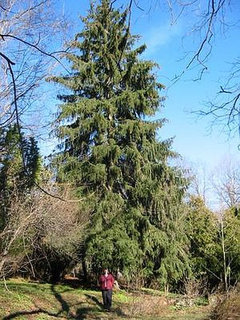
- 11 years agolast modified: 11 years ago
I have a feeling there's a reason that Firs aren't native to Missourri (living south of you in Arkansas), and your success rates may be low, due to climate.
I'd really recommend sticking with natives for more long term carefree success.
- 11 years ago
Hi spruce, since David and I have near to identical similarities with what may be soil pathogens that killed our larch, if it's not too much trouble, my soil type is: Hickory Silt Loam. Only if you feel like researching, of course.
Dax
abel k
Original Author11 years agoSpruceman:
I do what to try the holophylla but they seem to be rare and I cant seem to find bare root for a decent price. I could only find seedling plugs. I wanted the abies to be bare root so that I would not have to wait to long for them to get some size. I will still plant them ill just have to wait for them to grow.
I will plant some oriental around the same amount as Norway. I was planning on doing some fall planting but musser forest doesn't sell oriental spruce in the fall. I could buy plugs but then again I want to plant it with some size. There isn't that much information about oriental spruce on the web. It should be more heat tolerant but im not sure about how it compares to Norway spruce when it comes to drought tolerance, heavier soil, and disease.
dbarron
I do think that the success rate will be really low but the only reason im planting these trees is for my enjoyment. So if they don't grow it wouldn't really affect me ill just know that I tried and I didn't work for me. The native conifers don't really get me excited. They are short leaf pine and eastern red cedar. Short leaf pine doesn't grow were I live and doesn't do well.
- 11 years ago
abel:
What worries me most about your plans is that you won't be able to water. And as for a "mass" planting of fir, I see that as a big problem for you. They are very slow starters, so if you don't get enough rain for a couple of years at least, they will die. And it will be, for the holophylla, 6 to 8 years before they are 5 feet tall, and maybe longer for some others, so you will need to keep the weeds, grass, etc., from shading them much for a good while. Really, you will have a problem to some degree with anything you plant, considering your lack of time and ability to water and weed. I am retired, so I can "baby" my stuff, but if you can't do what I do, I am not sure what your survival rate will be. Planting takes a good amount of time and effort. I would hate to see you lose almost everything, and to have wasted your time.
So, maybe you could plant less, and therefore tend what you do plant better. For some things, like the fir, I think planting a few specimen trees in special places, and tending them carefully, would be best. With the pines, you could have better success, if you get enough rain the first year. They are often fairly drought resistant by the second. I water mine very carefully here the first year, so they will be strong. Then watering the second is not needed, unless we have a relatively bad drought. Also, by watering as I do, they get a very fast start. My Hybrid and loblolly pines in the best soil are usually 5 feet or more at the end of the second year. That makes my job of keeping them from being shaded by weeds and stuff much easier. My white pines take one more year, maybe two, to get that tall.
So, my suggestion--plant lots of pines, and I guess also Norway spruce, then hope for good luck with rain. I think the survival rate for the other things, unless you are very, very lucky, will be very low.
Another native pine you could consider, but which is not really fast growing, is pitch pine. At their best, they are very beautiful trees, and TOUGH. I have planted 10 here. Virginia pines are another option, but I think they are usually the least attractive of the pines. Some, when they get older, and grow in good soils, are nice enough.
If you want some fir, and want to plant a "forest" of them, ignoring my advice, I think there are a couple of places that offer Nordmann seedlings bareroot. Get the largest--at least 18"--larger if possible--and make the extra effort to plant them, getting the roots deep. Planting 6 inch seedlings without careful "tending" will be a total loss and a waste.
Maybe you could spread out your planting over several years.
Well, abel, sorry if I am giving too much advice. But I do have a lot of experience, having planted confer seedlings for over 40 years in various kinds of conditions.
--spruce
- 11 years ago
Indeed, you're hearing it from one of the best! Spruceman has been at this longer than most.
So.....if there's one thing this thread has provided me, it's a sense of good fortune that I didn't previously feel, for having done my planting where I did. Two springs ago, 6000 seedlings consisting of NS, hybrid larch, white pine and red pine....machine-planted of course, and just as obvious, simply no way to water anything. In my earliest plantings up there, maybe 250 trees at a time, I would water. It darn-near killed me, carrying water over bumpy ground, from a spigot with almost no pressure (from a neighboring farmhouse) or bringing it up in containers from home-just a truly difficult and punishing activity. So this main planting of 6000 were on their own from day one. Some of those larch are now head-high! So too with the red pine, they get up and running quickly.
I always felt, as I suppose many others do, that other areas must be more forgiving for this sort of activity. Now I'm wondering if I didn't land on the perfect area, by a combo of dumb luck and my wanting to be in what I call the "cedar belt", that area of near-northern Wisconsin most given to extensive and lush stands of Thuja occidentalis. That was really my plan-I wanted to be in that area, and our woods is comprised largely of that species. The more upland part of the site where all the larch, spruce and pine are going is just a nondescript sandy loam with a ton of small rocks. Again, by dumb luck, that stuff appears to be ideal for what it is we're trying to do. And all the weeds form this former farm field, which rose up and completely covered everything the first year: those annuals like ragweed, lamb's quarters, etc. are all gone now completely replaced over the course of one winter by perennial forbs like solidago, aster, etc. Pretty crazy how that went but the point is, I think the extreme weediness of the site that first year or two may have actually helped. we had a very wet year the first year-that had to have helped but also boosted the weed growth to enormous proportions. Second year was dryer but not too bad. All in all, I can't complain. seems I may have had better luck than many do with this sort of venture.
+oM
- 11 years ago
+om:
If you saw what I have to deal with here in VA, you would be even more thankful. With the fairly good soils, I have lots and lots of tall weeds, much of them perennials, like goldenrod, which, by the way I love. The goldenrod is usually 6 feet tall. When we get a lot of rain, I have ragweed up to 16 feet tall--or taller! But that is where conditions are the best. Other places are totally swamped by both grape vines and Japanese honeysuckle. Try keeping those off your seedlings. - and on top of that, I have lots of invasive shrubs, such as autumn olive or Russian olive, or whatever. And blackberry canes are everywhere--up to 8 or even occasionally 10 feet. BUT, these can be a blessing in another way--deer won't go through them to buck-rub or nibble.
And there is poison ivy everywhere, and it loves to climb up my trees. The land I have here has been abused for so long, it is an ecological nightmare!
And we have a drought very often here. 5 years ago, officially, we had an "extreme drought." At that point my Norway spruce screen had been in the ground for 3 years, and before I got on top of the need to water, I lost a few. Yes, after they were in the ground for 3 years! We have had the wettest spring, and early and mid-summer ever here this year. BUT, as I expected, we are entering a drought now, with no good prospects for rain for the next two weeks at least. It is hard to find any green in the lawns in Winchester. If I were not watering now, most everything I planted this year would be dead. Maybe, since they got a good start earlier this summer, I would get some "survival of the fittest." Dunno.
In the MD mountains, I had to keep the weeds off my spruce and pine seedlings for 4 or 5 years. My forester didn't think I could do it, but he didn't really know how much I love trees. Hah! But I never had to water there--but, of course, I lost everything planted in that terrible drought year I described. The next year, when we also had a bad drought, I didn't plant.
Anyway, +om, it is good to hear about your success. But I know the hazards, and I hope that everyone has success, hence my excessive giving of advice.
Anyway, +om, yes you had good luck, but you also did your homework, and knew what you were doing. Congratulations!
--spruce
- 11 years ago
Thanks buddy. We're fighting the good fight. Those folks in that old farmhouse-the one where I tried to get water, had to laugh at all my work and struggles, as I started my project right behind their property. In truth, to the casual observer, I'm sure my plantings look like a part of their property as the farmhouse they live in was a part of the very farm my field belonged to. Funny thing is, if we stand down at the base of that field and look back up-slope towards their house (and this is really a moderate slope) you can hardly see the house any more- a big old brick two and a half story farm house-what with all the larch and spruce taking over the view. Pretty amazing what a hard-working person or two can accomplish in a short time. That's why I get so tired of always hearing people talk about how "they'll never live to see a new tree grow" or words to that effect. I say, try it! you will be pleasantly surprised at how fast trees really do grow.
Speaking of work, one year-this was in the early going where I'd plant maybe 250 trees a spring-I got the bright idea to pre-dig the holes in the fall. Well, I dug and dug and dug. that's when they were chuckling at my efforts. Then spring came along a bit too dry and all those little piles of soil next to the holes were rock-hard. I had no backfill material, without chopping and chopping up hard dirt piles. Talk about a good idea that didn't work! Never will I do that again. But I learned.. Evidently, there's enough clay and silt in that ground to stick tightly together.
When we machine-planted that big bunch, we accidentally ended up with trees too close to our lane, so all of those will have to be moved, perhaps a couple hundred trees. So I'm thinking I'll scatter then wherever we want a tree or two and maybe give a few to that guy in the farmhouse, if he is willing to take down a lone box elder that is continuously seeding into my plantation. As it is, I'm going to have to go up there this fall or winter and do cut-stump[ treatments on all of those @#$%^& box elder saplings coming up in my trees. Darn junk. And that's all from one medium-sized mother tree.
I can relate to the weeds. That first year, the one where all the annual weeds came in, it was almost all lesser ragweed..Well, "lesser" in this case was about six feet tall in all the rain that year, and when I'd drive my vehicle down the lane to get to where I like to park, clouds of pollen would erupt so thickly it was like driving in a snowstorm! Good thing I'm not allergy-prone! Unbelievable...just clouds of ragweed pollen. Glad that's mostly gone now, replaced by the Solidago (goldenrod) and asters, etc. I'm fine with that change.
Hey look, I'm running away with this thread too!
+oM
abel k
Original Author11 years agoSpruceman
Thanks for all your help. You really couldn't get to much advise from you. I really enjoy reading your comments and im pretty sure I read all your post about Norway spruce and your forest. I only have a few months of experience with trees. Starting from this spring so I could learn a lot from a guy like you. Im going to plant a good mixture of all the trees this coming up spring and see what will survive the summer and then go from there. Whatever does well I will plant more of but what dies ill just forget about it and move one. I am thinking to cut down on how many firs I wanted to plant and just plant more pines and spruce. Treehaven seems to have good prices for firs so maybe ill just plant 25 of each fir and see what can survive out here with no care.
You really are lucky. I don't think my survival rate will be that great but seriously even if just a few survive ill be a happy guy. It will be rewarding to see the conifers grow here because there aren't that many around here other then eastern cedar.
- 11 years ago
Dax:
I read the official description of your soil. Now I took an introductory course in soil science when I was a forestry major in college, and I have taken an interest in soils since, and have the soil survey books for Garrett County, MD, and for both Frederick and Clarke counties in VA. I have studied these carefully. But, if the question is one as specific as what about your hickory silt loam could be responsible for the death of your larch trees, I have to admit, I am "way out of my depth."
Your soil is deep enough, and is well-drained enough, and seems to be "rich" enough, being used, where possible, for crops. I did notice that it is generally a sloping soil, often very steeply sloping, which leads to its most common use being for pasture. How much slope is there on your land there?
I forgot, what kind of larch do you have there? Were they fully established when they died? How tall? I can see, with my limited expertise, nothing about your soil that should have caused their death. But, if you have observed standing water near or around those larch trees that persisted for a week, more or less--or if the ground is occasionally really saturated for some period, that could kill any of the larches we are talking about. They definitely don't like soggy soil.
One other thing--could your soil have been disturbed/modified in any way. Could topsoil have been removed, or could there have been substantial erosion of the surface layers? If not generally over your land there, in the specific spot where the larch were? Could it have been very seriously compacted by heavy equipment of some kind. Or something dumped? Probably the majority of soils not in virgin forest, have been altered in some way, especially around urban developments.
If you had Japanese larch, and really would like to try larch again, try another spot, and try the hybrid and/or European. And water carefully for at least three years, especially when it's dry, as needed.
Have you ever seen any larch planted near there? Is there any arboretum? I never see any larch here, except at the VA Arboretum. They are virtually never offered at commercial nurseries--have never seen one anywhere around here. But I think they should be.
--spruce
- 11 years ago
Beng:
As for the "leaf" loss with your larch. I see some of that here--on some of mine, some years. None this year. I don't know the cause. Here it does no harm, and growth is not affected, it seems. Japanese beetles damage a lot of foliage also some years.
Yes, that's a handsome spruce tree. NS won't normally reproduce in your area, but I get good reproduction at my timberland in the MD mountains. It is not a seed problem--the seed is fine, but it is a weather/climate problem--too hot and dry for seedling establishment. If you want instructions for collecting seed, and planting, let me know. You could, artificially, grow them. But, seed from isolated trees--not cross pollinated--is not a good bet.
Here is the story of one of my best NS trees. My wife and I paid careful attention when we saw a nice NS tree in the D.C. area. Two of the very, very best were planted as "bride and groom" trees in front of an abandoned little house in Hyattstown, MD--really large, magnificent trees. They reminded me of the spruce in the pacific NW. There is a church almost across the street with a parking lot. One time when we went by there, we parked, and walked around, admiring these magnificent trees. Then I saw some tiny, tiny seedlings--only the little ring of cotyledons had appeared--no needles yet. I went and got a plastic coffee cup thrown by the roadside, and collected--very carefully--three of these tiny things. I planted them, very, very carefully at my place in Arlington, VA.
The first year, two survived, and the second, only one. We then moved from that house, so I dug up that little tree--then about 18 inches tall, and planted it at my timberland. Then, when we moved here, I dug it up again, and planted it here in Winchester. It is now one of my best looking NS trees, and is about 25 feet tall, and is growing almost two feet per year, on average. My wife and I call it our "Dixie Cup tree." Of course, it was a plastic coffee cup I originally collected it in, but no matter--we like the name, "Dixie Cup tree." It is in it's fourth home now, and we love it--it is one of our most cherished trees.
--spruce
- 11 years ago
Hi spruce,
There's a slope difference of 100'. I'm in a valley where commercial walnut production for timber is a growing trend. A walnut plantation not far me probably has a slope difference of 400 or more feet. Anyway there's semi rolling hills (where I am) and there is flat land and there are quite steep slopes. I always think of my property as having slightly rolling hills in the interior of a bowl shaped plot of land where hills are on all sides if you were standing at the lowest point dab smack in the middle. You pretty much hit the nail head on.
That larch I planted on a slope but where water run off would go right over it, and I planted it there because it would get that extra water just in case summer droughts were occurring on a given year. It was a larch that Resin put a tentative ID as gmellini or a hybrid gmellini. It was about 5' tall and established for 4-years-ish. It had finally shot a nice strong 18" leader this year.
The soil here after winter (ground is still frozen to semi-frozen) each and every spring I'll have an inch or two inches of water that has settled around the trunks of my trees in an 18" circumference. That's pretty much on all trees, however, especially at the top of my property on a flat area before it dips and turns hilly.
After heavy rains for days I may get an inch or two of water near the trunks again but it'll have drained the same day.
I've read all your questions: no topsoil was not removed; what larches I do find are on old farmsteads and are European. They're very rare to find. North of me I've found a grove of about 3-5 if I remember right (30 miles north) and those are European. And I've seen a hybrid in a cemetery once; and two other plantings of larch in the same area (The Quad-cities/ IL/IA). Of those last two, one is a European larch and the other I did not identify but is much more narrow than any European.
Dax
- 11 years ago
Dax:
How did you come to plant L. gmellini? I am completely unfamiliar with it. I did a quick web search, and learned just a little. Maybe summer heat could be a problem. It comes from a climate that, if I understand correctly, has cooler summers than yours.
The Hybrid larch is more narrow than European, and I think also than Japanese, so maybe the narrow one you see is the hybrid. BUT, I believe that most hybrid larches are F2 hybrids--at least I think those that I got from forest farm are--they show considerable variability in growth habit and color, etc. BUT--again--they do all seem to be more narrow than the two species that are crossed.
If you want to try larch again, maybe your best bet would be the European and/or the hybrid. From what I have read, it seems that the Japanese would be the best for drier sites, and maybe a bit more sensitive to soil that can get too wet. But, I really think any of the three should do well. And, if you want to give the space to them, you could try a couple in each different area you have, but maybe avoiding places that are more prone to having standing water, even if fairly briefly.
And, since you have deep soil, I would water any of the larches for at least two or three years, depending. It takes time for the roots to get down deep. My rule for watering most things here is a tad over an inch per week--in terms of gallon jugs, one is generally enough, two if the trees are over three feet tall. Another indicator I use is the growth of the lead shoot--once a larch is growing three feet per year, I don't water unless it is a severe drought, and generally, not even then. And once a larch is 6 feet tall, they are quite drought resistant here, and larger trees, I think, could withstand almost anything here in my fairly deep soils.
--spruce
- 11 years ago
Yep, I had it established. I watered it for years. I've gleaned your suggestions of kaempferi or hybrid or European. I won't be planting European because of the space allotment. I'll seek a hybrid or a Japanese.
I bought some rootstocks that many years ago that were sold as L.kaemperi. Then it coned and I brought the pictures to GW and Resin put that ID on it. So... that's how that story went....
I appreciate your taking the time, spruce.
--Dax


pineresin