Software
Houzz Logo Print
daninthedirt

zucchini as winter squash?

OK, I asked this as a secondary question in a previous thread, but that thread passed away, so I'll ask it as a primary question here.

Can zucchini be a winter squash? It's been many years since I grew zuchs in an SVB-free locale, and the SVBs here have made me swear them off. But if you allow them to grow, and mature, I assume the rind will get hard, and they will "winterize". That is, zucchini are called summer squash simply because people usually pick them in the summer when immature. You can harvest winter squash when they're immature and call them summer squash.

No question that it'll get huge. Probably like a cylindrical green pumpkin. But how edible is it? That is, do zucchini have any winter storage potential? I'm not interested in hearing why immature zucchini are good, or why huge zucchini are gross. Anyone actually tried this?

Comments (35)

  • 11 years ago

    No, they can't.

  • 11 years ago

    Huge zucchini aren't gross. They turn into 'marrows'. Google marrow recipes for loads of ideas of what to do with them. And no, Jean is right, they won't store.

  • 11 years ago

    Now I'm more confused. When I look up "marrow", I am told that they are simply a variety of squash related to zucchini, and it is a U.K-ism for summer squash. I'm sure there are lots of ideas of what to do with them. But the question was whether zucchini, if left on the vine, would eventually develop a hard rind that would enable long-term storability. Jean, I'm not sure if you're saying they can't be eaten, or they can't be stored, or they can't develop a hard rind. I asked several questions.

    Let me try rephrasing those questions. What exactly happens to a zucchini if left on the vine to naturally "mature"?

  • 11 years ago

    Why would you want to though? Zucchini has been bred for optimal traits as immature squash. If it forms a hard rind and a good taste as winter squash, that would not be intentional. If you want winter squash, IMO just plant a variety that has been bred for optimal eating quality when mature and storage potential. There are many bush varieties available if space is an issue.

    The common consensus seems to be that "winter" zucchini does not taste very good... however as I said in a previous thread there are so many different varieties and types of zucchini, what is the case for one variety may not be the case for another, and the results may be unpredictable and unreliable.

  • 11 years ago
    last modified: 11 years ago

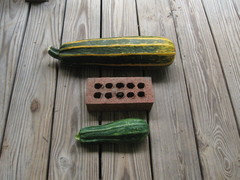
    I'm curious of people's experiences on this matter. On the other thread you mentioned, I posted a pic of the costata romanesco that I had let go to seed....

    This one has now finished curing. The rind is hard and it is sitting in the pantry.

    About a month ago I had done the same to another of the same variety. I cut it in half length-wise, removed the seeds, and was surprised that the flesh was so similar to winter squash. So, I got out a sheet pan, laid down some parchment (in case in went real bad lol,) and baked it like a winter squash.

    When it was soft, I scooped out the flesh and... yum. A delicate winter squash look and taste.

    I have no idea if the one in the pantry will keep. I'll probably not wait more than a month. Maybe next year I'll let a few more go, but for this variety at least, letting one go to seed often signals the plant to stop producing more female flowers and concentrate on maturing the seeds. It's basically sacrificing the plant. I suppose I could use one with a few small fruits already started, but the cool thing about zukes is a season-long harvest; and compared to others, this variety is known to produce fewer zukes per plant. I let a couple from different plants go to seed so as to have a little diversity in the gene pool.

    I am hoping someone else has tried it with other varieties.

  • 11 years ago

    I'm really just looking to answer some simple questions. It is irrelevant if zucchini has been bred for immature harvest. That's pretty obvious. And if I want winter squash, I'm well aware of how to get it. I never said that I wanted to do it. I said that I was curious about what would happen if I did.

    So there is a "common consensus" that winter zucchini doesn't taste good? Reference? Never heard about that. I'm having trouble even establishing that there even is, in fact, such a thing as winter zucchini. rgreen, I think it was your interesting experience with costata romanesco that led me to wonder about this, and I agree that it would be illuminating if people tried it with other varieties.

  • 11 years ago

    Dan, you don't need to be nasty. And it isn't irrelevant: it makes the answer, "it depends". If you don't want a discussion and don't like indirect comments than just try it yourself - it is a very simple experiment.

  • 11 years ago
    last modified: 11 years ago

    Marrows are not 'related to' zucchini, they are zucchini, simply grown up. It isn't a UK-ism for summer squash. It's a UK-ism specifically for large zucchini (which we actually call courgettes). However, there are some cultivars which are solely intended to be eaten small and others grown to be eaten larger. There is no reason not to use large zucchini in any marrow recipe up to the point where it becomes fibrous.

    I answered your question about storage. It was 'no'. In my experience they don't develop a thick, hard rind so the inside is not protected from deteriorating. The skin gets thicker and tougher but not hard. Old marrows left in the garden end up as hollow skins full of mush and eventually collapse in on themselves.

  • 11 years ago

    Thank you, floral_uk. I saw one online reference that explained "marrow" was "related to zucchini". But I'll take your word for it. The question of whether they will store is dependent on whether they develop a hard protective rind. You're saying they don't. That's important, and a deciding factor. And Peter, I wasn't being nasty. My apologies if I sounded that way. My question simply wasn't whether zucchini are good harvested immature. I will say that it really isn't a simple experiment to try it myself. Like I said, SVBs largely prevent me from growing zucchini here, and even if I could, I wouldn't get an answer for more than a year. This forum is a wonderful source of knowledge that allows me to find out the answer right now.

  • 11 years ago

    Sorry if I took it the wrong way.

    I had great success preventing SVB this year.. others had success also with similar methods. See my thread: http://forums2.gardenweb.com/discussions/3230732/squash-vine-borer-success

  • 11 years ago
    last modified: 11 years ago

    Curiouser and curiouser...

    At this point I can only wonder if it's a variety thing, or if, in order to be harvested as a marrow, the larger fruit are picked before they harden.

    I can only speak for my experience with the costata romaneso. Because it is an heirloom, letting it go to seed is a common practice. The 2 fruits that I let grow out for seed this year indeed developed a hard shell. In fact, the method for determining if they are ready for seed harvest is the 'fingernail test'. This is the same test used for harvesting certain winter squashes. When a fingernail no longer will pierce the skin, it is ready to harvest for seed.

    After cutting away from the vine, the next step in seed saving is to let the fruit cure. This is accomplished by either setting the zucchini out in the sun, or in a warm indoor location, for 1 - 2 weeks. The seeds are then ready for cleaning and saving.

    As described in my previous comment, this I did with the first one and - instead of waiting - I immediately collected the seeds, then cooked it just like a winter squash.

    So, first, we see a cultural difference. In the U.S., at least among gardeners I have met, and as evidenced from these 2 threads on the subject, there is no custom for harvesting zucchini (courgettes) in the 'marrow' stage. Here, when a zucchini goes hidden and gets bigger than desired, it is considered a hilarious mistake, often labeled with 'baseball bat' descriptions and questions of... "what do I do with this thing?"

    The 'lemonade from lemons' answer is usually along the lines of shredding for relish or zucchini bread.

    Now, this is still discussing large zucchini that does not yet pass the 'fingernail test'. Since there is no reason to grow out the average hybrid zucchini for seed saving, the usual answer is to cut it off the vine and enjoy your zucchini bread.

    So, if we don't get an experience from someone intrepid enough to have tried it with hybrids, hopefully someone will be just nutty enough to let one of those 'hidden' zukes go to seed.

    And one last observation of the hardness of the romanesco's shell. As Peter pointed out, we have our winter squashes bred for long term storage. This year I grew North Georgia Candy Roaster... a relatively small (only in comparison lol,) heirloom banana squash. It just so happens that the skin on the mature romanesco variety zucchini is quite a bit tougher than the skin on the mature banana type winter squash. Who knew?

  • 11 years ago

    About 25 years ago back in Russia, where were not much veggies in the stores to buy in winter and where were no such things as "winter squash"(just not in the culture at the time), we always let few overgrown zucchinis(mostly white ones) to mature on the vine and kept them in the room temperature for few months, usually till December. If you hold them longer, seeds usually started to grow inside, and it become not edible. But as soon as you eat them before - they were OK. Not great, but OK.

  • 10 years ago

    That's fascinating. Seeds start to grow inside while in storage? But of course scooping out seeds is standard practice for most winter squash. One of the advantages of harvesting immature squash is that seeds haven't started to grow.

  • 10 years ago

    I've kept a few overgrown zucchini on the kitchen counter with plans to shred them for zucchini bread or casseroles and then forgotten them. When I finally got to them 6 weeks or so later they were still okay to use. I removed the larger seeds and shredded the semi-hard rind and used them in breads, sauces, and soup. I don't remember any sweet taste, just the regular zucchini taste (or non-taste as I often think of it). Not sure if they would last for much longer than that or not. And they probably were not WAAAAY past prime and ready for seed harvest.

    If some get away from me again, I may try keeping them AND keep better track of how long they last. I'm not a huge fan of freezing or drying zucchini and it would be nice to be able to shred up a big old one for zucchini bread in November.

  • 10 years ago

    Now, if I put an immature zucchini on the kitchen counter for six weeks, it would end up as a pile of glop. So it sounds like there was some "winterization" going on here for naturegirl's zucchini. Developing a hard enough shell that it wouldn't dry out, and also resisting rotting. I agree that it's really non-taste that one is trying to preserve, but at least it sounds like the taste didn't get ugly.

  • 10 years ago

    Very mature zucchini will get seedy, corky, and pithy....if it doesn't rot. It won't become a winter squash.

  • 10 years ago

    Dan, if you can wait a week or so I will volunteer to don the white lab coat and do this experimentation. As I mentioned in the other thread, I leave my summer garden for the month of August every year. I pull a lot of my zucchini out, but normally leave at least one of each type in the ground to act as decoys for pests. When I get back I normally do a little taste testing and use what ever seems good, but this year I will be organized about it and report back. I've got costata, zephyr, jack pot, yellow crook neck, and Lebanese summer squash, and then a hybrid volunteer growing in the compost that was delicious immature before I left, and which my neighbor said is now big and striped.

  • 10 years ago

    That would be marvelous. But I'd be especially interested to know if such summer squash develop a hard shell that might render them storable for a few months. That being the case, it would be nice to know how edible they are after that time period. What I'm hearing (and the reports so far seem to not be entirely consistent) is that maybe they can develop such a hard shell, but maybe when they do, the texture inside isn't optimal.

  • 10 years ago

    Sometimes when my zuk goes down hill and it's too hot to worry about it, I'll just let it go. One year a zuk got all curly qued and the shell got hard. When I went to pick the plant I found that something had come in from the bottom and eaten all the squash and left a hard shell! I used it as a planter for 2 years after that! Now I usually leave one partial plant with a huge zuk hoping to repeat that!

    Anyway as to the question, that's the only time I've had the shell get very hard. Anything bigger than stuffing sized gets cooked, processed and frozen to use for soup base. Nancy

  • 10 years ago
    last modified: 10 years ago

    Maybe it depends on the variety. The zucchinis I've seen allowed to fully mature for seed saving had leathery semi-hard rinds and were kind of stringy inside and got sort of shriveled. I don't think long-term storage would have been possible with those, and they didn't seem very appetizing.

    If you want a dual-purpose squash, though, something like an Italian trombone variety might work? I know that wasn't your question (and FWIW, I didn't think you were being nasty--just that you were getting frustrated because people were answering every question except the one you were asking), but they are delicious as summer squash and supposedly quite good and butternut-like as mature winter squash. http://articles.latimes.com/2012/dec/04/news/la-lh-tromboncino-squash-20121127

    They're giant vines, though, not bushes like most zukes, so that may factor in to whether or not you can grow them (space concerns, etc.)

  • 10 years ago

    Thanks. I had another post (which kind of got me started on this one) about winterization of Tromboncino. Although mainly used as summer squash, yes, it sounds like they have some potential for winter storage. And yes, they are ENORMOUS vines. Leaves a foot across, and while I put mine in a month or two ago, they are already stretching out many yards.

  • 10 years ago

    Have you tried Tatume? I haven't but was thinking of trying it next year. I keep hearing that it's also dual summer/winter but haven't heard much about how it tastes as a winter squash.

  • 10 years ago
    last modified: 10 years ago

    Yes, "winter squash" is a misnomer. Thin skin vs thick skin or immature vs mature is better.

    All I grow now is the ridiculously large zucchini (black beauty). 3-4lb zucchini well past 12". Are their seeds, yes. Does the taste change? Not enough for me to lose everything to the SVB; skin gets hard and keeps them at bay.

    Storage is much better. So long as you took adequate care especially with watering, you can get almost two months on the counter. Now if you don't take care of them while they are growing you will get two results. They will either "dry out" inside and become very hard to cut--inedible after a while. Or they will begin to get soft and start to rot. Either way you still have a week or so before those symptoms happen. At best-two months to use them.

  • 10 years ago

    That's very interesting, and reasonably consistent with what I heard above. That you might be able to get a few months out of a zuke after letting it mature. Sounds like it might be edible, and someone was saying that at least they could grate it up and use it as filler in a cake or bread. So it's pretty clear that you can't get zukes to really behave entirely as a winter squash, but you can maybe stretch out it's usefulness for a while longer than you could with an immature one.

  • 10 years ago
    last modified: 10 years ago

    Few is pushing it. 60 days is the max I can get before issues happen. They either "dry out" or rot out. Real winter squash like butternut lasts for months.

    Yes, I grow them specifically for shredding mostly, but it still slices and tastes just like a smaller one. If you are going to freeze/can chunks or slices, then you want the smaller variety. I have no problem shredding the "over ripe" ones and freezing them in bags for use later. I also eat the seeds which should be as healthy as the pumpkin seeds that people overpay for today.

  • 10 years ago
    last modified: 10 years ago

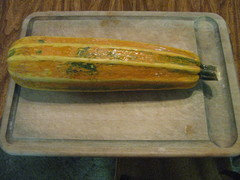
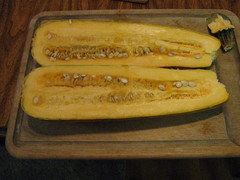
    Here are the results of cooking my second mature, cured-for-seed-harvest, costata romanesco heirloom zucchini...

    This was treated, pre- and post-harvest, much the same way as a winter squash. I think this post will settle some curiosity, but still open for consideration are the questions of whether all varieties of zucchini can be treated as a winter squash; as well as are the questions of potential storage times.

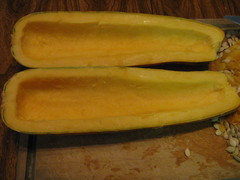
    Subject prepared for dissection:

    Cutting into it was about the same as any winter squash I have ever opened...

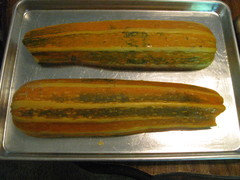
    Does it look like a winter squash?

    Ready for the oven...

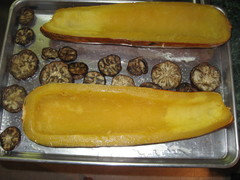
    After baking... Yep, got the oven on, no good reason to waste sheet pan space!

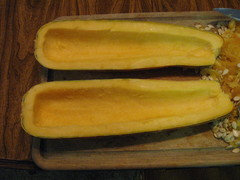
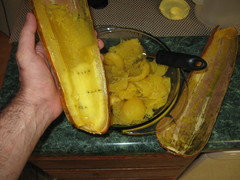
    And now for the scooping!

    The yellow color is much different than the whitish hue these were when harvested as normal zucchini. I would take a guess and attribute it to a significant rise in beta-carotene. Taste is a little 'grassy', but definitely not un-enjoyably so. It's less sweeter than winter squash, and it is not as intensely flavorful as those bred for keeping. I put a little butter and some maple syrup on it and thoroughly enjoyed tonight's "zucchini as winter squash" dinner.

    Here forward, whenever a zucchini goes beyond the normal harvest stage, I will have no qualms about letting it go for seed harvest and baking. If were to be a hybrid, depending on the results found with other varieties, I would bake the fruit and harvest the seeds for eating instead of saving.

    As far as the skins, these are definitely thicker and tougher than the banana-type, fairly-long storage winter squash that I have now curing.

  • 10 years ago

    I do not let mine turn yellow like it is over ripe / saving for seed. I think that is beyond the eating stage. I only have experience with BB zucchini and any yellowing beyond where it was resting on the ground is bad for making it palatable.

  • 10 years ago

    Daninthedirt mentioned winterization of Tromboncino, which as small squash are used similarly to zukes, though IMO their texture and taste is much better. IME they store amazingly well since I still have one in the pantry from last winter and it hasn't spoiled. I haven't tried eating one that's been stored since mine were saved for seed, but perhaps I will and share it here.

  • 10 years ago

    Ah. Thank you NHBabs. That doesn't exactly pertain to zucchini, but it is a good answer to a post that let to this one.

    http://forums2.gardenweb.com/discussions/3319519/tromboncino-as-winter-squash?n=19

    I have several tromboncinos on a vine that is expanding rapidly, and I have a few more months of growing time, during which I'll probably get more. These plants were actually put in in mid-July to replace some spring plants.

    These squash are so large, long term storage has value.

  • 10 years ago

    That looks like a PITA to store, has less mass, and likely SVB may drill that long neck easier. Butternut squash looks superior to that and is great for long term storage.

  • 10 years ago

    SVB do not attack fruit unless the vines are already dead. Anyway, tromboncino is pretty SVB resistant.

    I've had tromboncino as summer squash, and it's delicious. I'm guessing butternut squash as summer squash isn't as good, since there's no real tradition of using it this way. I hear that tromboncino as winter squash is OK but generally less intense in flavor than butternut squash. So, if limited space is an issue, I guess it's a matter of priorities. Since winter squash is delicious and cheap at the market but the taste of summer squash really benefits from being eaten ultra-fresh and straight out the garden, if I had no space for separate winter and summer varieties, I'd probably grow tromboncino as summer squash and just buy winter squash at market.

  • last year

    So I have a large zucchini that was harvested in late October.Very hard. 23 inches long Dark green rind that has matured to some orange spots on the ribs and spots. Been keeping nicely. It is January 14th today 2025.


    I harvested 99 butternut squash and the 1 zucchini. Ageing in ,60 degrees,dry, and good ventilation. I wiped the skins clean with rubbing alcohol. To kill natural yeast . Many were donated to a food bank. Been making 2 squash pies a week. For as long as they are well.

    I will try making a squash pie with the zucchini when it comes time. I like to bake the squash till it gets soft.

    The squash are very much living, and seem to have innate knowledge within. If cut or scratched, it will try to self heal, making a secretion, to seal it off.


    Will


  • last year

    I like this thread! Good info and I am curious like Dan and only looking for those who have done it. I like Dan's thinking outside the box.

  • last year

    I found a lady on Youtube that grows her zucchini really large and saves them for many months to eat later. She talks about eating them for Thanksgiving and Christmas - that's how long her zucchini lasts for her. So finding this thread is quite the coincidence after watching one of her many videos about it. I also realized it was her on the meme photo of the lady holding a giant photo-shopped zucchini - it's the thumbnail of her video! Lol.... Anyways, the channel is called "Robbie and Gary Gardening Easy" and here's one of many videos about growing and storing zucchini like winter squash and why she does it.. :)


    "Grow Giant Zucchini Squash Summer Garden Harvest to Store Eat Cook Bake Collect Seeds for Plants"


    https://youtu.be/TusrNPB16Ws?si=TEQ7lhZY5Az-dZbM