Software
Houzz Logo Print
shriyogini

Overpotting question

11 years ago

I am assuming that refers to a pot being too large for a plant. Would someone mind explaining why this is detrimental? Thanks again from another new girl on the block.

Comments (22)

  • 11 years ago

    Hi fellow newbie! I am sure that someone with more experience will give you a more detailed explanation, but I wanted to say Hi, since I am new to succulents too. :)

    More pot = More volume for the roots to need to seek water through. This means you end up using more water for the plant to get enough to drink, but also means more risk of roots sitting in water as the water will get used up slower.

    shriyogini thanked Dreamstained (6a)
  • 11 years ago

    Hello to you! Thank you for responding. There is a lot to learn. My mom sticks things in pots or the ground in whatever soil she has and tells them it is their job to grow and her job to give them food, water and love. She has a gorgeous backyard. I think Grandmas have special powers :)

    So...if you have a deep pot for decorative purposes, you would want to...???

  • 11 years ago

    Make sure it has drainage and plant something that is root established enough for the pots' depth

    shriyogini thanked nomen_nudum
  • 11 years ago

    So glad to read this. I'm a newbie, too and was just going to plant a new succulent in a tall pot. This makes sense, so I will find a more appropriate pot. Thank you!

    shriyogini thanked Sally Olsen
  • 11 years ago
    last modified: 11 years ago

    Understanding a plants characteristics is important to. Some succulents like a bigger root run. Both aloes and opuntias send out far ranging feeder roots. They can handle more of a pot but it is better to work up to it because it takes time to get those roots. When one un-pots aloes , one will find the pot encircled with roots. The whole pot can end up being roots. Opuntias need roots to anchor their architecture. They can get some large structures coming off a single growth point.

    shriyogini thanked wantonamara Z8 CenTex
  • 11 years ago

    I think Dreamstained is a lot more knowledgeable than she lets on! Her advice to you and the reason we don't give smaller plants too much of a pot is correct. Understanding a plant and its characteristics is also important as Wantonamara mentioned and it will come with time.

    shriyogini thanked Neil
  • 11 years ago
    last modified: 11 years ago

    It's surprising when you see the difference in pot volumes, even for small pots. Just going one inch wider doubles the amount of soil/water-holding capacity:

    • 3.5" Pot: 324 mL
    • 4.5" Pot: 647 mL
    • 6" Pot: 1.6 mL

    I would expand this further and say having a very-well-draining and not-very-water-retentive mix also doesn't actually give you the freedom to choose any pot size you wish either.

    Many succulents such as Lithops and other Mesembs are very sensitive to overwatering. If the plant only needed around 200 mL water today and it was in a 3.5" pot, you could make the mistake of giving it 100 mL too much (about half a cup).

    But in a 4.5" pot you could give it 400 mL too much (about the size of a pop can). These plants are excellent at seeking out water and their roots will extend and try to absorb as much of that as possible.

    The margin for error becomes much smaller and the problem becomes even worse with more water-retentive mixes.

    shriyogini thanked ewwmayo
  • 11 years ago

    Such a helpful discussion, thank you everyone for the great information. It all makes sense now! If I wanted to use a deep pot for succulents I should position a smaller pot inside the decorative tall one. That would make it easier to move the plant if it didn't like it's new home!

  • 11 years ago
    last modified: 11 years ago

    Shriyogini- I think that's ok if you do that temporarily. You will see people do that quite a bit and retailers also sell pots within a pot quite frequently. However, that is not always the best thing for succulent-type plants. You will understand better once i ask you the next few questions.

    Have you ever walked into a space where its been closed up for a while? And often you will hear someone say "open a window, we need some air in here?" Was there no air? of course there is air but, what happened to it? Well it became dank or "humid" or dry, and there was no active fresh air circulation. Left unchecked...the situation in that room would worsen. If you came back a year later there might even be layers of dust or mold could develop.

    Succulents have a way of fooling us at times. We may not know they're declining in health until a situation is very bad and then it may be too late to fix. Placing a plant within another pot may create that stagnant, "humid" situation. The gritty mix most of use for our plants provides quick-drainage and also AERATION, which is equally important.

    You and I may be in the best optimal health but, what would happen to us if we stayed in that dank room long enough? Slowly but surely our health would decline wouldn't it?

    It would be the same with getting caught in the rain without an umbrella. What's the first thing most people do when they get home? Get out of the wet clothes right? Why? It could make you sick couldn't it? You may not get sick right away..but a repeated pattern of this and you most likely would.

    I hope what i just told you makes some sense : )

    shriyogini thanked Neil
  • 11 years ago

    Yes it does. That was recommended at the nursery, but obviously not a great plan for succulents.

  • 11 years ago

    Thanks, Neil. :) Though, I should have explained why the roots sitting in water for too long was a bad thing, haha. Spaced on that bit of info.

    This thread was still really helpful for me to read as well, as i'm still trying to figure out what sort of container is going to be best for my Pleiospilos nelii. I was a less than senseable newbie and went out and fell in love with Succulents: Hardmode pretty much. I also bought the most overwatered one Lowes had.

    It came with six engorged leaves, and I got it to absorb it's eldest set of leaves since then, but I am still deathly afraid i'm going to overwater it, and trying to judge just how deep of a pot it's going to need since i've heard it said it needs a deeper one like the lithops as well, but i've not been able to find pictures to confirm.

    shriyogini thanked Dreamstained (6a)
  • 11 years ago

    There is a general rule about over-watering which most of us on the forum follow. If in doubt, don't. It is better to under-water than to over-water. An under-watered plant can be saved. An over-watered one..cross your fingers and pray!

    Think of it like this...let me ask you guys/ladies, do any of you cook? What would happen if you dumped a whole container of salt into your dish? The food would pretty much be ruined wouldn't it? You can't take the salt out once it's in. Better to under-season and if you or your guest want more, it would be a simple matter to add it.

    Plants love water. it's an ingredient they need for life. Succulent plants also love water. They don't love having it every day though.

    Examine or re-examine the conditions you have your plants growing in. Are they inside or out? Are they in containers or planted in ground? What is the climate like? Are they winter or summer dormant plants? Are they receiving adequate light? Is their growing medium quick-draining?

    All of this becomes second nature with more experience so don't let it it overwhelm you. The more you learn about your plants, the better care you will provide. What they give us in return is nothing short of amazing.

    You will find many equally amazing people on this forum as well. Some i am blessed to now call my friends. Their knowledge and insight, opinions are all freely shared to help us. Questions? Fire away! Pictures and stories? Share them! Updates? They're always welcomed.

    The best to all : )


    shriyogini thanked Neil
  • 11 years ago

    Like most newbies, this is what I most need to learn. I love the salt analogy, thank you! When I'm tempted to water, I will say "Maybe tomorrow." It also helped me to place small pebbles on top of the soil, so I'm not looking at the soil and thinking, "That looks dry. Better water it." I'm learning every day...

  • 11 years ago

    Sally

    Try the skewer/toothpick testing:

    Insert at least halfway into the soil (not into the root ball!). If it comes out clean and dry, time to water. You can lift the pot and feel it's weight when dry, and do same after watering - it will be heavier. So eventually you be able to tell just by lifting it.

    Rina

  • 11 years ago

    ........

  • 11 years ago

    Nomen- ?? did you fall asleep at the keyboard again? lol.

  • 11 years ago
    last modified: 11 years ago

    Nap time must be over thanks for waking

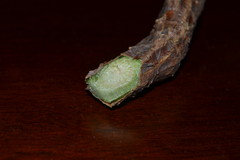
    is it the results of being over watered or under watered ?


  • 11 years ago

    Nomen- that looks like my knee.

  • 11 years ago

    The accurate words are about WATERING, not overwatering - 'When in doubt, don't.'

  • 11 years ago

    Overwatering: when you're not sure it's time to provide water, and you do it anyway.

    shriyogini thanked paracelsus
  • 11 years ago
    last modified: 11 years ago

    And to add onto what brad has said: And wind up with a melted mess.

    as for pot in pot decorations. I put a cut square (or whatever shape) egg crate (ceiling light covers) underneath the unglazed clay pot, this enables air all around the pot and also lifts the plant up out of the pot a little (also ensure that it won't be sitting in any drainage water that may happen.)

    shriyogini thanked laticauda
0