Software
Houzz Logo Print
stinkypoop

caulk over tile dilemma -- need pro advice or for hire in NYC

10 years ago
last modified: 10 years ago
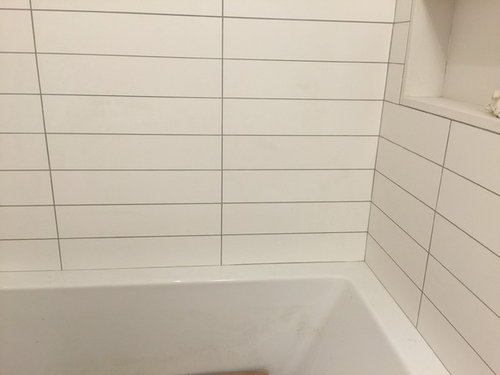
I'm really at a loss as to what to do here. I understand that (a) the tub-to-walltile joints should always be caulk because it's a change of plane, (b) one should never caulk over grout, especially in this location, since it's a surefire recipe for mold.

My contractor installed the tub tile and it rests directly on the tub edge. For the tiny hairline spaces between the tile and the tub (1/16" or smaller), he decided it was a good idea to grout it with the intent to caulk over it later.

Now I understand the proper thing to do in these instances is to remove the grout, pack the space with bond breaker tape or a closed cell backer rod (per Laticrete support's advice), and then only use caulk in the joint. But as you can see, there's not much room here for the inserts, let alone the caulk. I'm not even sure the grout can be removed in such tight confines.

What is the best thing to do here short of pulling out all the tile and recutting? That's not really an option unfortunately. Behind the tile is cement board, then some black waterproofing coating that was painted on, then thinset mortar, and then the tile. All of this sits on top of the tub edge as far as I can recall.

I desperately and deeply appreciate any help you all can provide!

Comments (24)

  • PRO
    10 years ago

    Pull the bottom row of tile; reinstall with a 1/8" gap. Fill the gap with color matched silicone.

  • 10 years ago

    Unfortunately that would conflict with the tile layout that continues off the edge of the tub.

  • 10 years ago

    Having built a lot of houses without ever hearing of bond breaker tape or Laticrete, I'd simply remove the grout between tub and lowest corse of tile and caulk it.

  • 10 years ago
    last modified: 10 years ago
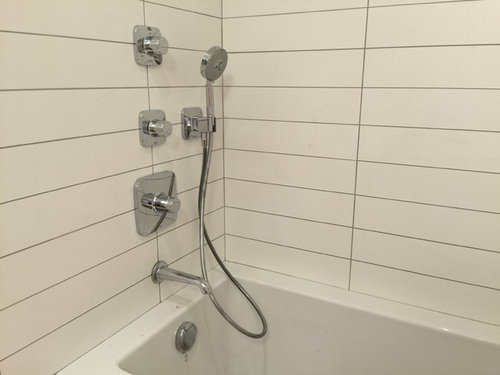
    the problem is that the grout-line at the bottom is miniscule -- 1/32 to 1/64 of an inch in some places. And my intrepid tiler has somehow managed to get grout into those spots. I doubt I can clean the grout out of there and I definitely don't think I can get caulk in there.

    Besides, there's a rule that your caulk shouldn't be deeper than the gap is wide. As far as the rule goes, I believe the depth should be no more than half the width of the opening, otherwise it won't bond the right way to stretch properly. Think of a thin rubber band vs a thin one. The thin one will stretch much longer, whereas the thick will be very tight.

  • 10 years ago

    My opinion is to caulk it and be done with it. You're entitled to do what you think you need to do, but I think you are worrying too much over nothing. In my experience, you should caulk where there is a change of plane, but caulking over in-place grout in the area you are worried about is not going to create a problem. In addition, I think it's possible for you to create a problem where none exists
    by trying to mess with the existing minuscule grout line.

  • 10 years ago

    Besides, there's a rule that your caulk shouldn't be deeper than the gap is wide.

    Another rule I've never heard of.

  • 10 years ago

    There are other important facts not revealed. Does the tub edge turn up behind the tile? What is the backboard, does it lap the tub lip and is there a gap between it and the tub surface?

    Remove the grout and fill the joint with a sealant (not caulk, there's a difference).

    A backer rod insures that the back of the sealant is curved and the depth of the sealant is not more than half the width of the joint but that doesn't apply here because the joint is too tight and there will be little movement between the surfaces.

    Silicone sealant is a good material for smooth dense materials where water will drain from it but be sure to mask off the surfaces since it is difficult to remove the residue.

    These kinds of problems often arise when the shower tile must align with adjacent wall tile. You can't stretch the stuff.

    stinkypoop thanked User
  • 10 years ago

    Thanks all.

    JDS, yes you hit the nail on the head. That's exactly my problem... but the grout line is too thin to even dig out the grout in some places. And when I said caulk i intended silicone caulk, like Latasil or GE Silicone II. Will that squeeze properly into a hairline crack? Also, if it's waterproof, where will the water that pools behind there drain too?

    I'm not sure I understand the question about wher the backboard laps the tub lip. The tub ledge is a bit slanted downwards into the tub so that's good. The cement backboard sits directly on the tub. However, I'm not sure if the seam where the cement board rests on the tube is sealed and don't know whether that is curved to create a drain path towards the tub. I'm going to ask my contractor and get back to you. How far does the sealant need to squeeze in? I imagine all the way in as far back as possible so that there's no void?


  • 10 years ago

    Just checked... they did a thorough job of waterproofing in the back. They have with silicone sealed the seam where the cement board meets the tub, and the waterproofing is done throughout. Water should not be able to escape past the cement board. So my main worry is water that gets trapped in the tubline grout space between the silicone and the waterproofed cement board.

  • 10 years ago

    There shouldn't be any reason for water to get behind the joint at the tub. the water is trying tented from the front side.

    Water soaks into the grout joints above and possibly into the cement backer board and then it drys out. No water should be draining down behind the tile.

    stinkypoop thanked User
  • 10 years ago

    Is the main reason to use caulk at a change of plane to avoid cracks? If so, you aren't going to see any cracks in that gap are you?

    (Off subject, but do you like how it's looking so far? I do!)

    stinkypoop thanked Fori
  • 10 years ago
    last modified: 10 years ago

    Yes, at dissimilar materials and changes in plane (corners) where the two surfaces will move independently, if the joint filler is brittle cracks can occur. In such a case you should use something flexible that adheres to both surfaces and can be formed in an hour-glass" shape that is smaller in depth than in height (using a backer rod),

    Since silicone cannot survive in constant contact with water, the joint is too small for an "hour-glass" shape and the tub edge and backer board are attached to the same wall studs (or they should be) I would use an adhesive caulk/sealant like Phenoseal in a color to match the tub. You can buy it in a small tube or a gun tube.

    It may help to fill the tub half full when sealing the joint.

    stinkypoop thanked User
  • PRO
    10 years ago
    last modified: 10 years ago

    "Since silicone cannot survive in constant contact with water..."

    JDS:

    How do you explain this? (Second paragraph, third sentence.)

    In fact, Phenoseal, the caulk you recommend for this application, recommends 100% silicone for this type of application.

    stinkypoop thanked Joseph Corlett, LLC
  • 10 years ago

    Thanks Fori! I do like it so far. I'm just concerned about the inevitable mold and maintenance issues.

  • 10 years ago
    last modified: 10 years ago

    The person quoted above knows just enough about sealants to be dangerous because silicone sealant should never be used below water or where it must strongly adhere to the surface of materials. Its advantage is flexibility which is not relevant for this small joint. Silicone has the added disadvantage that nothing will stick to the surface it has been on making it difficult to replace. The sealants favored for immersion in water and strong adherence are polysulfide and/or polyurethane based sealants.

    My knowledge of Phenoseal dates from when it was made by the Glouster Co. in Franklin, MA in the 80's and 90's. Apparently DAP bought Phenoseal. I have never run into a problem with it but it is not flexible enough to be used for bathroom tile work. It should however work fine for such a tiny joint because of its adhesive qualities and ease of installation and clean up.

    Other options that are more expensive and difficult to install are polyurethane sealant/adhesives like KBRS ShowerSeal or Sikaflex 11FC.

    The joint looks so small you might have to leave it alone.

  • PRO
    10 years ago

    "silicone sealant should never be used below water or where it must strongly adhere to the surface of materials."


    JDS:


    Respectfully, you haven't answered my fairly asked questions. If silicone can't be used under water or in applications requiring strong adhesion, how do you explain its place as the sealant of choice for glass fish tank manufacturers which require both?

  • 10 years ago

    I agree with just caulking over it, if there is a problem in the future then deal with it then. There shouldn't be much water getting behind where you caulk anyhow, the grout above will get wet and dry normally.

  • 10 years ago
    last modified: 10 years ago

    Its a matter of adhesion to the adjacent materials. Silicone adheres well enough to glass held in a frame on the inside of a tank where the water pressure is forcing the sealant into the joint but it doesn't adhere well enough to be used underwater where other forces will be involved. Think of silicone sealant as more of a gasket
    material than a sealant.

    Adhesive/sealants like polyurethane are such strong adhesives. Their greatest disadvantage is the difficulty in separating the materials later. Think of them more as adhesives than sealants.

    In this tight joint I felt that a less viscous adhesive/sealant would be appropriate. Its just an opinion; we don't need to debate it as if the joint were a serious waterproofing problem. In the end, whatever looks good will probably be fine.

    If silicone is used, protect the adjacent materials with masking tape. As I mentioned earlier silicone sealants leave a residue that’s difficult to
    remove, to which nothing will adhere, including fresh silicone or paint. Don't use a white silicone construction sealant in a fish tank; find a clear unadulterated silicone intended for that use.

    Sealant choice is not always simple or obvious. They have different properties when used with different materials in different conditions.

    stinkypoop thanked User
  • PRO
    10 years ago

    "If silicone is used, protect the adjacent materials with masking tape."


    In this case the best application would be to push a neat bead into the corner with no tape. Spritz the bead with Windex, spit on your finger, and smooth the bead into a convex shape. Wipe excess silicone from your finger onto a paper towel if necessary, rewet your finger, and begin again. Wipe up the Windex with a paper towel without touching the fresh silicone and you're done. Much faster and better looking than masking and no "tape edge".

  • 10 years ago

    When I first started caulking years ago, the only way I could get a semi-passable result was with tape. Once I discovered the "magic finger" method described above, I never used tape again.

  • 10 years ago

    Do you mean convex or concave? Would be helpful to see an example if convex since I'm unfamiliar with that. Also. How tough is it to push silicone into a tiny thin spot like that? Others are telling me the gap may be as small as 1/64 or 1/128 even. Thx

  • 10 years ago

    Yes...concave...the shape left by your finger. The tip of the caulk gun goes into the corner...no big deal. Leave a reasonable bead by using gentle finger pressure and don't worry about the dimension (although anything less than 1/8 inch would probably be useless). My advice: 1) quit overthinking this, 2) do it, 3) forget about it.

  • 10 years ago

    Or you can just wait for the grout to crack down the road, at which point you can easily remove it and replace it with caulk.