

Schefflera taiwaniana 'Yuan Shan'
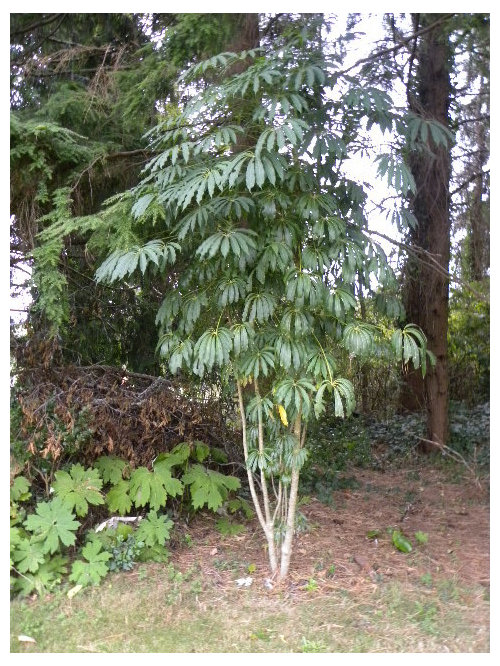
Another Schefflera in my collection of Schefflera. This plant is a Dan
Hinkley plant offered through Monrovia Nursery. It is starting to become common
in local PNW nurseries.
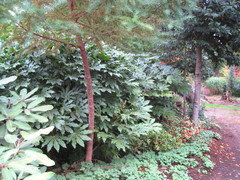
This plant is under the canopy of a hemlock tree. It was planted in the
spring of 2010, the first year offered by Monrovia. The deer trimmed the lower leaves off, but I don’t mind. I like it looking
like the small tree that it is. This species matures at about fifteen feet. They have as yet not produced flowers.
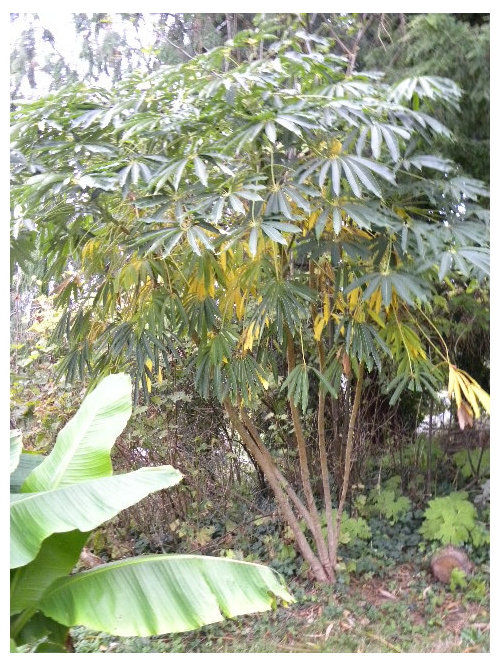
This one was also bought and planted in the spring of 2010. It is out in the
open. The petioles are yellow, the one in the shade are green. Both of these
plants are ten feet tall so have a few more years before they get to the mature
height.
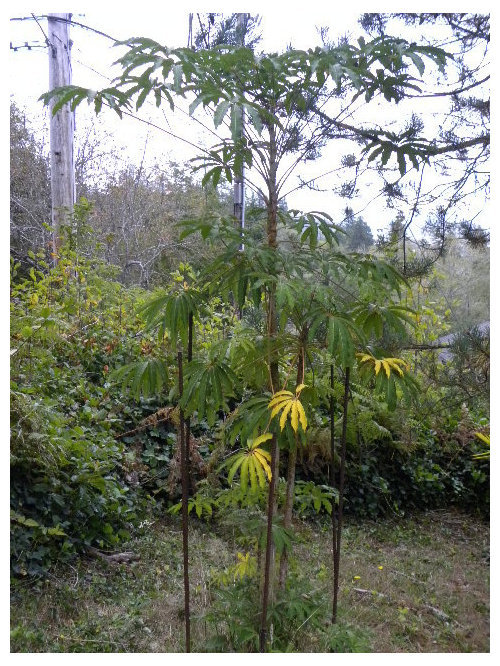
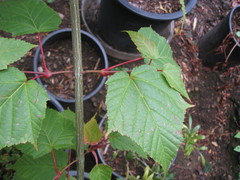
This third one was bought a few years later than the other two and is seven
feet tall. Its petioles are red. There is a different shape and texture of the
leaflets than the other two. Notice the yellow leaves, the last couple years they started shedding the previous years leaves in the fall. The one planted in the shade doesn't do this as much.
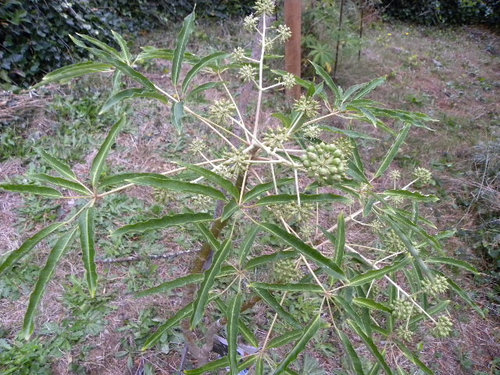
In the spring of 2014 Monrovia claimed to have brought out Schefflera
gracilis to the nursery world. They said they made a delivery to City People’s Garden Center in Seattle. I went there asking for one, but
they said they didn’t get any. I still went looking for it, and found this plant in a group of Schefflera taiwaniana ‘Yuan Shan’. It was label as
such also, but because it leaves didn’t look like S. taiwaniana nor S. gracilis I bought it. It was also blooming at only three feet, something S. taiwaniana
hasn’t done, but what S. gracilis does. Looking at plant boards from England
where they have been growing many more species of hardy Schefflera many more years
than us, they showed pictures of a hybrid between S. taiwaniana and S. gracilis that looks a lot like this plant. Maybe Monrovia had a cross between the two
species and didn’t realize it until later, then took S. gracilis off their
available plant list by late summer.
I collected the ripe berries from it, harvested the seeds out of them. Then
planted them. I now have a little over a dozen seedlings of it. The seedlings
might be a three way cross, since there was a S. brevipedunculata, another
plant from Monrovia’s Dan Hinkley’s collection, blooming next to this
plant.
Comments (16)
 10 years ago
I had no idea there were hardy Schefffleras!
John, your posts come as a complete surprise.
I assume you able to grow these in Issaquah? I live just a few miles south of there near Maple Valley.
Mike
- 10 years agolast modified: 10 years ago
He says in these posts he moved to the coast. The recently seen Asian scheffleras are tending to be from up in the mountains. Nevertheless I don't know about any of them being a safe bet out your way, specimens dating from before they came on the general market are at places like Heronswood and UBC Botanical Garden (Vancouver, BC, near the beach).
The last winter that separated the men from the boys was in 1990, anything not tested by that one remains unproven as a long term proposition here.
Related Professionals
Vincennes Landscape Architects & Landscape Designers · Lynchburg Landscape Architects & Landscape Designers · Wheeling Landscape Architects & Landscape Designers · Bakersfield Landscape Architects & Landscape Designers · Fayetteville Landscape Contractors · Westminster Landscape Contractors · Sioux City Landscape Contractors · Plymouth Landscape Contractors · Middletown Landscape Contractors · Tucson Landscape Contractors · Forrest City Architects & Building Designers · Shreveport Architects & Building Designers · Anderson Architects & Building Designers · Bangor Architects & Building Designers · Winona Architects & Building Designersjohnaberdeen
Original Author10 years agoYes, I'm living in Aberdeen now, I did live in Issaquah. Ron (Embothrium) saw my Issaquah garden at the Issaquah Fish Hatchery. His comment was a compost pile waiting to happen or something to that effect since I had so many eucalyptus and other semi-tender exotics growing there. Since I moved out the hatchery crew cleared most of them out.
As for Schefflera, I had Schefflera delavayi handle 12° F in Issaquah as a small two year old seedling with no problems. All the others that I have were planted in Aberdeen, and so far the worst it has been is 17° in 2013/14 winter. The fall event of 2010 was as hard on plants as single digit storms, with sixty degrees or higher during the day, nineteen in Aberdeen and twelve in Issaquah that night. That event killed many plants that handled termperatures far worst than those. The S. delavayi, S. taiwaniana, and S. fengii handled that event in Aberdeen with only minor damage. They continued growing from their terminal buds when the weather warmed. I had a S. hoi, which was killed. I have been told by plantsmen who know these plants very well, say that if you can grow Fatsia japonica then you can grow S. delavayi and S. taiwaniana. You should give them a try if you like the temperate jungle look!
johnaberdeen
Original Author10 years agoThe worst cold event that I saw was at my parent's home between Montesano and Elma in the early 1960's, either 62 or 63. Their thermometer read -4°F and it was cold for a long time. That winter killed a brown turkey fig, and set a Japanese arrow bamboo back to its roots. The 3 foot tall Fatsia japonica loss all its leaves looking like a dead stick in the ground. But as the spring termperatures warmed buds started to form on that stick and by the end of summer it was a full bush again. It went on to handle 1983 with 4° F and freezing day and night for a month as well as the 1989 and 1998 both with single digit cold that lasted a month with only drupy leaves that perked up when the weather warmed. So if that is an indication of F. japanica's hardiness then maybe the two Schefflera's can handle most of our cold.
- 10 years ago
His comment was a compost pile waiting to happen
I don't remember that
Since I moved out the hatchery crew cleared most of them out
Now there won't be anything interesting to look at out there, except the snake-bark maples - if those are still present
johnaberdeen
Original Author10 years agolast modified: 10 years agoIt's me Mike, I had to change my user name when Houzz took this board over. Besides I'm not at Issaquah any longer. If you can grow Fatsia japonica you can grow S. delavayi and S. taiwaniana. Go to Monrovia.com and type in Schefflera. The two Schefflera on their list will pop up, click on them to find a local nursery that carries them.
The two snake-bark maples were planted a long time before I got there, fall of 1998. They are starting to be crowded out by the large Acer macrophyllum growing near them. My garden was around the brick house east of the hatchery building. I tried planting some exotics on the hatchery grounds but the other employee who works there pulled most of them out.
- 10 years ago
Sometimes it seems the less a person knows, the more power he has.
I'll check out the trees next time I'm in Issaquah. I have a striped bark maple that I think is Acer capillipes. I'll get a picture later.
Yes, I can grow Fatsia. They sure start easy from cuttings.
Mike
- 10 years ago
Here's a picture of a seedling from the striped bark maple I have. The original grew fast and big and outgrew the area for where it was at, so I cut it down and put it in the woodshed.
- 10 years agolast modified: 10 years ago
Sometimes it seems the less a person knows, the more power he has
Singularity of purpose.
The plantings at the Government Locks in Seattle became known as the Carl English Botanical Garden, with the Corps eventually installing a commemorative plaque near the entrance.
But they were already doing decorative plantings there before Carl came into it. Every organization has a power structure, with official blessing often needed to keep somebody else on or near your level from messing with you - like we were all still children at home with our parents.
So now the public is to be deprived of what might have become a significant source of interest (at the hatchery) because somebody on the scene lacks vision.
johnaberdeen thanked Embothrium - 10 years ago
Thanks for sharing your experiences the Schefflera John. I've been looking at these at Swanson's & Sky for years now but never took the leap. It seemed that there was yet another new variety being offered every time I went back to Swanson's --usually with a Dan Hinkley label--, but that may have been selective memory. I have a small stream on my property and I'm considering moving in a bit of a tropicalesque direction there, inspired by a Tetrapanax planted last year which is looking really good.
johnaberdeen
Original Author10 years agoGo for it artinnature, it will give that exotic look to your garden like the Tetrapanax gives. But while the Tetrapanax will go deciduous when temperature get into the low twenties, the Schefflera will stay everygreen.
Just don't plant them in soggy soil, especially the S. brevipedunculata which is sensitive to root and bark rot.
- 10 years ago
How fast do these Yuan Shan grow? I am in North Carolina USA in Zone 7, so this will handle the winter, but tough to find out quickly they grow. Was not sure what size the OP bought them at. Anyone know? It is an amazing tree...tropical, but hardy.
johnaberdeen
Original Author10 years agoYuan Shan isn't a fast grower, The ones in the pictures above where planted six years ago from a two gallon pot. They were both about 1.5 feet tall. Both of them are now a little over eight feed tall. Dan Hinkley says they top out at about around fifteen feet tall, but like Fatsia japonica, they can be trimmed back to make them bushier.
BTW, the west coast Monrovia had three Schefflera at one time, taiwaniana, gracilis, and brevipedicellata. They quickly pulled gracilis from their lineup, And they are not going to sell brevipedicellata (which they incorrectly labeled as brevipedunculata until Dan Hinkley corrected them). I emailed them as to why those other two are no longer on their list, but of course they don't feel like responding. I'm hoping to see Hinkley in a couple of weeks, and ask him why they aren't selling either one. Hinkley told another person I know that Monrovia is going to sell S. alpina this summer. It is another hardy exotic looking plant that doesn't grow as tall as taiwaniana Yuan Shan, but has attractive palmate, shinny leaves.
- 10 years ago
Thanks for the information and response. I did buy the Yuan from the Monrovia nursery around here. It is in a 2# as well, but the nursery said they have been amazed with its fast-growing. Told me it has grown over a foot in the 2.5 weeks they had it. I saw the new growth line and it was quite amazing. Did this happen to you and then just slow significantly. Honestly, it is a great looking bush like tree. I really do not need the height where it is going, but when I get it, it will be amazing once I can trim the bottom and create a canopy.
Good info on the S. alpina. Will have to keep my eyes for that. I have a few more places I would like to put it in.
Funny thing on the Yuan...I felt pretty proud when I showed the tree to him. He loved it and said he had never seen it before. Worth doing the research.
johnaberdeen
Original Author10 years agoThat growth is what I experience. As the tree gets taller the growth increases. I imagine when it reaches its peak height it probably will slow or turn it into side branches and suckers. I don't know since my plants haven't reached that height yet.
BTW, the fourth picture of what I thought might have been a hybrid Schefflera was actually a S. gracilis that Dan Hinkley collected. With its linear leaflets it doesn't look anything like the S. gracilis that Far Reaches Farm was selling that have lancelote shaped leaflets. Mr Hinkley did say that this plant is very variable in leaf shape. The Far Reaches Farm plant looks a lot like Mr. Hinkley's S. brevipedicellata, except brevipedicellata is much hardier than their gracilis. I have had Hinkley's plant out side for two winters, but these winters were not that cold, this winter only getting into the high twenties, and the last winter low twenties.

Mike McGarvey