Software
Houzz Logo Print
ewwmayo

Bottom watering by submerging pots

11 years ago

Lately I've been watering my succulents by filling a tupperware tub partially with water (and a small amount of fertilizer) and then putting my pots into the tub. The water goes up to the surface of the soil and I let it soak for 10 minutes.

I found this gives more time for the Turface and bark to absorb water. Once my timer is up, I take the pots out and put them in a slanted growing tray to drain.

Using this method, I find watering indoors to be a lot less time consuming since I can water so many plants at once and they can all drain at once. With the higher water retention, I also found I am now able to extend watering frequency to every four days (from two or three).

Any of you doing this? Any downsides?

I've searched on and off for information on this but haven't had much luck. When you say 'bottom watering', most of the discussions are talking about setting a pot in a tray with some water and letting it wick up. This would lead to the harmful accumulation of salts.

Very plain photo of setup below, please use your imagination for the water. Thanks!

Comments (40)

  • 11 years ago

    mayo

    I guess with your lights, you can water more frequently. I never needed to water succulents (overwintering indoors) that often.

    Rina

  • 11 years ago

    Rina - How frequently do you water your plants indoors? Even though our mixes are different, I think the properties are quite similar. The Aloe rauhii gets the exact same treatment as the rest of my plants. If anything, your mix may be just slightly more water retentive than mine but that could also be the plastic pot.

    Honestly, I was hoping to water a little less frequently than this, but it seems that on the 5th day my plants show significant drought stress - leaves are quite shrunken and they often turn red (some leaves were sadly lost the other week when I went on vacation).

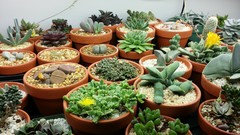
    Here are some of my plants after watering last night (photo just taken):

    Lately I've eased up on watering my Lithops - with the lower temperatures their dehydration has definitely slowed up.

  • 11 years ago

    I started watering this way this summer, it's so much easier and faster than top watering a bunch of small plants. But all my plants were in perlite/potting soil back then, I haven't tried it on anything I switched to the gritty mix, I'm a little afraid there might be some shifting, and all that water might be too much for the DE to handle. I'm probably wrong, but I just erred on the side of caution.

    ewwmayo thanked cm05
  • 11 years ago

    cm05 - Hmm, I have no idea how DE would hold up either. I didn't notice much shifting at all with my gritty mix. Sometimes the bark near the top floats up, so I try to pick that off if it accumulates too much.

    For my cuttings rooted in pure perlite, if I dunk them in too deep then everything floats up and shifts a little.

    Did you keep swapping out the water that the pots were dunked in? I end up putting 3 batches of plants per tub (I have two) and think it's probably a better idea to dump it and put in fresh water halfway through to reduce any excess salt concentrations.

    I've ordered an EC / TDS meter so maybe when that arrives I'll do some additional testing. Until then I'm stuck speculating a bit.

  • 11 years ago

    Do you fill the water half way up the tub or just half a bottom layer of the tub? I tried similar but the water didn't suck up all the way to the top of the soil. Only the inch that was submerged in water?

  • 11 years ago

    Gaeinpan - I fill the water right up to the level of the soil surface. Plants in the same size pots are all done together in a batch. Same as for you - my mix doesn't allow for water to wick up to the top.

    I think it's best to fully submerge the soil, otherwise salts may accumulate in the 'unwatered' portion.

  • 11 years ago
    last modified: 11 years ago

    Except for my mesembs, my plants are all in some form of gritty mix (by that I mean different proportions, no fines whatsoever). They're under T5HOs in the basement where it is 10 to 15C in winter. This time of the year I'm still watering once a week. By November that will slow down to once every fortnight. I water maybe once a month around december but only sparingly, others I don't water at all. Note though that all of them have spent at least one full year undisturbed in their pots. My less established plants are upstairs in the house.


    I have not seen dehydration though. Probably because I don't water them much in summer either.


    In my setup only a gravy boat will fit in there. A tiny one. Dunking all these pots in water will just make me very cold.

    Pagan

    ewwmayo thanked User
  • 11 years ago

    In the bonsai world it is a no-no to water from the bottom, but explanations never seem to be forthcoming. It leaves me to speculate whether it is old bonsai tales, or if there is science behind it. I can speculate that fertilizer and salt buildup would be the concern, but have seen no studies.

    ez

  • 11 years ago

    I had asked Al the same thing years ago. I forget exactly what he said but it was that this isn't a good long term idea because all and any draining of salts etc. would be in that water. I think occasionally, it is fine -- and I've done it with certain pots where I can't seem to get it hydrated which happens maybe once a year, but with others, pouring water in to gush out the bottom and clear it out is the objective.

    I would think, Eww, that doing this TO fertilize would be good (or acceptable). But then to be followed by a flushing, and then followed by fertilizing again at the next watering?

    Rina, if you don't move them, how do you water your indoor plants? I take them all outside....which might explain why I rarely water indoor plants LOL.

  • 11 years ago
    last modified: 11 years ago

    Grace

    It would be way too many to move :) I just water them with watering can. They are on shelves with trays and few with their own saucers. I use rain water collected in summer, and don't fertilize during winter (actually, I hardly ever fertilize them anyway). I am happy that I can keep them outdoors at least part of the year (late spring till fall), where they usually get watered by Mother Nature - depends on how rainy the season is. Sometimes, if dry for too long, I just take hose to them. This year, I had to water maybe 3-4x?

    Rina

  • 11 years ago

    I have heard that this is the best way to water violets, but I only do it occasionally even with them. I just water everything with a watering can until it starts coming out the bottom. I have drip trays on everything.

  • 11 years ago

    So many responses, thanks all!

    Pagan - Appreciate the feedback on your watering frequency. Helps me anticipate what I probably will encounter over the next few months. None of my plants have been in the same pot for a year; I think that is a big advantage for yours.

    I am exactly expecting your trend of a decrease in watering frequency by December and then going up from there. We'll see!

    Rina - It is annoying to move plants around to dunk them... Right now I have maybe 70 plants and I believe you have a lot more than that!

    No problem about posting all my findings and everything behind that. =) When I first joined these forums (not long ago) the majority of things I 'knew' were actually false. It's been so frustrating having wrong or conflicting information so I'm trying to fix that.

    The PH, EC, and TDS meters I've ordered are fairly cheap so I think the cost is worth satisfying my curiosity *laughs*. My other light/moisture/temperature meters were at a much higher cost but I definitely think they were worth it overall.

    Ez - I had seen a mix of suggestions for bottom or top watering bonsai but I can't say I have been following or personally know any really talented bonsai growers. My observation is that they really know their stuff... even if it's hard to find out why.

    Grace - Nice! What you say is along what I was thinking. As the soil soaks in the water, the salts would be dissolved and reach a sort of equilibrium (it's diluted). Then when the plant is removed, some of the unwanted salts/effluent remains and dries in the soil.

    Where as if you flushed it completely, the salts would be dissolved and washed away (hopefully) more effectively than if it was just soaked. Of course, you would have to flush enough water to do a better job.

    I am sure this is the intention of Al's method of watering once, waiting 15 minutes, then flushing. But really... I kind of wonder how many people do this. When I was outside this was easy, but inside it's a small ordeal.

    Lori - Thanks for the input!

  • 11 years ago

    Rina, oh yea...you have to bring all of your guys in! I brought in about 10 last week and I'm dreading when and how to water. With my house plants, when I water, I completely drench; so I do drag those outside. Occasionally, if I feel lazy, I hold the pots above a bucket inside the house, water, let it drain and repeat as I move to the next plant, dumping the bucket when it's full.

    It's so time consuming and so much more difficult than hosing everything down!

    That is one huge benefit of growing outside. I love my hose LOL. I actually brought these in partially to prevent myself from getting too happy with my hose over winter. :-)

    Eww, I do this with individual pots of cape fuschia and bougainvillea this year. They're in their second year in the 3 gallons and I didn't want to repot them with so many blooms on it, since the hummers were still around. To water that pot, though, requires immersing it in a pot of water (with or without fertilizer) and continuing to refill every 10-15 minutes. It's amazing how much water will get sucked up! I usually have to fill the bucket 3+ times before it stops gobbling.

    I will often go back to plants I watered earlier (outdoors, with a hose) that day to re-water just because I feel like it, but yea...I reckon it's not easy to do with a watering can! ;-)

    ewwmayo thanked Sugi_C (Las Vegas, NV)
  • 11 years ago
    last modified: 11 years ago

    Immersion watering is interesting. I have seen it recommended for and against, both strongly.

    I do it at times, but never with fertilizer myself. I also worry about salts build up even without fertilizer, feels a bit wrong dunking pot after pot into same bath to me. Would you take the contents of a cache pot and pour it into another? I guess in this case it's diluted quite a bit, so maybe not as bad as that.

    I don't know if the action of a pot draining after being filled from the bottom draws in as much air as watering from above, gravity and all - but maybe it does. I do often wonder if I fully manage to wet the area directly under plants with large root systems when watering from above.

    ewwmayo, are you still immersion watering?

  • 11 years ago

    Daniel - Yup, I am still immersion watering. Just did it again last night. I am alternating between watering and fertilizing every four days.

    When flushing, I use the same water in each medium/large tub (I use three) for two sets of pots. After that, I pour it out and fill up the tub again. About 1/3 of the water is removed when I take out the pots - I try to catch the effluent coming out of the drain hole with a plastic saucer before it falls back into the tub.

    Usually the tubs are not packed completely with plants so the water/effluent ratio isn't so bad.

    The easiest way to check accumulation of salts is on the rims of my clay pots. When I see that, I just raise the water level so it is completely above the soil surface/lip of the pot. The salt quickly dissolves and is flushed away.

    I prefer watering like-sized pots together so the water level always reaches the soil surface.

    My experience is top watering with gritty mixes (with a watering can) is not very even. For plants with shallow or proportionately small root systems (such as bare-rooted plants), top watering may not reach most of the roots which results in drought stress and it is a struggle to become established.

    I find that most of the water flows to the bottom so quickly that the Turface and bark don't get to absorb that much water. Perhaps with the addition of pumice/akadama/perlite and possibly sand, I think this problem would be negated to some extent.

    I'm a bit skeptical on how important flushing salts is in my gritty mix is. It has such a low CEC and my soil EC meters are maintaining quite low readings. It doesn't take much water to flush away any nutrients, so I believe it needs to be in moderation (of course). Maybe if I start adding other ingredients or using very different ratios then it'll become a bigger issue.

    Sadly, I still haven't received my liquid EC meter in the mail yet. That would be the concrete assurance that what I'm doing is okay. For now all I have is my notes and photos showing that things are still growing well. =)

    Well, that's my latest thoughts on my watering practices! Hopefully I'm not just trying to justify what I'm doing, because it sure is convenient. =P

    Instead of watching water flowing out of a spout and onto rocks, I just plop my pots into water and then spend the 10-15 minute of soak time per batch looking over the rest of my collection.

  • 11 years ago
    last modified: 11 years ago

    I do have an EC meter. Really only used it to assess my tapwater so far though (which appears to uphold NYCs tap water reputation - 50ppm or less TDS in what comes out of my tap). Measured some distilled water too, at 0. it really is distilled! always wondered about fraud potential there...

    Maybe I'll give this a try, now I'm curious. Gotta find that meter though, haven't touched it in a while.

    I never left anything soaking for near that long when I did experiment with immersion - 3 -5 minutes seemed to do a really good job soaking (using al's standard 1:1:1 gritty mix). Since convenience is one of your goals, why so long? Did you determine that long was necessary to fully saturate the pots?

    Daniel

    edit: your plants always look amazing. What is that crazily patterned succulent front and center in your post directly above?

    ewwmayo thanked rooftopbklyn (zone 7a)
  • 11 years ago

    Daniel - If you end up trying it, let me know how it goes. More experience from others is always helpful.

    Honestly the 10 minutes is a kind of generic thing I picked up from the internet. I try to immerse until the 'crackling' or 'sizzling' stops. To me, that indicates the Turface has absorbed a lot of the water and all the air pockets are filled.

    You raise a good point that it's probably a little too long and I can save time with a shorter soak. I'll do some testing to see what a good/better time is.

    Thanks! That's an Adromischus maculatus. I made a special request to a local greenhouse and they got it for me. Repotted immediately and started acclimatizing it to some good light. All those smaller leaves are new and growing!

    Everybody says it's a slow grower, but I think it's doing fairly well. These fall conditions are great. =)

  • 11 years ago

    I do the 10 minute soak thing with echiveria, jades, agave, aloes and haws and it works fine.

    tj

    ewwmayo thanked tsugajunkie z5 SE WI ♱
  • 11 years ago
    last modified: 11 years ago

    So I still haven't found my EC meter, but it'll turn up eventually now that I'm keeping an eye out. I did do a bit of experimentation with the aid of a scale.

    I selected 2 small pots, 1:1:1 gritty mix, that were mostly dry (both with plants rooted firmly), and watered one from the top and one via immersion. I lost the paper I scribbled the actual numbers onto to a routine tidying (my bad for leaving it on the kitchen counter), but it doesn't matter much.

    Both pots were at the moisture level where I normally water - about a day away from completely dry. I used my stock of aged tapwater (to allow chlorine release - actual chlorine, not chloramine, is the dark side of NYC's legendary water) with no additions for this exercise.

    Top watering pot, I watered as I normally do, which any normal person watching would consider severe overkill :), I like to hold my finger over the drain hole for periods of time, and I do it over the sink so plenty of water flows through the pot. Many times the pot's volume worth of water. I then set the pot at about 45 degree angle and waited 10 min, then weighed. Then watered again, tilted, waited 10 min, weighed, and since it had added since last time, did it again. At this point I had enough so I didn't try a fourth cycle.

    I immersed the other pot for 10 min, removed, set at about 45 degrees, waited 10 min, weighed - repeated whole cycle, and got exact same weight.

    The top water pot took approx 10g of additional water each cycle after the first. Maybe the second cycle took a bit more than the third, I will log directly into my plant journal next time.

    Not sure what effect from salt build up immersion may carry, or other advantages of top watering (gravity pulling in more air? is it any different than when water drains out of a just un-immersed pot?) that are lost, but my quick conclusion is that it's much more efficient to immersion water, and that top watering is more difficult to do thoroughly than I had realized. Next time I will try 5 minutes.

    Daniel

    ewwmayo thanked rooftopbklyn (zone 7a)
  • 10 years ago

    Just finished another round of measurements and wanted to update this thread with some of my findings about bottom watering:

    1. Watering by soaking 3 batches of plants in a tub of tap water did not significantly increase the amount of salts in the reused water (300 µS/cm tap water today vs. 340 µS/cm after watering).

    2. Watering by soaking 3 batches of plants in a tub of fertilized water did not significantly increase the amount of salts in the reused water (474 µS/cm starting vs. 498 µS/cm final).

    3. Fertilizing every other watering helps keep soil EC at more consistent levels (Soil EC decreased by 10-20% with tap watering after fertilized watering).

    4. Tap water EC can fluctuate slightly, but is relatively stable (no big surprise, 328 µS/cm vs. 300 µS/cm).

    5. Recommended manufacturer fertilizing EC can differ a fair bit. When trying something different, it's a good idea to check exactly how much to use (367 µS/cm vs. 136 µS/cm vs. 642 µS/cm).

    6. Soak times above 6 minutes do not significantly increase moisture absorption of gritty mix (10 min vs. 6 min soak, based on soil moisture readings).

    Based on this, I'm going to keep soaking my pots throughout the winter since it is effective, time saving, and does not seem to have any major downsides.

    Thanks all for your input!

  • 10 years ago

    Resurrecting this discussion. Are you still using this immersion method? How is it working out?

    ewwmayo thanked Renee
  • 10 years ago

    This is fabulous. Just added 5 more plants to my hotel windowsill situation, and since I have no shelving, trays, watering cans or hoses, I've been immersing them in the bathroom sink - 27 plants and all. Do let us know if this technique is still recommended!

  • 10 years ago

    Leslie, I just pictured your pots in a hotel bathroom sink! ROFLOL

  • 10 years ago

    If she keeps going with the purchases, she'll have the tub filled up as well :P

  • 10 years ago

    Ha!!! I'll post a picture of the gang next time they get a bath - I just got them all back on the windowsill. And shoot - why didn't I think about using the tub!?!?! Would have been MUCH easier. I'm out of room on the first windowsill in the room, but saw a new Grapto hybrid at the local HD that's HUGE, so I'm about to take over the other windowsill. Yup - I'm heading towards the tub now!


  • 10 years ago

    Heheheh :)

    im actually pretty interested in hearing follow up on Kevin's watering system as well. I'm currently moving them all over to the sink to water over a mesh strainer then dripping dry on a cooling rack. It's a PITA.

  • 10 years ago
    last modified: 10 years ago

    I guess it's been 10 months now? Plants are still doing great! No issues with salt accumulation, many have been repotted and the roots were extremely healthy. Many have bloomed several times - I would say it's a success.

    About 100 of my Haworthia are still kept inside and bottom watered. Another 100 or so succulents are outside and top watered while they are out there.

    Bottom watering by soaking is by far the most thorough method and results in best absorption. My plants outside would do better if bottom watered as well, but using the hose with the adjustable sprayer and flow regulator is just FAR faster.

  • 10 years ago
    last modified: 10 years ago

    Thanks! :)

    Are you still adding fertilizer to the water?

    ewwmayo thanked Renee
  • 10 years ago

    When watering with the hose outside, are there any issues with getting water in the rosettes, or is that not an issue for Haworthia generally?

    ewwmayo thanked michael19
  • 10 years ago

    "adjustable sprayer and flow regulator"

    Sounds fancy. Over here we use something called a watering can.

    I also use this bottom watering method to some extent, maybe not soaking for as long, but I agree, it is efficient and effective.

  • 10 years ago
    last modified: 10 years ago

    Renee - Yup, I'm still adding fertilizer to the water. Same way, didn't really change anything with that.

    Michael - Outside is a big mix of genera (Mesembs, Crassulas, Gasteria, etc.). Many I am very careful to not to get water all over the leaves because they are extremely susceptible to rot.

    Generally, water in the rosettes is not an issue with Haworthia IF you have good airflow and reasonable humidity (60% or lower). Mine get wet a lot of the time and I don't worry about it because I know my conditions are good.

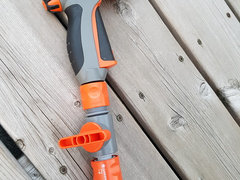
    The sprayer head I'm using below has many settings. My favourite is the 'powerful jet', which turns into a thin and straight stream that is easy to aim and doesn't dislodge smaller top dressings. There is also a full flow shower-style setting, which I use for my larger pots of Sempervivum, Jades, and Stapelia that are not so picky and can be totally drenched from above.

    Palmandsnow - It's very exotic, found at your local Home Depot. =)

    The adjustable hose sprayer on top doesn't turn down low enough, so the flow regulator lets me turn it down to a trickle just like my modified watering cans. And it never runs out of water!!

    Lets me water over 100 plants (many which I have to be careful not to drench the leaves) in about 25 minutes, which is makes me pretty happy.

  • 10 years ago

    Kevin--thanks for the explanation! I wondered how to best water large numbers of potentially rot-prone succulents outdoors, and that seems like it works well (and quickly).

    (I don't have that problem yet, but I figure it's only a matter of time...)

  • 10 years ago
    last modified: 10 years ago

    In agreement with Kevin, using the hose with same sprayer outdoors. There is so much better air flow, some breeze quite often, I think they dry up pretty fast. Indoors is another story...But yes, there are some one should be more careful about.

    This photo of 'Fred Ives' is taken just few hours after the rain, and it already dried up:

  • PRO
    5 years ago

    Hi.... New to this post. I too hv a big garden. Normally i am watering my plants via hose for pretty long until water drains from below. I repeat it n at a temperature of 45 degrees, my watering last for 3.5 days, which is quite time worthy. I hv some succulents n cactus pots, n 2 jades, which i hv filled wth soil to the brim to avoid them getting over watered. I have been practicing,submerging my pots in a bucket or tub full of water fr an hour or even leving them overnight. The plants look great. I hv been noticing only one issue, being soaked for so long n the water is all soggy, bt the pots get dry very fast.(yes this loaction receives the maximum sunlight right from morning until the sun sets). Is it the sun doing it or am i doing something wrong. I did read all comments, but could not find anything

  • 5 years ago

    HU-306282168 can you post some photos of your plants, soil mix, and growing area along with provide additional information where you are? I'm not sure if 45 degrees means Celsius or Fahrenheit which makes a big difference.

    You can put that here or start a new thread if you like. Also you can pick a favourite username as well in your Houzz settings. =)

  • PRO
    5 years ago

    My plants have a soul ratio of 1:1:1 of soil sand and perlite for cactus and succulents.as of jade it 2:1 of soil and sand. 45 degrees is celcius. I am from india. My plants r doing good, only issue i hve is wen i water my palnts via hose, the watering lasts for 3.5 days. But wen i soak my pots in bucket of water of tubs for few hours and even overnight,i find that thewater dries very fast. N in day or 2 the soil is bone dry. My pots are clay pots and concrete pots.


    P. S. -SORRY FOR MISSING ON SOME INFORMATION IN MY REV POST.

  • 5 years ago

    @Bob How are you checking the soil is dry - is this at the very bottom of the pot too? Soil and sand would hold a lot of water. Photos would definitely be informative. However, since I am in Canada I am not so knowledgeable for growing conditions as hot as in India!

  • PRO
    5 years ago

    My normal check up is once a week in summers wen i sense the soil is too dry by almost a knuckle or 2 knuckles deep. I submerge them, n the next day the cactus n succulents seem to look quite happy for a day or 3.


  • PRO
    5 years ago

    Hi... I submitted the pics twice bt cant see them here.... Or they will show up wen the admin approves.... If dat is the case plz delete one set of pics

    ...thank u very much fr ur timely reply ....appreciate it so much