Software
Houzz Logo Print
lissyanna21

Late 1930's woodwork - refinish or replace?

10 years ago
last modified: 10 years ago

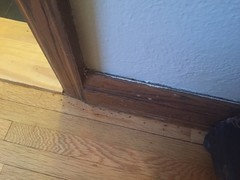
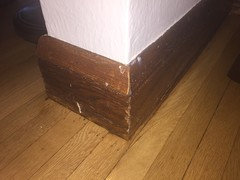
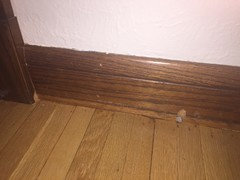
I originally had every intent to refinish the unpainted wood trim and doors in my late 1930's home. The baseboards have both latex and oil paint drips from sloppy PO's over the years, many have been drilled, scratched, dried-out, are falling away from the plaster, etc. My plan was to remove the salvageable toe-kick/quarter-round (which I did before I refinished the original oak floors, which turned out beautiful by the way :) ), but slowly remove, strip, re-stain and replace the baseboards and doors (and then figure out what to do about the windows and door trim :) ). However, as I've been working around (and living in) the house and getting the less-cosmetic things updated, I'm wondering if it might just be better to replace all the trim? The doors are hollow-core (which, as I'm reading up on 1930's homes, apparently became more of a thing as the depression wore on and labor became cheaper but materials did not), and the baseboard just seems like a cheap, plastic-like wood (I'm honestly clueless about this, but just from the weight and feel of it, I'm not even sure it could really be stripped and re-stained?). If it's not solid wood or decent quality to begin with, would it just be better to skip some of the labor and invest in a higher quality wood now? I know it's sacrilegious to pull out some of the original features, but I feel like that maybe only holds true when the original work was of a decent quality?

Comments (11)

  • 10 years ago

    "If it's not solid wood or decent quality to begin with, would it just be better to skip some of the labor and invest in a higher quality wood now?"

    Yes,it make's no sense preserving origional if it's ugly unless the home is to become a historical landmark. If backside looks good when you pull other trim,you might use reverse side as show side instead of going to trouble of stripping old finish. If some trim is nice wood beneath paint but decrotive molding prevents flipping,hire a hobby woodworker with a drum sander. The sander will remove paint from flat areas leaving only molded part for hand stripping.

  • PRO
    10 years ago

    Don't power sand painted trim...too much risk of lead paint contamination. Unless you are certain that all the paint is post 1980, treat it as though it contains lead. In my opinion, low temperature heat gun to remove the 90% of the paint and finish up with chemical stripper like the orange based products, is the most practical method. That said, I have not used the soy gel paint stripper so can't comment on it.

    Unless the trim work is nice material (oak, walnut, maple, cherry), don't bother to strip it. Save the time and aggravation and just replace it, it won't cost that much more than buying the stripper. If it is three piece baseboard, consider just stripping the cap and replacing the base and shoe with new wood. If you do decide to strip it, go to a good paint store and invest in one of those paint scraper sets with the interchangeable blades for different profiles...well worth the $15 bucks or so.

    I'm an old house lover and even I say that not everything is worth saving. Just because the builder ran out of money and used cheap trim should not sentence you to live with it forever. If you had a cheap fiberglass shower stall from the 1970s, would you think you needed to save it?

  • 10 years ago

    Not quite sure I understand what you're dealing with without seeing pic .... hollow core doors and fake wood plastic trim I thought were more recent invention - are you sure theyre original?

    However, FWIW.... one solution ive used is simply to paint out the baseboards where these have been too difficult or not worth refinishing - have them be same color as wall - but then refinish the doors, windows and trim. Baseboards are often more banged up and consequently harder to refinish (paint gets in all the dings and dents). Doors, trim, windows however are usually flatter/easier to sand with palm sander - once you get the paint off.

    Oh I would also include old growth pine or fir with desireable woods worth refinishing if you have these as trim or doors. Yeah, sure, at the time his was considered "cheap" wood but now, that's not true. Vintage reclaimed pine has become quite pricey/valuable! This wood is nothing like the awful cheap splintery farmed wood of today - its hard as nails, very tight beautiful grain. Itll last you another 100 yrs. If its late 30s - I dunno, it may or may not be the true old growth stuff. That's where a pic could help! If you think it looks plastic then probably not....?

  • 10 years ago
    Sorry I didn't get photos up here before... Here you go!
  • 10 years ago
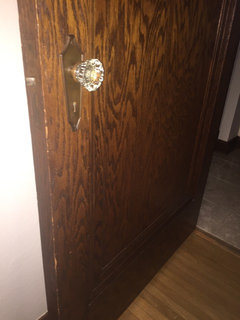
    And a door :) Not a clue if original, but definitely hollow core.
  • 10 years ago

    Ahh pictures,we're off to the races now. Op origionally asked if there are any reasons to preserve nondescript wood trim and doors when buying better quility is something she is willing to do. Now what? Try and convince her the refinished wood will look great up against the oak floor?

  • 10 years ago

    OK! Yes I can definitely see the 1939 there. Not quite into modern era but beyond early 1900s. I think my original opinion still stands - what do the door and window trim look like- the piece in the pic looks kinda solid, more substantial than the baseboard?

    Why do you say door is "hollow core" - looks to me like solid wood framing or possibly veneered with plywood inset panels...? If it truly is hollow prob not worth it.... or if veneered and badly chipped.... but if not it look great refinished - with that wild grain and door knobs that's the kind of period detail that is irreplaceable.

    I dont know if I would remove any trim. The beauty of flat plain surfaces is that you could get a really good high powered palm type sander able to hook up to a vac and just have at it. If you were to use a gel stain you wouldn't even have to take off all the original finish just enough to smooth and clean up the wood.

    Re upgrading to "better quality" - I don't know if anything that great or period appropriate can be found in a big box store - the fake Victorian stuff is way too thin and unsubstantial not to mention out of character with 1939. Would have to come from specialty place (in fact I think Ive seen that same baseboard once in a catalog LOL) or be milled but either of those two aren't really prohibitively expensive IMHO - just a simple flat trim of some sort would be good. Or if your house is small you might find something in a large enough quantity in an architectural salvage place.

    Klem you have a question mark after your last sentence - don't you think the oak trim and floor looks good together? Even if OP replaces I must say that the oak + oak looks good.


  • PRO
    10 years ago

    Now that I see the photos, I would refinish that trim. It is a substantial size, interesting profile and a nice grain.

    Those are not hollow core doors..I would describe that as a single inset panel door and it is quite similar in profile to the doors in my 1931 house.

  • 10 years ago

    Yes, refinish it. It may even be shellacked. Test it with some denatured alcohol; if it dissolves the finish then you can use denatured alcohol to clean it up and then re-shellac it.

    Diane

  • 10 years ago

    My house was built c.1880 but had remodeling work done in throughout the 30s and 40s. Much of the Victorian woodwork was removed at this time for new windows and doors to be put in. I have the same doors, but in pine and it is all coated in poly (or other shiny finish) when it would have traditionally been painted. I've been considering what it would take to convince my husband to let me strip it and paint it all. It looks like yours is oak - if that's the case, I would put the work into restoring it.