Software
Houzz Logo Print
bopwinter

Gritty Mix Question

11 years ago

Hello All,

I potted my tahitian lime in gritty mix in March this year and now I am wondering if I did it all ok, as it is dropping leaves again and the leaves are curling from the tip downwards.

Ingredients (each 1 part):

Bark fines

Pumice (turface doesn't exist here)

Gravel for Acquariums

I water around twice a week and feeding twice a week with foliage pro. Should I have gone for 511 mix?

Ideas?

Ben

Comments (25)

  • 11 years ago

    whats your zone? is the plant indoors or outdoors? in shade? sun?

    If you bare-rooted and repotted into gritty mix in March, you should have seen the effects within the first few weeks - often this transition is a bit difficult for the plant, and it'll drop leaves initially, but then bound back as the roots take hold.

    Given that your plant has been potted for over 6 months now, the cause of your recent issue is not likely to be caused by your potting media, but something else - environment sounds more likely (light/temp/humidity).

    However, it also wouldn't hurt for you to post a picture of your mix with a size reference such as a common coin if you are concerned it may be the source of your issue.


  • 11 years ago

    There is a bit of new growth, but it is also dropping leaves at the same time.

    I live in NZ (Auckland), so we are in spring at the moment. The plant is in full sun outdoors.

    Size reference for the mix may be a challenge, as we don't have the same coin sizes etc. Will a match box work?

    I just never seem to have luck with Citrus.

    Cheers,

    Ben

  • 11 years ago
    last modified: 11 years ago

    Any graduated ruler would work, even if metric :) my fault for making a non-global suggestion.

    Given the timing it doesn't sound likely to me that your problem is related to the mix, but maybe you need to water more often (which you could attribute to being caused by the mix). Pumice is less water retentive than Turface / calcined clay, and may not be a good 1 to 1 substitute for it so that's a real possibility.

    Perhaps some other container gardening members will chime in with suggestions, but you could also head over to the Citrus forum on GardenWeb to get more Citrus specific help.

    Daniel

  • 11 years ago

    Thanks Daniel. I guess that is my concern in that "is my mix just not working as well" and do I just give up and turn to 511 mix, as atleast I can get the ingredients for that.

    Are there any real substitutes to turface you know of?

    I will also do as you said and post in the citrus forum too.

    Thanks,

    Ben

  • 11 years ago

    5-1-1 is great if you can find suitable materials in the correct size that don't have too many fines. Don't skip the lime! (general statement, some acid loving plants maybe would be happier without lime - japanese maples for example, but I don't know anything about citrus). But I have had a japanese maple in limed 5-1-1 and it did just fine.

    You just need to do more maintenance with 5-1-1 vs. gritty - plants in 5-1-1 should be repotted every year ideally, and the old media discarded, because it compacts over time. Plants in gritty mix can wait until they need root work, and the mix can be reused with just a little work in most cases.

    I use 5-1-1 for most of my outdoor plants because its much easier for me to find materials for in large quantities and its much lighter weight for large pots (which I have many of outside). I do keep plants in it for 2 seasons sometimes, though it's pretty clear to me they'd be better served by more frequent repotting in almost every case. They don't die or anything, but they also don't grow as fast or well as when first put into fresh 5-1-1 or as plants that remain in gritty.

    I'm not that familiar with all the turface alternatives since I found a local-ish place to get some. Turface is made of "high fired calcined clay" and some brands of kitty litter are apparently made of the same material (albeit not to the exact same specifications) with reasonable particle sizes - searches on bonsai forums or google or even this forum for "turface alternatives" :) might shed some light.

    Daniel

  • 11 years ago
    last modified: 11 years ago

    Hi Ben, Napa Floor Dry can be a perfect substitute and is exactly the same as 'turface' only grey in color..That can be bought at a local hardware or auto store. If you can't find anything close, then I would turn to perlite which also holds more moisture than the fish gravel..I grow many citrus in the gritty mix, the actual 1.1.1 and you certainly have to water more often until the mix starts to break down or the roots grow into it..The area where the roots are should never dry out and it can be easy to do which describes what is happening to your tree...Now that you have used the fish gravel, even worst because the particle are much bigger and hold no water in comparison to the 'crushed granite'..You would be surprised that granite can hold water...

    Even if you use the actual ingredients in the right size and the right ration, it will force you to water more frequently, on some plants every day like my citrus but just for a few weeks...With the one you made, and even bigger particles, that concerns me...If I were you, I would either make the particles smaller, and find a way to improvise the granite with something better, or use the 5.1.1 mix for sure which will be easier for you)

  • 11 years ago

    Thanks for you help.

    I got aquarium gravel, but made sure it is the right particle size as the granite. However if it is supposed to hold some water that would be an issue.

    Sounds like my mix is not ideal and even stepping up watering may not sort it. Here in NZ there doesn't seem to be the same type of products as elsewhere, which makes sourcing ingredients hard work.

    Have you heard of any issues with 511 mix in a place with lots of rain? I know Citrus can be very fussy about wet feet etc.

    Cheers,

    Ben

  • 11 years ago
    last modified: 11 years ago

    Ben

    If there is a farm supply store nearby, you should be able to find chicken grit. That is most reasonably priced and great size grit that I find to use.

    I have used some aquarium gravel in the past, it was right size but lots of it is too large, too smooth and often colored. I was lucky enough to get good size and it was not smooth either. I have also lots of larger and green-colored one, and use it for top-dressing (sometimes).

    You can also check the farm supply store for dry stall (possibly under different name) - I am not really familiar with it, but it was mentioned before. I believe it is horse bedding product, and absorbent like turface or kitty litter.

    If you are 'stuck' with ingredient that may hold little more water, just use less of it in your mix.

    Rina

  • 11 years ago

    Rina made a GREAT point....If you can't find the granite, it would be much better for you to use much less of the gravel...Unless of course you are going to grow cactus...

    Yes, the 5.1.1 mix does wonders even in areas with lots of rain, just ask me...I have had summers where it rained every day for a month and not a one problem..That 5.1.1 only stays evenly moist which citrus trees love anyways..

  • 11 years ago

    That is good to know that 5.1.1 works in really wet climates, as it definitely likes to rain here in Auckland.

    In terms of using less of an ingredient. Would you use more bark or more pumice? The aquarium grit I got was as sharp as I could get it, but guess it will still be rounded. I will try and get a picture tonight of my mix and see what you guys think.

    Another thing is I used Gypsum in my mix (not lime) and was not adding epsom salts at the start. I am now spraying the foliage once a week now at 1/4 in a gallon (this I only did by accident as I read it will help the leaves). Is that enough you think?

    You have all been such a help.

    Ben

  • 11 years ago
    last modified: 11 years ago

    Pumice holds water internally, but not between the particles itself, so it drains well while supplying water to roots without them sitting in it (I hope I am saying it correctly...)

    The 'smoothness' of the gravel is probably not as much of a problem as the size of it could be. If too small or too large, any of the ingredients will not perform as expected.

    As for cat litter, here is the link to some reading about it and recommendations/availability around the globe:

    -using cat litter-

    Rina

    edited to add: I copied this part regarding using Epsom salts - it is from post by Al (tapla) in his thread :-click here-

    I use 1/8 -1/4 tsp Epsom salts (MgSO4) per gallon of fertilizer solution
    when I fertilize if the fertilizer does not contain Mg (check your
    fertilizer - if it is soluble, it is probable it does not contain Ca or
    Mg. If I am using my currently favored fertilizer (I use it on
    everything), Dyna-Gro's Foliage-Pro in the 9-3-6 formulation, and I
    don't use gypsum or Epsom salts in the fertilizer solution.

  • 11 years ago

    Couple of things.

    1) So adding gypsum instead of dolomite lime at the start isn't such an issue that I need to add mg from epsom salts going forward?


    2) My plan of action.

    • I am going to continue with my gritty mix for my lime and step up watering. Also I will get a pic for you guys to have a look at (was raining last night so didn't fancy going out).
    • Mix up some 5.1.1 mix and plant a Lemon Meyer in it to see how that goes and compare. Should I add gypsum or lime to it when mixing? also is feeding twice a week with FP (watering before) still ok and will not lead to a build up of salts?

    Cheers,

    Ben

  • 11 years ago

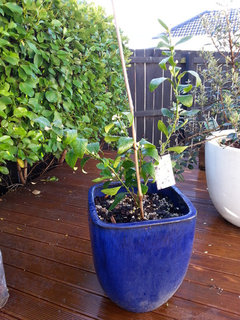
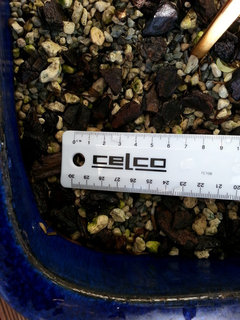
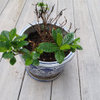
    Here are a couple of pics. One of the lime tree and one of the mix. I have now covered the mix in fine bark to act as a mulch of sorts.


  • 11 years ago

    Hit it with some double strength fertilizer and see what happens. Break it out of that rut.

    An acidified watering with white vinegar can also do wonders.

    Josh

  • 11 years ago

    Ben, the bark and gravel both look somewhat big to me, ideally they should be between about 3 - 6mm. Smaller pieces will increase water retention just by nature of their size. If that's Pine Bark, the bark portion could be a little bigger (up to 9mm) without much trouble, as pine bark is often flat rather than spherical geometrically, if that makes sense I didn't articulate it very well.

    In addition, as previously mentioned, you should increase the % by volume of pumice to account for the fact that it holds less water than turface and your gravel holds less water than something with a rougher surface (like crushed granite).

    Daniel


  • 11 years ago

    Cool I have some pumice, so could do that.

    The bark is pine bark, so it is a bit bigger due to that.

  • 11 years ago

    Hello Everyone!!!

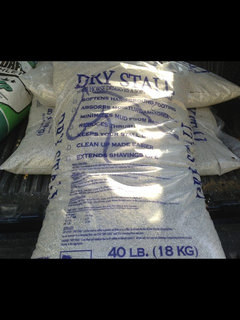
    i just wanted to post a picture of the Dry Stall that I use.. If you look at supply stores that cater to Horses, you can find this Pumice that will work in your mix. This came from Tractor Supply Store and was about 8 dollars for a 40 pound bag.

    Laura

  • 11 years ago
    last modified: 11 years ago

    Hi Monica!!!

    You will find that that most of us use Pumice in place of Perlite used in the 5-1-1 mix. Sometimes the Coarse perlite is hard to find as well, so this is an alternate to use in place of...

    It does look like some are using it in the Gritty mix.. I'll let Al clarify that for you...

    It's used more for aeration in your mix and does hold some moisture because of its structure. I like it because it isn't as light as the perlite and I can add it to my mix to keep it more secure. Sometimes perlite can be to light for some gardeners. It's all in what you are looking for when using in your containers.

    If you have weight issues due to the size of the container, then I would use Coarse perlite found at hydroponics stores. If you like it for smaller lightweight containers, I would use the Pumice. If I had a choice.. I would use Pumice instead of Perlite.. ( my opinion, of course...)

    This is an alternate for Perlite and it can be located in places that have stables ... If you have any areas that sell farm supplies and or associated with horse supplies, then you can probably find this. ( Tractor Supply stores , etc)

    Gritty Mix ingredients

    The alternate to Turface ( All Sport or MVP.. Same thing different suppliers) would be Napa Floor dry part #8822.

    Gran-I grit ( Growers size) Which is crushed Granite can be found on the east coast and is mined in Mt Airy NC. It's basically used for Poulty and aids in their digestion process . The farmers use it so the chickens can digest their food properly.

    Manna Pro ( Poultry) also carries this and it's for Poultry . Just make sure you find the 100% granite and stay away from other ingredients in it such as ground up oysters shells. ( always check the ingredients on the label on Manna pro ) they have different kinds available.

    Cherrystone is crushed quartzite and is another great stone to use in place of grit. It's beautiful but it's hard to find here on the east coast. It is mined in the Mid West... I do have a few bags and I covet mine because of the beautiful coloration . The Granigrit is grey and like it Too!!!

    Here is a link from this Container forum that talks about Pumice vs Perlite.

    http://forums2.gardenweb.com/discussions/1383968/pumice-versus-perlite?n=17

    I hope this helps you, Monica!!!

    Have a great day!!

    Laura

  • 11 years ago
    last modified: 11 years ago

    Laura covered it well, Monica. It would be used in the 5:1:1 mix in place of perlite, and would increase water retention while at the same time likely increasing aeration, but on a volume for volume basis, any increase in aeration over perlite would depend on the difference in particle size. In the gritty mix, it would come closest to serving as a substitute for Turface, but because it doesn't hold as much water as Turface, you would use slightly more pumice on a size for size basis than Turface. This would be especially true if the average size of the pumice was notably larger than the average size of Turface particles.

    Al

  • 11 years ago

    Thanks so much! Makes sense as I have found perlite too light when I pot up my Hoya cuttings to root. The cuttings often fall out of the pot. I'll have to try it.

  • 11 years ago

    OK so I need to increase my pumic amount to make sure I have enough water retention. Would the mix then be more like 1 part bark fine, 1 part granite and 1.5 parts pumice or would you go higher?

    Also any remedies to adding this pumice without having to pull the tree out?

    Thanks for your help everyone.

    Ben

  • 11 years ago
    last modified: 11 years ago

    I would go with 3 parts Fir or Pine Bark, 4 parts Pumice and 2 parts granite. If you are going to use Pumice in the Gritty.

    Always keeping the Fir bark or Pine bark fraction at 33%.

    Laura

  • 11 years ago

    Make up a small batch and compare it's behavior to what you use today in small clear plastic glasses with holes poked in the bottom. You should be able to see the difference clearly. While this won't tell you how much pumice you need to make your tree happy, it will give you an idea of the effect, and once you observe how your tree eventually reacts you will be in a much better position to make it (and others!) happy moving forward.


  • 11 years ago

    Good idea rooftopbklyn. I will try this and see what the impact is.

    Cheers,

    Ben

Sponsored
Buckeye Basements, Inc.
Average rating: 5 out of 5 stars40 Reviews
Central Ohio's Basement Finishing ExpertsBest Of Houzz '13-'21