Software
Houzz Logo Print
tropicbreezent

A pretty poor season for Mangos

10 years ago
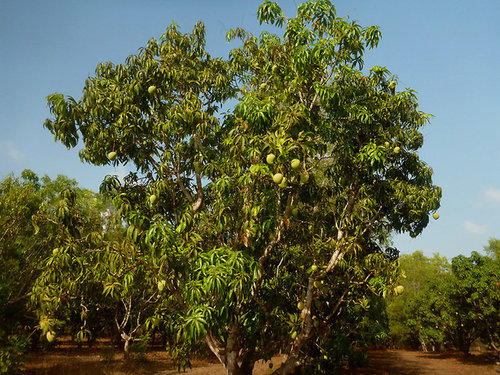
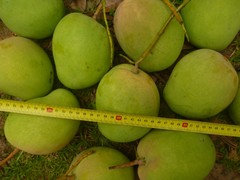
All through our area it's been a fairly poor season for Mangos but the fruit I do have is getting close to ripe. And don't all the local wildlife know it, LOL.


Comments (18)

  • 10 years ago

    Very nice haul! I only got one Manila fruit, but then it is a small tree and first time fruiting. I accidently knocked it off the tree when it was about 3 inches long, but left it on the counter and ate it a few days later -- yummy!

  • 10 years ago

    Either that's a mini wheel barrow or those Mangoes are the size of cantaloupes.

    Like Eloise my California Mangoes are sized about 10 to one or two large market Mangoes. But,very sweet and just with a concentrate that store bought never have.

    When the tree gets larger I expect the Baileys Marvel will too.

  • 10 years ago

    Very nice, are you from Australia or some place in that area that's just going into summer now?

  • 10 years ago

    Not quite the size of cantaloupes, but they are about 12 to 13 cms long. In the tropics mangos flower around mid winter and by beginning of spring the first lot have usually been picked. By start of summer they're generally finished but sometimes with a few stragglers still about. This year they've been late but I'm hoping
    to get a couple more wheelbarrow loads before the wildlife cleans them
    all out.


  • 10 years ago

    They must have been very late lol, its a few weeks from December which is winter for us. I live in the Caribbean which I assume is in the tropics (the tropic of cancer or Capricorn passes through one of my country's islands) and mangoes flower in January or February here which is midwinter for us. They've been gone from August/September at the latest, is it not late fall for you?

  • 10 years ago

    Technically, it depends on which side of the Tropic of Cancer you're on. But plants do their own thing. They either like it and thrive, put up with it and struggle, or else just die. They don't look at the atlas. Being in the tropics is why yours flower in winter, whereas other people on the forums will often say they're spring or summer flowering. Hence the discrepancy.

    I'm about 12 degrees off the equator, so if you want to make it relative to your area, I'm in the northern part of Columbia/Venezuela. Summer starts 1st December. The R2E2 mangos normally are the last and are usually finished a couple of weeks into December. It's quite logical when you look into it. Mangos come from a strong monsoonal climate. They don't like high humidity when flowering or fruiting. By the time the wet season comes they've finished.

  • 10 years ago

    Oh okay, about half the country is above the Tropic of Cancer and the rest is under it, so I suppose that would count as subtropical and tropical respectively. You're definitely more tropical than us though, which I guess explains why you have summer in December a bit, or perhaps you being in the Southern Hemisphere I'm not sure. When do yours flower? The month I mean.

    The reasoning makes sense too, our winter is in the heart of our dry season, although if we have an odd winter rain it might give the flowers some anthracnose problems, and the humidity is naturally high here. But overall it's fairly dry when they flower.

  • 10 years ago

    Mine flower mainly during July, about the same time as Cashews and Jackfruit. Although, Mangos start about a week or two later than the other two.

    You have an advantage in one respect, being on an island the temperatures are moderated. You're far enough away from the US continental land mass with ocean water between to have the effects of cold Arctic surges minimised. On the other hand places like Miami get snow because cold Arctic blasts come all the way overland. But then you have higher humidity which doesn't suit Mangos, but is good for things like Mangosteens, Rambutans, and lots of other tropical fruit.

  • 10 years ago

    Oh July, our seasons are definitely reversed then which is probably a hemisphere thing. And I agree with your thermogeographical assesmemt of my location lol. Also your English is very impressive for a second language, I have been taking Spanish for a few years and am nowhere near your level of prowess as you are with English.

  • 10 years ago

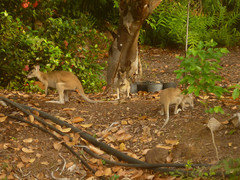
    My English is also far better than my Spanish (which is only slightly above non-existant, LOL). I think where we crossed wires was when I tried to give you an idea of where I lived relative to the equator by giving you the equivalent location on your side of the planet. Here's a photo of some of the locals at my place feeding on mangos which were dropped to the ground by Flying Foxes.

  • 10 years ago

    Oh okay lol, are you not originally from the area? My assumption was going off of the national language for both countries being Spanish. And the equator stuff has been a bit confusing lol, that's really interesting that you guys have kangaroos though. Aside from cats and dogs we have no land animal larger than a raccoon here, but no squirrels at least. Are flying foxes a type of squirrel or an actual fox?

  • 10 years ago

    The straight answer is I'm in Australia, in the north. The animals in the photo are Agile Wallabies which over run my place (and surrounding area). Wallabies are generally a smaller type of kangaroo, but the name isn't scientific. Flying Foxes aren't either squirrels or foxes. They are often called Fruit Bats because their diet consists of fruit (and the nectar of flowers). But to call ours Fruit bats is misleading. Bats are virtually blind, they fly by echo-location (sort of radar). Our Flying Foxes go by sight only. Bats usually roost in caves or hollows, some sort of a dark place. Flying Foxes also hang upside down but up in trees. A tree full of them from a distance can look like it's full of fruit. A flying Fox has a head that looks a bit like a fox, but doesn't have a fox tail. They are fair size and can get up to a wing span of one metre. Enough to wrap around you if they decided to hug you, LOL. There are several different species of them and they love mangos.

  • 10 years ago

    OH, now I understand what you meant about likening your location to the equivalent one near mine, and Spanish with an Australian accent sounds like it would be quite something lol.

    I had heard the term wallabie before in Australian tv shows and such but didn't know what it meant, thanks for the info. Interesting fauna! As to the other apparently they are an bat suborder of megabats, whereas the ones with echolocation are microbats. Very cool area it sounds like. Also I served as a staff in Jamaica at a church camp over the summer and two of the staff were there from Australia, great girls and very friendly people.

    It sounds like the flying foxes/fruit bats could be a vermin of sorts when it comes to your fruit tree harvests?

  • 10 years ago

    They're not popular with orchardists but they are a protected species.

  • 10 years ago

    Yea I can see how it would be important to keep the biological diversity high. Well as they say g'day mate! Thanks again for the interesting discussion.

  • 10 years ago

    @Tropic - Are those Kensington Prides? I didn't know they got that large. Look more like Keitt's.

  • 10 years ago

    Yes, those in the photo are Kensington Pride. But I also have Nam Dok Mai and R2E2, plus two other varieties.