Software
Houzz Logo Print
ewwmayo

Gritty Mix Porosity

11 years ago
Have any of you measured the porosity of your soil mixes? In particular, for gritty mix (but I'm interested to hear for other soils you may have measured for).

Using a handy article by Fafard Technical Services, How to Test a Growing Mix's Pore Space and Water Holding Capacity, I came up with the following results:

  1. 51.6% total porosity.
  2. 29.0% air space.
  3. 22.6% water holding capacity.

Which sounds alright to me. But as per this thread from 2007-2010, A Soil Discussion, my soil mix has a fairly low total porosity and not that much air space?

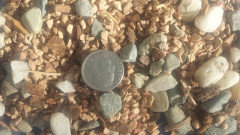
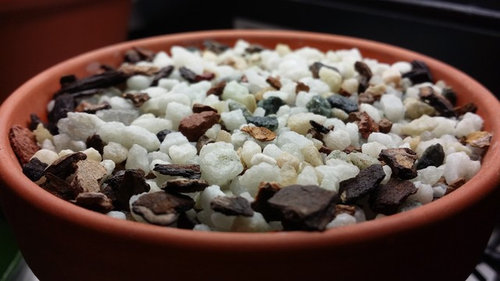
What gives? Are my particles smaller than ideal? Typical 3.5" pot of mix shown below:

Any helpful articles with porosity recommendations also welcome. I'm looking just to understand soil mixes more and potentially take additional measurements of other soil components I am interested in using.

Just curious to hear what others have measured!

Comments (87)

  • 10 years ago

    I think a lot of standard mixes have been documented, published. I not sure if there is one standard container, in which these measurements are referenced. As far a personal knowledge not really, Just leaning as everyone is, maybe just tweaking around more here and there. I have made some Bonehead mistakes, Plus learned from the Oldtimers (Farmers, Gardeners, etc). Currently I have researched myself to complete confusion. I have some declining Manzanitas , after transplanting up to new mix,That I am trying restore. I moved them to 100% Pumice, with Capillary watering from bottom only. I was interested in the future, maybe doing more Data Logging on Container Plant variables such as EC, Available Water, Transpiration rates. I think Ewwmayo was doing moisture measurements. There may be a market for some products developed by forum members. The take away is all the forum members are growing healthy plants in many mixes and methods. So maybe the Plants just like the attention and pampering.

  • 10 years ago

    Do you have a scale? I most often use "jennings CJ4000", fairly modestly priced, .5g accuracy, 0 - 4000g range. But there are also many less expensive scales, available just about everywhere.

    Do some measurements. This thread is specifically about porosity, measured by forum participants. The best way you can contribute is to measure the Pumice you are using, perhaps when saturated via Capillary watering from the bottom only as you practice.

    The measurements you keep discussing, and that I am suggesting you actually do, are independent of media composition and meant as a way to quantitatively compare different media, which seems to be a theme of much of the copy/pasted content you have posted. Lets try to eliminate some confusion. That's the goal. Forget research. Try empirical measurement.


  • 10 years ago

    In addition I have been a information junkie since childhood, always wanting to know how things worked :-)

    I purchased a digital scale online, it is the hanging type, used for fishing etc. I was starting to use this for irrigation scheduling. My background was Data Acquisition Systems and Instrumentation. I am familiar with Test and Measurement Methodology. As for porosity measurements,combined weight and mathematical methods are used frequently. For example soil based total porosity is calculated by the ratio of the weight of the sample compared to weight of a equal volume of solid rock. The average value used,is sp of 2.65 for most rocks. The same technique can be applied to any mix. Using the densities of your materials and their proportions used as the reference value. Maybe a few empirical measurements to verify the accuracy of the technique. So what is it specifically the majority of members are looking in the empirical data ( Misc Medium, Gritty Mix, etc). I don't use the Griitty Mix ( as described) for growing. Didn't want to screen bags of bark, as relaxing and therapeutic as it is. But do use some of the ingredients described. As far as using 100% pumice or sand. It is a Bonsai technique to rejuvenate plants. This was leaned from John Naka. If this thread was strictly for Gritty Mix Porosity, I apologise for posting unrelated information, and will terminate future postings unrelated to exact topic discussed.

  • 10 years ago

    You are welcome to post whatever you want. Most appreciated would be porosity measurements from any mix you use. Can you do this?


  • 10 years ago

    Sure. If it turns out ,Total porosity can be found by simple techniques. It will save a lot of time, and labor.

  • 10 years ago

    Just happy to clarify this thread is for all sorts of mixes. I consider gritty mix a more generic term than 1:1:1 bark/turface/grit.

    I'd be more than happy to see numbers for cut peat (the really aerated stuff) since not many are using that. Or for whatever else.

    Gritty mix sounded so exceedingly simple, yet I've repotted all but two plants from the original batch that I made. The more time passes, the more attuned I've become to each pot's (customized mix's) shortcomings.

    Maybe it's a compete understatement/generality when someone says they use gritty mix because the customization is enormously variable.

  • 10 years ago
    last modified: 10 years ago

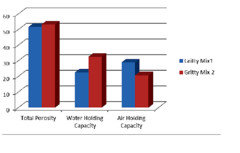
    Gritty Mix Figures revisted. Possible switching of Water Holding Capacity term for Water Holding Porosity value. Calculated Values I got.

    Total Pot Volume
    84.5ml

    Water held at Saturation 45ml

    Water Retained after drainage 27.5ml (Total Sat weight 191- Total Drained Weight
    163.5)

    Water Drained 17.5ml (Water Held at Sat 45ml - Water
    Retained after drainage 27.5ml)

    AHC 20.71%

    WHC 32.54%

    ewwmayo thanked dale92539 Riverside Co SoCal
  • 10 years ago
    last modified: 10 years ago

    Here were the calculated values from my OP:

    248mL - Volume, measured

    128mL - Water added to fill

    72mL - Water drained

    29.03% - AH

    22.58% - WHC

  • 10 years ago
    last modified: 10 years ago

    ewwmayo I noticed that what was called WHC in the measurements
    was really Water Holding Porosity. WHC is referenced to the total container
    volume. The previous calculations used Total Porosity value instead.

    So Your Values are

    248mL - Volume, measured

    Total Porosity 128ml/248ml
    equals 51.6%
    Water Retained 128ml- 72ml equals 56ml

    Water Drained 72ml

    WHC 56ml/248ml equals 22.6%

    Aeration Capacity 72ml/248ml equals 29%

    The same as your results just rounded

    Just a little taller container than Daniel used for his measurements maybe. His had more water holding value.

    ewwmayo thanked dale92539 Riverside Co SoCal
  • 10 years ago
    last modified: 10 years ago

    Plant Available Water is a different story. You would have to put the mix in a pressure chamber with porous material bottom. Apply pressure in steps collect water amounts per step for release rates. Also wait till wilt, reweigh container again to see amount of water lost. (Plant available amount)

  • 10 years ago
    last modified: 10 years ago

    Quick Method of Determining Total Porosity

    Once you measured the Total Porosity (TP)of the Gritty Mix.
    You may use this value for future measurements to determine TP. Since 1 minus
    Total Porosity is the volume of the solids in mix. Use this value to determine
    Gritty Mix density. Example: 1000 ml Mix
    weights 1500 grams at 50% TP.

    1500grams/1000ml(1-TP%)= 3grams/cc or sp=3.0

    This will become your density reference.

    The TP of your mix would be the 1 minus the ratio of the
    weight of your mix volume to an equal volume of reference value ( volume of
    solids). Example:

    % Solids in Mix = (Weight Volume of Mix/ Weight of Same
    Volume Reference Value) *100

    % TP= 100 - % Solids in Mix

  • 10 years ago
    last modified: 10 years ago

    100% Pumice Test Results

    Pumice was from Orange County Farm Supply 40
    to 50 lb about $8

    12oz Cup 11.5 cm deep
    volume 354.88 cc

    Total Porosity = 0.75 75%

    Aeration Porosity = 0.6666 67%
    of Total Porosity

    Water Holding Porosity = 0.3333 33% of
    Total Porosity

    WHC =0.25 25%

    ewwmayo thanked dale92539 Riverside Co SoCal
  • 10 years ago
    last modified: 10 years ago

    Premier Tech ProMix HP Test Results

    Specs

    65-75% Sphagnum Peat, 25-35% Perlite, Dolomite and Calcitic Limestone added.

    Straight from Bag, no sifting

    Total Porosity = 69.2%

    Aeration Porosity = 22% of Total Porosity

    Water Holding Porosity = 78% of Total Porosity

    WHC = 53.8%

  • 10 years ago

    Thanks Dale!

    I am going to re-assess some gritty mix and make sure I do a good job saturating it, I think I may not have the first time.

    I also have some pumice that I recently got to experiment with and will see how it compares.

    Daniel

    ewwmayo thanked rooftopbklyn (zone 7a)
  • 10 years ago

    The 12oz cup is about 1/2 way between a 4" and 6" pot. Plus wanted to keep standard for all measurements. Can use any size desired.

  • 10 years ago

    I also have a bag of Dry Stall Pumice will test also

  • 10 years ago
    last modified: 10 years ago

    Oil Dri Test Results

    Screened for >1.5mm Particles (window screen equivalent)

    Total Porosity = 83.3%

    Aeration Porosity = 32% of Total Porosity

    Water Holding Porosity = 68% of Total Porosity

    WHC = 56.44%

    ewwmayo thanked dale92539 Riverside Co SoCal
  • 10 years ago

    32% of Total Porosity + ( plus) 68% of Total Porosity

    Equals 90 % of the 100%


  • 10 years ago
    last modified: 10 years ago

    Looks OK 32+68=100 according to Calculator. The air and water take up a percentage of the pore space only. But the Total should 100% of Pore Space. Figures not related to Total Volume of Container if that is what you were referring too. Only Total Porosity and WHC is referenced to Total Volume of container

    WHC= 83.3%*68%= 56.644% the difference from 56.44% due rounding of figures of Porosity Figures.

    Edit: will retest and recalculate again mix again, was a little tired during test.

    Edit2: Recaulated in Excel

    83% *32%* 12oz =3.1872oz difference 83% to 83.3%

    83%* 68%* 12oz= 6.7728oz

    100-83%= 17% solids

    17% *12oz= 2.04oz

    3.1872oz + 6.7728oz + 2.04oz = 12oz

    Just some rounding causing small differences, not going for more than 1% accuracy.

    Would recommend using and programming Spreadsheets, the setting up of many variables, and formulas is very convenient. Created a multipurpose workbook for most all Horticulture Calculations.

  • 10 years ago
    last modified: 10 years ago

    Any pot can only hold 100 % of content. Yes 32+68=100 ( according to any calculator) as 100 % of a pots entire space is already occupied by 100 % of documented spread sheet information the same pot will have 0% for anything else.

    As no two items can occupy the same space at the same time the space remaining for root % must always = 0 % in the pot... according to the calculator.

  • 10 years ago
    last modified: 10 years ago

    nomen, the 100% you are talking about represents the amount of space for air and water only, in a pot with media but no plant. The media does not count as part of that 100%.

    Much of the air and water space will be filled with roots over time. That is precisely the space that is available for roots.

  • 10 years ago
    last modified: 10 years ago

    %Total Porosity(empty space) + % Solids( space occupied by matter) = 100% Container Volume. We were just dividing the empty space into segments. Part of it with water, and part with air, after drainage has occurred.

  • 10 years ago

    Will just add extra term. Air Holding Capacity AHC referred to total container volume. Will include this with all data.

  • 10 years ago

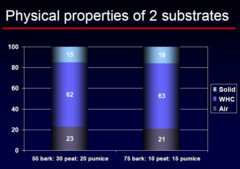
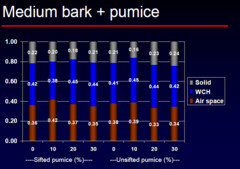
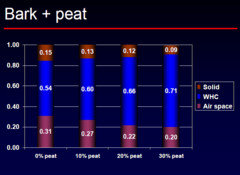
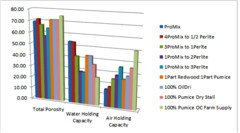
    Fir Bark, Peat, Pumice Mix Charts

    ewwmayo thanked dale92539 Riverside Co SoCal
  • 10 years ago
    last modified: 10 years ago

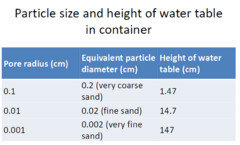
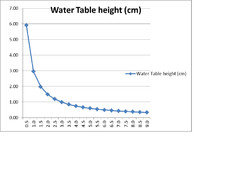
    A perched water table exists in every container planting, only the height varies with pore sizes. The Perched water table height is the same height that free water would rise in a capillary tube, whose diameter is the same as Soil Mix. pore diameter. Even a 1 meter diameter pipe has a capillary rise in the thousands of inches, but it is still there. The Gritty Mix has a perched water table, but at a lower height about 1/2" for 1/16" diameter pores. Water will rise about 1/2" in a 1/16" diameter tube. This is dictated by Physics, and empirical testing. The different mixes just modify the PWT height, Water Holding Capacity, and Aeration Capacity. The way to eliminate PWT's as previously discussed, is with the continuation of capillary pull under the container. ( Wicking, Pot in Pot, etc.)

    PWT Chart from Cornell University Publication

    Following Formula:

    PWT height(cm)= 1.47/pore radius(mm)

    PWT height(cm)= 1.47/(particle diameter(mm)/2)

    PWT height(in)= PWT height(cm)/2.54

    Chart PWT Height(cm) versus Particle Size(mm)

  • 10 years ago
    last modified: 10 years ago

    2 new measurements using 14floz volume of medium in 16oz cup.

    100% Oil Dri 1.5mm screened (2nd measurement)

    TP- 71.46%

    AP- 40%

    WP -60%

    WHC- 42.9%

    AHC- 28.56%


    100% Pumice Dry Stall 1.5mm screened

    TP- 71.46%

    AP- 50%

    WP - 50%

    WHC- 35.73%

    AHC- 35.73%

  • 10 years ago
    last modified: 10 years ago

    4parts Pumice Dry Stall to 1part Oil Dri

    Oil Dri 20% by volume

    1.5mm screened approx 1/16"

    TP- 57.2%

    AP- 50%

    WP - 50%

    WHC- 28.6%

    AHC- 28.6%

    Mix used as Inorganic Growing Medium, optional, add a little Sphagnum Peatmoss (about 10% to 15%) to increase WHC.

  • 10 years ago
    last modified: 10 years ago

    Edit: Updated Mixtures of ProMix and Perlite, and Redwood/Pumice

    ewwmayo thanked dale92539 Riverside Co SoCal
  • 10 years ago

    Gritty Mix Measurements (Graphical version of the 2 previous measurements)

    ewwmayo thanked dale92539 Riverside Co SoCal
  • 10 years ago

    Calculating Total Porosity of Gritty Mix

    You can calculate your total porosity from the weight of
    your mix compared to the Particle density. The Particle Density is the weight
    per unit volume, if your mix was compressed down to Zero Total Porosity. You
    can calculate the Particle density of your mix, by first measuring the Total
    Porosity using the water method. The Particle density would be:

    Particle Density=Weight of Dry Mix/ [(100%-Total Porosity%)*
    Container Volume]

    This will give you a weight per volume unit. From the particle density you can calculate the Total
    Porosity of any container in the future by:

    TP= 100%-(Weight of Mix/(Particle Density of Mix* Container
    Volume)

    The Total Porosity of Mix varies Batch to Batch , depending
    on Particle Packing and Shapes.

    ewwmayo thanked dale92539 Riverside Co SoCal
  • 10 years ago
    last modified: 10 years ago

    Finally managed to get everything I needed to do more sample cases! I have included pure ingredient measurements to add some different information than what Dale has posted above.

    Sifted Perlite:

    • 77.2 % Total Porosity
    • 63.5 % Air Space
    • 71.8 % Aeration Porosity
    • 28.2 % Water Holding Capacity

    Blended and Sifted Reptibark

    • 73.4 % Total Porosity
    • 68.9 % Air Space
    • 77.2 % Aeration Porosity
    • 22.8 % Water Holding Capacity

    Granite Grower Grit:

    • 53.5 % Total Porosity
    • 72.6 % Air Space
    • 85.3 % Aeration Porosity
    • 14.7 % Water Holding Capacity

    Turface:

    • 68.6 % Total Porosity
    • 24.7 % Air Space
    • 48.3 % Aeration Porosity
    • 51.7 % Water Holding Capacity

    I had to add extra water to the Turface many times since it could hold so much water. Did the same for the bark, but it took much longer since the bark was dry (never soaked) and a little hydrophobic at first.

    Good to finally have these numbers and the ones above. Planning on phasing out bark this year, so all the information above will help me come up with my new soil mix.

    Still hoping to get some small/medium pumice in the spring, those measurements will have wait until then.

  • 8 years ago

    Does anyone in this thread have water capacity %, porosity (% air space), and saturation % for sphagnum peat moss? If additional variables must be supplied to answer that question, then please supply those variables using whatever type of peat is normally used in the 511 mix.

  • 8 years ago
    last modified: 8 years ago

    At the really awkward site: goo.gl/twwhri there some graphs that answer the questions about water capacity % etc. asked above. This link may be shot lived. Check soon.

  • 8 years ago

    @albert_135 on pages 51 and 53 he gives the water holding capacity of a peat+bark mix, but he never gives WHC data for peat alone.

  • 8 years ago
    last modified: 8 years ago

    WHC varies with Container Height, Medium Compaction, and Individual Particle Sizes. It is better to do DIY measurements. I don't use 511 or Gritty mix, so cannot reference any Data.


  • 6 years ago
    last modified: 6 years ago

    @ewwmayo My formula for porosity is very simple and easy to understand:

    Vs = Volume of dry soil in a pot

    Vp = Volume of water needed to fill the pot to the soil line

    Porosity ~= Vp / Vs

    That is "approximate" because where you eye the top of the soil line when you fill with water is a tiny bit subjective.

    For my gritty mix that gives:

    Vs = 800 ml

    Vp = 500 ml

    Porosity ~= 500 / 800 = 62.5%

    That is higher than your result, but it should be because I have the wrong sized granite in my mix. Until I find a local supplier for poultry grit #2, I have been using too-large granite that is 1/4" to 3/8". So I have less air available between the granite particles for the water to occupy.


  • 6 years ago

    @dale92539 Riverside Co SoCal I read your old post here saying you were planting manzanita trees in soil that is 50% peat? I thought those trees want very dry soil between waterings?

  • 6 years ago

    FWIW, here are my very rough numbers for LECA (light expanded clay aggregate) graded between 3-8mm (1/8-1/3 inch). I'll post more numbers once I check more samples...

    Total porosity: 47% of container volume
    Air filled: 79% of total porosity, or 37% of total container volume (79×0.47)
    Water: 21% of total porosity, or 10% of total container volume (21×0.47)

    I chose 3-8mm LECA simply because it was the only material closest sized one that wasn't prohibitively expensive in France, and could get delivered soon enough to finish most of my repotting by June.

    It looks like the biggest drawback is the wide range of particle sizes that seem reduce total porosity. I might fine tune my "mixture" next summer in case I see improvements in total porosity or water holding capacity by either screening out the largest particles or crushing a small fraction of them. For now though, 2-3 weeks in, most of my plants seem to be doing fine!

  • 6 years ago

    @ewwmayo Can you define the difference between "Air Space" and "Aeration Porosity". I have seen these ideas referred to in various sources using very inconsistent terminology.

  • 6 years ago
    last modified: 6 years ago

    So after improving my experimental technique a bit, I get numbers more in line with the ones posted by others here. Making the gritty mix with 3/8" granite stone, I get a porosity of around 51.9%. If I substitute the 3/8" granite stone with 1/16" to 1/8" pumice, I get porosity of around 55%.

    Note that these numbers are not very precise. One "batch" of a soil mix can be a little different than the last batch, depending on how you measure the materials you are incorporating. In addition, there is subjectivity in measuring the container volume and in measuring the amount of water that it takes to top off the soil line. I would be surprised if our numbers are more accurate than about a 10%.error margin.

    Here is a photo of the gritty mix made with small pumice. It looks like the particle sizes are really uniform. I really want to try out this version of the mix.


  • 6 years ago

    @westes Zone 9b California SF Bay - It took me a while because I had to dig back into my old calculations for this. Houzz doesn't show my old tables which makes following what I did a bit harder. I agree that there can be some variations batch-to-batch.

    Air space % = mL water to fill / mL water that drained out

    Aeration porosity % = 100% - Water Holding Capacity %

    To me, the Water Holding Capacity is the most important because staying on top of watering when busy is my own biggest challenge.

    I actually have samples of peat and leca balls in my loft which I've been meaning to test for many months now. The media was graciously given to me to test. Just didn't get a chance and keep forgetting to do it.

  • 6 years ago
    last modified: 6 years ago

    @ewwmayo I think the way you are defining these things is crossing wires. You can measure the air or water in the soil and then divide either of those by the soil volume. Porosity by definition must equal the sum of air and water space in the soil. For 95% of all cases, that is all you need to do.

    For example, for one of my gritty mixes, porosity was 51.9%. Air Space was 37.5%. Maximum Water Holding Capacity was 14.4%. 37.5+14.4 = 51.9. That must be true by definition because porosity is just the air and water holding capacity of the soil.

    Intuitively, this is a simple way to understand the problem of how the soil divides out. If the soil was 1000 ml, the water to fill the soil (porosity) was 519 ml. The air space in the soil after draining was 375 ml. The max WHC was 144 ml. It is much more useful to think about air and water as percentages of the total soil volume than as percentages of air and water summed.

    Some simple definitions:

    Porosity = mL water to fill to the soil line / mL volume of soil under test (then convert to %)

    Air Space = Minimum Air Holding Capacity = mL water that drained out / mL volume of soil under test (then convert to %)

    Maximum Water Holding Capacity = Porosity - Air Space

    Your own document that you cited in the original post agrees with those formulas. But I do not think the ideas are expressed as clearly as they could be.

    Now, going beyond the above, you can take the air and water as a percentage of porosity. But why do this? It's much less useful to understand what percentage of the porosity is air and what percentage is water than it is to understand what percentage of the total soil volume is air and water? It should be clear that you can have two different soils with radically different porosity, but identical air and water percentages of porosity. For example:

    Soil A: Porosity is 60% Water as a percentage of porosity is 25%

    Soil B: Porosity is 20%. Water as a percentage of porosity is 25%.

    What good would it be to compare these two soils and say that water as a percentage of porosity was 25% in both cases? Mathematically it is true, but it is not the most important detail about the two soils.

    What is important is to find the actual percentage of water in the soil volume. For my examples:

    Soil A: WHC = 0.6 * 0.25 = 0.15 = 15%

    Soil B: WHC = 0.2 * 0.25 = 0.05 = 5%

    ewwmayo thanked westes Zone 9b California SF Bay
  • 6 years ago

    @westes Zone 9b California SF Bay - I didn't make the definitions, only took them from the published papers. If it was up to me, I'd call them something different too. =)

  • 6 years ago

    @ewwmayo Don't even get me started on the terms they are using. :) I agree that a lot of the confusion stems from how they use terms inconsistently. Why refer to Air as "Space" but Water as "Capacity"? Since these things have a common denominator, why not just call them Air Capacity of Soil and Water Capacity of Soil? That would be so much cleaner and the formula would be in the terms. But I agree we are stuck with what we are stuck with.

    My point is that you are using different formulas than the article you cite.

    From the article,

    • "Calculate total porosity using the water volume required for saturation and (dividing by the) volume of (the) mix in the container"
    • "Calculate the percent air space — the volume of air contained in the mix after drainage. After saturation, remove the tape, letting the water drain into a pan. This is the water held in the larger pore spaces, the "gravitational water." Measure the water volume drained. Calculate (the) percent (of) air space by dividing the volume of the drained water by the volume of the (soil mix in the) pot."
    • "Lastly, calculate water holding capacity. Note: less water drains out of the mix than is added. Water is retainecLbythe smaller pore spaces for later use by the plant. The amount of retained water is known as the "water holding capacity." To calculate: Subtract the percentage of air pore space from the total porosity."


    ewwmayo thanked westes Zone 9b California SF Bay
  • 6 years ago

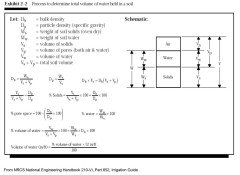
    @westes Zone 9b California SF Bay - I think I'm too tired these days to think about math and formulas. Maybe this will help, take a look:


    It's from the U.S. DEPARTMENT OF AGRICULTURE, SOIL TECHNICAL NOTE 1 PROCEDURE FOR MAKING KNOWN MOISTURE SOIL SAMPLES FOR IRRIGATION WATER MANAGEMENT PURPOSES.

  • 6 years ago

    @ewwmayo The diagram in that image is very clear and useful. Those new calculations are layers beyond where I need to go for now. For my initial use of all of this, I just want to know how much air and how much water is in my soil mix. I am not particularly interested in calculating what percentage of porosity is taken by air and water.

  • 6 years ago

    westes,

    Then you're missing part of the point.

  • 6 years ago

    @cactusmcharris I miss lots of points. The amount I do not know exceeds the amount I do. Making that point is not helpful. What specifically should I be taking from the image he posted that has immediate value to calculating air space and water holding capacity and porosity?

  • 6 years ago

    To me ewwmayo calculations and definitions were pretty clear and served my purpose. The terminologies do not bother me much. These things always have some historical reasons. English in particular is not a very consistent or precise language anyway. Equations and diagrams almost always clear up the confusion.

    ewwmayo thanked tropicofcancer (6b SW-PA)
  • 6 years ago
    last modified: 6 years ago

    @topicofcancer Now that I understand the underlying concepts better, I can translate his numbers into the ones that are immediately useful. All his calculations are correct, so this all about using language in a consistent way.

    But, for someone who does not understand the underlying concepts, reporting the water content of a soil mix as a percentage of the soil volume, while reporting the air space of the soil mix as a percentage of the porosity, is going to lead a beginner into significant confusion.

    Without making a big deal about it, I simply want to advance the proposal that air and water content should be reported as a percentage of the volume of the soil mix. That gives immediately useful information. That was the way the article he cited did it.