Software
Houzz Logo Print
eric_johnson6290671

Looking for the perfect tree - Zone 10B

Hi, I'm in Coastal Southern California. I want to plant a tree in the front yard. This is intended be the signature feature that defines my property. I'm the primary corner house as you enter the neighborhood, so I want something that will command attention. To give an example of what I mean, I've attached a photo of a Camphor tree that I love. That's not my house, but it's the effect that I'm going for. To summarize, I'm looking for something that will be big, beautiful, and majestic.

So why not just plant a Camphor tree? That was the plan, until my wife shot it down. She's concerned with Camphor trees being terribly messy year round and an overall nuisance. Can anyone confirm or deny that?

And this is where I need your help...If not the camphor, then what? I'm open to all suggestions (well... as long as it's not a palm or a pine :-).

Thanks in advance!


Comments (37)

  • 11 years ago
    last modified: 11 years ago

    I agree with hoovb about thinking differently about what a statement tree could be besides size. In southern CA I would consider tabebuia or chorisia. Both are spectacular in bloom and uniquely suited to our climate. Another statement tree would be jacaranda although some dislike them because of the mess the flowers make. I personally think they don't age gracefully, but the other two would make a statement when in bloom.

  • 11 years ago

    I have no recommendation on a tree, but definitely not a camphor tree! There's a street camphor tree in front of my house, and a couple in the back that border my neighbor's fence. They reseed terribly all over the place, they drop lots of leaves, they buckle sidewalks and their branches grow so fast that I've had to call the city to come cut the branches that are hitting my roof! It's a beautiful tree, but is it worth all the problems it causes, no!

  • 11 years ago

    How about an arbutus?

  • 11 years ago

    @hoovb - I like your idea about visiting the LA Arboretum or the San Diego Botanic Garden. That makes a lot of sense.

    @kentc - We've considered the jacaranda, but I think the mess is enough to remove it from the conversation. Also, I have to be considerate of the fact that my wife is terribly afraid of anything that flies, buzzes or crawls. So a flowering tree that attracts bees as the jacaranda would is probably not the best idea. The tabebuia you suggested is also quite beautiful, but I suspect I'll have the same issue.

    @eloise_ca - Thanks for the input. I think I've pretty much settled in to the fact that a camphor is a no go for me.

    @lgteacher - Never heard of arbutus until you mentioned it. Looks kinds cool. I'll have to look further into it.

    Thanks for all the suggestions! I'm always open for more.

  • 11 years ago

    Eric, how about melaleuca quinquenervia? This is kind of the dry climate analog to a birch tree. It has white, peeling, spongy bark that is striking. Usually they are multitrunked. They grow fast and are drought tolerant. They get about 30ft tall and only about 15ft wide, so maybe a grouping of two or three of them closer together would make a grove effect that would make a statement. They do have insignificant flowers, I don't think bees are much of a problem, my mother has several and I've never noticed them.

  • 11 years ago

    There are some really eye catching, out-of-the-ordinary trees from Australia & other places at the SD Botanic garden which is why I mentioned it. Some of these are also at the LA Arboretum.

    Quercus suber: Cork Oak

    Stenocarpus sinuatus, the firewheel tree

    Boojum, Fouquieria columnaris, if you really want to be "out there".
    Dracaena draco -- Dragon Tree
    Schotia brachypetala

    Podocarpus latifolius -- far less common than Podocarpus gracilior, and even more beautiful, and not so huge.

    Some photos here:

    Some out of the ordinary trees at SD botanic garden

    Keep in mind any tree with striking showy flowers is going to be messy because those showy flowers will drop on the ground, eventually.


  • 11 years ago
    last modified: 11 years ago

    I agree that size may not be the best route for a signature tree; what you want is something distinctive and unique to your neighborhood. You want people to stop to look at your tree--the fifth specimen of something isn't going to have the same impact, no matter how beautiful. What trees, or specimens, are commonly used in your immediate area?

    You may want to give the Tabebuias another look. I prefer the pink to the yellow, even though I prefer the yellow color more. The yellow blooms sporadically for a few weeks at a time, but the pink can easily bloom for 3 months without a breather. Both are showy. The flowers are messy when they drop, like a jacaranda's, but they don't stain and become glued to the concrete in the same way. The bees don't favor the trumpet trees' flowers in my garden.

    Betula nigera 'Summer Cascade' is a fast growing attention-getter beside my patio. It stays short, only about 7-8' high with a 10-12' spread. But the bark and form is interesting year round.

    Chorisia trees are gorgeous and have interesting trunks, but they do get huge.

    Paperbark melaleucas are an allergy sufferer's nightmare, so be aware of that going in if allergies are a problem. They used to be used frequently, and we still have quite a few mature specimens in our neighborhood.

    I love Arbutus 'Marina', but their beauty is a bit subtle from a distance, until they get large. Watch out for soil diseases doing them in--it can appear as if they go from lovely to dead suddenly. That has broken my heart more than a few times.

    Cork oak is one I was going to mention, too. Stenocarpus is interesting and pretty; notoriously messy, though. I don't get hoovb's enthusiasm for Fern Pine / Podocarpus --- IMO they are the a photo representative for boring! ;-) I had a full-crowned 9-footer in a pot that I could not give away. Ended up hacking it up and throwing it into the green waste bin because I didn't want to plant it and be stuck looking at the same ol' visual 24/7/365/forever. Your mileage may vary, of course. :D

  • 11 years ago

    I love Arbutus marina and have one planted where I see it all the time. It is not a large tree. Anything that blooms will attract bees and bugs and my A. marina has just started it's winter bloom. It's crawling with bees and a hummingbird vigorously defends it from me when I'm outside

    Crepe myrtle has a flashy, long summer bloom and the fallen flowers aren't particularly messy. It's also not large, but needs full sun or it may mildew.

    If you are near the water Metrosideros excelsa is very pretty, but not large. The hummers love it.

    A big, handsome olive is always a nice statement and you can get non-fruiting varieties. They can be transplanted when quite large, if you have the coin.

    if you are inland, Palo Verde Desert Museum is gorgeous. Near the water it will still bloom, but not quite as magnificently. It's also not huge, but a bit bigger than any of the above trees. It casts very little shade, but not much will grow well under it, anyway

    Chitalpas are pretty when in bloom, but otherwise sort of plain.

  • 11 years ago

    I really like podocarpus gracilior, it has very fine needle like leaves that have nice texture from far away. The are billowy, clean and fresh green looking, I think they look nice any time of the year but I would not call them a statement tree. I have a PV Desert Museum and love it, but bees love it more than I do. When it is in flower it is almost vibrating from hundreds of them swarming the blossoms.

  • 11 years ago

    I just removed a Camphor in June. It was close to the size in your photo. Very messy.

    Twice a year it would shed branches 1-3 feet long and plenty of leaves. In January it has black berries for birds that stain everything. A few seedlings in grass and nearby beds. Don't plant one.

    The tree removal guys put all the mulch in the beds and filled the hole. Once I removed the mulch it still smelled for couple weeks.

    Since was in my small front yard 15x15 I'm thinking of a small Crape Myrtle.

  • 11 years ago
    last modified: 11 years ago

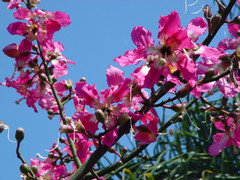
    I like Ceiba speciosa (silk floss tree), and I had one in Venice that bloomed profusely, and so I planted one in Westchester, but it has been growing much more slowly. You should see some in bloom right now at the L.A. County Arboretum. The trunks are spiky, which I like, although that may be a personal taste.

    Close-up of flowers in Venice.

  • 11 years ago

    How about a mango?

  • 11 years ago

    Almond trees have a lot of flowers.

  • 11 years ago

    I would look into Calodendrum capense (Cape Chestnut) or a yellow Spathodea campanulata (African Tulip). Both of those trees are striking when in bloom and are nice looking trees when not in bloom, IMO. Personally, I also wouldn't rule out the pink Tabebuia or Ceiba speciosa options because they really make a statement when in full bloom.

  • 11 years ago

    There is a large Cape Chestnut in Glendora that is impressive in bloom. The pink tabebuias have a graceful form even when they aren't blooming, I think they're beautiful trees.

  • 11 years ago
    last modified: 11 years ago

    How about Agathis robusta? A stunning and underappreciated tree.

    Here's one at the Chavez Ravine Arboretum near Dodger Stadium (zone 10b).

    The plants don't seem to get much if any attention there (horticulturally speaking), but this tree looks spectacular.

  • 11 years ago

    Native and drought resistant- sycamore,

  • 11 years ago

    Eric Johnson, the artist?

  • PRO
    11 years ago

    People will steal your mangoes if you have a mango tree. I had one in my back yard in Venice, and I had to start locking the yard to prevent thieves. Nut trees might have the same problem, but I did consider a Macadamia tree for my front yard.

  • 11 years ago

    Wow! This place is truly amazing. You all have really given me some stuff to think about. Admittedly, my tastes are a little less adventurous than some of the suggestions made, but I appreciate them all. The tabebuia has been mentioned quite a few times, and for good reason -- it's a beautiful tree. Despite the original intent of something that doesn't flower, it's getting some serious consideration. The mango tree is also a consideration -- although perhaps for a different spot, not as the primary tree in the front yard.

    Not mentioned here but also a new one on the list is the liquidambar styraciflua. Either the rotundiloba variety or the standard with a yearly application of TreeTech Snipper. I know one commenter suggested that I chose something that isn't common in the area. The Sweetgum definitely doesn't qualify in that regard. Now that I know what they are, I've seen dozens of them. Only about 6 in my neighborhood, but all around the area and in parks. Nevertheless, they are quite beautiful, especially at this time of year. And I'd be the only one on my street to have one.

    Another suggestion that was made -- I thought in this thread, but now that I look again, I guess not -- is a Japanese Zeklova. Two questions relating to this:

    1) Any experience with them? Advice?

    2) They are zoned 5-8. I don't mean to derail the conversation, but I need a little education on how the zoning works. Aren't the hardiness zones meant to give us a guide of the lowest temperature a tree can withstand? And if so, why even put an upper limit on it? Zone 5 is the coldest in that range, so shouldn't it be anything 5+?

    Lastly, I know the podocarpus was a point of discussion earlier. As it were, I am considering that too, only not as a tree. I'll be planting about 60lf of privacy hedge and this seems like a good option. So, a little boring is A-OK with me. As long as it's tall, green, and screens me from my neighbors. :-)

    And no, llilibel03, not any one of the famous Eric Johnsons. But you're still welcome to tell people you met me. :-)

  • PRO
    11 years ago
    last modified: 11 years ago

    Some trees need cold temps, possibly to kill pests that can attack them, or else to make fruit or flower. Some plants are given a minimum zone, requiring a hard freeze so that they do not become invasive, which means that they would grow TOO well in milder climates, to the detriment of other plants.

    My street has sweetgum trees planted along it in front of everyone's house, and I did not like them at first because they are deciduous and make nasty balls that pile up in the yards and streets, but I've gotten used to them. There is only a short period when they do not have leaves. They are listed as zones 5-9, but they do well in zone 10 - not sure why that is not included in its hardiness zone.

    I have Fuji apple tree in my back yard (it came with the house), and it is listed as zones 4-8. In my zone, the tree does not lose leaves in the winter, and it puts out flowers in the fall, thinking that it is spring. It does lose its leaves some time around March or April, but it does appear a bit confused and blooms late, possibly because it needed a colder winter.

  • 11 years ago

    Sweetgum/liquidambar trees will destroy your sidewalk, your driveway and anything else in its path. The spikey fruit will clog city drains and feel like porcupine quills when stepped on.

  • 11 years ago

    Liquidambar can be nice fall foliage trees, about the only reliable fall color we have. In the right place they can be perfect for that, but be aware that they have vigorous, greedy, bordering on invasive surface roots.

  • 11 years ago

    If you want a big statement tree, it's hard to beat Chorisia speciosa if you have the space. Taxodium mucronatum is one you rarely see in residential areas but if you have the room it is pretty impressive. The oaks are so slow you'll probably never see them monumental.

  • 11 years ago

    The Liquidambar rotundiloba is not supposed to produce those nasty seed pods. At our old house, the city took out a sick, old sweetgum in the parking strip and offered to replace it with the rotundiloba form, so they must be okay for that purpose. Although the neighborhood was lined with sweetgums, the sidewalks were in pretty good shape. Any big tree is going to have a lot of roots.

    Some plants need winter chill to go dormant properly in the winter, so a tree that can tolerate winter weather in zone 8 may not do well in zone 10.

    You said "no pines", but a conifer (podocarpus is a conifer!) might be a good idea. A big old pine can have an interesting, gnarly growth pattern, but it won't bloom and attract bees. Almost anything else that blooms will attract bees, whether or not the blooms are conspicuous.

    One other non-flowering option would be a male gingko. They will give you good fall color. The females make stinky fruit, but you can buy cutting grown males. Gingko, Chinese pistache and sweetgum are pretty much the only trees that will color in the fall in San Diego


  • 10 years ago
    last modified: 10 years ago

    A Mango tree? Looks great and the bonus of free Mangoes. No problems with roots or getting too gigantic. In 10b soucal they top out at 30'. That's a good sized tree.

  • 10 years ago

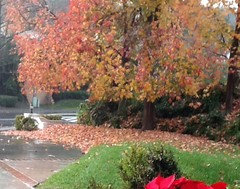
    Poppy cock I say to the liquidamber haters. Different strokes and all, but to me the beautiful fall folliage is every bit as breathtaking as any flowering tree. Yes, the balls are ouchy, so not recommended where one might go barefoot. Yes, the roots can show above ground, but not very noticeable except in the most pristine lawn. Our forty year old neighborhood also has many near the sidewalks and none are damaged at all by the roots. Not sure, but believe the rotundaioba are quite slim and look best planted in duplicates. You can keep your fabulla-tabula. :). I'll always love my LAmbdrs best! Below are my two and neighbors behind. They " bloom" from late Oct. Thru late December.


  • 10 years ago

    There is always Jacaranda. Or,Brazilian fern tree.That's very different. Peltaphorum..That's a seriously attractive tree. Cassia's. The Jacaranda and Cassia might too common,but the Peltaphorum would be the only one on the block.

    Tibouchina granulosa..a great small tree. Blooms all year in 10b I would think.

    Many more choices like Ficus petiolaris- beautiful smaller Ficus tree. Or the Mexican Taebulia species..those are drought hardy more then most flowering trees. African tulip tree Spathodea ?..another sure fire blooming tree that hummers love.

    Take a look at marriedtoplants blog. He's has some great tropical flowering tree's in soucal I never heard of.

  • 10 years ago

    Ugh Jacaranda. The flower drop reeks like cat piss.

  • 10 years ago

    Now,Now. That sounds like a plastic tree lover.

  • 10 years ago

    It can be overpowering if you have a decent sized one in your back yard. Makes the whole yard unoccupiable. They look amazing in median strips and parks but it was a happy day when I cut mine down.

  • 10 years ago

    I have never noticed a smell from jacarandas, but then, they are in neighboring yards. Anyway, the OP had already considered, and nixed them from the list, for their messiness, and bees, if I recall correctly.

    -------------------------------------

    Tibouchina granulosa is beautiful. But is there even a grower source for them in California? I have read they are challenging in this climate, with mature specimens sometimes checking out, and preferring Florida over this state.

  • 10 years ago
    last modified: 10 years ago

    T,granulosa is rated to Z10A. I read its taken 28f in Jacksonville and lived. I would think the usual EBAY and Florida internet would carry them. Top Tropicals is one to ask.

    As far as big ones that die? Could be they dont like to go dry like the other Tibouchina' sp. in California. Its our climate. Just as Aloe Dichotoma can get huge and impressive-- then one year rot and die from being too wet.

  • 10 years ago
    last modified: 10 years ago

    Unfortunately, Top Tropicals states that they will no longer ship T. granulosa because it degrades too much during transit. When someone is looking for a statement specimen, I doubt they intend to begin with a typical shipping-sized plant. eBay would likely offer only tiny plants (Personally, I wouldn't buy anything through eBay. YMMV). An online source would be a more logical option for someone just looking for a special tree to grow. A shame they don't ship well.

  • 10 years ago
    last modified: 10 years ago

    GF, Tibouchina's are FAST growers. If its anything like the ones (the regular Tibouchina's) we see here in summers warmth? It might go from 4" pot to waist high in one summer.

    If you like it- worth a chance. I haven't had problems with ebay plants. If I have a choice I go with the source who has a better rating.

  • 10 years ago

    There is also Delonix regia. What does great also are Metrosidero's. There are huge ones in Golden Gate park. I've seen them inland looking great too.

Sponsored
River Mill Construction
Average rating: 5 out of 5 stars2 Reviews
Delaware County's Customer Focused General Contractor