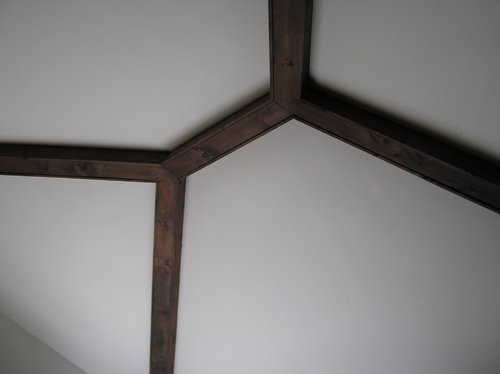
I have a ranch-style home, built in 1978. The family room is 14 x 18 and the ceiling is like the inside of a milk carton, with wood beams at each change of plane:
The highest part, the short section connecting the two "Vees" is at 11 ft high. The tops of the walls are at 8.5 ft., so though they may look flat in the photo, the "Vees" do climb from the corners of the room to the center short beam.
There is no light in this house. No room has so much as a ceiling fixture, though the halls do. I laugh when I see the posts about people needing to have their lighting plan done by Friday! The builder of this home's lighting plan was that a switch by the door operates a wall plug somewhere in the room. In this Family Room, the wall switch operates the TV and cable system. Oops.
Originally, I wanted to add a ceiling fan with a light kit to the center of the short flat beam. I figured that the parts that make up the beam would come apart, the fan would be hung somehow, then a hole would have to be made in the face piece of wood to allow the fan's shaft to pass through, and the electrical would have to be surface-mounted inside the beam going to the corner of the room, where it would enter the wall. There it could hook up with the switch that should not be controlling the TV, and it could take over that switch box. The TV and such might get its own, new circuit.
I ran into two problems. I could never find a fan with a light kit that gave enough light to brightly light the room without those awful 1970s-style tulip light-bulbs-pointed-to-blind-your-eyes fixtures, and then there was the slanted ceiling. I can't really get up there to measure how far from the ceiling or beams a ceiling fan's blades would be any given distance out. Given that the ceiling is only 11 ft, that the beams are about 7" or 8" deep, then the tips of the ceiling fan blades would have to be x" down from them as they make their sloping descent toward the 8.5 ft corners of the room. See? Complicated.
We used to have an antique floor lamp in this room with a 300 watt mogul base up light and three 60 watt bulbs in the shade area. DH got fed up with it and banished it. We now each have task lighting at our chairs and there is one other table lamp. The adjoining kitchen was remodeled five years ago and has four Cree 6"LED cans and four 4" LED cans and one of the 4" is on the boundary between the two rooms and we do get a lot of light from the kitchen when the lights are all on. The Family Room definitely needs its own lighting, though. We are now in our late 50s and need more light than ever to see well.
Our roof is just above the ceiling in the Family Room. When we insulated, our contractor could not get "in there" to add any insulation. In addition, when we had the roof replaced, a lot of the "nail pops" in the ceiling drywall lost their drywall mud and the whole ceiling needs repairs and repainting due to that. So I know there is no getting up above this ceiling to install anything. That is the reason that I am guessing that a fan or a chandelier has to be installed in (or even ON) the ceiling behind the faux beam, then the "cover" piece of the faux beam has to be cut to allow the rod or chain to pass through. Is this going to look ridiculous? It seems passable to me for the rod of a ceiling fan. But what if I want to put in a chandelier? http://www.build.com/livex-lighting-8678-chandelier/s920436?uid=2307384
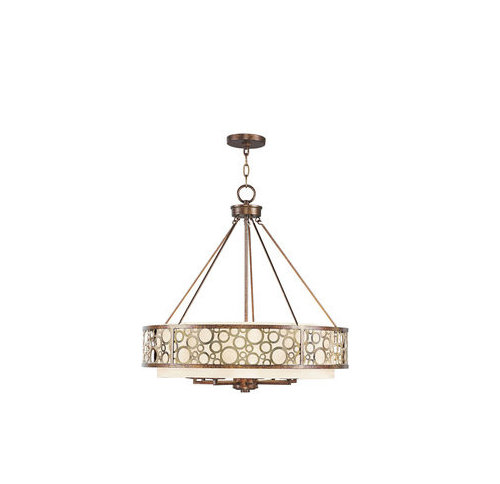
That round 5" bronze canopy it hangs from has to be at the ceiling. No faux beam is going to hold up that light. What is it going to look like with a chain coming through a hole in the faux beam? This thing puts out a lot of light and will brightly light the room. I can use LED bulbs in it, too.
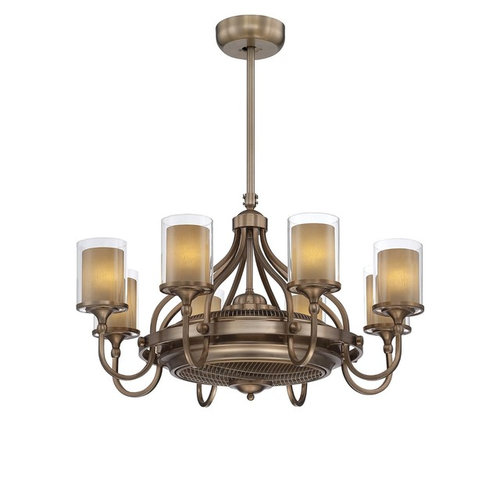
I just now found this possibility, I don't know if this particular fan would give off enough light with the heavily tinted shades, but the idea of hiding a fan in the housing of a lighting fixture is interesting and gets rid of my problem with the slanting ceiling. http://www.amazon.com/dp/B00DSU5H9S/ref=wl_it_dp_o_pC_nS_ttl?_encoding=UTF8&colid=105DYTR9DCPLU&coliid=IJO7BY3SWH2QV&psc=1
1. So how would I have a handyman mount a ceiling fixture in this situation? What if we can't get above the drywall, can we mount on the drywall in the faux beam?
2. Is it legal to put the wiring inside the beam, perhaps in a track to get it to the wall, where we can fish it to the switch?
3. Would you simply drill a hole in the face board of the beam and put the lighting's rod through, or would you line that hole with a rubber gasket (if I could find one)? Or try to find a dummy canopy to put there so it looks like the light/fan is hanging from it? Oftentimes, the canopy does hold the fan, and is not just decorative, right? So the real one will be inside the beam, doing its work. Hence the need for a "dummy" one if I want one that can be seen outside, hanging from the faux beam.
Is there anything that I am missing as I think about adding a ceiling fixture - ceiling fan or chandelier - to this room?












David