Software
Houzz Logo Print
greenclaws

Portulacaria afra, picture thread

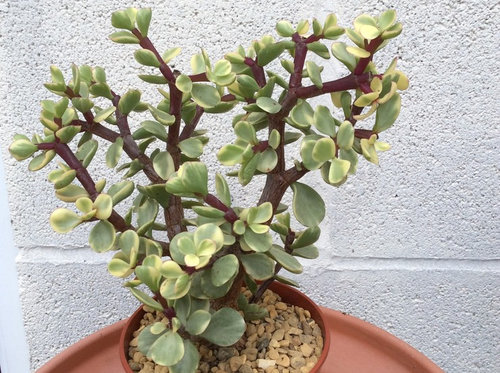
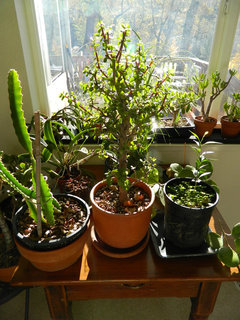
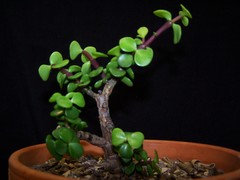
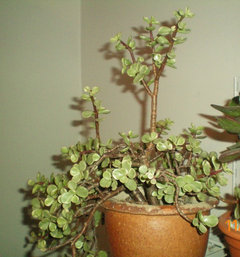
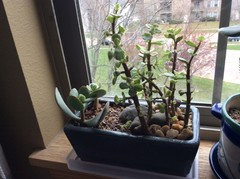
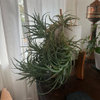
For those who may be fed up of Jades, let's try and find the port afra growers out there. Here's my effort, a port afra variegata, mealies had a feast on it but I've finally managed to banish them. Spotted the other day that it's now at the spine developing stage. It's in a three inch pot btw, so nothing as large as we saw in S Africa last Nov....yet! It keeps having the ends nipped out as I want it to stay small and compact.

Gill UK

Comments (50)

  • 11 years ago

    HI Gill


    Richard

  • 11 years ago
    last modified: 11 years ago

    Nice pair Richard ; ) They can hide all manner of wildlife including medium sized elephants, so beware, you have been warned!

    Gill UK

  • 11 years ago

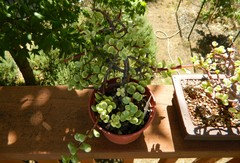
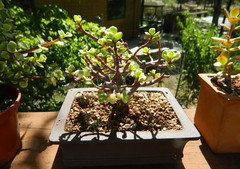
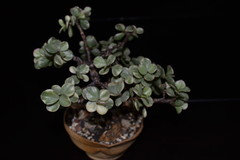
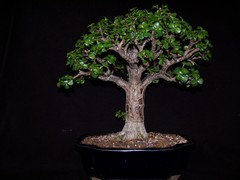
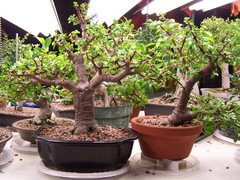
    Here are a couple of variegates...one grown wild for cuttings, the other restrained for bonsai. I'll have to get updates of these.


  • 11 years ago

    Josh, do they root easily from cuttings? Mine has two sprouts growing from opposite sides of the base of its single trunk that I'm thinking of removing in the hope of making it more tree like.

    Gill UK

  • 11 years ago

    Hello!

    Yes, they root very easily from cuttings. With the variegates, you just have to keep them from getting too hot/dehydrated while they are rooting. The standard green version I've rooted by sticking cuttings straight into the ground during the Summer and digging them up for potting in the Autumn.

    Josh

  • 11 years ago

    Thank you: )

    Gill UK

  • 11 years ago

  • 11 years ago

    My green Port. afra.....took a beating in a recent hailstorm, but not too much damage.

  • 11 years ago

    Al- that is a great specimen in the last pic, bottom left. Looks an ancient tree. How long you grown that one and did you do the training, superb, I love it.

  • 11 years ago

    I don't buy any plants that have had any work done to them, other than an occasional pruning to keep them within bounds. I've had that plant from a cutting for about 15 years. It was recently hacked back hard and is making its way back to a more respectable appearance after taking steps to reduce the heavy branching in the top. You can see it's grown a lot - not so much in ht, but in thickness. It needs 2 more years until it's back in shape. Picture's not the best - sorry.

    Al

  • 11 years ago

    That's a stunning plant Al, thanks for sharing it with us. That tree in either of it's stages wouldn't look out of place if sized up and placed in a natural landscape, it looks so natural.

    Can I ask, what is the little cutting growing in please? I can't make my mind up what the container is made of, is it ceramic? It almost appears to be something natural, it's really puzzling me!

    Gill UK

  • 11 years ago

    Superb Al :-)

  • 11 years ago
    last modified: 11 years ago

    Al,

    Really nice looking P. Afra's. Are the two pics in the first posting (with the acorn) the same plant?

    Thanks for sharing with us, I'm sure you realize we'd all love to see more of your creations ;)

    Gill, it's the top of an acorn. I know as I just stepped on one this weekend barefoot (ow!), I was in a backyard filled with huge oak trees. It was uncharacteristicly warm out on Friday.

    Daniel

  • 11 years ago

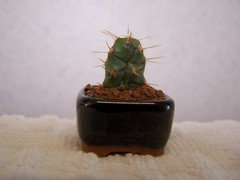
    Thanks for the kind words, guys. The medium is Turface fines (high fired clay granules) that would normally be discarded or used in beds or hypertufa projects. The container is a white oak acorn cap.

    I do enjoy some succulents for their unique appearance, but I'm mainly interested in plants that lend themselves to manipulation (you can see that even the 4 kinds of mint next to the Portulacaria above have all been pinched & pruned), and Portulacaria fits that description. Here's a pic more recent than the one of the plant on the bench.

    It's plants more like this that really capture my interest though ......

    Sorry for straying from the topic.

    Al

  • 11 years ago
    last modified: 11 years ago

    The plant in the acorn was an idea I had for a companion plant to a bonsai I displayed somewhere. After a year or so, the cap crumbled & I probably gave the plant away or discarded it. It was a pain to keep up with anyway - it had to be watered every couple of days with a pipette (McDonalds coffee stir stick or equal).

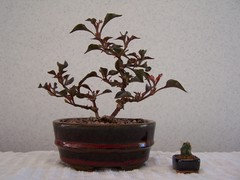
    If you look at the other Portulacaria to the right of the larger plant under lights above (I'll repost the pic below), this is the cutting it grew from (below it):


    Al

  • 11 years ago

    Gotta love a bit of bonsai :-)

  • 11 years ago

    An acorn cap??? Crikey, I knew most things in the USA were bigger than here in the UK, but who would have thought a plant could grow in an acorn cap! That's bonsai on a micro scale. I will have to check out the oak tree that is growing in my garden, it's acorns are considerably smaller. It's a 90 yr old English Oak and obviously a different cultivar.

    Gill UK

  • 11 years ago
    last modified: 11 years ago

    To get a sense of how small this pot is, look at the knap on the terrycloth towel. The Turface fines it's growing in are the size of coarse grind black pepper. Ht from the towel to the top of the plant is shorter than a quarter (20-25 mm)

    This pic might offer some perspective:


    Al

  • 11 years ago
    last modified: 11 years ago

    Here is my unruly P. afra - couple of shoots just waiting to be snipped off...better yet, I should send it to Al for some training - maybe after few years it will start looking presentable:

    Rina

  • 11 years ago

    Al, I love the acorn cap planter! Growing up, we used those for everything, but never for plants. And you have all given me another succulent to look for- thanks (I think?)!!

  • 11 years ago

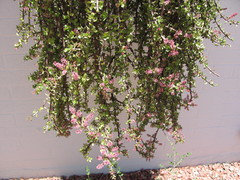
    Here's one flowering in Phoenix.

  • 11 years ago

    For this plant, is a purplish-looking stem or a solid green stem what I should look for? I have two little ones, but their stems are starting to look different.

  • 11 years ago

    Purplish stems.

    Josh

  • 10 years ago

    I just found this thread!

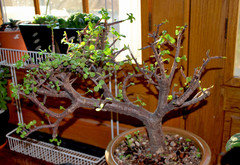
    I got this terrifying P. afra one Christmas. The conversation went like this:

    Friend: Do you like jade?

    Me: No.

    Friend: Great! I got you one from an estate sale!

    I haven't touched it at all. I have an inkling there are hundreds of things wrong with the way it looks and could use some sentient pruning.

    Pagan

  • 10 years ago

    Kind of looks like.... A tree from the lion king stylish Was it a little difficult to tell your exited to gift friend it wasn't a jade ?

  • 10 years ago

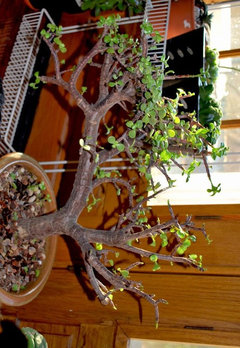
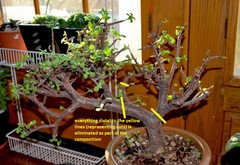
    Next June, you could rotate the planting angle 90* to the right so the very large left branch becomes the top and the current top becomes a semi-cascading branch, or simply remove the large left branch entirely and build on what remains after that branch is gone. If you treat the large left branch as a cutting, you'll have a good start on a second tree.

    Al

  • 10 years ago

    Nomen, i told him then and there and he thinks it actually made his joke even funnier lol

    Al, in case you drop by this thread, did you mean orientate it this way?

    Because...um, egads. I want to negotiate for at least 45 decrees to, at most, 50 degrees rotation.

    Pagan

  • 10 years ago

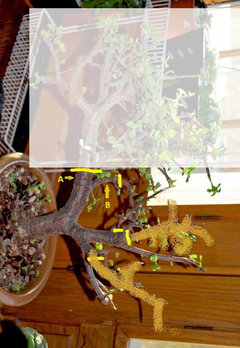
    If you do that, you end up with an awkward looking slingshot sort of arrangement. I'd either eliminate the large (horizontal in the original picture )branch entirely, or rotate about 90* so you end up with a good framework to build on.

    What you would do is, get the plant healthy, then make the pruning cuts shown and wait for back-budding on A or B, proximal to the pruning cuts.

    You could even do the semi cascade by eliminating A at the point of bifurcation (where the 'Y' is formed), so it's gone entirely, and build the top from one of those branches above where the 2 marks representing pruning cuts almost touch to form a right angle.

    Or


    If you did this, you could tie what is now the small branch that will be the top into a more vertical position by using the right moving branch as an anchor point. This framework offers a LOT of taper, which promotes the impression of significant age.

    Lots of options. The main issue to deal with is that slingshot crotch formed by the big branches - also the very straight line of the large horizontal branch moving left in the picture above.

    Al

  • 10 years ago

    My vote would go to removing the large left branch entirely. The trunk would then have movement and taper. At the next repot, you could tip the plant about 30-45 deg toward the left. Alternatively, you could keep it at that angle and encourage growth on the left.

    The removed left branch, as mentioned, would make a great new tree to work with as well.

    ez

  • 10 years ago

    Would these plants fare well in an led tent or would it be too stuffy for them?

  • 10 years ago

    No comments on P. afra ( don't currently gave any) but just wanted to say to Pagan that the shower-caddy thingy in the background is genius!! They would totally fit in my windows., especially my Haworthia & Gasteria window....YAY more space!

  • 10 years ago

    breton2,

    You also might want to check out this shower-caddy-in-window thread: here

    Phil,

    Probably depends how stuffy you keep it. P. Afra probably would prefer less humidity and heat than your Adenium, but you can probably find a happy medium, especially with well aerated fast draining soil. If you have space give it a try, you can likely find a small P. Afra to experiment with - at least, around here in the USA it's common and inexpensive.

    Daniel


  • 10 years ago

    I just recently acquired my first of these...

    I purchased it 50% off from Lowes a month or so back. It was in pretty rough shape and had that terrible top layer of glued rocks. Even though it was already fall I got it out of that and repotted it in gritty mix. Same pot, and it came with the silver dollar jades too, and at least one other dead succulent. The silver dollars have already shown some new growth, but not the P. Afra. their roots didn't look too great so I hope they are working on that. :-) . I plan to cut all these about halfway back come spring. And I assume they will likely need a repot as well.

  • 10 years ago

    I have quite a bit of pruning to do.


  • 10 years ago

    Deva, I hope they pull through. Why do they insist on these stupid glued on rocks, suppose it's basically to help them die faster and you then go and buy replacements. Useful pot btw!

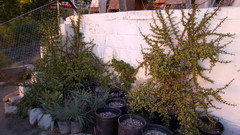
    Nil, what style do you see for your p.a.'s? They look pretty big judging by the height of that retaining wall behind, please post some pics of how you achieve the new look you plan for them as it will be interesting for us to follow it through.

    Gill UK

  • 10 years ago

    BEAUTIFUL, EVERY SINGLE ONE OF YOU! Al, love that Acorn size and that other little one, wow..

    I gave all mine away and after seeing how nice they all look, I miss mine now. Ha

  • 10 years ago

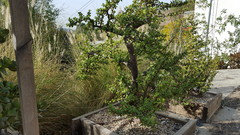
    They are big compared to most of the pics I see, but they are only about 4 foot tall. You can stand under the big ones around here.


  • 10 years ago
    last modified: 10 years ago

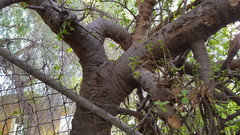
    Some of those are probably going to end up as hedging if they don't have too much that is interesting. Here are a couple of the more interesting ones that I'm working on. Although they have a long way to go.

  • 10 years ago

    I need to give this a bump, since it is time to do the deed. Scary.

    First, I know nothing, Jon Snow. So here is my P. afra and I am thinking of just following this recommendation by Al:

    How on earth do people make such cuts? Tree saw? I'll just google the rest--rooting, etc. Thanks!

    Pagan

  • 10 years ago

    Do you have a Ginzu knife in the kitchen? That would do the job. Let the cutting dry a few days and then stick it in the potting mix. Easy-peasy.

  • 10 years ago
    last modified: 10 years ago

    How on earth do people make such cuts? Tree saw?

    You might find a Ginzu knife a little it to flimsy but there are firmer hand saw blades out there that are't pricey that could be found in the big box hardware store.

    If you find the hard cuts ascetically pleasing to you then by all means have at it. Also keep in mind the wider the cut is; the longer it takes to root.

  • 10 years ago

    Cut at a 'joint', or rather just above it a quarter-inch. That quarter-inch will dry up and fall off in a few weeks.

    ez

  • 10 years ago
    last modified: 10 years ago

    Right - leave a little stub at the cut and don't let anything grow off of the stub. You want it to dry up and fall off - sort of like a scab.

    If you're going to root the cutting, after it's separated, clean it up with a straight edge razor blade or fresh utility knife blade. Be careful not to use anything that will crush the vasculature of the plant - like loppers, anvil or even bypass pruners when you rem ove the cutting from the rooted part of the plant. Use a fine tooth saw and make sure there is nothing ragged hanging from the proximal end of the cutting - that's where the rot (fungal infections) start and why you clean up the proximal end of the cutting with something very sharp. Also, right after preparing the cutting but before the cut dries or calluses, dip the end in flowers of sulfur, cinnamon, or another antifungal preparation suited to your application - and prune any branches you leave on your cutting back hard. Last tip: There is nothing that says your plant must rise from the soil perfectly perpendicular. In fact, if you want movement in the trunk, it should not exit the soil perfectly vertical and then transition to a trunk with movement. Figure out what angle you want the cutting to exit the soil at, then make your basal cut so it's horizontal. IOW - it won't be cut 90* to the trunk axis.

    Al

  • 10 years ago

    Whoa. I'm glad I asked. Thank you, everyone. I have 12 different handsaws but none that I can or will use for this purpose. I have to solve that first.

    Seriously, thanks for taking the time explaining.

    Pagan

  • 10 years ago

    You can use a 14 or 18 tooth hacksaw blade if you like. DON'T use a drywall saw (too coarse). I often use a 14 T 1" power hacksaw blade just held in my hand to do chops on trees.


    Al

  • 10 years ago

    Oh. That fine. That's like 30 thousand teeth per inch or something! But that's doable. I don't have a hacksaw but I'll get blades. The one that came with my jigsaw is too short. Amputation this weekend, then.

    To be furthered...

    Pagan

  • 10 years ago
    last modified: 10 years ago

    That's not all that 'fine'. Most hacksaws used for metal are 24 or 32 T(eeth/inch). I like the 14T best. You CAN buy fine pruning saws, too. I bought 2 Swedish brand (Bahco) pruning saws 20-30 years ago & a dozen replacement blades. I use one saw for root work ..... like sawing the bottom half of the root mass off ..... and the other for pruning. When the root saw gets intolerably dull (5 years?), I change the blade by taking the one from the pruning saw and replacing that with a fresh blade,. It's amazing how quickly a quality pruning saw can cut through even large branches.

    Al

  • 10 years ago

    I've used a folding garden saw, meant for pruning branches in the yard, with good results. My viburnums don't mind sharing :-)

    ez

  • 10 years ago

    Effective - YES; but coarse blades make rough cuts with lots of tiny shreds of tissue and uneven surfaces, which makes cuttings more prone to rotting. When you start a cutting, you're essentially participating in a race with the fungaluglies to see who can establish a root connection to the cuttings existing vasculature before rot plugs the plumbing.

    Al